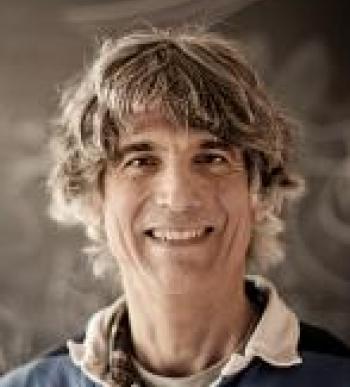
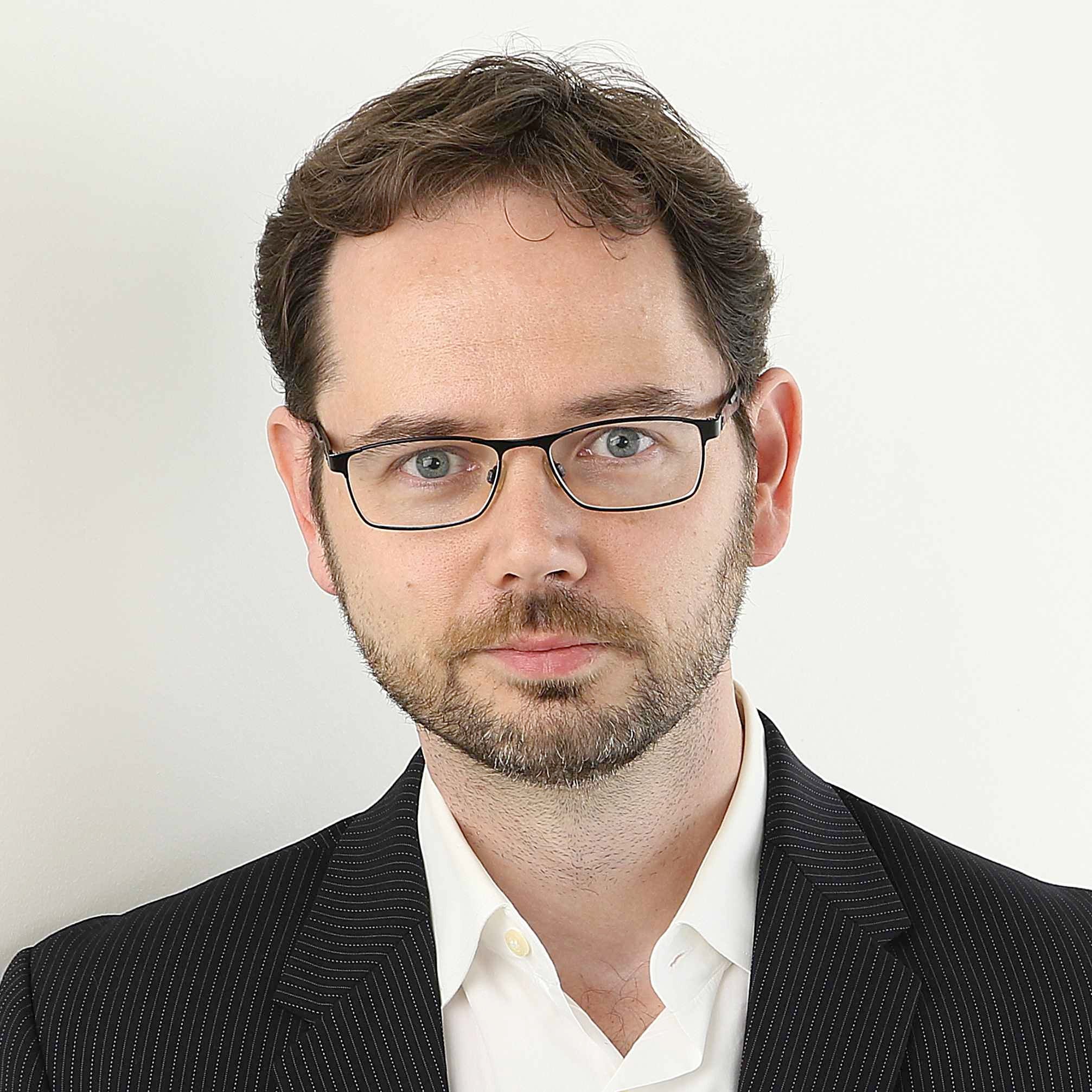
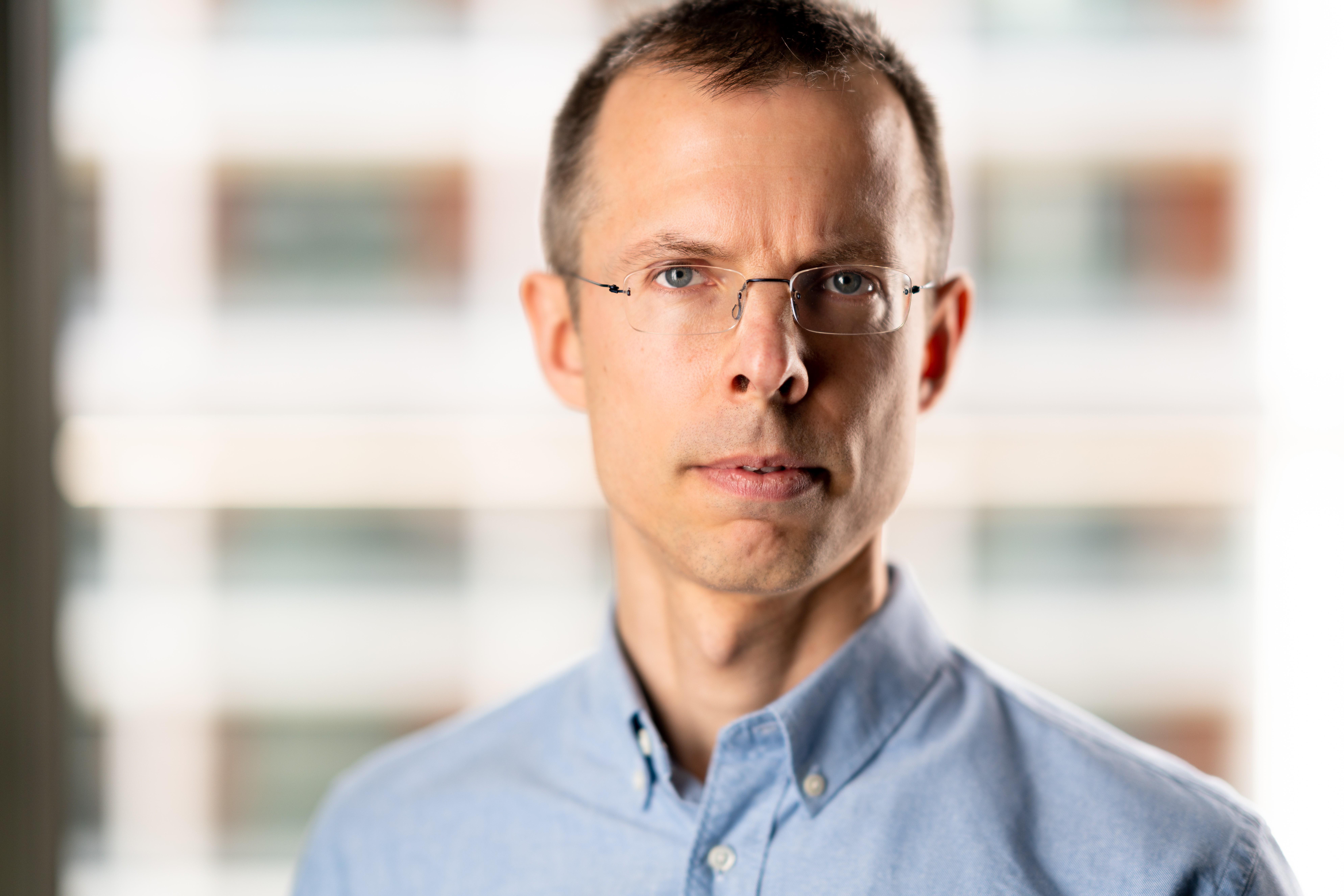
David Gabai is the Hughes-Rogers Professor of Mathematics at Princeton University's Department of Mathematics. His research focuses on topology, hyperbolic geometry, and low-dimensional topology, particularly in the study of 3-manifolds and knot theory. He has collaborated extensively with leading researchers in the field, addressing foundational questions in geometric topology and hyperbolic structures. His work explores topics such as Heegaard splittings, ending laminations, hyperbolic volume minimization, and the classification of exceptional 3-manifolds. Recent contributions include advancements in shrinkwrapping techniques, knot covering problems, and the interplay between geometric and topological properties of manifolds. While no specific educational background is detailed in the provided text, his affiliations and publications indicate a deep engagement with geometric topology. Awards and grants are not explicitly listed here. He has advised no listed students in the given data, though his collaborations suggest mentorship in research groups. His research often intersects with geometric structures, manifold decompositions, and topological dynamics, reflecting a commitment to advancing foundational questions in topology and geometry.
Mark Crowley is an Associate Professor in the Department of Electrical and Computer Engineering at the University of Waterloo , with a cross-appointment in the Cheriton School of Computer Science . He is actively involved in the Waterloo Artificial Intelligence Institute (WAII) , the Waterloo Institute for Complexity and Innovation (WICI) , and serves as National Secretary for the Canadian Artificial Intelligence Association (CAIAC) , coordinating the Canadian Conference on AI . Research interests span the theoretical and applied aspects of Reinforcement Learning , Deep Learning , Manifold Learning , and Ensemble Methods . His work addresses challenges in domains with spatial dynamics, multi-agent systems, and uncertainty, particularly in Computational Sustainability (forest fire management, sustainable forestry), Autonomous Driving , Medical Imaging , and Material Design . Recent research focuses on integrating causal modeling with generative representation learning to improve out-of-distribution robustness in motion forecasting applications. Key publications include foundational work on ChemGymRL environments for safe chemical process reinforcement learning, Generative Causal Representation Learning for robust forecasting, and collaborative work on multi-advisor reinforcement learning in multi-agent settings. He co-authored a textbook Elements of Dimensionality Reduction and Manifold Learning (Springer, 2023) with Prof. Ali Ghodsi and Prof. Fakhri Karray. Teaching includes graduate and undergraduate courses in Algorithm Design , Computational Intelligence , Reinforcement Learning , and Data Modeling at the University of Waterloo since 2018. His research group has produced several notable graduates including Benyamin Ghojogh (2021), who continued as a postdoc until 2022.
Tom Coates is a Professor of Pure Mathematics in the Department of Mathematics at Imperial College London's Faculty of Natural Sciences. He holds affiliations with the Artificial Intelligence Network, the CNRS-Imperial Abraham de Moivre UMI, and the Pure Mathematics research group. His office is located in the Huxley Building (662) on the South Kensington Campus, London SW7 2AZ, and he can be contacted via email at t.coates@imperial.ac.uk or phone at +44 (0)207 594 3607. Professor Coates' research spans pure mathematics with emphasis on algebraic geometry, mirror symmetry, and Gromov-Witten theory. He investigates quantum cohomology and Fano variety classification to construct a 'Periodic Table for shapes' through computational algebra, data mining, and machine learning. His work integrates geometric methods with cluster-scale computing to identify structural patterns in algebraic varieties, focusing on quantum periods, toric degenerations, and Laurent polynomial applications. His recent publications (2021-2024) demonstrate a strong trend toward computational classification of Fano varieties and polytopes, leveraging machine learning for dimension prediction and database construction. Key themes include mirror symmetry via Laurent inversion, toric geometry applications, and connections between Gromov-Witten invariants and modular forms. These works often utilize custom tools like PCAS and Fanosearch for large-scale algebraic computations. While specific student names are not listed, Professor Coates mentors PhD and Master's students in algebraic geometry and computational mathematics. His research is supported by the Simons Foundation, member institutions, and contributors, enabling international collaborations through networks like the CNRS-Imperial Abraham de Moivre UMI. He leads a research team developing the Periodic Table for shapes framework, utilizing high-performance computing resources. The team maintains open-source tools including PCAS (Periodic Table for Algebraic Shapes) and Fanosearch for Fano variety exploration, with code repositories hosted on Bitbucket and quantum period databases published in Scientific Data.
Alireza Salehi Golsefidy is a Professor in the Department of Mathematics at the University of California, San Diego (UCSD). He received his Ph.D. from Yale University under Gregory Margulis, a Fields Medalist. His research focuses on algebraic, arithmetic, and analytic properties of linear groups, homogeneous dynamical systems, and expander graphs. He has held positions at Princeton University and the Institute for Advanced Study as a Veblen Research Instructor before joining UCSD in 2011. Education: Ph.D. in Mathematics, Yale University (2006). Research Interests: His work bridges discrete subgroups of Lie groups, homogeneous dynamics, and number theory. Recent contributions include studies on super-approximation, spectral independence, and geometric group theory. He has organized workshops on thin groups, arithmetic groups, and homogeneous dynamics at MSRI and Oberwolfach. Grants & Awards: Alfred P. Sloan Research Fellowship (2012), Clay Liftoff Award (2006), NSF grants 1602137, 1902090, and 2302519. His research explores applications of expander graphs and random walks in algebraic structures. Teaching: Currently teaching Algebra (Math 200C) in Spring 2025. Past courses include advanced algebraic topology, representation theory, and graduate-level number theory. Labs/Teams: Co-organizes UCSD's Algebra Seminar and contributed to the 2013 Lie Theory Workshop. Active in collaborative projects on group actions and automorphic forms.
Professor Marios C. Angelides is a full-time faculty member at Brunel University London , serving as Professor of Computing and Divisional Lead within the College of Engineering, Design and Physical Sciences . He leads the Creative Computing Research Group under the Institute of Digital Futures and contributes to the Digital Media department at Brunel Design School. BSc (First Class Honours) and PhD in Computing from the London School of Economics (LSE) Chartered Engineer (CEng) and Chartered Fellow of the British Computer Society (FBCS CITP) His research focuses on Creative Computing , specifically applying Machine Learning , Serious Gaming , and Cognitive Modeling to develop Smart IoT Applications . His work spans autonomous drone fleets for environmental monitoring, cybersecurity middleware for Android systems, wearable technology for lifestyle recommendations, and historical analysis of Alan Turing’s legacy in modern AI. Recent publications highlight trends in deploying Machine Learning for: IoT systems optimization Autonomous aerial/underwater vehicle coordination Deepfake detection using Turing’s Imitation Game Energy allocation in CubeSats via gaming mechanics Scientific recognition includes being Deputy Editor of The Computer Journal and runner-up for the 2016 Oxford University Press Wilkes Award . He has supervised PhD students in topics like Smart Android Middleware for Cybersecurity and Wearable Recommendation Systems , with active involvement in editorial boards and international conferences.
Byron Boots is the Amazon Professor of Machine Learning in the Paul G. Allen School of Computer Science and Engineering at the University of Washington, where he directs the UW Robot Learning Laboratory. He also serves as a Principal Research Scientist in the Seattle Robotics Lab at NVIDIA Research and co-chairs the IEEE Robotics and Automation Society Technical Committee on Robot Learning. Dr. Boots received his Ph.D. from the Machine Learning Department in the School of Computer Science at Carnegie Mellon University, where he was a member of the Sense, Learn, Act (SELECT) Lab co-directed by Carlos Guestrin and his advisor Geoff Gordon. Prior to joining the University of Washington faculty, he was an Assistant Professor in the School of Interactive Computing within the College of Computing at Georgia Tech, and before that, he completed a post-doc in the Robotics and State Estimation Lab directed by Dieter Fox at the University of Washington. Professor Boots' research focuses on the intersection of machine learning, artificial intelligence, and robotics, with particular emphasis on developing theory and systems that tightly integrate perception, learning, and control. His work spans computer vision, state estimation, localization and mapping, high-speed navigation, motion planning, and robotic manipulation. His group develops algorithms drawing from deep learning and neural networks, nonparametric statistics, graphical models, nonconvex optimization, quantum physics, online learning, reinforcement learning, and optimal control. The research demonstrates a strong theoretical foundation while maintaining practical relevance to real-world robotic systems. His recent publications reveal a clear trend toward integrating advanced machine learning techniques with robotics, particularly in model predictive control, motion planning, and learning-based approaches to robot control. His work shows increasing focus on developing theoretically grounded methods that can handle the complex, nonlinear dynamics of real-world robotic systems while maintaining computational efficiency. The publications span top venues including ICRA, CoRL, IROS, and NeurIPS, demonstrating broad impact across multiple subfields of robotics and AI. Finalist for Best Systems Paper at Conference on Robot Learning (CoRL-2021) Multiple papers selected for oral presentations at top robotics conferences Work recognized for theoretical contributions and practical applications in robot learning As director of the UW Robot Learning Laboratory, Boots leads a vibrant research group focused on fundamental and applied research in robot learning. The lab maintains strong collaborations with NVIDIA Research and has produced numerous high-impact publications that bridge theory and practice. Professor Boots teaches courses in autonomous robotics, machine learning, and reinforcement learning, contributing to both undergraduate and graduate education at the University of Washington.
Prof. Dr. Thomas Schick is a Professor of Mathematics at the Mathematical Institute of the University of Göttingen, leading the vibrant research group in Topology and Geometry. His work focuses on areas such as index theory, K-theory of C*-algebras, and geometry and analysis. He is a core member of the Research Training Group 2491 'Fourier Analysis and Spectral Theory', serving as its speaker, and has supervised numerous doctoral students in topics ranging from persistent cohomology to spectral engineering. His academic journey includes a PhD from Johannes Gutenberg University Mainz (1996) under Wolfgang Lück, followed by postdoctoral positions at the University of Münster and Penn State University before joining Göttingen in 2001. He has held visiting roles at institutions worldwide. Prof. Schick is an Ordentliches Mitglied of the Göttingen Academy of Sciences, a Fellow of the American Mathematical Society, and leads the Scientific Advisory Board of the Mathematisches Forschungsinstitut Oberwolfach. He edits several high-impact journals, including Annales Mathématiques Blaise Pascal and the Bulletin of the Iranian Mathematical Society. His research interests span topological and geometric analysis, with recent work exploring scalar curvature rigidity, T-duality, and coarse geometry. He regularly teaches advanced courses and seminars, including 'Index Theory and Theorems' and 'Topological Data Analysis', and actively mentors students through the RTG program.
Xieyuanli Chen is an Associate Professor at the National University of Defense Technology (NUDT), China. He holds a Dr.-Ing. (summa cum laude) from the University of Bonn (2022), a Master's in Robotics from NUDT (2017), and a Bachelor's in Electrical Engineering from Hunan University (2015). His research focuses on robot learning, perception, and navigation, with an emphasis on LiDAR-based SLAM, autonomous systems, and semantic perception. Education: PhD: University of Bonn, 2018-2022 (supervised by Prof. Cyrill Stachniss) Master's: NUDT, 2015-2017 Bachelor's: Hunan University, 2011-2015 Research interests include robotics, autonomous systems, computer vision, and LiDAR perception. He has authored over 90 papers in top venues like TRO, RSS, ICRA, and CVPR. He serves as an Associate Editor for IEEE RA-L, ICRA, and IROS, and is a member of the RoboCup Rescue Robot League Technical Committee. Awards include the RSS Pioneer Award (2021), Best-in-Class RoboCup awards, and recognition as a World’s Top 2% Scientist (2024). His work spans LiDAR localization, moving object segmentation, and efficient semantic mapping. He advises students in robotics and autonomous systems. Labs/Teams: Active in the PRBonn group (University of Bonn) and leads research at NUDT on LiDAR-based perception systems.
Tim Browning is a Professor of Number Theory at the Institute of Science and Technology Austria (IST Austria). He leads the Browning Group, focusing on analytic number theory and its interfaces with algebraic geometry. His research addresses Diophantine equations, rational points on algebraic varieties, and the distribution of arithmetic objects. He organizes the Algebraic Geometry & Number Theory Seminar and the Women in Math Day. Previously, he held roles at the University of Bristol and University of Oxford. He has authored over 100 publications and received accolades including the Ferran Sunyer i Balaguer Prize and an ERC Starting Grant. His group includes PhD students and postdocs working on topics like rational points, sieve methods, and arithmetic statistics. Education: PhD in Mathematics, University of Oxford (2002) Postdoctoral Fellowships at University of Oxford and Université de Paris-Sud Research Interests: Analytic and arithmetic methods in number theory, Diophantine geometry, rational points on varieties, circle method, sieve theory, and arithmetic statistics. His work often combines geometric and analytic techniques, such as the circle method and algebraic geometry to solve problems like Manin's conjecture and the distribution of solutions to polynomial equations. Grants & Leadership: ERC Starting Grant (2012) Serves on editorial boards of journals like Compositio Mathematica and Commentarii Mathematici Helvetici Organizes international conferences and workshops Labs/Teams: Leads the Browning Group at IST Austria, which includes postdocs and PhD students working on number theory and algebraic geometry. Collaborates with researchers globally on topics like the arithmetic of Fano varieties and rational curves.
Kirsten Wickelgren is a Professor in the Department of Mathematics at Duke University, affiliated with Trinity College of Arts & Sciences. Her research focuses on homotopy theory and arithmetic geometry, with support from the National Science Foundation through grants DMS-2405191 and DMS-2103838. She has held academic positions at Duke, Georgia Tech, and Harvard, teaching advanced courses in algebraic topology, algebra, and geometry. Her research explores intersections of algebraic topology and number theory, including motivic homotopy theory, quadratic forms, and enumerative geometry. Notable contributions include enriched counts of geometric objects over finite fields and arithmetic counts of curves in projective spaces. Wickelgren has advised numerous PhD students, including Chongyao Chen, Cameron Darwin, and Thomas Brazelton, and has mentored undergraduate and high school research projects. She has organized conferences such as the Abel Symposium 2025 and co-organized the Mathematics Employment Experience for High School Students at Duke.
Ryomei Iwasa serves as Associate Professor in the Department of Mathematical Sciences at the University of Copenhagen, where his research bridges algebraic geometry and algebraic topology through advanced investigations in motivic homotopy theory and cohomology frameworks. His core research spans Algebraic Geometry, Algebraic Topology, Motivic Homotopy Theory, and K-Theory, with specialized focus on motivic spectra, algebraic cobordism, and the structural relationships between cohomology theories and moduli spaces. Recent publications demonstrate deep engagement with foundational aspects of Milnor excision, cdh descent, and modulus conditions in cycle theory. Analysis of his publication trajectory reveals a concentrated effort toward geometrization of cohomology theories, particularly evident in his 2025 Journal of the American Mathematical Society paper on Conner-Floyd isomorphisms and ongoing seminar work. Collaborations with leading mathematicians including Toni Annala, Marc Hoyois, and Wataru Kai underscore his position at the forefront of these mathematical frontiers. Scientific recognition includes: ERC MOSHOT grant He actively directs a weekly seminar on geometrization of cohomology theories, structuring comprehensive explorations from filtered modules to de Rham cohomology and prismatization. The seminar program—featuring presentations by Qingyuan Bai, Adrien Morin, and Florian Riedel—demonstrates his commitment to advancing collective understanding and mentoring emerging researchers in specialized mathematical domains.
Guido Pintacuda is a CNRS Research Director and Head of the Lyon High-Field NMR Center (CRMN) at École Normale Supérieure de Lyon since 2019. His work centers on advancing solid-state NMR methodologies with ultra-fast magic-angle spinning (MAS) to achieve atomic-level resolution in complex biomolecular and materials systems that are intractable to conventional techniques. Educational background: Undergraduate studies (1992-1997) and PhD in Sciences (1998-2002) at Scuola Normale Superiore in Pisa, Italy; postdoctoral research at Karolinska Institutet (2001-2004) and Australian National University (2004). Research interests focus on pushing NMR frontiers through high-field instrumentation and fast MAS (up to 160 kHz), with dual objectives: (i) biomolecular structure determination for membrane proteins, amyloid fibrils, and viral assemblies; (ii) solid-state NMR of paramagnetic materials like battery cathodes and catalysts. His innovations include proton detection in fully protonated proteins and DNP-enhanced sensitivity. Recent publications (2021-2024) show heavy emphasis on proton-detected NMR under fast MAS for structural biology, alongside growing work in paramagnetic materials. Key trends include method development for μs–ms dynamics, miniature rotor protocols for membrane proteins, and collaborations with Bruker for 150+ kHz probe technology. Scientific awards: ERC Consolidator Grant (P-MEM-MAS, 2015-2021) Sackler Prize (2017) ISMAR Fellow (2020) Mentoring and grants: Principal investigator for major projects including ERC (2.5 M€), ANR CTRbyNMR (384 k€), and EU PANACEA (5 M€, co-coordinator). Actively mentors PhD student Clément Ollier and postdocs (Z. Sun, S. Medina-Gomez) at ENS Lyon and international schools. Labs and teams: Directs CRMN (UMR 5082 CNRS/ENS Lyon/UCBL), a world-class NMR facility with unique high-field equipment. Leads a research group developing 150+ kHz MAS probes in partnership with Bruker Biospin and maintains strong ties to the University of Delaware (T. Polenova) and European networks.
Rémi Giraud is an Associate Professor at ENSEIRB-MATMECA (Bordeaux INP) in the Electronic department, conducting research at the IMS laboratory within the Signal and Image Processing group (MOTIVE team). He is also a member of the In2Brain research group. Dr. Giraud received his M.Sc. in telecommunications from ENSEIRB-MATMECA and a Master's in signal and image processing from the University of Bordeaux in 2014, graduating with honors as top of his class. He completed his Ph.D. in computer science at the University of Bordeaux in 2017, followed by a year as Assistant Professor before becoming Associate Professor in 2018. Current position: Associate Professor at ENSEIRB-MATMECA (Bordeaux INP), Electronic department Research affiliation: IMS laboratory, Signal and Image Processing group, MOTIVE team Additional affiliation: In2Brain research group Education: PhD in Computer Science (2017, University of Bordeaux), M.Sc. in Telecommunications and Signal/Image Processing (2014, ENSEIRB-MATMECA and University of Bordeaux) His research focuses on image processing and analysis, deep learning, and computer vision, with particular expertise in (un)supervised image segmentation, colorization, matching techniques, irregular under-representations (superpixels), spatial relations, and medical imaging (3D MRI applications). His work bridges theoretical computer vision with practical medical applications, developing algorithms that enhance image understanding in both general and specialized contexts. Dr. Giraud has developed several significant methodologies including SCALP (Superpixels with Contour Adherence using Linear Path), TASP (Texture-Aware SuperPixel), DSP (Dual Superpixel Descriptors), and NNSC (Nearest Neighbor-based Superpixel Clustering). His publications demonstrate consistent advancement in superpixel segmentation techniques with increasing focus on medical imaging applications, particularly brain MRI analysis. He currently supervises multiple PhD students including Julien Walther (working on Deep Learning Models from Structural Image Representations), Eloi Navet (An AI Assembly for Neurological Disease Prediction), Edern Le Bot (Holistic Brain MRI Segmentation), and Matthieu Vilain (Semi-supervised Deep Learning for image sequences). His research has resulted in numerous publications in top-tier conferences and journals, with a clear trajectory from theoretical algorithm development to practical implementation in medical contexts.
Jean-Luc Thiffeault is a Professor of Applied Mathematics at the University of Wisconsin-Madison, serving as Chair of the Department of Mathematics. His research spans applied mathematics, fluid dynamics, and topological chaos, with a focus on mixing mechanisms in viscous flows, biogenic mixing by microorganisms, and computational modeling. Key research themes include: Topology-driven fluid mixing via braid theory; Chaotic advection in low-Reynolds environments; Microswimmer interactions with boundaries and waves; Development of numerical tools for dynamical systems analysis. He has authored significant software packages like braidlab (braid analysis), rodent (ODE integration), and jlt lib (utility functions for scientific computing). Collaborative projects include studies on hagfish slime unraveling, burger flipping dynamics, and Brownian particle winding around vortices. His work is supported by NSF grants DMS-0806821 and CMMI-1233935, emphasizing interdisciplinary approaches combining mathematics, physics, and computational methods.
Nick Salter is an Assistant Professor in the Department of Mathematics at the University of Notre Dame, part of the College of Science. He holds a Ph.D. from the University of Chicago (2017) and a B.A. from Reed College (2011). His research focuses on the interplay between geometry/topology, geometric group theory, and complex algebraic geometry, particularly exploring monodromy groups in relation to mapping class groups, surface bundles, and moduli spaces of Riemann surfaces and Abelian differentials. He is supported by an NSF CAREER grant and previously held an NSF postdoctoral fellowship. Salter's educational background includes: Ph.D. in Mathematics, University of Chicago, 2017 B.A. in Mathematics, Reed College, 2011 His research interests are centered around: Monodromy groups and their applications in algebraic geometry and topology Mapping class groups, braid groups, and their connections to moduli spaces Surface bundles, configuration spaces, and their topological and geometric properties Geometric group theory and its interplay with low-dimensional topology Salter’s recent publications emphasize the study of monodromy in diverse contexts, including algebraic geometry (e.g., quintic plane curves, cyclic covers), topology (surface bundles, configuration spaces), and geometric group theory (mapping class groups, braid groups). His work bridges abstract algebraic structures with concrete geometric phenomena, often revealing deep connections between seemingly disparate areas. Notable recognition includes: NSF CAREER Grant (DMS-2338485) NSF Postdoctoral Fellowship (2017–2020) In addition to research, Salter has organized thematic programs, including a 2025 program on 'Discrete groups in topology and algebraic geometry' at the Center for Mathematics at Notre Dame, and a Math Circles Institute (July 2025). His NSF grants support his exploration of monodromy and related structures. He collaborates with researchers like Aaron Calderon and Pablo Portilla Cuadrado, and contributes to initiatives such as the Riverbend Community Math Center’s outreach programs.