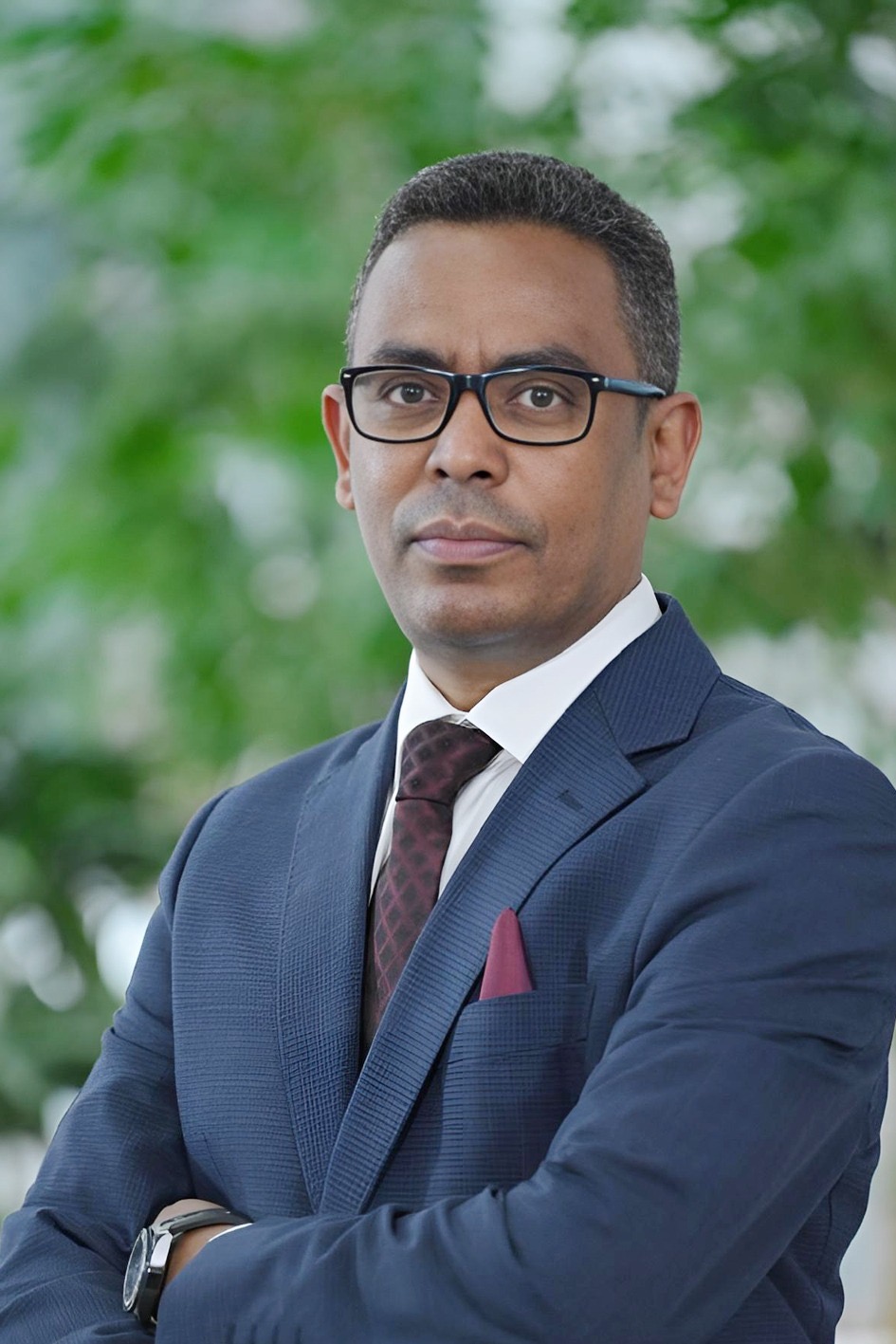
Dr. Berihu Teklu Gebrehiwot is an Assistant Professor in the Department of Mathematics at Khalifa University, specializing in quantum information, metrology, and computation. His research focuses on quantum estimation, entanglement generation, and quantum communication protocols. Ph.D. in Theoretical Quantum Information, University of Milan M.Sc. in Theoretical Quantum Optics, Addis Ababa University B.Sc. in Physics (minor Mathematics), Addis Ababa University His work explores quantum-enhanced sensing protocols, particularly in sloppy statistical models where parameters are interdependent. He investigates entanglement dynamics in cavity magnomechanical systems and develops techniques for force sensing in inverted potentials. Recent publications highlight his contributions to quantum metrology of spin chains, magnon blockade, and feedback control of quantum correlations. A 2021 Entropy paper received an Editor’s Choice award. Critical metrology of minimally accessible anisotropic spin chains (2024) Strong magnon blockade via squeezing (2023) Feedback control in magnomechanical systems (2023) Quantum phase communication with noiseless amplifiers (2019) He advises MSc student Firoz Chogle on precision measurement in nonlinear quantum oscillators and collaborates with Prof. Ernesto Damiani and Dr. Jianyi Lin on quantum computing projects.
Alireza Qaiumzadeh is a Research Professor at the Department of Physics, Faculty of Natural Sciences, Norwegian University of Science and Technology (NTNU). His research spans theoretical condensed matter physics with a focus on emergent phenomena in quantum materials and technologies. Quantum Magnetism Spintronics (Topological, Superconducting, Neuromorphic) Topological Phases of Matter Ultrafast Nonequilibrium Phenomena Quantum Field Theory of Many-Body Systems He has secured significant grants including the FRIPRO grant (€1.02M, 2025-2029) and EEA/Norway GRIEG grant (€1.4M, 2020-2024). His recent articles explore topological magnon gaps, spin Nernst effects, and hybrid quantum systems. Martin Landrø’s award for outstanding master’s thesis (2025, 2023) He supervises PhD and Master students in projects ranging from magnon condensation to quantum transport. His team collaborates internationally and utilizes advanced theoretical and computational methods.
Jakob Lass is a Researcher at the Laboratory for Neutron Scattering and Imaging, Paul Scherrer Institute (PSI) in Switzerland, specializing in advanced neutron scattering techniques for quantum materials research. His work bridges experimental physics and computational tool development to probe complex magnetic phenomena. His research focuses on condensed matter physics with emphasis on quantum magnetism, magnetic materials, and topological spin textures. Key areas include skyrmion phases in centrosymmetric metals, bond-dependent interactions in frustrated magnets, heavy fermion systems like UTe 2 , and quantum critical phenomena. He develops critical software infrastructure such as DMCpy for neutron diffraction analysis and AMBER for spectrometer background estimation. Analysis of his 2023-2025 publications reveals a dual focus: methodological innovation in neutron instrumentation (e.g., BIFROST spectrometer development, background reduction techniques) and fundamental discoveries in quantum materials (e.g., magnon band splitting in altermagnets, spin-flop transitions, and skyrmion formation mechanisms). His work frequently employs honeycomb lattice antiferromagnets and centrosymmetric metals as model systems. Dr. Lass actively contributes to PSI's Laboratory for Neutron Scattering and Imaging, collaborating on international projects at facilities like the European Spallation Source. His team develops cutting-edge neutron spectrometry techniques while investigating exotic states of matter under extreme conditions including high magnetic fields and low temperatures.
Roles & Affiliations: Demie Kepaptsoglou is a Senior Lecturer in Physics at the University of York, Deputy Director of the SuperSTEM facility, and a Staff Scientist at the EPSRC National Facility for Advanced Electron Microscopy. She holds an affiliation with the School of Physics, Engineering and Technology. Previously, she served as a Staff Scientist at the University of Manchester’s School of Materials and a Postdoctoral Researcher at the University of Oslo’s Institute of Physics. Education: MScEng in Mining & Metallurgy Engineering (National Technical University of Athens, Greece, 2001) PhD in Materials Science (National Technical University of Athens, Greece, 2007) Research Interests: Her work focuses on advanced electron microscopy and spectroscopy techniques, applied to nanomaterials, thermoelectrics, topological insulators, and functional oxides. Key areas include defect analysis, interface studies, and the development of vibrational/magnon spectroscopy in electron microscopes. She explores applications in graphene, 2D materials, and spin-to-charge conversion systems. Grants & Collaborations: Leads projects such as 'New Horizons 2020' (magnon interfaces) and collaborates with institutions globally. Co-supervises PhD students Connor Murrill and Fayzah Talbi. Awards: European Microscopy Society Outstanding Paper Award (2020) Labs & Facilities: Based at the SuperSTEM facility (STFC Daresbury) and contributes to the York Nanocentre.
Mark D Lumsden serves as Spectroscopy Section Head within the Neutron Scattering Division of Oak Ridge National Laboratory's Neutron Sciences Directorate, overseeing operations of 10 neutron spectrometers across the High Flux Isotope Reactor (HFIR) and Spallation Neutron Source (SNS) facilities. A McMaster University PhD graduate (1999), he joined ORNL as a Eugene P. Wigner Fellow before progressing through leadership roles including Time-of-Flight Spectroscopy Group Leader (2011-2017) and Spectroscopy Group Leader (2017-2020). Ph.D. in Physics, McMaster University, Canada (1999) B.Sc. in Physics, St. Francis Xavier University, Canada (1993) His research centers on quantum materials investigation through neutron scattering techniques, specializing in quantum magnetism phenomena including spin liquids, topological magnons, and frustrated magnetic systems. Recent work examines field-induced quantum phase transitions in honeycomb lattice materials like α-RuCl3 and YbCl3, while earlier contributions established foundational understanding of iron-based superconductors. His experimental approach combines advanced spectrometer development with precision measurements of magnetic excitations across diverse quantum materials platforms. Lumsden's publication trends reveal sustained focus on quantum magnetic phenomena since 2005, with increasing emphasis on Kitaev materials and topological magnonics after 2015. His work spans condensed matter physics, materials science, and neutron instrumentation, characterized by collaborations across international facilities and frequent appearances in high-impact journals including Physical Review B, Nature Communications, and npj Quantum Materials. Fellow, American Association for the Advancement of Science (2021) Fellow, Neutron Scattering Society of America (2018) ORNL Director's Award for Research Accomplishment (2016, 2009) Fellow, American Physical Society (2015) Gordon Battelle Award for Scientific Research (2011) As Section Head, Lumsden directs a major neutron science capability while maintaining active research programs funded through DOE Office of Science grants. His leadership includes managing the SPICE data acquisition system development (recognized with 2005 ORNL Significant Event Award) and coordinating multi-institutional teams studying quantum spin liquids. Current projects investigate topological magnon gaps and quantum criticality in frustrated magnets, leveraging ORNL's world-leading neutron facilities. Lumsden's Spectroscopy Section operates integrated neutron scattering capabilities across HFIR's triple-axis spectrometers and SNS's time-of-flight instruments including CNCS, HYSPEC, SEQUOIA, and ARCS. His team develops advanced methodologies for measuring quantum magnetic excitations under extreme conditions (high magnetic fields, low temperatures), supporting both in-house research and external user programs through ORNL's user facilities.
Zhihong Chen is the Reilly Professor of Electrical and Computer Engineering and Mary Jo and Robert L. Kirk Director of the Birck Nanotechnology Center at Purdue University. She holds a B.S. in Physics from Fudan University (1998), and M.S. and Ph.D. in Physics from the University of Florida (2002–2003). Her research focuses on nanoelectronics, 2D materials, spintronics, and interconnect technologies, with applications in advanced semiconductor devices, flexible electronics, and probabilistic computing. She has led major initiatives such as the SRC nCORE NEW LIMITS Center and served as Technical Program Chair for Device Research Conferences. Education: B.S., Physics, Fudan University (1998) M.S., Physics, University of Florida (2002) Ph.D., Physics, University of Florida (2003) Research interests include nano-materials manipulation, 2D device fabrication, and reconfigurable computing. Her lab explores novel materials for interconnect scaling, spintronic devices, and graphene-based solutions. Key projects include Cu-2D hybrid interconnects and valleytronics for low-power electronics. Awards include IEEE Fellow (2020), Spira Teaching Award (2013), and multiple best paper awards. Her work has been sponsored by ONR, NSF, SRC, and Intel. Current lab activities include 2D material integration, probabilistic spin logic, and nanoelectronic reliability. Labs/Teams: Chen Lab (Birck Nanotechnology Center), collaborating with industry partners like Intel, Ford, and Northrop Grumman.
Ting Yu is a Professor and Chair of the Department of Physics at the Charles V. Schaefer, Jr. School of Engineering and Science, Stevens Institute of Technology. She holds a PhD in Physics from Imperial College London (1997). Her research focuses on quantum information science, quantum physics, and quantum technology, particularly in non-Markovian dynamics, quantum entanglement, and quantum metrology. She has secured NSF and DARPA grants and serves on editorial boards for journals like Quantum Information and Entropy . Her work spans theoretical modeling of quantum systems, quantum feedback control, and quantum coherence dynamics. Education: PhD (1997), Physics, Imperial College London, UK Research Interests: Entanglement and decoherence in quantum nanodevices Continuous quantum measurement and feedback control Non-Markovian quantum open systems Quantum phase transitions and topological computation Grants: NSF Grant (2008–present): Theory of Quantum Dynamics of AMO Systems DARPA Grant (2009–present) Professional Contributions: Editorial roles: Quantum Information , Entropy , Scientific Reports Reviewer for NSF panels and funding agencies Member, American Physical Society (APS) and Optical Society of America (OSA) Key Publications: Her recent work includes studies on non-Markovian quantum trajectory methods, quantum synchronization protocols, and entanglement generation in optomechanical systems. She has contributed to foundational topics like quantum Fisher information and modular operators in supersymmetric systems.
Shufeng Zhang is a Professor of Physics at the University of Arizona, holding an office in PAS 357. He obtained his Ph.D. in Physics from New York University in 1991. His research focuses on condensed matter physics, particularly spin-polarized electron transport theory, fast magnetization dynamics, magnetic devices, and strongly correlated systems. Key research interests include spin Hall effects, spin torque phenomena, magnon dynamics, and the interplay between spin and charge transport in nanoscale magnetic systems. His work explores quantum magnetism in two-dimensional materials, magnetoelectric effects, and voltage-controlled magnetism. Notable contributions include theoretical advancements in spin-transfer torque mechanisms, magnetic tunnel junctions, and magnon-mediated transport processes. His research has been recognized through awards such as the Galileo Circle Fellowship (2019), Henry and Phyllis Koffler Prize (2017), and election as an APS Fellow (2005). Publications highlight investigations into magnetic dynamics, spin-orbit coupling effects, and the development of novel spintronic devices. His work frequently appears in top journals like Physical Review Letters and Physical Review B.
Prof. Dr. Manfred Albrecht serves as Chairholder and Group Leader of the Magnetism research group within the Experimental Physics IV division at the Institute of Physics, University of Augsburg. His work is situated in the Faculty of Mathematics, Natural Sciences, and Materials Engineering, where he leads investigations into advanced magnetic materials and nanostructures. His research spans Magnetism in thin films and nanostructures Spintronics and magnonics Skyrmion and topological spin texture physics Synthetic antiferromagnets and exchange-coupled systems Magneto-optical and magneto-acoustic phenomena Functional oxide materials His laboratory employs advanced techniques including transmission electron microscopy, ion accelerators, molecular beam epitaxy, and various magnetic characterization tools. Recent publications (2023-2025) demonstrate leadership in skyrmion physics, magnetoacoustic wave control, and advanced magnetic thin film systems, with high-impact publications in Nature Physics, Physical Review Letters, and Advanced Functional Materials. His work shows particular strength in room-temperature topological spin structures and nonreciprocal magnetoacoustic effects. Prof. Albrecht supervises numerous doctoral and master's students through thesis topics in magnetism and thin films, and maintains active collaborations across international institutions. His laboratory features extensive equipment including TEM, ion accelerators, molecular beam deposition systems, and various magnetic characterization tools essential for cutting-edge nanomagnetism research.
Olivier Delaire is an Associate Professor at Duke University, holding joint appointments in the Thomas Lord Department of Mechanical Engineering and Materials Science, the Department of Physics, and the Department of Chemistry. His research group investigates atomistic transport processes in energy materials using neutron/x-ray scattering, spectroscopy, and quantum simulations. Education: M.Sc., Pennsylvania State University (2000) Ph.D., California Institute of Technology (2006) Research Focus: Delaire's work centers on phonon dynamics, electron-phonon coupling, and thermodynamics in functional materials. Key areas include superionic conductors for batteries, thermoelectrics for energy conversion, metal-insulator transitions, and lattice anharmonicity. His group employs advanced scattering techniques to probe atomic-scale energy transport mechanisms in complex crystals. Publication Trends: Recent articles emphasize phonon-mediated phenomena in quantum materials, including ultrafast lattice disordering, anharmonic phonon collapse, superionic diffusion, and magnetically driven phase transitions. Common themes involve thermal conductivity manipulation, ionic conduction engineering, and nonequilibrium material responses probed via neutron/x-ray methods. Awards: DOE Early Career Award (2014) World Materials Research Institute Forum Prize (2010) Director's Award, Oak Ridge National Laboratory (2009) Louis Rosen Prize, Los Alamos National Laboratory (2008) Clifford G. Shull Fellowship (2008) Outstanding Ph.D. Research Award, Neutron Scattering Society of America (2006) Laboratory: Leads the Delaire Research Group at Duke's Fitzpatrick Center (CIEMAS), specializing in experimental and computational studies of energy transport. The group utilizes national facilities like Oak Ridge National Laboratory for neutron scattering experiments.
Professor Gregory A. Fiete is a faculty member in the Department of Physics at Northeastern University. His research group explores condensed matter physics with a focus on interaction effects in quantum many-body systems, spanning nanoscale electron confinement to frustrated magnetism in macroscopic samples. The group employs both numerical and non-perturbative analytical methods, often guided by experimental motivations. Recent research emphasizes topological insulators, quantum magnetism, transition metal oxides, entanglement spectra, and the fractional quantum Hall effect. The team investigates unusual phases of matter with unexpected properties, leveraging quantum geometry and nonlinear optical responses in 2D materials. Key methods: Numerics, non-perturbative analytical techniques Active areas: Bilayer graphene, magnon dynamics, phonon-magnetic interactions Applications: Topological materials, spintronics, quantum computing
Denis Candido is an Assistant Professor at the University of Iowa in the Department of Physics and Astronomy. His research focuses on theoretical and experimental condensed matter physics, quantum information science, and spintronics. His primary research interests include: Topological Materials Quantum Spin Systems Magnonics Spin-Orbit Coupling Quantum Coherence and Decoherence 2D Electron Systems The 15 most recent publications highlight his work on quantum spin centers in diamond nanostructures, topological phase engineering in magnonic crystals, and spin-orbit coupled systems in complex oxide interfaces. Key themes include the development of quantum sensors, analysis of edge states in topological insulators, and exploration of magnon-mediated qubit interactions for quantum computing applications.
Brent Fultz is the Barbara and Stanley Rawn, Jr. Professor of Materials Science and Applied Physics at the California Institute of Technology . A graduate of MIT (B.Sc., 1975) and UC Berkeley (Ph.D., 1982), he has held progressively senior faculty roles since 1985, becoming a full Professor in 2003 and receiving his named chair in 2013. Materials Physics and Chemistry Thermodynamics and Entropy Studies Neutron and X-ray Scattering Techniques Energy Storage Materials Research His research spans fundamental and applied materials science, with particular focus on vibrational thermodynamics and phase transitions. Recent work combines experimental neutron scattering with machine learning interatomic potentials to study phonon entropy, and develops novel materials for hydrogen storage and lithium battery electrodes . He leads the ARCS spectrometer project at Spallation Neutron Source and contributes to DANSE software for neutron data analysis. Key scientific contributions include: Explaining the Invar effect through spin-phonon competition Developing miniaturized Mössbauer spectrometers for planetary missions Quantifying vibrational entropy in metallic glasses through inelastic scattering Establishing the anharmonic origins of thermal expansion anomalies in NaBr and TiO2 His awards include: TMS EMPMD Distinguished Scientist Award (2010), William Hume-Rothery Award (2016), multiple society fellowships, and the 2022 Neutron Scattering Society of America Service and Leadership Award.
Eric Montoya is an Assistant Professor in the Department of Physics and Astronomy at the University of Utah, where he has led the MLAB (Magnetic Materials and Spin Dynamics Laboratory) since January 2022. His research focuses on experimental condensed matter physics, specializing in magnetic materials, spin dynamics, and nanofabrication for spintronic applications. Education: PhD in Physics, Simon Fraser University (2016) BS in Physics and Astronomy, Western Washington University Postdoctoral Scholar, Physics and Astronomy, University of California, Irvine Research Focus: Montoya's group investigates spin-orbit interactions, magnetization dynamics, and spin transport phenomena. They develop novel spintronic devices like spin Hall oscillators and explore quantum technologies through materials engineering. Recent breakthroughs include discovering self-generated spin-orbit torques and anomalous Hall nano-oscillators. Publication Trends: His 26+ articles primarily explore spin-orbit torques, nano-oscillators, and spin transport mechanisms. Works frequently bridge fundamental physics (e.g., quantum well states, chaos-driven magnetization) with applied device innovation (memory, oscillators). Common themes include interfacial spin effects, universal Hall phenomena, and radiation-resistant nanodevices. Awards: NSF CAREER Award (2025) Grants & Advising: Secured $900k NSF-MRI grant (2023) for materials characterization systems. Advises PhD/Master's students including Noah (DOE CSGF fellow), Prakash (poster award winner), and Jonathan (undergraduate research awardee). Research supported by instrumentation for electrical/magnetic characterization. Laboratory: The MLAB group specializes in sample growth, nanofabrication, and spin dynamics characterization, with recent work on universal Hall effects and spin-orbitronic devices.
Professor Buddhika Mendis is affiliated with the Department of Physics at Durham University and serves as Facility Director of the GJ Russell Facility. His expertise lies in electron microscopy and materials science , with a focus on thin-film solar cells and electron beam-specimen interactions . His research interests include: Electrical activity of grain boundaries in photovoltaics Partial ordering in CZTS solar cell materials Nanomaterial distribution in hybrid solar cells Electron beam scattering from dopant atoms Chemical analysis of rough interfaces and core-shell nanoparticles Recent publications explore topics like magnon spectroscopy , Compton scattering , and 3D electron diffraction simulations , reflecting his technical contributions to electron microscopy and semiconductor characterization . He supervises postgraduate research students including Areesha Ali , Kaviya Dhamotharan , Mian Faisal , and Sam Hayes , advancing experimental and computational methodologies in materials analysis .