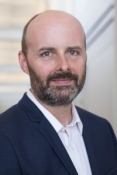
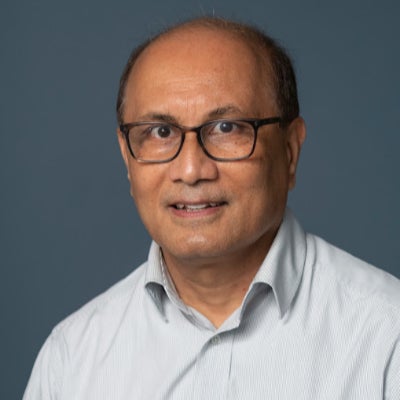
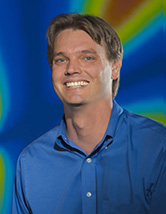
Matteo Pezzulla is an Associate Professor at Aarhus University within the Department of Mechanical and Production Engineering Mechanics and Materials. His research focuses on fluid-structure interactions, soft hydraulics, and elastic instabilities, with applications in biomechanics and solid mechanics. Areas of expertise: Soft hydraulics, Fluid-structure interactions, Elastic instabilities, Biomechanics, Solid mechanics Teaching: Theory of Elasticity (BSc), Slender Structures (MSc) Memberships: American Physical Society (APS), Education Committee at AU Projects: The Architecture of Photosynthesis (2023–2026), Smart Fluidic Channels (2023–2025) His work bridges analytical, numerical, and experimental methods to study shell mechanics and biological systems. Publications highlight fluid-induced buckling, magneto-elastic materials, and biomimetic designs. Contact: matt@mpe.au.dk | +45 20 69 75 22
David Huitink is an Associate Professor and Twenty-First Century Professor in the Department of Mechanical Engineering at the University of Arkansas College of Engineering. His research spans the intersection of materials and thermal sciences, with a focus on leveraging fundamental thermophysical material behaviors for engineered applications. He directs the EMPIRE Laboratory (Engineered Multi-Physical Interactions & Reliability Evaluation), which focuses on reliability engineering for next-generation electronic packaging solutions. Dr. Huitink received his educational foundation at Texas A&M University, earning a Bachelor of Science (2006), Master of Science (2007), and Doctor of Philosophy (2011), all in Mechanical Engineering. As an NSF Graduate Research Fellow during his doctoral studies, he specialized in complex nano-scale interactions at material interfaces under chemical and mechanical influence. His research interests encompass materials science, thermal sciences, and reliability engineering, with particular focus on thermophysical material behaviors, energy sciences, and thermally active functional materials. The Huitink lab works closely with Electrical Engineering collaborators to develop next-generation high-density power electronics for electrified transportation and power conversion systems. Recent efforts include additive manufacturing for hot-spot thermal management, transient temperature abatement, and interconnect fabrication technology development for enhanced electronic packaging lifetimes through thermal cycling events. Analyzing his recent publication record reveals a clear trend toward advanced thermal management solutions for power electronics, with increasing focus on phase change materials, nanowire-enhanced interconnects, and reliability modeling under combined stress conditions. His work bridges fundamental materials science with practical engineering applications in high-power systems, particularly for electric vehicle technologies and aerospace applications. NSF Graduate Research Fellow (2007-2011) Texas A&M Graduate Diversity Fellow (2008-2011) Texas A&M Graduate Merit Fellow (2006-2007) National Merit Scholar (2002-2006) BSA Eagle Scout (2001) Dr. Huitink brings significant industry experience to his academic role, having spent over five years at Intel Corporation as Quality & Reliability Engineering Program Manager for Intel's Custom Foundry Division. There he pioneered advanced reliability prediction methods for silicon-based flip chip microelectronic packages and developed testing protocols and FEA methods for Design for Reliability guidance. He currently serves as Associate Editor of Microelectronics Reliability Journal and has patent applications filed in Low Z-height Electronic System design and thermal optimization of space-limited electronic systems. The EMPIRE Laboratory maintains strong connections with Arkansas's multi-disciplinary power electronics program, which includes 14 faculty members across 4 departments, approximately 100 graduate students, and nearly $10 million in annual research expenditures. The lab collaborates with several centers of excellence including GRAPES, POETS, and SEEDS, utilizing state-of-the-art facilities such as NANO, HiDEC, and NCREPT.
Colin Holbrook is an Associate Professor at the University of California, Merced , affiliated with the School of Social Sciences, Humanities and Arts and the Department of Cognitive and Information Sciences . His research focuses on decision-making under threat , social determinants of trust , and human-AI interaction during crises . University of California, Merced Cognitive and Information Sciences Department School of Social Sciences, Humanities and Arts Research interests span evolutionary psychology , group prejudice , moral psychology , and human-robot interaction dynamics . Recent work investigates overtrust in AI recommendations , physical anthropomorphism effects , and cross-cultural pandemic behavior . Publications reveal consistent patterns in threat perception , social cognition , and robot trust calibration . Collaborative efforts include partnerships with institutions like the UCLA Center for Behavior, Evolution & Culture , the AHRC Culture and the Mind Project , and the Institute of Cognition & Culture . His lab develops virtual reality experiments for robot-guided emergency scenarios while exploring cognitive adaptations through transcranial magnetic stimulation and behavioral studies across diverse populations.
Jason Chun Shing Pun is a Senior Lecturer in the Department of Physics at the University of Hong Kong, focusing on light pollution research and public science education. He has contributed to astrophysics, neutrino physics, and cosmic ray studies while leading environmental outreach initiatives. Education: B.A., B.S. (Rochester), M.A., Ph.D. (Harvard) Key Research Areas: Light pollution monitoring, supernova remnants, neutrino experiments, and X-ray sources in galaxies His work spans astrophysics and environmental science, with notable projects like the Daya Bay neutrino experiment and Aberdeen Tunnel cosmic ray research. He also initiated Hong Kong's night sky brightness monitoring network. Recent publications emphasize urban light pollution analysis via satellite data (VIIRS, Luojia-1), Earth Hour natural experiments, and multi-source methods. These studies highlight trends in artificial lighting, urban planning, and citizen science engagement. Scientific accolades include the 2022 Secretary of Home Affairs’ Commendation Scheme and the 2018 Dark Sky Defender Award. He has secured grants from the HKSAR Environment and Conservation Fund and HKU Teaching Development Grant. Dr. Pun actively engages in public education through workshops, competitions, and collaborations with international bodies like the International Astronomical Union. His projects, such as the GaN-MN YouTube channel and bilingual education booklets, demonstrate a commitment to global light pollution awareness.
Joseph V. Rispoli serves as Assistant Professor of Biomedical Engineering in Purdue University's College of Engineering, joining the faculty in 2015 after completing his Ph.D. at Texas A&M University. His prior industry experience includes high-speed digital design development for multiprocessor server motherboards at Dell. Educational background: B.S. in Electrical Engineering, University of Virginia, 2002 B.S. in Computer Engineering, University of Virginia, 2002 Ph.D. in Biomedical Engineering, Texas A&M University, 2015 His research program pioneers hardware innovations for high-field magnetic resonance imaging, with three core thrusts: Anatomically-tailored radiofrequency coil design for 7-tesla human studies In vivo spectroscopy of multiple NMR-active nuclei (proton/carbon-13) for biomarker detection Electromagnetic modeling frameworks for patient safety validation During doctoral research, he engineered over 20 specialized RF coils to investigate breast cancer biomarkers through advanced spectroscopy techniques. Scientific recognition: No awards specified in source documentation. Academic mentorship and funding activities remain undocumented in the provided institutional profile.
Daniel Månsson is a Professor at the Department of Electrical Engineering, Royal Institute of Technology (KTH), specializing in smart electricity grids and power system components. His work spans electromagnetic compatibility (EMC) of large distributed systems, energy storage optimization, and privacy protection in smart metering. PhD in Engineering Physics (with specialization in Electromagnetism) Docent (Swedish Academic Title) in Electrical Engineering His research focuses on: Optimization of self-sufficient microgrids with energy hubs Smart meter privacy protection using energy storage EMC analysis of photovoltaic systems and UWB transients Hybrid energy storage system performance in renewable grids Recent publications indicate expertise in: Electromagnetic interference from solar PV systems Cyber-physical security in smart meters Conducted emission analysis Greenhouse gas reduction through optimized storage
Professor Bas Baskaran is an academic leader at Deakin University 's Faculty of Science, Engineering and Built Environment , serving as Pro Vice Chancellor International Research Partnerships and Associate Dean, International and Partnerships . With over 30 years of experience in Australian higher education, he focuses on international academic partnerships and engineering curriculum development . Doctor of Philosophy – University of Melbourne Master of Engineering – Asian Institute of Technology Bachelor of Science in Engineering – University of Peradeniya His research spans integrated urban/industrial water management , wastewater treatment technologies , and pollution prevention , with expertise in chemical , environmental , and civil engineering . Recent work explores: Functionalized biopolymer aerogels for heavy metal removal 2D nanosheet-based photocatalysts for wastewater treatment Advanced membrane technologies for fouling resistance Scientific recognition includes: 2011 Australian Government's 'Visiting Researchers Program in Thailand' He has supervised: 6 PhD graduates (e.g., Deepak Mallya, Sara Abdi Kheibari) Several Master's students (e.g., Geoff Verhoef, Joanne Puckett) Leadership roles: Pro Vice Chancellor International Research Partnerships (2020–present) Head of School – School of Engineering (2009–2010) Deputy Dean – Faculty of Science and Technology (2006–2008) Grants include: $25,000 – Barwon Water (2023) $258,822 – Smart Water Fund (2006–2008) $230,865 – Geoffrey Gardiner Dairy Foundation Ltd (2003–2007)
Dr. Arijit Bose is a Distinguished Engineering Professor in the Department of Chemical, Biomolecular, and Materials Engineering at the University of Rhode Island (URI). His research focuses on energy storage systems, water quality monitoring, and the impact of microplastics on marine ecosystems. He holds a Ph.D. from the University of Rochester (1981) and a B.Tech. from the Indian Institute of Technology, Kanpur (1976). His current work includes developing all-solid-state lithium-ion batteries for underwater vehicles and medical devices, designing hybrid carbon-gold nanoparticles for nitrate/phosphate detection in water, and investigating microplastic interactions with marine bacteria like Synechococcus . His research is funded by agencies such as the Department of Energy (DOE), National Science Foundation (NSF), and the Office of Naval Research (ONR). Bose’s interdisciplinary studies bridge material science, environmental engineering, and plasma physics. He has pioneered techniques to enhance battery safety, improve SERS-based sensors, and analyze microplastic effects using advanced microscopy and DNA sequencing. His lab collaborates with institutions worldwide to address challenges in sustainable energy and environmental health.
Bruno Chaudret is a Research Professor at INSA-Toulouse, France, and a member of the French Academy of Sciences since 2005. He serves as Director of the Laboratoire de Physique et Chimie des Nano-Objets (UMR 5215) since 2011 and has held leadership roles in CNRS and IFPEN. PhD, Imperial College London (1977) Doctorat d'État, Université Paul Sabatier Toulouse (1979) His research bridges organometallic chemistry and nanomaterials , focusing on: Magnetic nanostructures Catalysis via C-H bond activation Dihydrogen complexes Self-assembly of nanoparticles into superlattices Gas sensor materials His scientific work spans nanoparticle synthesis , magnetic properties , and catalytic applications , with significant contributions to controlled nanoparticle shapes and assemblies. Notable scientific awards include: Coordination Chemistry Award, French Chemical Society (1982) CNRS Silver Medal (1997) Geoffrey Wilkinson Prize, Royal Society of Chemistry (2008) Grand Prix Pierre Süe, SCF (2010) He has supervised 36 PhD students and 26 Post-Doc fellows , while contributing to 16 patents and 370+ refereed publications . His work extends to industrial applications through licencing.
Quanxi Jia is a SUNY Distinguished Professor, Empire Innovation Professor, and National Grid Professor of Materials Research at the University at Buffalo. He holds appointments in the Department of Materials Design and Innovation within the School of Engineering and Applied Sciences and serves as Scientific Director of the New York State Center of Excellence in Materials Informatics (CMI). Education: PhD in Electrical and Computer Engineering, University at Buffalo, 1991 MS in Electronic Engineering, Jiaotong University, Xian, China, 1985 BS in Electronic Engineering, Jiaotong University, Xian, China, 1982 Research Focus: Jia's work centers on advanced electronic and energy materials, particularly epitaxial thin films and heterostructures. His research investigates processing-structure-property relationships, monolithic integration of functional materials, and superconductors for quantum/energy applications. Key methodologies include pulsed laser deposition and polymer-assisted techniques, with emphasis on oxide heterostructures , memristive devices , and multiferroic systems for next-generation electronics. Publication Trends: Recent publications (2023-2025) reveal dominant focus on neuromorphic computing via resistive switching devices (58% of sampled works), superconducting thin films for quantum applications (20%), and strain-engineered oxide heterostructures (22%). His group pioneers HfO 2 -based artificial neurons, NbN superconducting films on CMOS platforms, and multiferroic membranes, demonstrating strong industry-academia translation potential. Scientific Recognition: Fellow of Los Alamos National Laboratory Fellow of Materials Research Society (MRS) Fellow of American Physical Society (APS) Fellow of American Ceramic Society (ACerS) Fellow of AAAS Fellow of IEEE Fellow of National Academy of Inventors (NAI) Leadership & Infrastructure: As CMI Scientific Director, Jia oversees New York's flagship materials informatics initiative integrating AI with experimental materials science. His prior directorship of DOE's Center for Integrated Nanotechnologies (Los Alamos/Sandia) established expertise in national lab collaboration. The group maintains 50+ U.S. patents and 500+ publications, with current work targeting quantum device integration and sustainable neuromorphic hardware. Research Ecosystem: The CMI hub connects Jia's team with industry partners (including National Grid) and national labs, facilitating rapid prototyping of energy materials. Current thrusts include machine learning-guided ferroelectric design, CMOS-compatible superconductors, and recyclable perovskite sensors, positioning the group at the semiconductor-energy nexus.
Mark Wilson is a Professor in the Department of Chemistry at Durham University, where he leads the Computational Soft Matter research group. His laboratory is housed in the Wolfson Suite for Computational Chemistry, focusing on molecular dynamics and Monte Carlo simulations of complex molecular systems. The group's research is primarily funded by EPSRC grants, supporting investigations into liquid crystals, polymers, proteins, and nanostructured materials. Wilson's research integrates theoretical chemistry with computational physics to study: Self-assembly processes in chromonic liquid crystals and surfactants Multiscale modeling approaches combining atomistic and coarse-grained methods Protein dynamics and allosteric regulation mechanisms Phase behavior of bent-core liquid crystals and ferroelectric nematics Interfacial phenomena in polymer-surfactant systems Analysis of his 15 most recent publications reveals strong emphasis on: methodological developments in dissipative particle dynamics; molecular engineering of pharmaceuticals; and predictive modeling of soft material behavior. Recurring themes include surfactant phase diagrams, liquid crystal polymorphism, and computational methods validation through experimental collaboration. Wilson currently supervises four PhD students and maintains an active research team with six group members. His laboratory utilizes advanced high-performance computing resources for large-scale simulations, with recent work extending to biomolecular systems including beta-amyloid aggregation and antimicrobial peptides.
Hong Wei is a Professor at the Department of Mechanics and Aerospace Engineering , Southern University of Science and Technology (SUSTech) . He also serves as Director of SUSTech Global and Associate Dean of Academic Affairs at Shuli College . Previously, he held tenured positions at Iowa State University and dual appointments at Hokkaido University . Hong Wei earned his B.S. and M.S. in Solid Mechanics from Tsinghua University , followed by a Ph.D. in Engineering Science from Harvard University (2006) . His research spans solid mechanics , soft matter mechanics , dielectric breakdown , smart materials , electrochemical reactions , and surface instability . Current work focuses on phase-field modeling and coupled deformation-transport phenomena in soft materials. His representative publications cover cutting-edge topics in Science Advances , J. Mech. Phys. Solids , and Soft Matter , with trends in hydrogel mechanics , electromechanical coupling , and material failure analysis . Scientific recognition includes being named a Fellow of the American Society of Mechanical Engineers (ASME) , alongside editorial roles in journals like Meccanica and International Journal of Applied Mechanics . Hong Wei has mentored students such as Sun Xingjian (doctoral student), Wang Sicong , Pan Lei , Feng Xianke , and Shen Zhiyuan , who received the Lixue Scholarship . He has led international projects and secured grants from the National Science Foundation (USA) and National Natural Science Foundation of China .
Dustin Froula serves as Assistant Professor in the Department of Physics and Astronomy at the University of Rochester and leads the Plasma and Ultrafast Physics group at the Laboratory for Laser Energetics (LLE). His research focuses on experimental plasma physics for inertial confinement fusion and high-energy-density science using major facilities including OMEGA, OMEGA EP, and the National Ignition Facility. His academic credentials include: MS in Physics, University of California, Davis (2000) PhD in Physics, University of California, Davis (2002) Froula's research centers on laser-plasma interactions , Thomson scattering diagnostics , and laser-plasma acceleration in inertial confinement fusion contexts. He investigates phenomena like stimulated Brillouin/Raman scattering, cross-beam energy transfer, and turbulent dynamos, with applications spanning fusion energy development and laboratory astrophysics. His work combines advanced experimental techniques with computational modeling to address fundamental plasma transport questions. Analysis of his 2023-2025 publications reveals dominant trends in flying-focus laser techniques for particle acceleration, laboratory dynamos for astrophysical modeling, and instability mitigation for fusion ignition. Key thematic clusters include high-resolution plasma diagnostics, advanced laser pulse shaping, and magnetized turbulence studies using multi-facility experimental platforms. His scientific recognition includes: Department of Energy's Outstanding Mentor Award (2007) APS Fellowship (2017) John Dawson Award (2019) Ernest Orlando Lawrence Award (2020) Thomas H. Stix Award (2023) Froula has mentored numerous students earning the DOE Mentor Award, with research funded by Department of Energy and National Science Foundation grants supporting his work on OMEGA, NIF, and OPAL facilities. His group develops novel diagnostic techniques like continuous angular-resolution Thomson scattering and flying-focus pulse systems for electron acceleration. He directs the Plasma and Ultrafast Physics group at LLE, operating the OMEGA 60-beam laser, OMEGA EP petawatt system, and MTW short-pulse facility while collaborating with Lawrence Livermore's Jupiter Laser Facility and National Ignition Facility. Current projects include dephasingless wakefield acceleration platforms and turbulent dynamo experiments for astrophysical analog studies.
Dr. Maxim Durach is an Associate Professor in the Department of Biochemistry, Chemistry and Physics at Georgia Southern University's College of Science and Mathematics, where he has been employed since 2011. He maintains affiliate positions with the Center for Advanced Materials Science and the Sustainable Fuels Research Network. His research focuses on theoretical and computational physics for nanotechnology applications, with specialized expertise in photonics, metamaterials, plasmonics, and optoelectronics. Durach's research investigates fundamental phenomena including quartic metamaterials, plasmon drag effects, momentum absorption of light and plasmons, optical forces, photonic integrals, nanorod metasurfaces, optical neutrality (invisibility) in metamaterials, and hyperbolic metasurface cavities. His work contributes to UN Sustainable Development Goals through advancements in materials science and nanotechnology. With an extensive publication record spanning electromagnetism, metamaterials, and nanophotonics, Durach's recent research (2020-2025) demonstrates strong focus on isotropy-broken media, surface electromagnetic phenomena, and advanced optical materials characterization. His theoretical frameworks explore novel beam propagation models, scattering mechanisms, and topological phases in complex media. Durach leads an active research group developing computational approaches for nanophotonics applications. His laboratory investigates plasmonic phenomena through both theoretical modeling and experimental validation, with work supported by consistent research output since 2007. Current projects explore inverse methods in electromagnetism, beam propagation in anisotropic media, and advanced metamaterial designs.
Devid Maniglio is an Associate Professor at the Department of Industrial Engineering, University of Trento. His research focuses on bioengineering, biomaterials, and tissue engineering, with a particular emphasis on bioprinting, surface modification, and functional materials. He has contributed to advancements in silk fibroin and hydrogel-based systems for medical applications. Research Interests Bioengineering for personalized medicine Biomaterials and surface engineering 3D bioprinting and tissue regeneration Molecular imprinting and biosensors Drug delivery and cell encapsulation Teaching Diagnostic and therapeutic technologies for personalized medicine Engineered materials for precision medicine Fundamentals of biomedical technologies Functional surfaces laboratory Labs & Collaborations Devid Maniglio is affiliated with the Functional Surfaces Laboratory at the University of Trento, collaborating with researchers such as Stefano Rossi and Flavio Deflorian. His work integrates interdisciplinary approaches in biomedical engineering and sustainable medical technologies.