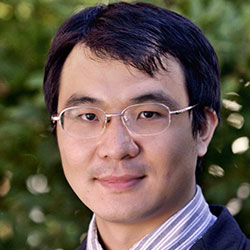
Prof. Edy Tri Baskoro, M.Sc., Ph.D., is a faculty member at the Faculty of Mathematics and Natural Sciences, Bandung Institute of Technology. His academic career spans combinatorics, graph theory, and discrete mathematics, with extensive research on Ramsey graphs, metric dimensions, and graph labelings. Education: Bachelor's from ITB (1987), Master's from University of New England (1992), Ph.D. from University of Newcastle (1996) His research focuses on combinatorial structures, including Ramsey minimal graphs, partition dimensions, irregularity strength, and quadratic embedding constants. Key subfields include tree graphs, path-cycle Ramsey problems, and algorithmic graph theory. Recent publications address edge-locating colorings, unicyclic Ramsey graphs, and applications of graph theory in educational programs. He has contributed to teacher training initiatives in Lombok, Cirebon, and Makassar, as well as textbook development for machine learning. His work involves collaborations in graph theory research and projects like PKR Graph Theory for Nation Building. While no specific awards are documented in the provided text, his contributions to combinatorial research and mathematics education in Indonesia are significant.
Erika L.C. King is an Associate Professor of Mathematics and Computer Science at Hobart and William Smith Colleges (HWS), where she has been a faculty member since 2001. She earned her Ph.D. and M.S. from Vanderbilt University and her A.B. from Smith College. Her office is located in Lansing Hall, and she can be reached at eking@hws.edu or (315) 781-3355. Dr. King specializes in graph theory with research interests focusing on domination theory of graphs, well-covered graphs, and zero forcing in graphs. Her scholarly work has explored various aspects of graph structures, including vertex-magic edge labelings, plane triangulations, and 4-regular, 4-connected, claw-free graphs. She has supervised numerous undergraduate research projects through the HWS-REU program, mentoring students like Rayan Ibrahim, Rebecca Jackson, and others who have co-authored publications with her. Her recent publications demonstrate a continued focus on domination theory and well-covered graphs, with her 2024 paper 'Well-Forced Graphs' representing the latest development in this line of research. Her work spans both theoretical developments and practical applications of graph theory concepts. Dr. King is actively involved in the mathematical community through memberships in the Association for Women in Mathematics, Mathematical Association of America, and American Mathematical Society. She has organized departmental colloquia and supported students attending conferences like the Nebraska Conference for Undergraduate Women in Mathematics. She has taught a wide range of mathematics courses from introductory calculus to advanced topics in graph theory and abstract algebra. Her teaching portfolio includes MATH 110 (Discovering in Mathematics), MATH 130-131 (Calculus I-II), MATH 204 (Linear Algebra), MATH 232 (Multivariable Calculus), MATH 278 (Number Theory), and multiple sections of MATH 313 and MATH 571 (Graph Theory).
Matthias Beck is a Professor of Mathematics at San Francisco State University (SFSU), where he has held positions since 2004. He specializes in combinatorics, number theory, and discrete geometry, focusing on lattice-point enumeration in polyhedra and Ehrhart theory. His research has led to influential textbooks such as Computing the Continuous Discretely (2007) and Combinatorial Reciprocity Theorems (2018). Beck has also contributed to education through the Art of Proof textbook and leadership roles like Associate Chair of the Mathematics Department. Beck's academic journey includes a Ph.D. from Temple University (2000) and postdoctoral fellowships at institutions like MSRI and the Max Planck Institute. His awards include the MAA's Deborah and Franklin Tepper Haimo Award for Distinguished Teaching (2013). He has advised numerous graduate and undergraduate students, fostering collaborations in research areas from magic squares to graph colorings. His work bridges pure and applied mathematics, with applications in music theory, optimization, and combinatorial geometry. Beck actively participates in academic service, including editorial roles at journals like the Electronic Journal of Combinatorics and leadership in initiatives like the National Alliance for Doctoral Studies in Mathematics.
Margaret Bayer is a Professor in the Department of Mathematics at the University of Kansas, within the College of Liberal Arts & Sciences. She specializes in combinatorics and discrete geometry, with research focusing on convex polytopes, hyperplane arrangements, Eulerian posets, and flag vectors. Her work bridges combinatorics with algebraic geometry, particularly through connections to toric varieties. Her research explores the combinatorial structure of geometric objects, including face lattices of polytopes and the interplay between algebraic and geometric properties. Recent work includes studies on cut complexes of graphs, matching complexes, and applications of combinatorial methods in education and algorithm design. Bayer has authored/co-authored over 40 publications, including foundational works on flag vectors, the cd-index of Eulerian posets, and lattice polytopes derived from Schur polynomials. Her articles often address topics like polytope enumeration, topological properties of graph complexes, and combinatorial optimization in exam design. She serves as Book Review Editor for the Association for Women in Mathematics Newsletter and has advised numerous collaborative projects. Her teaching includes intermediate analysis and discrete mathematics courses.
Sarita Nemani is a Professor of Mathematics at Georgian Court University, affiliated with the School of Arts, Sciences, and Education and the Department of Mathematics, Computer Information Systems, and Physics. She previously served as Chair of both the Mathematics & Computer Information Systems and Physics Departments from 2013 to 2019. Doctor of Philosophy (PhD) in Mathematics, University of New Brunswick, Canada Master of Philosophy (MPhil) in Mathematics, Indian Institute of Technology Bombay Master of Science (MS) in Mathematics, University of Bombay Bachelor of Science (BS) in Mathematics, Wilson College, University of Bombay Her research focuses on perturbation methods for linear systems with special matrices (banded, circulant, Toeplitz), parallel algorithms for computational efficiency, and graph theory (interlace polynomials, vertex magic labeling). She also explores mathematical education reform and curriculum innovation. Sarita’s recent publications highlight trends in algebraic stability analysis , graph labeling techniques , and high-performance matrix computation . Her work bridges theoretical mathematics with practical algorithmic implementations. She has designed undergraduate and graduate courses in linear algebra, differential equations, abstract algebra, and graph theory. Her leadership roles include directing the 'Girl Involved in Science and Technology' program (2010–present) and moderating the Georgian Court University Math Club and New Jersey Pi Mu Epsilon chapter.
Alison Marr is a Professor of Mathematics at Southwestern University, located in Georgetown, Texas. She holds a Ph.D. from Southern Illinois University (2007), an M.S. from Texas A&M University (2004), and a B.A. from Murray State University (2002). Her research focuses on graph theory, graph labeling, and recreational mathematics, with notable contributions to magic labelings of directed graphs and combinatorial design. Marr has served as Department Chair and co-chair of the Transforming Paideia Initiative, emphasizing interdisciplinary education. She teaches across the mathematics curriculum, including innovative courses like a First-Year Seminar on game shows and a team-taught Global Health Paideia Seminar. Active in professional leadership, Marr co-directs the Enhancing Diversity in Graduate Education (EDGE) Summer Program for women in mathematics. She is also involved in inquiry-based learning (IBL) and serves on committees for the Mathematical Association of America (MAA) and Association for Women in Mathematics (AWM). Her recent work addresses equity in calculus education and curriculum modernization. Marr has advised students like D. Beckelhymer and D. Adams, and her research spans over 20 peer-reviewed journal articles, including contributions to Graphs and Combinatorics , Symmetry , and Recreational Mathematics Magazine . Her presentations include invited addresses at conferences such as the Mid-West Conference on Combinatorics and international workshops on graph labeling. Marr collaborates widely, with co-authors including W.D. Wallis and R. Simanjuntak. Beyond academia, she engages in community outreach through teacher circles and high school presentations on mathematics and game shows.
Marcin Anholcer is a Professor at the Department of Operations Research and Mathematical Economics, Institute of Informatics and Quantitative Economics, University of Economics in Poznan. His research spans both theoretical and applied domains, focusing on network optimization, graph theory, stable matchings, and fair division. He integrates mathematical methods into economic and financial contexts, contributing to combinatorial optimization and operations research. Education: Doctorate in 2006 and 2011 (specific institutions not detailed). His work addresses problems in graph labeling, distance magic labelings, and stochastic transportation models. He has also contributed to empirical studies on exclusionary constraints in logistics and supply chains. His research bridges pure mathematics and economic applications, with a strong emphasis on algorithmic solutions and computational models. His publications demonstrate trends in combinatorial optimization, hypergraph algorithms, and the application of mathematical models to financial forecasting. He has extensively explored group irregularity strength and chromatic numbers in graphs, alongside practical transportation and supply chain optimization. He has supervised 4 promoted theses and participated in 3 research projects. His methodological contributions include heuristic algorithms for complex optimization problems and comparative analyses of nonlinear allocation techniques.
Petr Lisonek is a Professor in the Department of Mathematics at Simon Fraser University (SFU), part of the Faculty of Science. His research focuses on applications of algebraic and combinatorial methods in cryptography, error-correcting codes, steganography, and computer algebra. Education: Ph.D. in Computer Science from Johannes Kepler University (1994). Research Interests: Non-linear functions in symmetric cryptography and their algebraic/combinatorial constructions. Design of error-control codes for classical and quantum channels using finite fields and finite geometries. Steganographic schemes leveraging linear codes for secure information hiding. Algorithmic aspects of cryptography and coding theory in computer algebra systems. Recent Research Trends: Recent work emphasizes quantum code construction, cryptographic APN permutations, and foundational results in quantum contextuality (Kochen-Specker sets). Publications span topics like twisted codes, maximal nonassociative quasigroups, and minimal magic sets in quantum mechanics. Affiliations: Editor for Advances in Mathematics of Communications . Maintains a research website at CECM .
John McCoy is an Assistant Professor of Marketing at the Wharton School of the University of Pennsylvania. He is also affiliated with the Wharton Neuroscience Initiative and Penn's MindCORE hub. His academic work bridges marketing, cognitive science, and computational modeling. Dr. McCoy's research focuses on mathematical models of judgment and decision making , computational cognitive science , crowd wisdom , and forecasting . Methodologically, he uses a combination of behavioral experiments and computational modeling, drawing on ideas and techniques from psychology, economics, marketing, Bayesian statistics, and computer science. Much of his current work centers on better ways to aggregate judgments from multiple individuals, including in situations where the majority may be wrong and the truth may be unverifiable. His research has gained significant attention, with popular accounts appearing in the Wall Street Journal , NPR , and the New Yorker . A key contribution is the "surprisingly popular answer" method for extracting wisdom from crowds, which selects not the "most popular" answer but the "surprisingly popular" one by eliciting both answers and predictions about others' answers. Dr. McCoy teaches graduate courses including Consumer Research Topics and Marketing Management. His teaching focuses on contemporary topics in consumer research, drawing from marketing, psychology, and economics literature to help students develop research ideas and understand theoretical and methodological approaches to consumer behavior. His scholarly work spans multiple domains including crowd wisdom, individual-level decision making, semantic cognition, and graph theory. His research has important applications in marketing, healthcare communication, and forecasting methodologies.
Nadia Lafrenière is an Assistant Professor with a limited-term appointment at Concordia University . She holds a Ph.D. in Combinatorial Mathematics from Université du Québec à Montréal (UQAM), under the supervision of Franco Saliola. Previously, she was a John Wesley Young Research Instructor at Dartmouth College. Her research focuses on algebraic combinatorics , particularly spectral properties of combinatorial structures, card shuffling dynamics, and dynamical algebraic systems. She is also deeply engaged in mathematics outreach, designing activities for diverse audiences through radio shows, walking tours, and educational workshops. Education : Ph.D. in Combinatorial Mathematics (2019), UQAM M.Sc. in Complexité palindromique des mots et des arbres (2016), UQAM Research Interests : Her work explores spectral properties of random walks, combinatorial actions on permutations, and homomesy in dynamical systems. She has contributed to studies on interval-closed sets, toggle groups, and Markov chain mixing times. Her methods bridge algebraic combinatorics with probability theory, often involving eigenvalue analysis and poset theory. Outreach Contributions : Lafrenière co-hosted the French radio show L’oeuf ou la poule , presenting monthly math segments for four years. She co-created Maths in the city walking tours in Montreal, Chicago, and Trois-Rivières, using urban landscapes to illustrate mathematical concepts. For schools, she offers workshops on Braess’s paradox, magic tricks, and mathematical problem-solving, tailored for K-12 audiences. Grants & Collaborations : Supported by the Institut des Sciences Mathématiques, she delivers talks on applied combinatorics (e.g., traffic modeling, relationship optimization). Her collaborations span North America, with co-authors like Joel Brewster Lewis, Jessica Striker, and Rosa Orellana. Labs & Future Work : Her research continues to investigate combinatorial dynamics, particularly homomesy phenomena and eigensystem analysis of shuffle operators. She actively promotes mathematics through accessible public engagement initiatives.
Edray Herber Goins is a Professor of Mathematics and Statistics at Pomona College, part of The Claremont Colleges. He has held positions at prestigious institutions including Purdue University, Stanford University, and the Max Planck Institute. His research focuses on number theory, elliptic curves, Belyi maps, and Galois theory. He leads the NSF-funded PRiME program (Pomona Research in Mathematics Experience), mentoring underrepresented students in mathematics research. Goins earned a B.S. in Mathematics and Physics from Caltech (1994) and a Ph.D. in Mathematics from Stanford (1999). He received an honorary LHD from Cooper Union (2019) and was named an AWM Fellow (2019). Notable awards include Purdue’s Spira Teaching Award (2011) and Black Issues in Higher Education’s 2004 Emerging Scholar of the Year. His research interests include Selmer groups for elliptic curves, Dessins d’Enfants, and origami as branched covers. He co-leads the MAD Pages project documenting African diaspora mathematicians. Grants include multiple NSF/NSA awards totaling over $1M for PRiME and ADJOINT programs.
Erika L. C. King is an Associate Professor in the Department of Mathematics and Computer Science at Hobart and William Smith Colleges, where she has been a faculty member since 2001. She holds a Ph.D. from Vanderbilt University, which she earned in 2002, and her academic career began with teaching roles at Vanderbilt prior to joining HWS. University: Hobart and William Smith Colleges School: Department of Mathematics and Computer Science Academic Rank: Associate Professor Email: eking@hws.edu Office: Lansing 304 Phone: (315) 781-3355 Her research is deeply rooted in graph theory, with a focus on domination theory, well-covered graphs, and zero forcing in graphs. These areas reflect her interest in structural and combinatorial properties of graphs, with applications in discrete mathematics and theoretical computer science. King teaches a broad range of undergraduate courses, including MATH 110 (Discovering in Mathematics), Calculus I and II, Linear Algebra, Number Theory, Graph Theory, Abstract Algebra, and advanced topics in combinatorics. She has also supervised honors projects and independent studies, particularly in graph theory and algebraic graph theory. Her recent publications, spanning from 2024 to 2003, demonstrate sustained scholarly output in graph theory. Key themes include domination, labeling games, well-covered graphs, and structural analysis of specific graph families. She frequently collaborates with undergraduate researchers, especially through the HWS-REU program, mentoring students like Rayan Ibrahim, Rebecca Jackson, Naima Nader, and Michael Rivera. Her 2024 paper on "Well-Forced Graphs" continues her exploration of zero forcing, while earlier works establish foundational results in domination and graph classification. King is professionally active, with affiliations in the Association for Women in Mathematics, the Mathematical Association of America, and the American Mathematical Society. She supports student development by writing recommendation letters and encouraging participation in research, graduate studies, and professional conferences such as the Nebraska Conference for Undergraduate Women in Mathematics. She has advised several students on senior honors projects and independent studies, including Adam Giambrone on vertex magic labelings and Leya Tesmenitsky. She also plays a role in departmental outreach, such as organizing colloquia and supporting alumni panels on careers in mathematics and computer science. Her sabbatical in Fall 2025 for research underscores her ongoing commitment to scholarly advancement.
Lester I. McCann is a Professor of Practice in the Department of Computer Science at the University of Arizona, with his office located in GS 819. He earned his Ph.D. from North Dakota State University in 1994 and maintains active contributions to computer science research and education. Educational Background: Ph.D., North Dakota State University, 1994 Professor McCann's research centers on Computer Science education and database management systems. He developed innovative educational tools including "Graph Magic" for visualizing graph algorithms and "Guided slides" for tablet-based flexible lectures. His database work addresses relational algebra comprehension and concurrency control in high-performance computing environments, bridging theoretical concepts with practical pedagogy. His publication timeline from 1990-2008 reveals a strategic shift from foundational database research (multidatabase systems, concurrency control) toward educational technology development. This evolution highlights sustained commitment to enhancing computer science instruction through software tools, assignment design, and visualization techniques across algorithms, data structures, and database courses. Scientific Awards: No awards mentioned in the provided text. Available documentation contains no references to student advising relationships, research grants, or laboratory affiliations. His professional activities appear focused on classroom innovation and publication without indication of grant-funded projects or mentored graduate students in the source materials.
Liu Han is the Orrington Lunt Professor of Computer Science at Northwestern University, with a courtesy appointment in Industrial Engineering & Management Sciences. He directs the MAGICS (Modern Artificial General Intelligible and Computer Systems) Lab and the Center for Foundation Models and Generative AI (CFMG). Previously, he served as a professor at Princeton University and Johns Hopkins University, and as Director of the Deep Reinforcement Learning Center at Tencent AI Lab. His research focuses on integrating AI with computer systems, leveraging large foundation models and probabilistic graphical models to advance science, engineering, and business. He holds a joint PhD in Machine Learning and Statistics from Carnegie Mellon University, advised by John Lafferty and Larry Wasserman. Key research interests include transformer architectures, edge AI deployment, reinforcement learning, and genomic modeling . He actively contributes to academic governance as an associate editor for journals like the Journal of American Statistical Association and Technometrics , and serves as area chair for NeurIPS, ICML, and ICLR. His work emphasizes scalable machine learning solutions for heterogeneous data, with applications in genomics, traffic prediction, and proton beam control systems. Awards: Presidential Early Career Award (2025?), Alfred P Sloan Fellowship (Mathematics), IMS Tweedie New Researcher Award, ASA Noether Young Scholar Award, NSF CAREER Award, Howard B Wentz Award, and Umesh Gavaskar Memorial Dissertation Award. Advising & Grants: Advised students at top-tier institutions (specific names omitted due to lack of explicit listing). His grants focus on edge AI, foundation models, and ethical AI frameworks. Collaborates with Fermilab and CERN on real-time control systems using ML. Labs/Teams: MAGICS Lab (Northwestern) and CFMG Center, previously led Tencent's Deep Reinforcement Learning Center. Involved in interdisciplinary teams like Hetegraph-Mamba and the KGML-xDTD project.
Alexander J. Summers is an Associate Professor and Associate Head of Graduate Affairs in the Department of Computer Science at the University of British Columbia (UBC), where he joined in 2020. Prior to UBC, he was a senior researcher (Oberassistent) at ETH Zurich. His research focuses on program correctness, including specification and verification logics, type systems, and automated tools for deductive verification. He leads the Prusti Project, developing verification tools for the Rust programming language, and collaborates on the Viper Project, an intermediate verification language framework. Summers is also actively involved in teaching, offering courses on advanced software engineering and program verifiers. His research interests span formal methods, programming languages, and automated reasoning, with a particular emphasis on Rust and ownership-based systems. He has contributed to the development of verification tools like Viper and Prusti, which aim to enhance software reliability through deductive techniques. Summers has been recognized with awards such as the Distinguished Reviewer Award (ACM SIGPLAN) and the Amazon Research Award. Summers has published extensively in top venues like POPL, PLDI, and OOPSLA, with recent work addressing challenges in Rust's ownership model, formal verification frameworks, and automated reasoning techniques. His lab focuses on advancing the state of the art in program verification while maintaining strong ties to practical tool development and empirical studies of programming practices. He actively mentors students at UBC, including PhD and M.Sc. candidates, and has supervised postdoctoral researchers. Summers is also engaged in academic service, serving on program committees for conferences like OOPSLA and IJCAR, and contributes to the broader formal methods community through tool development and educational initiatives.