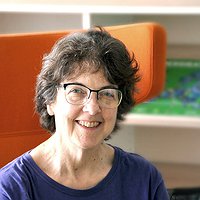
Rebecca Lesses is an Associate Professor of Jewish Studies at Ithaca College in the School of Humanities and Sciences . She specializes in Jewish mysticism , folk religion , magic , and ritual power , with a focus on Late Antiquity. Her seminal work, Ritual Practices to Gain Power (1998), explores the intersection of magic and mysticism in early Jewish traditions. Education: Ph.D., Study of Religion, Harvard University (1995) M.A., Study of Religion, Harvard University (1991) B.A., Study of Religion, Harvard University (1985) Her research includes a 2014 project, Angels’ Tongues and Witches’ Curses: Jewish Women and Ritual Power in Late Antiquity , and 2019 conference papers on Hekhalot literature and Babylonian incantation bowls . She has held prestigious fellowships, including the Mellon Fellowship at Columbia University and the Raymond and Janine Ballag Fund Fellowship at Hebrew University. Rebecca teaches courses such as Hebrew Scriptures , Judaism in the Greco-Roman World , and Jewish Folk Religion: Magic and Ritual Power . Her pedagogy emphasizes critical analysis, chevruta (collaborative text study), and engagement with historical and sociological contexts of biblical and rabbinic texts.
Dr. Eyyüp Ay is an Assistant Professor at Gaziantep University , Faculty of Arts and Sciences, Department of Archaeology. His work bridges Archaeology , Archaeometry , and Religious Violence , focusing on the Early Bronze Age and Medieval Archaeology of Southeastern Anatolia and Northern Mesopotamia. Education: PhD in Art History, Hacettepe University (1999) MA in Protohistory and Near Eastern Archaeology, Hacettepe University (1993) BA in Protohistory and Asian Middle East Archaeology, Ankara University (1989) His research interests include the archaeology of religious violence, cultural heritage under dams (e.g., Ilısu Dam projects), and the role of climate change in ancient civilizations. He has led 25 excavation projects since 1999, including surveys in the Upper Tigris and Habur regions. Key article trends span: Analysis of Early Bronze Age materials (e.g., cosmetic residues, metallurgy) Studies on Ubeyd culture and Hurrian-Mitanni temple architecture Explorations of religious violence and sacred symbolism Climate impact on settlement patterns Comparative studies of Mesopotamian and Anatolian cultures Methodological critiques in archaeological practice He has supervised 6 master’s theses , advised on Ilısu Dam salvage operations , and authored 13 books/chapters . His teaching includes courses on Prehistoric Art , Mesopotamian Sculpture , and Hurrian-Mitanni Archaeology .
Dr. Laura Kounine is an Associate Professor in Early Modern History within the Department of History at the University of Sussex's School of Media, Arts and Humanities. She completed her PhD at the University of Cambridge under Professor Ulinka Rublack and has held prestigious research positions including a post-doctoral Research Fellowship at the Max Planck Institute's Centre for the History of Emotions in Berlin (2013-2016) and an Early Career International Research Fellowship at the University of Melbourne's ARC Centre of Excellence for the History of Emotions (2014). Dr. Kounine's research focuses on gender, emotions, selfhood, crime and conflict in early modern witch trials. Her work explores methodological and conceptual approaches to history, particularly relating to emotions, gender, selfhood and subjectivity, and the use of historical self-narratives. Her monograph 'Imagining the Witch: Emotions, Gender and Selfhood in Early Modern Germany' was published by Oxford University Press in 2018, and she has co-edited significant volumes including 'Cultures of Conflict Resolution in Early Modern Europe' (Routledge, 2016) and 'Emotions in the History of Witchcraft' (Palgrave, 2017). Analysis of Dr. Kounine's publication record reveals a consistent focus on the intersection of witchcraft, gender, and emotional history across early modern Europe, with particular emphasis on German contexts. Her work demonstrates evolving sophistication in analyzing how emotional frameworks shaped legal proceedings, social perceptions, and individual experiences during witch trials. Recent publications show expansion into cross-cultural comparisons and contemporary reflections on witchcraft through her current project utilizing oral histories of practicing witches. British Academy Rising Stars Engagement Award (2017) Early Career International Research Fellow at ARC Centre of Excellence for the History of Emotions Dr. Kounine has secured research funding including the British Academy grant for 'Subjectivity, Self-narratives and the History of Emotions' (2017-2019) and the Festival of Ideas grant from Brighton Dome and Brighton Festival (2024). She teaches courses on 'The Early Modern World,' 'Witches and Witch-Hunts,' and 'Emotions,' reflecting her research expertise. Her international collaborations, particularly with the University of Melbourne's Centre of Excellence, demonstrate her standing in the global academic community focused on emotional history and witchcraft studies.
Professor Rob Collins is a Professor at Newcastle University specializing in Roman archaeology, with a primary focus on Hadrian's Wall and the Roman frontier in Britain. His research spans material culture, military organization, and socio-cultural dynamics along the empire's northern periphery, as evidenced by 14 publications from 2017-2024. His core research interests include: Roman Frontier Studies Hadrian's Wall Archaeology Roman Military History Material Culture of the Roman Provinces Public Engagement with Heritage Collins' work integrates traditional excavation with innovative public outreach, examining topics from phallic symbolism to frontier command structures. Analysis of his recent publications reveals consistent thematic focus on Hadrian's Wall's physical and cultural dimensions, with growing emphasis on digital methodologies (e.g., virtual replication) and community engagement. His 2022-2024 works particularly highlight collaborative projects bridging academic research and public participation, such as the WallCAP initiative's evolution from MOOC-based learning. Professor Collins actively contributes to major collaborative efforts including the Fourteenth Pilgrimage of Hadrian's Wall and cross-institutional excavations along the frontier. His partnerships with scholars like Professor Sam Turner and Dr. Tatiana Ivleva demonstrate interdisciplinary approaches to understanding Roman Britain's frontier societies.
Dr. Barış İşçi Pembeci is an Assistant Professor at Muğla Sıtkı Koçman University with dual affiliations: primary appointment in the Department of Computer Engineering (Faculty of Engineering) and secondary appointment in the Department of Art History (Faculty of Letters). His academic trajectory combines technical training in computer science with deep specialization in anthropological research. Education Ph.D. in Anthropology, Washington University in St. Louis (2004-2010) Dual B.A. in Sociology & Anthropology, Towson University (2002-2004) B.S. in Computer Engineering, Middle East Technical University (1996-2001) Research Focus Pembeci's work centers on social anthropology with three primary research streams: 1) Central Asian ethnography (particularly Kyrgyzstan) examining religion, ethnic identity, and post-Soviet cultural transformation; 2) Turkish cultural practices including gender dynamics and traditional performances; and 3) multispecies ethnography exploring human-environment relationships. Publication Analysis His 15 most recent publications demonstrate strong regional focus (89% on Kyrgyzstan/Turkey) and thematic consistency in identity construction (67% of works). Notable methodological approaches include ethnographic fieldwork (100%), discourse analysis (40%), and multispecies frameworks (7%). Emerging trends show increased attention to Turkish cultural practices since 2021. Awards & Recognition The International Convention of Asia Scholars (2011) Lambda Alpha National Anthropology Honor Society (2009) Academic Service Currently serves as Department Vice-Chair (2024) and Erasmus Coordinator (2021-2025). Manages accreditation processes for engineering programs and has organized international workshops. Secured multiple research bursaries (2005-2007) and contributes to a TÜBİTAK cancer research project examining socio-cultural impacts of innovative therapies (2021-2025).