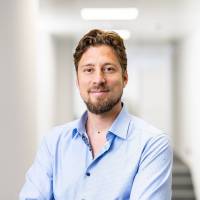
Felix Resch is a PreDoc Researcher at the Cyber-Physical Systems department of Vienna University of Technology (TU Wien). His work focuses on neuromorphic computing and autonomous systems. Education: BSc, Technische Universität Wien Role: Project Assistant (Projektass. Dipl.-Ing.) and PreDoc Researcher Research interests include neuromorphic sensing-processing integration and attention-based neural networks for autonomous applications. Current work involves the NimbleAI project (2022–2026) and AI-driven autonomous racing systems. Recent publications highlight trends in 3D-integrated neuromorphic chips and attention-based neural networks for autonomous systems. He is affiliated with the Cyber-Physical Systems group (E191-01) at TU Wien. Contact: felix.resch@tuwien.ac.at | Phone: +43-1-58801-18225
Samuele Tosatto is an Assistant Professor in the Computer Science Department at the University of Innsbruck and affiliated with the Digital Science Center. His research focuses on enabling robots to learn in real-world environments through reinforcement learning and abstraction techniques, addressing challenges in scalability and efficiency. Ph.D. in Computer Science from Technical University of Darmstadt (2020) M.Sc. and B.Sc. in Software Engineering from Polytechnic University of Milan His work emphasizes theoretical aspects of reinforcement learning, particularly policy gradient estimation and temporal-difference methods. Recent publications highlight innovations in data-driven teleoperation, movement primitives, and off-policy optimization, aligning with his goal of bridging simulation-to-reality gaps. He teaches courses including Introduction to Robotics, Optimization and Numerical Computation, Machine Learning, and Data Analysis II. His research is disseminated via platforms like Google Scholar and samueletosatto.com.
Dr. Michael Vierhauser is an Assistant Professor in the Department of Computer Science at the University of Innsbruck. His research focuses on Cyber-Physical Systems (CPS), runtime monitoring, autonomous systems, and software engineering methodologies. He specializes in safety-critical systems, human-machine interaction, and innovative educational technologies for programming and software development. Key research areas include: Runtime monitoring frameworks for CPS and UAVs Development of adaptive systems and self-protective IoT devices Integration of AI into software engineering education Agile methodologies for sustainability assessment His recent publications emphasize field-testing of drone missions, automated simulation testing for aerial systems, and frameworks like FORTE for scalable environmental monitoring. He leads projects like Dronology, an incubator for CPS research, and contributed to tools such as ReMinds and GRuM for runtime monitoring. Dr. Vierhauser collaborates on digital transformation initiatives in underground construction and has designed learning analytics dashboards to improve programming education outcomes. His work bridges theory and practice through real-world applications in emergency response systems and industrial 4.0 contexts.
Peter Reichl is a Professor in the Faculty of Computer Science, leading the Research Group Cooperative Systems. His work spans interdisciplinary research in Human-Computer Interaction, IoT systems, and Digital Ethics. He actively contributes to the UN Sustainable Development Goals through innovative technology solutions. Key projects include the European Distributed Data Infrastructure for Energy, COMPASS, and symbIoTe. Research interests include mobile computing, tangible interfaces, quantum computing education, and ethical implications of digital transformation. Over 134 publications since 2008 reflect his work in music technology, IoT frameworks, and socio-technical systems analysis. Recent articles highlight creative tech solutions like LEGO-based music sequencers and philosophical explorations of Digital Humanism. He has organized major events like the Dagstuhl Workshop on Quality of Experience (QoE Vadis?) and contributed to policy discussions on digital democracy in Austria. Key Projects: symbIoTe (2016-2018), COMPASS (IoT solutions), European Energy Data Infrastructure (2023-2025) Notable Activities: Panellist on Digital Transformation Ethics (2024), Poster Presenter for Muco app (2022) Labs/Teams: Research Group Cooperative Systems focuses on IoT interoperability and human-centered tech design.
Andreas Holzinger is a University Professor for Digital Transformation for Smart Agriculture and Forestry at the Institute of Forest Engineering, Department of Agricultural Sciences, University of Natural Resources and Life Sciences Vienna (BOKU). He pioneered interactive machine learning with human-in-the-loop frameworks to advance trustworthy AI, focusing on explainability, robustness, and ethical alignment with human values. His work bridges artificial intelligence with forestry technology, ensuring safety, privacy, and sustainability. 2022: University Professor at BOKU 2021: IFIP Fellow 2020: ELLIS Member 2019: Visiting Professor at University of Alberta 2019: Academia Europaea Full Member His research interests span Human-Centered AI , Explainable AI , Digital Transformation in Forestry , and Trustworthy AI . He develops frameworks where humans collaborate with AI systems to enhance decision-making in forest operations, focusing on transparency and controllability. His recent publications emphasize Interactive Machine Learning and Explainable AI in forestry contexts, including cable corridor planning, danger zone detection, and sensor-based data interpretation. Articles explore 3D point cloud analysis , human-robot collaboration , and contextual counterfactuals to improve AI systems' reliability. Scientific Awards: Most influential Paper Award (2025) Fellow of IFIP (2021) Member of ELLIS (2020) Full Member, Academia Europaea (2019) He supervises theses on Forestry Technology , Plant Development , and Stress Resilience , mentoring students working on smart sensors, genetic analysis, and AI applications in agricultural systems. His collaborations span institutions in Austria, Canada, Finland, Italy, New Zealand, and the USA.
Sabine Lehner is a researcher at the Ilse Arlt Institute for Social Inclusion Research within the Department of Social Sciences at FH St. Pölten . Holding a PhD in Philosophy (2022) from the University of Vienna, her work bridges critical sociolinguistics, border studies, and human-machine interaction. Research Focus : Discursive construction of borders and boundaries Language ideologies in AI and assistive technologies Migration narratives in asylum procedures Linguistic landscapes in educational spaces Posthumanist approaches to language Ethical dimensions of human-machine communication Key Projects include Smart Companion 2 (AI-driven assistive robotics), JMF (Young Refugees), and studies on exclusion in welfare systems. She received the ÖAW-DOC Fellowship (2018-2020) and contributed to numerous publications in applied linguistics.
Vishwanathan Mohan is a Lecturer (US equivalent: Assistant Professor) in Robotics and Artificial Intelligence at the University of Essex, UK. He was formally trained in Microelectronics and VLSI design at the Indian Institute of Technology Madras, and his scientific career began with neuromorphic VLSI models of associative memories. Education: Indian Institute of Technology Madras (Microelectronics and VLSI design) His research focuses on human-robot symbiosis, cognitive robotics, and embodied language learning. Key themes include goal-directed reasoning, cooperative robotics in shared workspaces, and neural frameworks for memory and body schema organization in robots. His work spans applications in industrial and humanoid robotics. Recent publications highlight neural models for social cognition, physical reasoning, and episodic memory systems. Collaborators include notable researchers such as Giulio Sandini and Pietro Morasso from the Italian Institute of Technology. As a Guest Associate Editor for Frontiers in Neurorobotics, he contributes to editorial roles. No scientific awards or advising details were explicitly mentioned in the available text.
Christian Rauch is a Researcher at the Chair of Cyber-Physical-Systems at the Technical University of Leoben and a Research Scientist at Bosch Corporate Research. He earned his Ph.D. in Robotics and Autonomous Systems from the University of Edinburgh in 2020 and has over a decade of experience in applying machine learning to robotic perception and manipulation in unstructured environments. Primary Affiliation: Technical University of Leoben (Chair of Cyber-Physical-Systems) Secondary Affiliation: Bosch Corporate Research (Robot Learning group) Education: Ph.D. in Robotics and Autonomous Systems (University of Edinburgh, 2020) Research Interests Machine Learning applications for robotic systems Robot Learning with focus on Foundation Models Robot Vision for manipulation tasks Perception and manipulation in industrial/domestic contexts Open-Source Contributions Developed super_point_inference (C++ implementation of SuperPoint inference) Created MultiMotionFusion (motion modeling for object manipulation) Maintained rgbd_export and torch_cpp tools Academic Activities Teaching: "Introduction to Machine Learning" (190.018), CPS Research Seminar (190.003) Location: Franz-Josef-Straße 18, 8700 Leoben, Austria Contact: +43 3842 402–1908 | Christian.Rauch@unileoben.ac.at
Hamid Eghbal-zadeh is a Postdoctoral Researcher at the Institute of Computational Perception at Johannes Kepler University Linz (JKU). Previously, he worked as a Research Scientist at Meta and held roles at the Institute for Machine Learning at JKU. His research focuses on adversarial machine learning, representation learning, and robust deep learning models. He has made significant contributions to acoustic scene analysis, generative models, and reinforcement learning. Education : PhD in Machine Learning from JKU (2019), defended with distinction. BSc/MSc details not explicitly stated in text. Research Highlights : Developed Mixture Density GANs to address mode collapse in GANs Pioneered receptive-field regularization techniques for audio classification Contributed to top-performing systems in DCASE challenges (2016-2019) Active in reinforcement learning and domain adaptation research Awards/Competitions : Multiple top placements in international challenges (DCASE, MediaEval), outstanding reviewer recognitions (ICML 2022, ICLR 2022). Advising : Supervised 6+ students in topics like acoustic scene classification, generative retrieval, and sound event detection.
Prof. Hans-Peter Kaul is a Universitätsprofessor (full professor) in Plant Production at the University of Natural Resources and Life Sciences, Vienna (BOKU). His research focuses on crop management systems, precision agriculture, invasive species control, and sustainable soil management. He leads the iPBAU Plant Production department, with affiliations to bSKO Arbitration Commission and iFTEC Forestry Technology. His work integrates advanced technologies like AI-driven crop modeling and remote sensing with traditional agronomic practices. Key research interests include optimizing nitrogen use in intercropping systems, combating invasive plants like ragweed, and developing climate-resilient crop varieties. He has pioneered studies on energy efficiency in tillage systems and soil health in long-term experiments. His lab (DiLaAg) focuses on digitalization in agricultural sciences, emphasizing data-driven farming solutions. Recent publications emphasize AI applications in agriculture, soil-plant interactions, and crop yield prediction using radiative transfer models. He collaborates on projects like Farm/IT, enhancing farming resilience to climate risks through digital tools. His work addresses both ecological sustainability and agronomic productivity in Central European agroecosystems. Notable contributions include conceptual frameworks for agroecological transformation and studies on weed allelopathy. His research bridges basic plant science with applied farming practices, aiming to improve resource-use efficiency and biodiversity in agricultural landscapes.
Walid Fdhila is a Researcher in the Security and Privacy group within the Faculty of Computer Science, focusing on blockchain applications and process management systems. His technical expertise spans distributed systems, privacy-enhancing technologies, and compliance verification. Research domains include: Blockchain-based audit systems for healthcare Privacy-preserving federated learning Cryptocurrency transaction anonymity Process compliance in decentralized environments Verification of distributed business processes He leads the 'Decentralized Trust in Digital Societies' project and develops applications of distributed ledger technology. Recent work creates frameworks for privacy-aware process execution across organizational boundaries.
Samuele Ghizzo serves as a Tutor at the Alpen-Adria-Universität Klagenfurt (AAU), affiliated with the Department of Intelligent Systems Technologies and the Department of Networked and Embedded Systems within the Faculty of Technical Sciences. His research focuses on interdisciplinary areas including robotics, AI applications, multi-agent systems, and sensor networks. He contributes to projects addressing challenges in autonomous systems, environmental complexity, and applied engineering solutions. Recent work highlights include studies on swarm robotics dynamics, automated sorting systems, and radar technology innovations. While no specific awards are listed, his involvement in funded research projects underscores active participation in technical and academic collaborations.
Marco Dorigo is a Full Professor (part-time) at the Department of Computer Science, Faculty of Electrical Engineering, Computer Science and Mathematics, University of Paderborn since 2011. He is also a Research Director (Directeur de Recherches) at the IRIDIA laboratory, Universite Libre de Bruxelles since 2004. His academic career includes various research roles at institutions such as IDSIA in Switzerland and postdoctoral positions at ULB. His research focuses on Swarm Intelligence, Artificial Intelligence, and Robotics, with particular emphasis on optimization algorithms inspired by natural systems, such as Ant Colony Optimization. He has contributed significantly to the development of swarm robotics and self-organizing systems. Notable awards include the ERC Advanced Grant (2010), Cajastur International Prize for Soft Computing (2007), and the Prix Wernaers 2012 for the "Swarmanoid, The Movie" . He is a member of multiple prestigious organizations, including Academia Europaea and the IEEE. He has supervised over 12 PhD students and 40 MSc students. His research has been supported by grants such as the ERC Advanced Grant, and he has contributed to projects like the Swarm-Bot robotics system. He leads research at the IRIDIA laboratory, focusing on swarm intelligence, and has been involved in initiatives like the Swarm-Bots project, exploring self-organized robot colonies.
Prof. Franz Hartlieb is a Professor and Deputy Head of the Institut für Rechtswissenschaften at Alpen-Adria-Universität Klagenfurt. His research focuses on legal studies, media law, and democratic processes, with a particular emphasis on media literacy and policy. He has contributed to projects like the #NoFakeFacts citizen science initiative, aimed at enhancing media literacy among youth. His work integrates interdisciplinary approaches, including collaborations on education policy and public policy analysis. Prof. Hartlieb has published extensively in journals like *Journal of Higher Education Development* and *Physical Review E*, addressing topics ranging from swarm intelligence to legal commentary. His teaching spans legal education and research methodologies. He has secured research funding from institutions such as the Austrian Agency for International Cooperation in Education and Research (OeAD) and the Austrian Research Promotion Agency (FFG). His professional roles include administrative leadership at the institute and active participation in academic conferences and editorial roles.
Jan Steinbrener is an Associate Professor at the University of Klagenfurt's Institute for Intelligent System Technologies and serves as Vice Rector for Research and International Affairs, leading the Research Council. His roles include overseeing research strategy, international collaborations, and faculty research activities. Research Interests: Steinbrener focuses on robotics, artificial intelligence, and autonomous systems. His work emphasizes sensor systems, UAV navigation, and embedded AI applications. Projects include drone-based wind turbine inspection and AI-driven control systems for industrial robotics. Grants & Projects: He leads initiatives funded by the Austrian Research Promotion Agency (FFG), including 'Wind Turbine Blade Inspection Using Multimedia Drones' and 'Embedded AI - Shaping the Future of Power Electronics.' Collaborative projects with Carinthian Economic Development Fund and Infineon Technologies highlight his industry-academia partnerships. Academic Contributions: Steinbrener's research spans robotics, control systems, and sensor technology. Key publications include studies on UAV navigation algorithms, light-field imaging, and reinforcement learning applications in robotics.