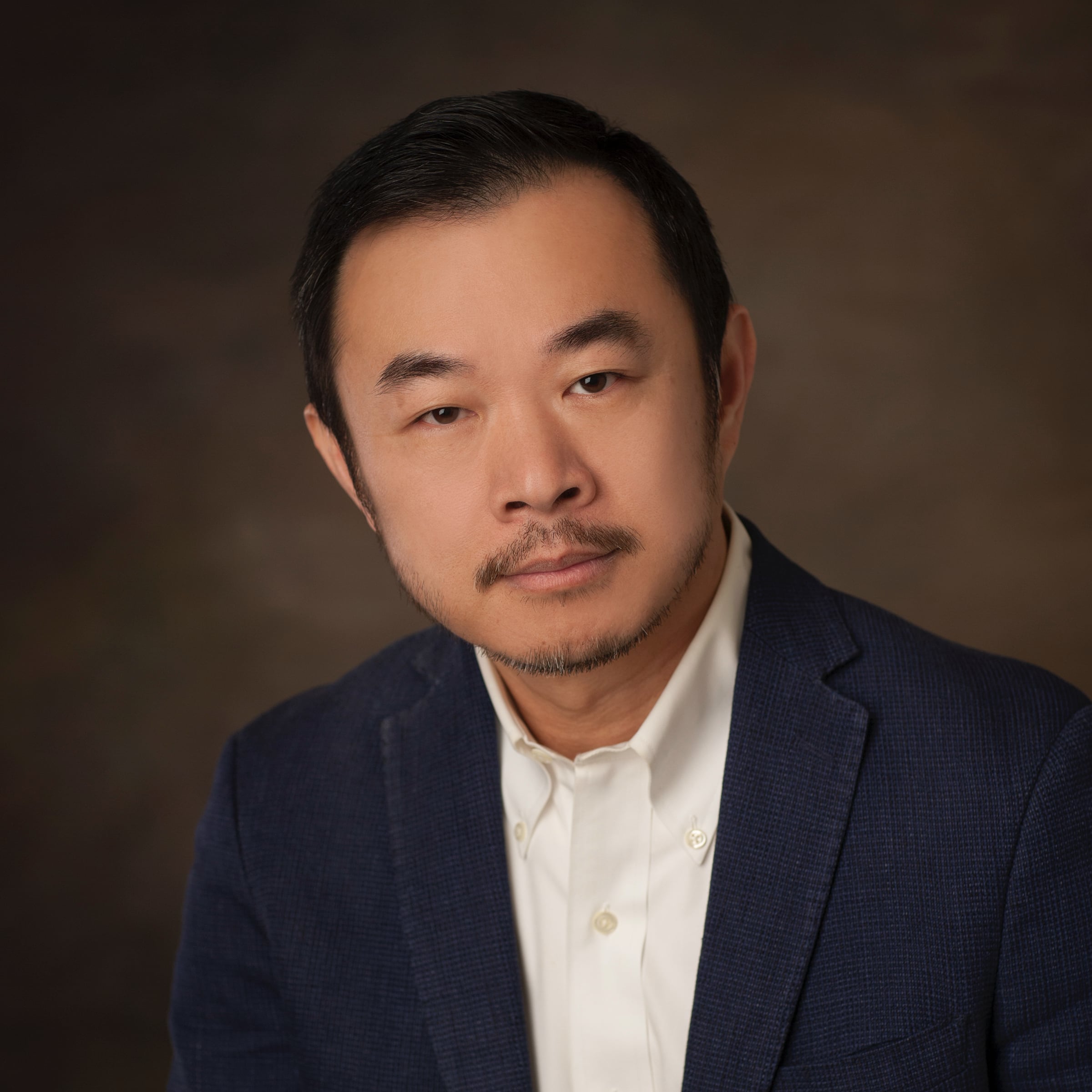
Eric Xing is a Professor in the Machine Learning Department at Carnegie Mellon University, with an affiliation to the Computer Science Department. His research focuses on advancing artificial intelligence, particularly in machine learning, bioinformatics, and interdisciplinary applications. He advises three students: Aviv Bick, Lingjing Kong, and Yonghao Zhuang. His recent work spans cutting-edge topics such as graph neural networks, generative AI, biosecurity safeguards, and scalable language model evaluation. Notable contributions include foundational models for RNA prediction, efficient video diffusion systems, and ethical frameworks for AI deployment. He actively bridges AI with fields like genomics, healthcare, and urban planning through collaborative projects. Xing’s research often emphasizes practical applications, such as edge computing-optimized inference systems and open mathematical corpora. His work has implications for both technical advancements and societal challenges, reflecting a commitment to impactful, interdisciplinary AI research.
Larry Wasserman is a UPMC University Professor at Carnegie Mellon University, jointly appointed in the Department of Statistics and Data Science and the Machine Learning Department. He received his Ph.D. from the University of Toronto in 1988 and is recognized as one of the leading statisticians of his generation. His research spans theoretical and applied statistics, with core interests in: Foundational inference : Nonparametric methods, asymptotic theory, causal frameworks Modern applications : Machine learning, high-dimensional statistics, astrostatistics Interdisciplinary domains : Bioinformatics, genomics, physical sciences via the STAMPS group His recent publications demonstrate strong emphasis on causal methodology, optimal transport, and robust inference, with applications ranging from particle physics to genomic analysis. Articles frequently develop novel nonparametric techniques with minimax optimality guarantees. Award highlights include: COPSS Presidents' Award (1999) - Top honor for statisticians under 40 CRM-SSC Prize (2002) - Landmark contributions to statistics Fellowships: American Statistical Association, Institute of Mathematical Statistics, AAAS He leads the Statistical Machine Learning Theory Group and founded STAMPS (Statistical Methods for Physical Sciences). His textbooks All of Statistics and All of Nonparametric Statistics are widely used in graduate programs globally.
Stephan Seiler is a Professor of Marketing and Economics (by courtesy) at Imperial College Business School. He holds editorial roles as Co-Editor at Quantitative Marketing and Economics and Associate Editor at Management Science , Journal of Marketing Research , and Journal of Industrial Economics . His research focuses on consumer choice behavior, including search patterns, user-generated content analysis, and the application of machine learning to marketing challenges. He earned his PhD from the London School of Economics and previously worked at Stanford and UCLA. Notable awards include the MSI Young Scholar designation and the 2024 Marketing Science Service Award. His work bridges economic theory with empirical marketing, emphasizing causal inference and policy applications such as soda tax impact analyses. Education : PhD in Economics, London School of Economics Previous Institutions : Stanford University, University of California, Los Angeles (UCLA) Research Interests: His work explores consumer decision-making in markets ranging from healthcare (e.g., hospital choice) to consumer goods (e.g., laundry detergents). Key themes include: Consumer search behavior and information asymmetry Impact of digital platforms on content generation (e.g., Wikipedia, Twitter) Econometric modeling of demand and pricing strategies Awards & Recognition : Marketing Science Institute Young Scholar (2020) UCLA Faculty Excellence Award (2020) Marketing Science Service Award (2024) Editorial & Academic Contributions : Co-organizes the European Quant Marketing Seminar series and actively reviews for top-tier journals. His 2025 paper on causal inference in pricing demonstrates his leadership in methodological innovation.
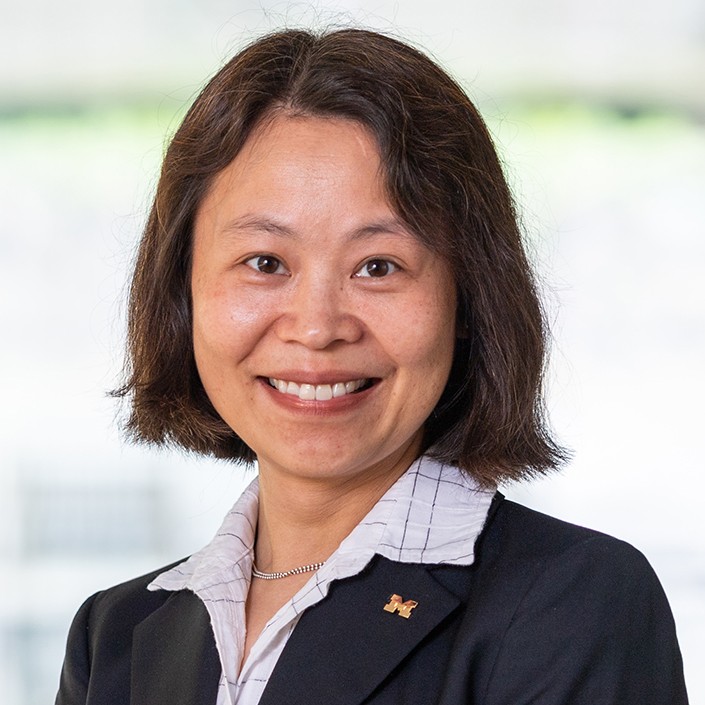
Mingyan Liu Mingyan Liu is the Alice L. Hunt Collegiate Professor of Engineering and Associate Dean for Academic Affairs at the University of Michigan's College of Engineering. He holds a joint appointment in the Department of Electrical Engineering and Computer Science (EECS). His research focuses on cybersecurity, optimal resource allocation, incentive design, and network performance modeling, with emphasis on strategic interactions in cyber-physical systems. Liu has pioneered work on cyber insurance mechanisms, adversarial machine learning, and federated learning security. Education B.S. in Electrical Engineering, Nanjing University of Aeronautics and Astronautics, China (1995) M.S. in Systems Engineering, University of Maryland, College Park (1997) Ph.D. in Electrical Engineering, University of Maryland, College Park (2000) Research Highlights Liu's research group has developed technologies commercialized through QuadMetrics, Inc. (acquired by FICO), creating the first global enterprise cybersecurity ratings system. His work bridges game theory, machine learning, and network science to address challenges in cyber risk quantification, incentive mechanisms for secure software development, and fair AI systems. Awards & Recognition Awarded the NSF CAREER Award (2002), multiple Crosby Research Awards (2003, 2014), IEEE Fellow (201?), and best paper awards at IPSN (2012) and DSAA (2014). His book *Embracing Risk: Cyber Insurance as an Incentive Mechanism for Cybersecurity* (2021) synthesizes his theoretical and applied work in cybersecurity economics. Professional Contributions Liu served on editorial boards of IEEE/ACM Transactions on Networking and ACM Transactions on Sensor Networks. His current efforts include MURI projects on AI-driven edge networks and NSF-funded work on federated learning privacy frameworks.
Myo Thida is an Assistant Professor of Computer Science at Bard College at Simon’s Rock, USA. She holds a PhD in Computer Vision from Kingston University, UK, and degrees in Electrical and Electronic Engineering from Nanyang Technological University, Singapore. Her research focuses on computer vision, data science, and machine learning, particularly in video and image analytics, abnormality detection, and social impact-driven projects. She has contributed to institutions like Chiang Mai University (Thailand), A*STAR (Singapore), and co-founded a data analysis service company. Myo is an advocate for STEM education equity, leading initiatives like Women in AI Myanmar Chapter and receiving accolades such as the ASEAN Science Diplomat Award (2021) and recognition for leadership in the Asia Pacific (2023). Education: PhD in Computer Vision, Kingston University, UK (2008–2013) MEng in Electrical & Electronic Engineering, Nanyang Technological University, Singapore (2005–2008) BEng in Electrical & Electronic Engineering, Nanyang Technological University, Singapore (2005–2008) Research Interests: Myo’s work bridges technical innovation with societal challenges, emphasizing video analytics for surveillance, data-driven policy-making, and educational reform. Her projects include developing AI tools for social good, such as digital disparity analysis in Myanmar and gender equality initiatives in STEM. She collaborates globally, having taught in Singapore, Myanmar, Bhutan, Thailand, and the USA since 2004. Recent Research Trends: Her publications span AI-driven solutions for digital inequality, gender equity, and interdisciplinary education frameworks. She combines computer vision techniques (e.g., abnormality detection in crowds) with policy analysis, showcasing cross-disciplinary impact. Recent work highlights AI’s role in addressing global challenges like workforce skill gaps and sustainable digitalization. Awards & Recognition: ASEAN Science Diplomat Award (2021) US ASEAN Science & Technology Fellowship (2019) Leading Light for Kindness and Leadership (Asia Pacific, 2023) Grants & Advising: As a US-ASEAN fellow, she developed Myanmar’s science policy framework. She advises on education reform and leads the Women in AI initiative. Her consulting work includes projects on curriculum design (e.g., Chiang Mai University’s CMU-CDIO syllabus) and corporate data strategies. Labs & Collaborations: Engages in interdisciplinary projects at Simon’s Rock, focusing on AI ethics and community outreach. Her work often involves partnerships with NGOs and policymakers to translate technical research into actionable social solutions.
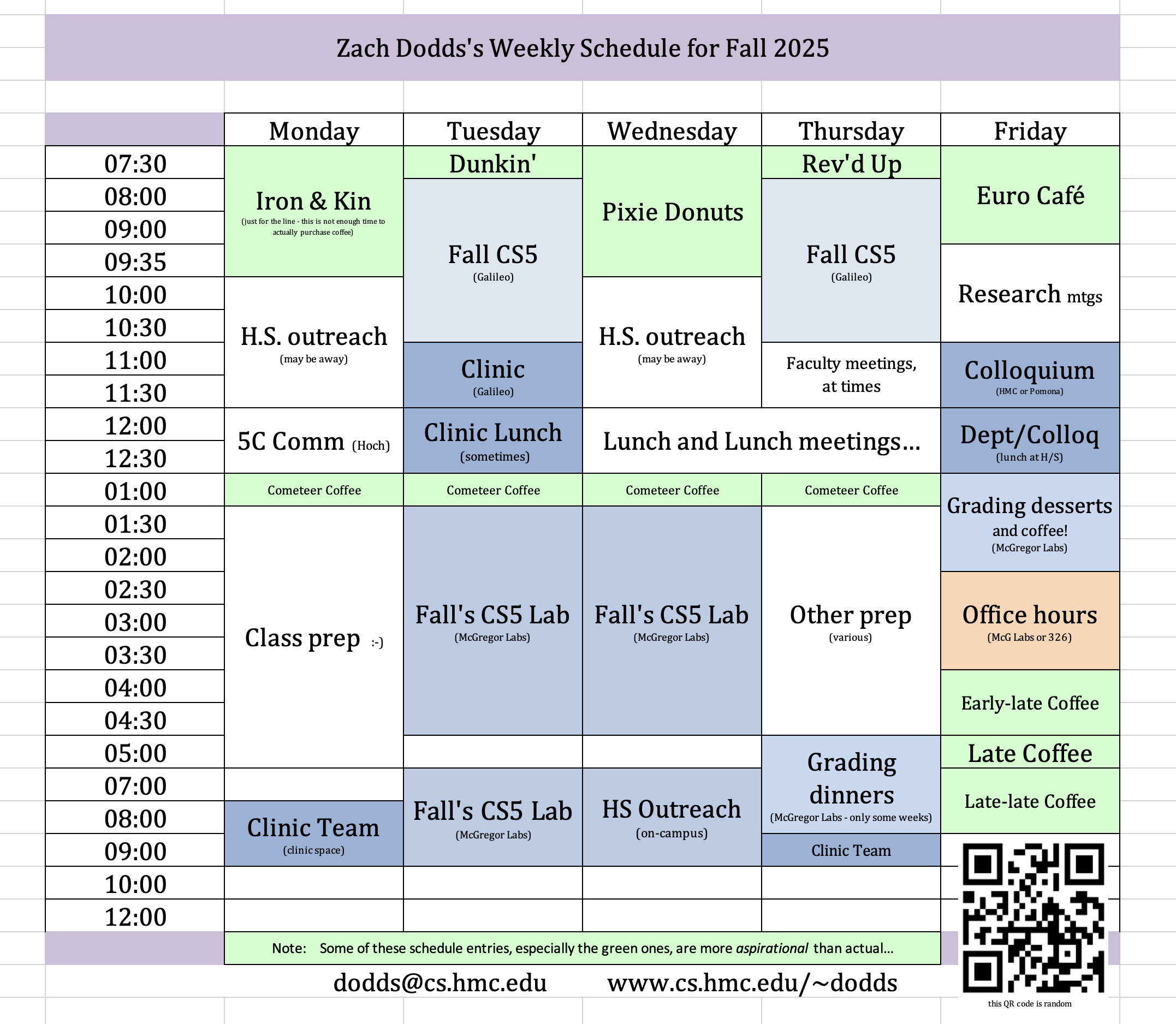
Zachary Dodds is a Professor at the Computer Science Department of Harvey Mudd College. He is actively involved in course development, ACM programming contest mentorship, and interdisciplinary research at the intersection of computer science, biology, and robotics. Email: dodds@cs.hmc.edu Research Interests : Dodds focuses on computer science education innovation, accessible robotics platforms, and interdisciplinary applications of computing. His work bridges AI, robotics, and computational biology, emphasizing hands-on learning and curricular reform. Articles : His recent publications explore computing literacy, AI in education, and robotics for non-majors. Key themes include pedagogy, accessible technology, and cross-disciplinary engagement. Courses : He teaches foundational courses like CS 5: Introduction to Computer Science , SCI50: CS for Discovery , and advanced topics in CS 183/184: Computer Science Clinic . Programming Contests : Dodds organizes Harvey Mudd's ACM programming teams, which have consistently ranked in the top 10 regionally since 2010. He emphasizes collaborative problem-solving and algorithmic thinking. Labs & Collaborations : He contributes to robotics education through initiatives like the Harvey Mudd Robotics Core Lab and partnerships with institutions such as Chatham College and Carnegie Mellon University.
Prof. Drew Dimmery is the Professor of Data Science for the Common Good at the Hertie School's Data Science Lab. He holds a PhD in Politics from New York University (2016), with a focus on causal inference and machine learning. Prior to joining Hertie, he served as Scientific Coordinator at the University of Vienna’s Data Science Research Network (2021–2023) and worked on Facebook’s Core Data Science team (2016–2020), developing experimentation tools and methods. His research emphasizes methodological innovation in causal inference and machine learning, particularly applied to social media and internet studies. Key areas include experimental design, algorithmic transparency, and policy applications of data science. He has published in top-tier journals like ICML, KDD, and Science, and his work bridges computational methods with societal challenges such as electoral integrity, digital governance, and public welfare provision. Recent publications analyze the impact of social media platforms on elections, user behavior, and mental health, leveraging large-scale experimentation and causal analysis. His endowed professorship, supported by the Dieter Schwarz Foundation, includes scholarships for the Master of Data Science for Public Policy program, reflecting his commitment to applying data science for societal benefit.
Dr. Nusrat Jahan is a Professor in the Department of Mathematics and Statistics at James Madison University (JMU), where she has been since 2005. Her research focuses on statistical genomics, machine learning applications in high-dimensional data, and sparse dimension reduction techniques. She holds a PhD in Mathematical Sciences/Statistics from Mississippi State University (2006), an MS in Statistics from Queen's University (1992), and a BS in Statistics from the University of Dhaka (1987). Her recent work involves integrating gene expression studies across platforms to identify biomarkers and applying statistical methods to genomic data. Notable publications include studies on retinal gene expression and meta-analysis techniques for microarray data. She is affiliated with the Center for Genome and Metagenome Studies and actively contributes to interdisciplinary research in computational biology. Teaching responsibilities include courses in statistics and multivariate analysis. Office: Roop Hall 319; Contact: jahannx@jmu.edu.
Dr. Spyros Samothrakis is a Senior Lecturer and Chief Scientific Adviser at the School of Computer Science and Electronic Engineering, University of Essex. His primary roles include academic research and advisory work in artificial intelligence and machine learning. He holds a PhD in Computer Science from the University of Essex, an MSc in Intelligent Systems from the University of Sussex, and a BSc in Computer Science from the University of Sheffield. His research focuses on Reinforcement Learning (RL) , Machine Learning (ML) , Neural Networks , and Role-Playing Games (RPGs) . He explores applications in areas like causal inference, game theory, and supply chain management. Recent work includes developing frameworks for automated cost estimation in games and analyzing AI agents in complex socioeconomic systems. Notable contributions include studies on self-play algorithms, causal structure learning, and the societal implications of AI. His articles span topics from neurocontrol optimization to ethical considerations in AI deployment. Dr. Samothrakis advises PhD students in computer science and has supervised research on causal effect estimation, memory-driven exploration, and text generation. He has secured grants from organizations like the Alan Turing Institute and the ESRC for projects involving AI in micro-social change and data-driven decision-making. His collaborations extend to industry partners such as the National Theatre and NHS Trusts, applying AI to healthcare and cultural data analysis. He actively contributes to conferences and publishes in top-tier journals like Neural Networks and IEEE Transactions .
Katherine Lisa Keenan is a Senior Lecturer at the University of St Andrews' School of Geography & Sustainable Development, with a focus on Population and Health Research. She serves as Deputy Director (Training) for the Scottish Graduate School for Social Science, dedicating 50% of her time to the University of Edinburgh. Her work intersects anthropology, demography, and epidemiology, with a strong quantitative methodological background. Education includes an MSc in Demography and Health and a PhD in Epidemiology from the London School of Hygiene and Tropical Medicine (LSHTM), followed by postdoctoral positions at LSHTM and LSE before joining St Andrews in 2017. She holds visiting roles at the Centre for Fertility and Health (Oslo), the International Max Planck Research School for Population Health and Data Science, Getulio Vargas Foundation (Brazil), and the Antimicrobial Resistance Institute of São Paulo. Research focuses on social determinants of population health, including antimicrobial resistance (AMR) in East Africa and Brazil, multimorbidity trajectories in Scotland, and social dimensions of miscarriage. She leads projects using mixed methods to address health inequities and has contributed to initiatives like the HATUA and CARE consortia. Teaching focuses on quantitative methods for undergraduate geography and sustainable development students, alongside research-led courses in demography and health inequalities. Her recent publications emphasize Bayesian network modeling, AMR burden estimation, and pandemic impact analysis. Key collaborations include the ERC-funded Connecting Generations Centre and the NIHR/MRC-funded HATUA and CARE projects. Labs/teams include the Scottish Graduate School for Social Science, the International Max Planck Research School (MPIDR-PHDS), and strategic partnerships with institutions in Brazil and East Africa. Her work aligns with UN SDGs 3 (Good Health), 10 (Reduced Inequalities), and 17 (Partnerships).
Mehmet Barut is an Associate Professor and Chair of the Department of Finance Real Estate And Decision Science at Wichita State University (WSU), where he also serves as Director of the Supply Chain Graduate Programs. He holds a PhD in Industrial Management from Clemson University and previously worked as a visiting professor there. His research focuses on Yield Management, Supply Chain Management, Information Integration, and Problem-Based Learning. Dr. Barut earned his BSc and MSc in Management Engineering from Istanbul Technical University (1988–1991) before completing his PhD at Clemson in 1999. He joined WSU in 2000 and pioneered the STEM program in Management Science and Supply Chain Management in 2018. His teaching spans Operations Management, Risk Management, and Project Management. His recent research emphasizes information dynamics in supply chains, Bayesian network applications, and experiential learning methodologies. Over 20 years, he has published widely on topics like RFID implementation challenges, ant colony optimization for manufacturing, and global supply chain education. Dr. Barut’s work bridges academic rigor and practical applications, with contributions to both operational efficiency and pedagogical innovation in STEM fields.
Dr. Joaquín Lomba Maurandi is a Full Professor at the Faculty of Arts and Humanities , Universidad de Murcia , specializing in Prehistory and Archaeology . His research focuses on Chalcolithic Iberia , bioarchaeology , ancient DNA analysis , and rock art studies . He is affiliated with research groups such as Historical Archaeology and Heritage of the Western Mediterranean and Digital Humanities: History and Video Games . Email: jlomba@um.es Doctorate: Universidad de Murcia (1995), thesis on Lithic Industries of the Eneolithic in Murcia Research Interests: His work spans European Prehistory , funerary rituals , settlement patterns , and biological profiles of ancient populations , with a focus on the Copper Age in SE Spain . He employs linear discriminant analysis , machine learning , and stratigraphic studies to explore social complexity and environmental interactions. Key Contributions: He is renowned for analyzing the Camino del Molino collective tomb (1348 individuals, 3rd millennium BC), developing sex estimation models using long bones, and studying prehistoric livestock and rock art in Murcia. His methodologies have redefined approaches to multi-individual burials and ancient DNA datasets .
Asad M. Madni is a Distinguished Adjunct Professor in the Department of Electrical and Computer Engineering at the University of California, Los Angeles (UCLA). His research focuses on intelligent sensors, wireless networks, MEMS, and signal processing, with applications in automotive safety, aerospace, and medical instrumentation. He holds over 69 patents and has authored over 200 publications, contributing to advancements in sensor technology and electronic systems. Madni's academic and professional journey includes degrees from UCLA (B.S., M.S.), California Institute of Technology (EMP), and Stanford University. He has received prestigious awards such as the IEEE Medal of Honor (2022), John Fritz Medal (2023), and induction into the National Inventors Hall of Fame (2024). His work spans academia, industry collaborations, and international recognition, including honorary fellowships from the Royal Society of Edinburgh and Royal Aeronautical Society. His research interests emphasize wearable sensors, computational sensing, and fault-tolerant systems. Recent publications highlight innovations in photonic network analyzers, autonomous sweat sampling patches, and AI-driven systems. Madni’s contributions to aerospace, defense, and biomedical engineering have significantly impacted global technological advancements.
Dr. Kathryn Woodcock is a Professor in the School of Occupational and Public Health at Toronto Metropolitan University. She directs the THRILL Lab, focusing on human factors in amusement ride safety and inclusive design. Her expertise spans accident analysis, safety inspection, and accessibility, with over 75 peer-reviewed publications. She teaches accident theory and safety evaluation in occupational health programs and coordinates the Invitational Thrill Design Competition for student teams. Education: PhD in Mechanical and Industrial Engineering (University of Toronto), MEng and BEng in Systems Design Engineering (University of Waterloo). Research Interests: Human factors in public spaces, amusement ride safety engineering, and accessibility for deaf and disabled populations. She emphasizes knowledge transfer through industry partnerships and standards development. Professional Contributions: Serves on ASTM Committee F24, TSSA Amusement Devices Advisory Council, and chairs the Journal of Themed Experience and Attractions Studies. Recognized with awards including the Ontario Medal for Good Citizenship and Safety Impact Award (2015). Advocacy: Promotes accessibility in themed attractions and supports deaf academics. Longest-serving Deaf professor in Canada and first Deaf woman to earn an engineering PhD in Canada.
Sergio Galletta is a Senior Researcher at the Center for Law & Economics at ETH Zurich, holding a Ph.D. in Economics from the Università della Svizzera italiana. Previously, he served as an Assistant Professor of Economics at the University of Bergamo and held postdoctoral fellowships funded by the Swiss National Science Foundation (SNF) at the Institut d'Economia de Barcelona and the Institut d'Anàlisi Econòmica (CISC) in Barcelona. His research focuses on political economy and public finance, employing methods from applied microeconomics and machine learning. Key topics include corruption, political selection, media influence, direct democracy, and fiscal policy. Recent work examines the effects of Fox News on U.S. elections, media slant contagion, and the impact of pandemic-related policies on health behavior and inequality. Publications span journals such as the American Economic Journal , Political Analysis , and Journal of Development Economics . Collaborations include projects on vaccination uptake, gender representation in politics, and fiscal policy polarization. Ongoing research explores domestic abuse during lockdowns and cross-border tax reforms. Galletta has contributed to policy-relevant studies on anti-corruption strategies, judicial sentiment measurement, and civic capital’s role in public health outcomes. His interdisciplinary approach bridges law, economics, and data science, reflecting his affiliation with ETH Zurich’s Department of Law, Economics and Data Science.