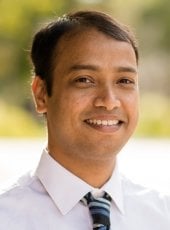
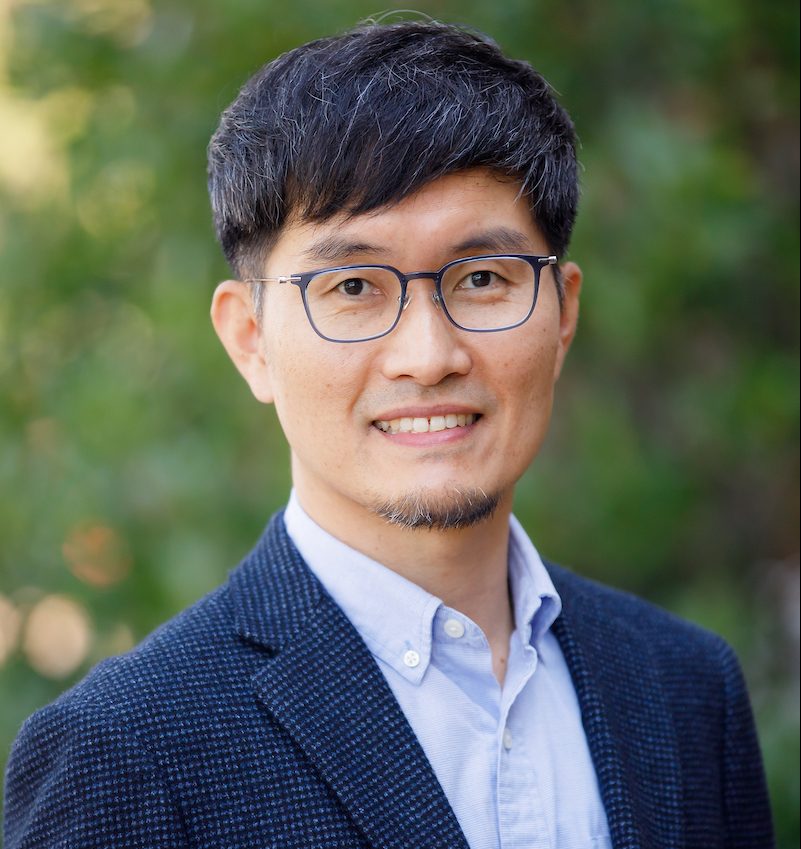
Susanta Ghosh is an Assistant Professor in the Department of Mechanical and Aerospace Engineering at Michigan Technological University, where he is also a faculty member of the Center for Data Sciences at the Institute of Computing and Cybersystems. His research integrates Bayesian Machine Learning , Scientific Machine Learning , and Computational Mechanics to address uncertainty quantification in materials design, fracture modeling, and biomedical imaging. Education : Ph.D. and M.S. from Indian Institute of Science (IISc), Bangalore; B.S. from Indian Institute of Engineering Science and Technology, Shibpur. Research Expertise : Bayesian Neural Networks, Uncertainty Quantification, Computational Inverse Problems, Electronic Structure Prediction, and Nonlocal Elasticity. Funding : NSF CAREER Award (2025-2030, $669,490), DOE grants for chiral nanomaterials (2022-2025, $321,941; 2025-2028, $396,528), and NSF EAGER Award (2019-2022, $170,604). Teaching : Undergraduate and graduate courses in mechanics, finite element methods, and applied machine learning. Selected Awards : National Science Foundation (NSF) CAREER Award (2025)
Anjith George is a researcher at École Polytechnique Fédérale de Lausanne (EPFL) in the School of Computer and Communication Sciences, working within the Biometrics Security and Privacy Laboratory. His research focuses on advancing face recognition systems with particular emphasis on security, efficiency, and cross-domain applications. He maintains a strong collaborative relationship with Professor Sébastien Marcel's research group at EPFL. George's research interests span multiple critical areas in modern biometrics including face recognition systems, face anti-spoofing techniques, heterogeneous face recognition across different modalities (such as visible to infrared), and efficient model deployment for edge devices. His work addresses fundamental challenges in biometric security by developing robust systems that can withstand presentation attacks while maintaining high accuracy across diverse conditions. He has made significant contributions to the field of synthetic data generation and utilization for improving face recognition systems, exploring how knowledge can be effectively transferred from synthetic to real-world domains. Analysis of George's recent publications reveals a clear research trajectory focused on solving practical challenges in face recognition. His work has evolved from fundamental eye tracking and gaze direction research in the early 2010s toward increasingly sophisticated face recognition systems addressing security vulnerabilities, efficiency constraints, and domain adaptation problems. A significant portion of his recent work explores the potential of synthetic data to overcome limitations in real-world training data, while also investigating how to bridge the gap between different face recognition modalities. His research demonstrates a strong emphasis on practical applications, particularly in resource-constrained environments where edge deployment is necessary. George has been actively involved in major biometrics competitions and challenges, including the FRCSyn Challenge and EFaR (Efficient Face Recognition) competition, contributing to community benchmarking efforts and advancing state-of-the-art solutions. His collaborative work spans multiple institutions globally, reflecting the international nature of biometrics research.
Michael Möller is a Professor for Computer Vision at the University of Siegen, Germany. His research focuses on integrating model-based and learning-based techniques in imaging and vision, with an emphasis on efficient optimization algorithms for solving high-dimensional minimization problems. Research Interests: Combining classical model-based methods with deep learning Optimization algorithms for inverse problems Applications in CT reconstruction, image segmentation, and quantum computing Development of energy-dissipating neural networks and non-smooth regularization techniques Scientific Awards: Best Paper Award at ISWC 2021 Best Paper Honorable Mention at GCPR 2020 Best Paper Award at VMV 2015 Collaborations and Grants: Active collaborations with institutions like IEEE, Springer, and universities across Europe. Publications in top-tier venues such as NeurIPS, CVPR, ICCV, and ICLR. His work spans theoretical frameworks (e.g., convex relaxations, spectral methods) and practical applications (e.g., medical imaging, THz defect detection).
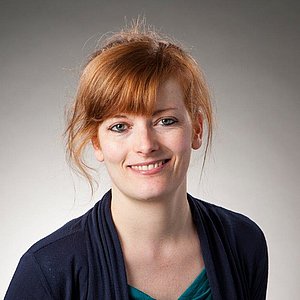
Dr. Elena Atroshchenko is a Senior Lecturer in the School of Civil and Environmental Engineering at the University of New South Wales (UNSW), where she joined in 2019. She is a member of the Centre for Infrastructure and Engineering Safety (CIES), contributing to research in computational mechanics and structural engineering. Prior to her appointment at UNSW, she served as an Assistant Professor at the University of Chile, Santiago, from 2012 to 2019. MSc in Mechanics and Applied Mathematics, Saint-Petersburg State University, Russia, 2006 PhD in Civil Engineering, University of Waterloo, Ontario, Canada, 2010 Dr. Atroshchenko's research primarily focuses on Computational Mechanics and Numerical Methods, with specific applications to fracture mechanics, acoustics, and the bending and vibration of composite plates. Her work extensively utilizes Boundary Element Methods (BEM) and Isogeometric Analysis for solving complex engineering problems. She has made significant contributions to shape optimization, inverse problems, and generalized continuum theories, particularly in the context of structural analysis and material behavior at microscales. Her recent publications (2023-2025) demonstrate a strong emphasis on advanced computational techniques for structural analysis, with particular focus on boundary element methods, isogeometric analysis, and peridynamics. Her research spans multiple domains including structural health monitoring of bridges, thermal metamaterials design, fracture mechanics, and optimization of functionally graded materials. A notable trend in her recent work is the integration of machine learning techniques with traditional computational mechanics approaches. Dr. Atroshchenko teaches CVEN2002 - Civil and Environmental Engineering Computations and CVEN9802 - Structural Stability at UNSW. She is actively involved in research projects related to infrastructure safety and computational methods development. Her office is located in the Civil Engineering Building (H20), Level 6, Room CE607 at UNSW.
Prof. Dr. Tobias Lasser is an Adjunct Professor at the Technical University of Munich (TUM) since 2024, leading the Computational Imaging and Inverse Problems research group. He holds affiliations with the TUM School of Computation, Information and Technology and the Munich Institute of Biomedical Engineering. His academic career includes a PhD (2011) and habilitation (2017) in Computer Science from TUM, along with prior roles as a Postdoctoral Fellow and Akademischer Rat at TUM's Chair for Computer Aided Medical Procedures. His research focuses on computational imaging , inverse problems in tomography , and clinical decision support systems . Key areas include X-ray phase-contrast/dark-field imaging, light field microscopy, and multi-modal medical data analysis. Notable contributions include advancements in sparse-view CT reconstruction, artifact-free deconvolution techniques, and AI-driven diagnostic tools. Recent work emphasizes integrating deep learning with traditional imaging modalities, such as encoder-decoder architectures for anomaly detection and attention-based models for skin lesion classification. His team also explores robotic sample holders for advanced CT setups and open-source frameworks like elsa for tomographic reconstruction. Educations: Diplom-Informatiker (2006), Diplom-Mathematiker (2008), Dr. rer. nat. (2011, summa cum laude), Habilitation (2017) Awards: IEEE editorial award (2023), Best Poster (2021), Supervisory Excellence (2021), Teaching Award (2021) Labs/Teams: Munich Institute of Biomedical Engineering, Computational Imaging Group (TUM)
Marc BOCQUET is a Professor and Senior Researcher at CEREA, a joint laboratory between École des Ponts ParisTech and Électricité de France (EdF) R&D. He serves as Deputy Director of CEREA and holds academic affiliations with Sorbonne Université, École Polytechnique, and other Paris-area institutions. His research focuses on data assimilation, inverse problems, and machine learning applications in geosciences, environmental statistics, and climate modeling. He has authored 110+ papers and co-edited books, and is a Fellow of the European Centre for Medium-Range Weather Forecasts. **Research Interests:** Development of mathematical methods for estimating atmospheric/oceanic states and improving geoscience models using observational data. Applications to atmospheric chemical transport models and dispersion modeling in urban environments. Integration of machine learning (e.g., deep learning, generative AI) with data assimilation for climate projections and emissions quantification. **Key Contributions:** Pioneered hybrid models combining machine learning and classical data assimilation for weather forecasting (e.g., IFS system). Advanced generative AI-based emulators for sea ice dynamics and wildfire spread. Developed neural network approaches for CO₂ plume inversion using satellite imagery (e.g., OCO-3 SAM data). **Awards:** Fellow of the European Centre for Medium-Range Weather Forecasts (ECMWF). **Labs/Teams:** Active in CEREA and collaborates with institutions like École Normale Supérieure and Université de Toulouse through projects like DRUIDS (PEPR Maths-Vives).
Professor Otto Muskens is a faculty member in the Department of Physics and Astronomy at the University of Southampton , where he leads the Integrated Nanophotonics Group . His research spans nanophotonics , metamaterials , and AI-enabled design , with applications in space-based radiative cooling and defense technologies . His team focuses on programmable photonic circuits using ultra-low-loss phase change materials and ultrafast spectroscopy of nanophotonic systems. Recent work includes wafer-scale silicon photonic testing and machine learning-driven inverse design of optical components. Funding sources include EPSRC , EU projects , and Royal Society grants. Teaching: Module leader for Physics Skills 1&2 (PHYS1017, PHYS1019); Programme leader for MPhys with Nanotechnology Supervision: Currently advising nine PhD students in physics and electronic engineering Collaborations: Active projects with EPSRC, European Union, and European Space Agency
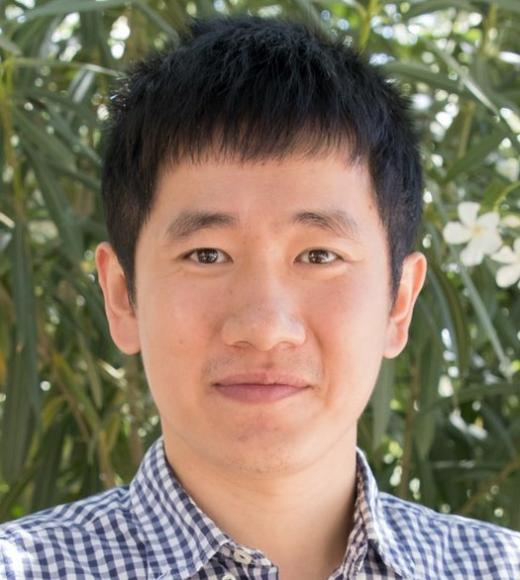
Xinfan Lin is an Associate Professor in the Department of Mechanical and Aerospace Engineering at the University of California Davis, part of the College of Engineering. His research focuses on dynamic system modeling, diagnostics, and control, with a particular emphasis on machine learning, data analytics, and control-integrated design optimization. His work addresses applications in intelligent battery management systems, electric vehicles, unmanned aerial systems (UAS), electric-vertical-takeoff and landing (eVTOL) aircraft, and spacecraft. He leads the Lin Research Lab, which combines multi-physical domain knowledge, control theories, and machine learning to advance transportation and aerospace technologies. Lin has received the NSF CAREER Award and was elected as an IEEE Senior Member. His research interests include battery electrochemical dynamics, system-level estimation and control, and energy systems optimization. He has contributed to advancing methodologies for battery health monitoring, energy-efficient UAV mission planning, and hybrid physics-based machine learning models. Key applications of his work include improving battery management for electric vehicles, optimizing multirotor drone efficiency, and enhancing aerospace systems through integrated system modeling. His recent publications highlight advancements in energy-optimal trajectory planning, reinforcement learning for battery diagnostics, and lightweight electrochemical modeling techniques.
James Demmel is a Professor of Computer Science and Mathematics at the University of California, Berkeley, with joint appointments since 1990. His research focuses on numerical linear algebra, high-performance computing, and parallel algorithms. He co-developed widely used libraries like LAPACK and ScaLAPACK. Demmel holds ACM, SIAM, and IEEE Fellowships, and is a member of both the National Academy of Engineering and Sciences. Education: Ph.D. in Computer Science, UC Berkeley, 1983 B.S. in Mathematics, Caltech, 1975 Research Interests: Demmel’s work emphasizes numerical methods for linear algebra, including algorithms for eigenvalue problems, matrix factorizations, and high-performance computing architectures. His contributions bridge theory and practice, addressing challenges in floating-point arithmetic and algorithm scalability. Publications & Awards: Over 150+ publications, including foundational papers on LAPACK and iterative methods. Recipient of the SIAM Activity Group Linear Algebra Best Paper Prize (1988, 1991), Wilkinson Prize (1993), and ACM Supercomputing Test of Time Award (2019). Labs & Teams: Demmel collaborates with groups like Berkeley Benchmarking and Optimization Group (BeBOP) and CLIMB, focusing on algorithmic efficiency and exascale computing.
Dr. Thomas Humphries is an Associate Professor in the Division of Engineering and Mathematics at the University of Washington Bothell since 2022. He earned his Ph.D. in Applied and Computational Mathematics from Simon Fraser University and holds a B.Math from the University of Waterloo. His research focuses on tomographic image reconstruction and mathematical optimization techniques. Ph.D., Applied and Computational Mathematics, Simon Fraser University (2011) M.Sc., Applied and Computational Mathematics, Simon Fraser University (2007) B.Math, Joint Honours Applied Math and Computer Science, University of Waterloo (2005) His work in Medical Imaging addresses challenges in CT and SPECT reconstruction, particularly for polyenergetic/sparse data. He also explores derivative-free optimization in oil field operations and has developed open-source MATLAB code for polyenergetic CT reconstruction available on GitHub. Recent publications focus on superiorization methodology and machine learning integration. Key research trends include iterative reconstruction algorithms, metal artifact reduction, dynamic SPECT imaging, and regularization techniques. No formal scientific awards are listed in the provided text. Dr. Humphries teaches mathematics courses including calculus, linear algebra, and numerical analysis. His professional journey includes postdoctoral work at Memorial University (2011-2013) and Oregon State University (2013-2015) before joining UW Bothell in 2015.
Melina Freitag is Professor for Data Assimilation at the Institute for Mathematics, University of Potsdam. Her research spans numerical linear algebra, inverse problems, and model order reduction, with applications in geophysics, image processing, and machine learning. She leads the Data Assimilation Group and contributes to the SFB 1294 Collaborative Research Center. Education : Prof. Freitag earned her Diplom in Mathematics at TU Chemnitz (2004) and PhD in Mathematical Sciences from University of Bath (2007). Research Themes : Her work focuses on Krylov subspace methods, low-rank approximations, and preconditioning for large-scale systems. She bridges classical numerical analysis with modern data assimilation, addressing challenges in: Bayesian inverse problems with unstable systems Optimized spectral sampling in X-ray imaging Physics-informed neural networks for Navier-Stokes inversion Parameter-dependent eigenvalue analysis Collaborations & Grants : She collaborates with institutions like KTH Stockholm and Arizona State University. Her group secures funding through SFB 1294 and participates in INI Cambridge networks. Leadership : Co-Chair of GAMM Activity Group on Applied Numerical Linear Algebra SIAM Activity Group on Linear Algebra Chair (2022) Teaching : Delivers courses on numerical optimization, matrix methods in data science, and inverse problems, integrating computational theory with real-world applications.
Luc Berthouze is a Professor of Complex Systems (Informatics) at the School of Engineering and Informatics, University of Sussex, where he leads interdisciplinary research at the intersection of mathematics, engineering, and neurophysiology. He also holds an honorary appointment at the Great Ormond Street Hospital Institute of Child Health, University College London. His educational background includes a PhD in Applied Mathematics and Computer Science from the University of Evry Val d’Essonne (1996), followed by research positions at the Electrotechnical Laboratory (ETL) and the National Institute of Advanced Industrial Science and Technology (AIST) in Japan, before joining the University of Sussex faculty in 2006. His research focuses on dynamical processes on networks, including neuronal synchronization, epidemic spreading, and fault detection in IT infrastructures. He develops mathematical models and analysis methods rooted in dynamical systems, random processes, graph theory, control theory, and signal processing. Applications span neuroscience (EEG, EMG, MEG), robotics, and large-scale network management. The trend in his recent publications reveals a strong emphasis on network dynamics across biological and technological systems. Key themes include functional connectivity inference, metastability in oscillatory networks, epidemic modeling on structured networks, and scalable observability in microservices. His work increasingly bridges neuroscience and computer engineering, exemplified by projects like 'Rethinking large-scale network management through the lens of neuroscience.' Mathematical Neuroscience Mathematical Epidemiology Time Series Analysis Network Analysis Synchronization and Criticality Motor Control and Coordination He has received substantial research funding from EPSRC, Innovate UK, Moogsoft, Aviva, and the Leverhulme Trust, supporting work on network controllability, data-driven decision making, and Bayesian inference. His grants often involve collaborations with industry partners, indicating applied and translational impact. He supervises research projects and teaches courses such as 'Intelligence in Animals and Machines,' contributing to both undergraduate and postgraduate education. His lab and research team work on developing scalable mathematical frameworks for network analysis, with applications in healthcare, robotics, and IT infrastructure.
Dr. Julie A. Jackson is a Professor of Electrical Engineering in the Department of Electrical and Computer Engineering at the Air Force Institute of Technology (AFIT), part of the Graduate School of Engineering and Management. She holds a Ph.D. in Electrical Engineering from The Ohio State University (2009), an M.S. (2004), and a B.S. (2002) from Wright State University. Her work bridges theoretical and applied radar systems, with emphasis on synthetic aperture radar, signal processing, and electromagnetics. Ph.D., Electrical Engineering, The Ohio State University, 2009 M.S., Electrical Engineering, The Ohio State University, 2004 B.S., Electrical Engineering, Wright State University, 2002 Dr. Jackson's research focuses on radar systems , particularly synthetic aperture radar (SAR) , compressive sensing , polarimetric imaging , and passive radar using commercial signals . She develops advanced signal processing algorithms for feature extraction, autofocus, and clutter modeling. Her work enables high-resolution imaging in challenging environments and has been applied to both military and civilian remote sensing. Her recent publications show a strong trend in exploiting sparsity and crosstalk in polarimetric SAR, autofocus algorithms using convex optimization, and passive radar using LTE and WiMAX signals. These efforts reflect a deep integration of electromagnetic theory, statistical signal processing, and computational imaging. Dr. Jackson has received numerous accolades, including: 2023 EN Distinguished Teaching Professor Award 2022 John L. McLucas Basic Research Award 2020 Air Force Outstanding Scientist/Engineer Award (Mid-Career) 2019 IEEE Fred Nathanson Memorial Radar Award 2019 Gage H. Crocker Outstanding Professor Award 2016 SOCHE Faculty Excellence Award She has advised multiple graduate students and led collaborative research with faculty and laboratory technicians at AFIT. Her work has been supported by internal Air Force research funding and has resulted in peer-reviewed publications, patents, and real-world radar applications. Dr. Jackson also holds a U.S. patent on polarization recovery in SAR systems, highlighting the translational impact of her research. She is actively involved in the IEEE Aerospace and Electronic Systems Society and contributes to the advancement of radar technology through publications, conferences, and mentorship. Her laboratory work emphasizes experimental validation of theoretical models, particularly in heterogeneous clutter environments and multistatic configurations.
Nathan Jeong is an Associate Professor in the Department of Electrical and Computer Engineering at The University of Alabama, College of Engineering. He leads the Intelligent Sensor and Wireless System Lab (ISWS), where he conducts cutting-edge research at the intersection of artificial intelligence, wireless systems, and sensor technologies. His work is supported by major federal grants, including a $3 million project from the Federal Transit Administration and the U.S. Department of Transportation for autonomous bus safety. Ph.D., Electrical and Computer Engineering, Purdue University, 2010 Visiting Scholar, Georgia Institute of Technology, 2010 M.S., Electrical and Electronic Engineering, Yonsei University, 2002 B.S., Radio Sciences and Engineering, Korea Maritime University, 2000 Dr. Jeong's research spans artificial intelligence, wireless power transfer, millimeter-wave systems, vehicle-to-everything (V2X) communication, adaptive RF front-ends, and biomedical electronics. His lab focuses on developing intelligent sensor systems for applications in healthcare, agriculture, transportation, and public safety. He integrates machine learning with electromagnetic and RF technologies to create innovative solutions for real-world challenges. The recent publications from Dr. Jeong and his team reflect a strong trend toward intelligent sensing systems using microwave and millimeter-wave technologies. These works span domains such as non-invasive food quality inspection, wearable biomechanical monitoring, autonomous vehicle safety, and UAV-based remote sensing. The integration of machine learning with electromagnetic wave-based sensing is a unifying theme, demonstrating a multidisciplinary approach to solving complex engineering problems. National Academy of Inventors Inductee Award Faculty and Staff Innovation Pitch Competition Award IEEE Distinguished Microwave Instructor Ambassador Alabama Society of Professional Engineers Graduate Student Engineer of the Year (advised student) Randall Outstanding Undergraduate Research Award (multiple students) Most Innovative Award, Crimson Startup Academy (student award) Dr. Jeong has successfully advised numerous graduate and undergraduate students, many of whom have gone on to win prestigious awards and publish high-impact research. He has secured significant external funding, including a $3 million federal grant for autonomous bus safety systems, demonstrating strong grant-writing capabilities and leadership in large-scale research initiatives. His work bridges industry and academia, leveraging over eleven years of industrial experience at Samsung, BlackBerry, and Qualcomm. The Intelligent Sensor and Wireless System Lab (ISWS) is a vibrant research group under Dr. Jeong’s leadership, actively engaged in projects involving AI-driven sensor networks, wireless power, V2X communication, and biomedical electronics. The lab fosters innovation through hands-on research and collaboration, welcoming motivated students at all levels.
Mathews Jacob is a Professor of Electrical and Computer Engineering at the University of Virginia’s School of Engineering and Applied Science, leading the Computational Biomedical Imaging Group (CBIG). His research focuses on image reconstruction, analysis, and quantification in MRI, particularly in ultrahigh-resolution brain MRI, cardiac/pulmonary MRI, and metabolic imaging. He holds a B.Tech from National Institute of Technology, M.E. from Indian Institute of Science, and Ph.D. from Swiss Federal Institute of Technology. Research Contributions: Dr. Jacob pioneered model-based deep learning frameworks like MoDL and MOL, advancing accelerated MRI techniques. His work bridges machine learning and medical imaging, with applications in dynamic speech MRI, motion-compensated cardiac imaging, and compressed sensing. Professional Roles: He serves as Associate Editor for IEEE Transactions on Medical Imaging and was General Chair of IEEE International Symposium on Biomedical Imaging (2020). A Fellow of IEEE (2022), he has received NSF CAREER (2009), ACS Research Scholar (2011), and Eminent Researcher (2024) awards. Grants & Projects: His NIH-funded projects include ultra-high-resolution multi-contrast MRI, free-breathing dynamic MRI, and MR spectroscopic imaging for Alzheimer’s research. Current grants emphasize computational MRI innovations. Labs & Impact: The CBIG lab develops cutting-edge imaging algorithms, collaborating on clinical applications like pulmonary hypertension detection via cardiac MRI radiomics. His work impacts radiology, oncology, and neurology.