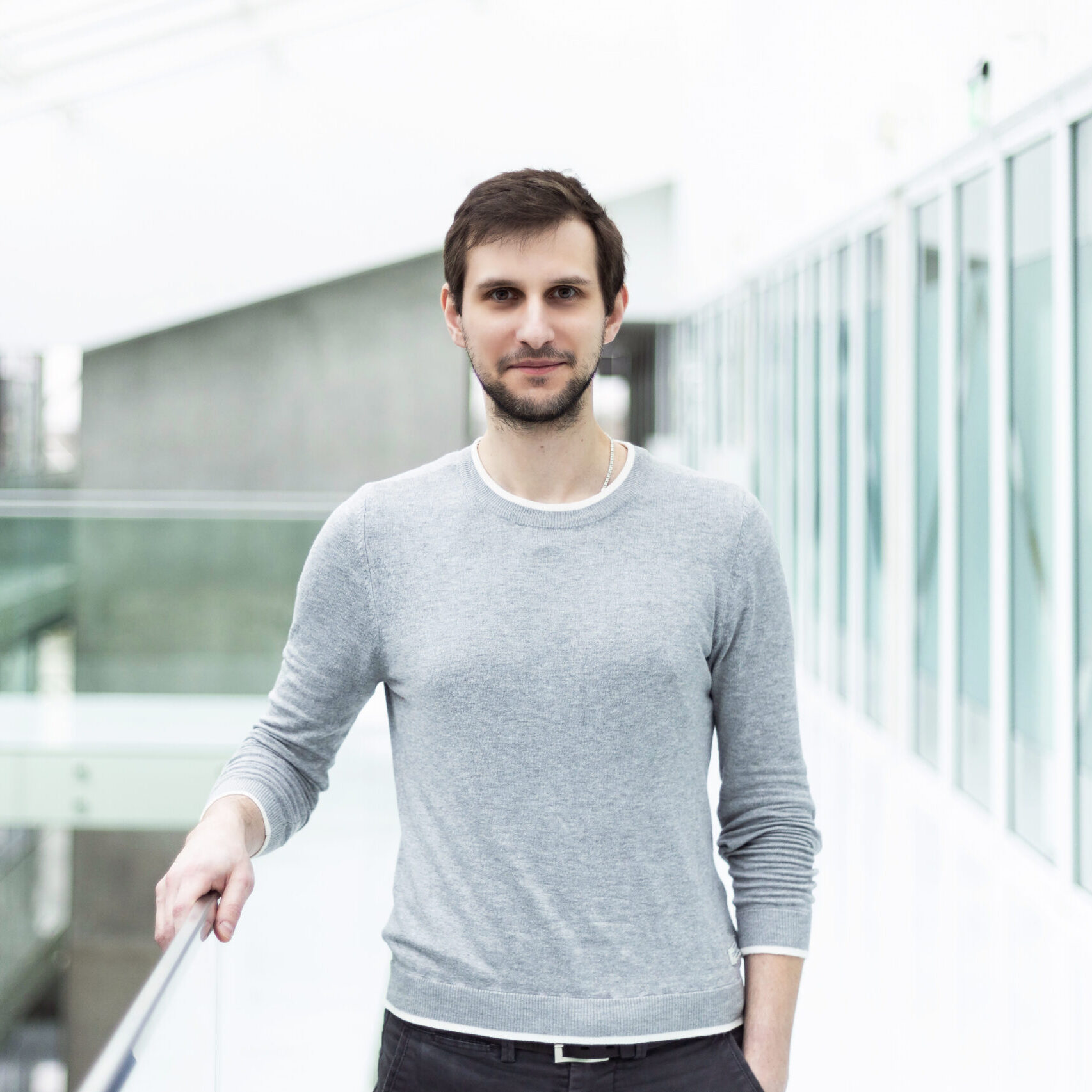
Andrius Sološenko is a Senior Researcher at the Institute of Biomedical Engineering at Kaunas University of Technology (KTU), affiliated with the Biosignal Analytics Laboratory . His scientific and practical interests focus on: Development of algorithms for arrhythmia recognition in wearable devices Biosignal modeling, particularly photoplethysmogram (PPG) analysis Application of machine learning techniques, including convolutional neural networks (CNNs) Contact: andrius.solosenko@ktu.lt
Gabriel Pires is an Adjunct Professor in the Department of Electrical Engineering at the Polytechnic Institute of Tomar (Portugal) and Integrated Researcher at the Institute of Systems and Robotics - University of Coimbra. He coordinates Lab. VITA.IPT (Life Assisted by Intelligent Environments) and leads the Brain-Computer Interface research group in the Human-Centered Mobile Robotics Lab. His cross-disciplinary affiliations include collaboration with the Coimbra Institute for Biomedical Imaging and Translational Research. Dr. Pires specializes in EEG-based brain-computer interfaces and biosignal processing, aiming to enhance BCI reliability for clinical rehabilitation and assistive technologies. His research spans: BCI usability enhancement Wearable biosensors development Telehealth platforms Human-robot interaction Machine learning for medical applications He has supervised over 70 students and researchers, and manages multiple national/EU projects including: BCI4ALL (€1.8M FEDER, 2025-2028) FLEXEMG (wearable muscle sensors) UpReGain (stroke rehabilitation) POWERAUT (autism intervention) Honors include the IEEE Transactions Best Paper Award (2022) and Fraunhofer Portugal Challenge.
Dr. Urs Hackstein serves as a Research Assistant in the EU project QUMPHY and Lecturer for special tasks at the Department of LSE, Technical University of Central Hesse (THM), Germany. His work bridges computational methods with medical diagnostics, focusing on uncertainty quantification in machine learning applications for cardiovascular analysis. Educational background: Dr. rer. nat. (Doctor of Natural Sciences) Dipl.-Math. (Diploma in Mathematics) Research Interests: Machine Learning in Medicine: Developing frameworks to quantify uncertainties in ML algorithms for medical signal interpretation, particularly photoplethysmography (PPG) analysis. Cardiovascular Diagnostics: Creating non-invasive support systems for early aortic aneurysm detection through biofluid mechanics simulations and biosignal processing. Medical Data Science: Integrating biosignal analysis with clinical data for predictive modeling in cardiovascular medicine. Active Research Projects: EU project QUMPHY: Quantifying uncertainties in machine learning for medical physics applications under Prof. Bernhard's supervision. BMBF project CardioInBaMed: Developing AI-driven diagnostic tools for aortic aneurysm detection through biosignal processing. He maintains laboratory facilities at Ringallee 37 D14.2.01, Gießen, supporting experimental work in biofluid mechanics and medical signal acquisition.
Dr. Mohammad A. Ahad is an Associate Professor and Interim Department Chair in Electrical & Computer Engineering at Georgia Southern University, where he has been faculty since 2011. His research focuses on bioinstrumentation, biosensors, and biomedical signal processing, particularly in Electrical Impedance Myography (EIM) for non-invasive medical diagnostics. Education: Ph.D. Electrical and Computer Engineering, University of Tennessee, Knoxville (2007) M.S. Electrical and Computer Engineering, University of Tennessee, Knoxville (2002) B.S. Electrical and Electronic Engineering, Bangladesh University of Engineering and Technology (1998) Research Focus: Dr. Ahad's work spans biomedical instrumentation development, FPGA-based system design, and computational modeling of biological systems. His EIM research enables novel diagnostic approaches for muscle pathologies and cancer detection through finite element analysis and electrode optimization. Grant Leadership: Secured competitive funding as PI for multiple NIH and NSF projects focusing on human-robot interfaces, non-invasive instrumentation, and early cancer detection techniques using impedance methods. Teaching: Specializes in hands-on engineering education including digital design with DE2 boards, embedded systems programming, and signal processing laboratories.
Christofer "Chris" Toumazou is a distinguished British Cypriot electronic engineer serving as the Regius Professor of Engineering at Imperial College London, a prestigious appointment made during the Queen's Diamond Jubilee in 2013. He also holds positions as Chief Scientist of the Institute of Biomedical Engineering and Professor of Circuit Design at Imperial. Beyond academia, Toumazou is an accomplished entrepreneur, having founded Toumaz Holdings Ltd and DNA Electronics Ltd., and co-founding DNAnudge, which developed the groundbreaking CovidNudge point-of-care diagnostic system. With a research portfolio spanning over 800 publications, Toumazou's work primarily focuses on the intersection of semiconductor technology and biomedical applications. His most significant contribution is the development of ISFET (Ion-Sensitive Field-Effect Transistor) technology for DNA detection, which eliminates the need for optical systems in genetic testing and enables miniaturized, lab-free diagnostic devices. This innovation has been applied across various healthcare domains including pandemic response, cancer diagnostics, and personalized medicine. Toumazou's publication record shows consistent high-impact output across biomedical engineering, electrical engineering, and applied physics. His recent work (2020-2022) has particularly emphasized point-of-care diagnostics, personalized healthcare systems integrating genetic information with real-time monitoring, and novel approaches to DNA analysis. His research demonstrates a clear trajectory from fundamental circuit design to practical healthcare applications that address significant clinical needs. Fellow of the Royal Society (FRS) Fellow of the Royal Academy of Engineering (FREng) Fellow of the Academy of Medical Sciences (FMedSci) Fellow of the Institution of Engineering and Technology (FIET) Fellow of the Institute of Electrical and Electronics Engineers (FIEEE) Regius Professor of Engineering at Imperial College London Professor Toumazou maintains an active research program with numerous ongoing projects bridging engineering and medicine. His work continues to focus on developing next-generation diagnostic technologies that integrate semiconductor electronics with biological systems, with particular emphasis on making sophisticated genetic testing accessible at the point of care. Through his academic position and entrepreneurial ventures, he maintains strong connections between fundamental research, commercial development, and clinical implementation of new healthcare technologies.