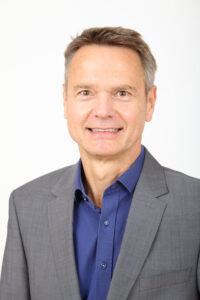
Moritz Staudinger is a PreDoc Researcher at the Data Science department of Technische Universität Wien . His research focuses on reproducibility in machine learning and information retrieval, with particular emphasis on query generation, data citation, and evolving database schemas. Current projects: FAIR-AI (2024–2026) , HumRec (2021–2025) , and DoSSIER (2019–2024) Collaborations: Works with Andreas Hanbury , Andreas Rauber, and others Research interests include large language models for scientific applications, temporal information retrieval, and FAIR data principles. His recent publications examine reproducibility challenges across machine learning, systematic literature reviews, and environmental data management. Supervisions : Mentors students working on topics like data sovereignty, multilingual fact-checking, and quality indicators for data management plans. Collaborates on the DBRepo semantic repository framework.
Manuel Wimmer is a Lecturer in Business Informatics at TU Wien's Faculty of Informatics, specializing in model-driven engineering methodologies. His research develops foundations for model transformation, metamodeling, and interdisciplinary engineering. Research interests include model-driven software engineering, cyber-physical systems, web engineering, and industrial automation, with applications in smart production systems. Current work focuses on bridging IT/OT domains through standardized modeling approaches. Recent publications address quantum-edge cloud architectures, AI-enhanced modeling, and industrial security challenges. Article trends demonstrate strong focus on modeling language engineering, interoperability solutions, and quality assurance in complex systems. Leads the Christian Doppler Laboratory for Model-Integrated Smart Production and coordinates EU projects on low-code engineering platforms. Supervises doctoral research in model-driven technologies and software quality.
Radu Grosu is a Full Professor and Head of the Cyber-Physical Systems Research Unit at TU Wien. His research focuses on modeling, analysis, and control of cyber-physical and biological systems, with applications in robotics, autonomous systems, medical imaging, and formal verification. He leads the Scuderia Segfault team for autonomous F1TENTH racing and has extensive collaborations with industry partners like TTTech Auto AG and FFG. His work integrates machine learning, control theory, and formal methods to address challenges in safety-critical systems and autonomous decision-making. Roles: Full Professor, Head of Research Unit, Faculty Council Substitute Member Affiliations: TU Wien, Scuderia Segfault, Austrian Science Fund (FWF) projects Research interests span cyber-physical systems (CPS), cardiac-cell networks, genetic regulatory networks, and AI-driven solutions for healthcare and manufacturing. He has pioneered methods in neural circuit policies, flocking control, and real-time reinforcement learning. His projects include EdgeAI for embedded systems, radiation treatment optimization in glioblastoma, and autonomous vehicle testing frameworks. Key contributions include: Developing Lagrangian reachability analysis for safety verification Advancing neuromorphic IoT architectures and sensor networks Creating tools like DeepSTL for translating requirements into specifications Grants include FFG-funded projects on autonomous driving examiners and energy-efficient neuromorphic systems. His work bridges theoretical foundations with practical implementations in CPS resilience, medical diagnostics, and industrial automation.
Stefan Szeider is a full professor and chair of the Algorithms and Complexity Group at the Faculty of Informatics, Technische Universität Wien (TU Wien). He also serves as a visiting scientist at UC Berkeley's Simons Institute for the Theory of Computing. His academic journey includes positions at the University of Durham (UK) and the University of Toronto (Canada), and he earned his Mathematics PhD from the University of Vienna in 2001. Dr. Szeider's research focuses on designing efficient algorithms for problems in Artificial Intelligence, automated reasoning, and combinatorial optimization. He leads several initiatives, including the Vienna Center for Logic and Algorithms (VCLA), and has secured funding from the ERC, EPSRC, FWF, and others. His Erdős number is 2, reflecting his collaborative network in mathematics and computer science. Key achievements include the first ERC Starting Grant awarded to an Austrian computer scientist (2009), and awards such as the Highlighted Paper Award at SAT 2023 and Best Paper at CP 2020. He advises numerous PhD students and postdocs, fostering the next generation of researchers in algorithms and complexity. Notable contributions extend beyond academia to public outreach, including initiatives like the 'Algorithms Think Differently' educational program and the 'Algorithms in 60 Seconds' video competition. His work bridges theoretical foundations and practical applications, influencing both academic and real-world computational challenges.
Peter Frühwirt is an External Lecturer in the Department of Information Systems Engineering at Vienna University of Technology (E194). His research focuses on cybersecurity, database forensics, and usable security, with a particular emphasis on tamper-proof systems, QR code vulnerabilities, and forensic-aware database solutions. Education : Dipl.-Ing. Dr.techn., BSc BSc Research Interests : Cybersecurity, Database Forensics, Machine Learning Applications in Security, QR Code Security, Web Application Security, Traffic Classification His recent publications analyze forensic-aware database protocols, QR code threats, and machine learning applications for attacker profiling. He teaches courses including Advanced Software Engineering, Software Engineering Project, and Software Quality Assurance.
Patrick Indri is a PreDoc Researcher at the Department of Informatics, Technische Universität Wien , specializing in machine learning and its intersections with formal methods and data privacy. His work focuses on graph neural networks, robustness verification, and temporal logic applications. Education : MSc degree holder Research Interests : Expressive Graph Neural Network architectures for specialized graph types Differential Privacy integration in graph-based learning systems Robustness Certification with probabilistic guarantees Temporal logic applications in Cyber-Physical Systems anomaly detection Key Projects include the StruDL (2023–2027) initiative exploring structured deep learning. His publications demonstrate expertise in both foundational machine learning and applied formal verification techniques.
Daniela Kaufmann is a PostDoc Researcher at the Department of Formal Methods in Systems Engineering , part of the School of Informatics at Vienna University of Technology. Her work focuses on combining SAT solving and computer algebra for formal verification of arithmetic circuits. Research Interests: Daniela specializes in Formal verification of arithmetic circuits Algebraic reasoning SAT/SMT solving Grammar inference Automated reasoning Finite field arithmetic verification Recent Article Trends: Her publications emphasize hybrid approaches merging SAT techniques with computer algebra for circuit verification, finite field arithmetic reasoning in SMT solvers, and fuzzing-based grammar inference. She has contributed to tools like AMulet2 and PolySAT, addressing scalability challenges in multiplier verification. Projects: Daniela is a key researcher in the CalgSAT (2024-2027) ARTIST (2021-2026) SFB SPyCoDe (2023-2026) projects funded by the Austrian Science Fund (FWF).
Markus Kirchweger is a PreDoc Researcher at the Department of Algorithms and Complexity, Faculty of Informatics, Technische Universität Wien. His work spans Satisfiability (SAT) solving, graph theory, and combinatorial optimization, with a focus on symmetry breaking and SAT modulo theories. Research Interests: Developing SAT-based frameworks for graph generation and enumeration Dynamic symmetry breaking in combinatorial problem encodings Integrating user propagators into CDCL solvers Applying SAT techniques to conjectures like Erdős-Faber-Lovász and Rota’s Basis Co-certificate learning and shortest common supersequence optimization Projects: INCR (2021–2024), REVEAL-AI (2020–2024), SLIM (2019–2024), ASK-SAT (2024–2027).
Nachum Dershowitz is a Full Professor at the School of Computer Science, Tel Aviv University, with a career spanning institutions like the University of Illinois at Urbana-Champaign, Microsoft Research, and the Weizmann Institute. His research bridges theoretical computer science, computational logic, and digital humanities. Fields: Rewrite systems, termination proofs, automated reasoning, program verification, computational linguistics Awards: Herbrand Award (2011), Test-of-Time Award (2006), Chair in Computational Logic (2012) Grants: NSF, ISF, Intel, Google, Israeli Ministry of Science His work on historical manuscript analysis combines computer vision with natural language processing, while his contributions to term rewriting systems have shaped automated deduction. He has edited volumes in logic and AI, and served as program chair for major conferences.
Distinguished Professor Jie Lu is Associate Dean (Research Excellence) in the Faculty of Engineering and Information Technology at the University of Technology Sydney (UTS), where she also serves as Director of the Australian Artificial Intelligence Institute (AAII). With over two decades of academic service at UTS, she has held progressively senior roles including Professor since 2007, Head of School of Software (2011-2014), and Director of the Centre for Artificial Intelligence (2017-2020) before assuming her current leadership positions. Professor Lu earned her PhD from Curtin University in 2000 and joined UTS the same year. Her academic journey progressed from Lecturer (2000-2001) to Senior Lecturer (2002-2004), Associate Professor (2005-2007), and ultimately Professor (2017-present). Professor Lu's research spans computational intelligence with particular expertise in decision support systems, fuzzy transfer learning, concept drift, and recommender systems. Her work bridges theoretical innovation with practical applications across transportation, telecommunications, healthcare, and education sectors. She has pioneered approaches in data-driven decision making that deliver tangible economic benefits and risk management solutions for industry partners. Her recent publications demonstrate continued leadership in AI research, with a focus on addressing challenges in non-stationary environments, out-of-distribution detection, cross-domain recommendation, and healthcare applications. Her work increasingly integrates large language models with specialized domain knowledge for enhanced decision support. Officer of the Order of Australia (2022) 2023 NSW Premier's Prize for Excellence in Engineering or Information & Communication Technology Australian Laureate Fellow (2019) IEEE Fellow for contributions to fuzzy machine learning and decision making (2018) Fellow of International Fuzzy Systems Association (2017) Australia's Most Innovative Engineer Award (2019) Multiple IEEE Transactions Outstanding Paper awards Professor Lu has supervised over 50 PhD students to completion, with half pursuing academic careers and half working in industry. She has secured over A$10 million in research funding as lead Chief Investigator, including 10 highly competitive ARC Discovery Projects. Her industry collaborations include significant projects with Optus, Sydney Trains, Domain Holdings, and healthcare organizations. As Director of the Australian AI Institute, Professor Lu leads Australia's largest AI research hub with over 250 researchers and PhD students. Under her leadership, AAII has secured 47 ARC grants and over 110 industry projects since 2017. She also serves as Editor-in-Chief of Knowledge-Based Systems, a leading journal in the field.
Jerzy Tiuryn is a Full Professor at the Faculty of Mathematics, Informatics and Mechanics, University of Warsaw (since 1992), with a PhD in Mathematics from the same university (1975). He served as Vice Dean for Scientific Matters and International Relations (2005-2012) and is actively engaged in editorial roles for journals like Theoretical Computer Science , Information and Computation , and BioMed Research International . Education: PhD in Mathematics (University of Warsaw, 1975). Research Interests: His work spans past contributions in program verification, semantics, typed lambda calculus, and type theory, with current focus on bioinformatics and computational biology. Specific areas include sequence analysis, gene family evolution, protein-protein interaction networks, gene regulatory regions, gene mutations in bacterial drug resistance, and comparative genomics. Trends in Publications: His recent articles emphasize computational methods in bacterial genomics (CAMBerVis, CAMBer), regulatory element prediction (Bi-Billboard), protein interaction mapping via phylogeny, and Bayesian network modeling for gene expression. Themes center on genomic data analysis, evolutionary conservation, and algorithm development for biological systems. Scientific Contributions: Awards and memberships highlight leadership in European and Polish academic networks: Board Member, European Research Consortium for Informatics and Mathematics (ERCIM) (2011) First President, Polish Bioinformatics Society (2008-2010) Founding Member/President, PLERCIM (2007-2012) Member, Academia Europaea (since 1996)
Moshe Y. Vardi is a University Professor and the Karen Ostrum George Distinguished Service Professor in Computational Engineering at Rice University . He also serves as a Fellow for Science and Technology Policy at the Baker Institute for Public Policy and is a Senior Editor of the Communications of the ACM . Vardi has held significant roles such as Department Chair at Rice (1994-2002) and leadership positions at IBM and Stanford. Education : Ph.D. in Computer Science (1981), Hebrew University, Jerusalem, Israel. Research Interests : Vardi's work spans automated reasoning , a field with applications in machine learning , database theory , computational-complexity theory , knowledge in multi-agent systems , and computer-aided verification . His research emphasizes the unusual effectiveness of logic in computer science and societal implications of technology. Scientific Awards : Vardi has received numerous accolades, including the Gödel Prize , Knuth Prize , Blaise Pascal Medal , ACM SIGMOD Codd Award , and multiple IBM Outstanding Innovation Awards . He is a fellow of over 10 prestigious societies, including the IEEE , ACM , American Academy of Arts and Sciences , and National Academy of Sciences . Advising and Leadership : Vardi has advised notable students like Kuldeep S. Meel , who won awards under his guidance. He has led initiatives such as the Technology, Culture, and Society program at Rice and served as Editor-in-Chief of Communications of the ACM .
Luca San Mauro is an Assistant Professor of Logic at the University of Bari, holding the RTDb rank. His research focuses on computability theory, particularly its applications in philosophy, mathematics, theoretical computer science, and linguistics. He has held roles at TU Wien, Sapienza University of Rome, and the University of Siena. He earned his Ph.D. in Mathematical Logic from Scuola Normale Superiore in Pisa (2016) and holds habilitation as associate professor in Mathematical Logic and Logic and Philosophy of Science from the Italian Ministry of Education. His work bridges foundational logic with practical computational methods, addressing topics like equivalence relations, computable reducibility, and algebraic structure classification. Recent research emphasizes applications in argumentation frameworks, belief revision systems, and dialectical logic. He explores how computational tools can resolve paradoxes and clarify mathematical assertions, intersecting with formal semantics and epistemology. Publications span theoretical advancements in computability, such as analyzing Friedman-Stanley jumps and Borel equivalence relations, alongside interdisciplinary studies on fuzzy set approximation and linguistic pragmatics. His work often highlights the interplay between abstract mathematical concepts and their algorithmic realizations. Despite no listed awards, his contributions reflect significant engagement with both pure and applied logic communities. While no advisees are listed, his academic trajectory suggests mentorship roles in his research collaborations. He actively contributes to seminars like “Algebra i Logika” and maintains an international presence through Google Scholar and ResearchGate.
Dr. Christoph Kogler MSc. BSc. is a postdoctoral researcher and lecturer at the University of Natural Resources and Life Sciences, Vienna (BOKU) and the University of Applied Sciences Campus Wien. He is affiliated with the Department of Economics and Social Sciences and the Institute of Production, Economics and Logistics, where his work focuses on logistics, supply chain and risk management, business analytics, industrial engineering, and sustainability in the bioeconomy, particularly the forestry and timber sectors. He is actively pursuing his habilitation and is recognized for his innovative teaching and research. His research interests center on sustainability research, supply chain management, risk management, agent-based and discrete event simulation, serious game-based learning, logistics, business process modeling, and transport in industrial engineering. He applies interdisciplinary methods from economics, social sciences, and computer science to promote a fair transition toward a sustainable bioeconomy. His teaching innovations have earned him nominations for the Austrian State Prize for Teaching (Ars Docendi) in 2022 and 2023, and his courses are featured in the national Atlas of Good Teaching. The recent publications and projects reflect a strong trend in using simulation technologies to enhance the sustainability, resilience, and efficiency of wood supply chains. His work emphasizes decision support systems, risk analysis, contingency planning, and educational applications of simulation in forestry logistics. He leads and contributes to multiple projects funded by FFG, the Austrian government, and Erasmus+, with a focus on digital transformation and e-learning in higher education. Fellow of the Freiburg Rising Stars Academy Fellow of the Austrian Marshall Plan Foundation Fellow of ACM/SIGSIM Nominated for Ars Docendi State Teaching Prize (2022, 2023) Recipient of Dissertation, Teaching, and Paper Awards Best Thesis Award, Karl-Franzens-University Graz (2016) Kogler advises master’s students in logistics and supply chain topics and has led numerous workshops and international symposia. He is deeply involved in academic service, serving as a reviewer for over 30 journals, editorial board member of Drewno , and active organizer and program committee member for major conferences such as the Winter Simulation Conference and International Wood Supply Game Competition. His research stays at UC Berkeley, Brno University of Technology, and the University of Freiburg highlight his international collaboration and academic leadership. He leads the project 'Serious Game-basierte and Agenten-basierte Modellierungskompetenzen für die Holzwertschöpfungskette' and contributes to several others focused on sustainable wood transport and resilient supply chain management. His work integrates serious games and simulation to train future leaders in sustainable enterprise management. He is a key figure in advancing simulation-based learning and digital transformation in academic and industrial forestry contexts.
Alexey Ignatiev is an Associate Professor in the Optimisation research group at Monash University's Faculty of Information Technology. Previously, he was a postdoctoral researcher and researcher at the University of Lisbon's Faculty of Sciences, focusing on SAT/SMT-based decision procedures. He holds a Ph.D. from the Matrosov Institute for System Dynamics and Control Theory (Russian Academy of Sciences), where his thesis explored parallel CDCL-BDD integration. His research emphasizes formal methods in AI, including explainable AI (XAI), SAT-based reasoning, and optimization for applications like software upgradability, model-based diagnosis, and fault localization. His work spans over 100 publications, with notable contributions to MaxSAT solving (RC2 solver), neuro-symbolic frameworks (NEUSIS), and rigorous explanations for machine learning models. He has collaborated extensively with institutions like the University of Lisbon and Monash University, contributing to advancements in formal verification and interpretable machine learning.