Anders Björn is a Professor at the Department of Mathematics (MAI) at Linköping University (LIU), affiliated with the Analysis and Mathematics Education (ANDI) division. His research focuses on Nonlinear Potential Theory , particularly p-harmonic functions , quasiminimizers , and Newtonian Sobolev spaces in metric spaces. He co-leads the research group in this area and contributes to Analysis on Metric Spaces . He teaches undergraduate and graduate courses, including Real Analysis and Functional Analysis . Organizational Roles: Organizer of the Mathematical Colloquium, Local Representative for Svenska Matematikersamfundet (Swedish Mathematical Society). Editorial Work: Former Technical Editor for Acta Mathematica (2004–2015) and Arkiv för Matematik (1993–2015), both published by Institut Mittag-Leffler. His research explores foundational questions in mathematical analysis, blending pure mathematics with interdisciplinary applications. He emphasizes understanding properties of solutions to differential equations in general settings, akin to constructing an 'identikit' of mathematical phenomena. His work is published in collaboration with the ANDI group, and he actively engages in promoting mathematics through outreach and academic service.
Joakim Lindblad is a Professor at the Department of Information Technology, Uppsala University , and holds affiliated roles as Senior Research Associate at the Mathematical Institute of the Serbian Academy of Sciences and Arts, and Head of Research at Topgolf Sweden AB. With over two decades of expertise in image analysis and machine learning , his work bridges computational methods with biomedical applications. Key affiliations: Uppsala University, Serbian Academy of Sciences, Topgolf Sweden Specializations: Deep Learning, Multimodal Image Registration, Quantitative Microscopy His research focuses on reliable image processing frameworks that integrate intensity and spatial information , particularly for biomedical applications . Recent publications highlight innovations in autofluorescence-based cancer detection , self-supervised one-class learning for sparse instance identification, and rotation-equivariant CNNs for robust analysis of cytology images. Recent article trends demonstrate expertise in multimodal image analysis (2024: 3 papers), oral cancer detection (2025: 2 papers), and multiscale biomedical imaging . His 2025 work on the Uppsala Storytelling Dataset introduces novel frameworks for multimodal dataset creation in AI research. While no scientific awards are explicitly mentioned, his extensive publication record (2000-2025) across top venues like Pattern Recognition , PLOS ONE , and IEEE Transactions indicates significant academic impact. His methodological contributions span stochastic distance transforms , fuzzy set defuzzification , and multimodal image registration techniques. Collaborative work with researchers like Nataša Sladoje and interdisciplinary teams has produced innovations in automated cytology analysis , TEM image enhancement , and AI-driven medical diagnostics . His 2021-2022 projects introduced contrastive learning approaches for multimodal image registration and explainable AI frameworks for infant engagement analysis.
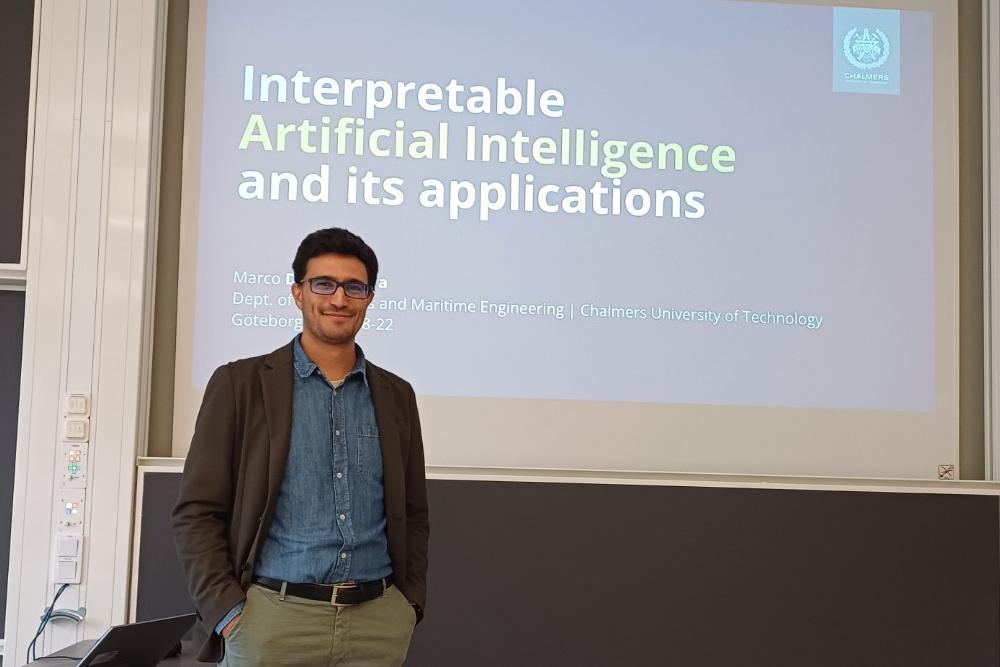
Marco L. Della Vedova is a Senior Lecturer in Applied Artificial Intelligence at Chalmers University of Technology, Sweden. He works in the Vehicle Engineering and Autonomous Systems division within the Department of Mechanics and Maritime Sciences, as part of Prof. Mattias Wahde's research group. Since 2025, he has served as Director of the Data Science and AI master's programme (MPDSC) at Chalmers, where he teaches courses including Introduction to Artificial Intelligence and Digitalization in Sports. Dr. Della Vedova earned his academic foundation at the University of Pavia, Italy, where he completed his BSc (2006), MSc (2009), and PhD (2013) in Computer Engineering. His doctoral research focused on "Real-Time Physical Systems and Electric Load Scheduling" under Prof. Tullio Facchinetti. During his PhD studies, he spent a year at U.C. Berkeley hosted by Prof. Francesco Borrelli at the Model Based Predictive and Distributed Control Lab. His research spans multiple AI domains with a strong emphasis on interpretability. Dr. Della Vedova develops interpretable methods for conversational AI, naturalness evaluation of forests using canopy height models, and geospatial applications. His work bridges theoretical AI with practical societal benefits, particularly in environmental monitoring, transportation systems, and orienteering. He has previously contributed to cloud computing, hate speech detection, and cyber-physical energy systems, demonstrating his interdisciplinary approach to AI research. Dr. Della Vedova's publication record reveals a consistent trajectory of impactful research across multiple domains of artificial intelligence. His recent work shows a strong focus on interpretability in AI systems, with significant contributions to natural language processing, geospatial analysis, and causal inference. The research demonstrates both theoretical depth and practical applications, particularly in environmental monitoring and social media analysis. His methodology often combines traditional machine learning approaches with novel interpretability techniques, creating bridges between complex AI systems and human understanding. Dr. Della Vedova has received several prestigious recognitions for his work: Best PhD thesis award from the Order of the Engineers of Bergamo (2013) Italian champion of Il Cervellone (2012) Top Italian performer in IEEEXtreme 6.0 programming competition (148th overall globally, 2012) Premio Arturo Schena award from Fondazione Credito Valtellinese (2010) With over 50 students supervised through bachelor's and master's theses, Dr. Della Vedova has established himself as a dedicated mentor in the AI community. His current PhD students include Minerva Suvanto working on interpretable NLP and Vivien Lacorre developing AI for railway infrastructure inspection. His supervision spans diverse topics from forest naturalness evaluation to hate speech detection and transportation optimization. Beyond formal supervision, he actively contributes to educational initiatives including serving as Director of Chalmers' Data Science and AI master's program and developing innovative teaching methods that connect theoretical concepts with real-world applications. Dr. Della Vedova is deeply embedded in both academic and professional communities. He leads the Applied Artificial Intelligence research group at Chalmers while maintaining strong connections with European research networks through projects like the ERASMUS+ EUrienteering initiative. His interdisciplinary approach is reflected in collaborations across computer science, environmental science, and social sciences. Notably, he applies his AI expertise to orienteering both as a researcher developing localization methods and as a licensed Event Advisor for the International Orienteering Federation, demonstrating how his professional and personal interests converge in innovative ways.
Dr. Pei Huang is a Senior Lecturer in Energy Engineering at Dalarna University, Sweden, working within the Department of Information and Technology. His academic career focuses on multidisciplinary research at the intersection of energy systems, electromobility, and sustainable urban development, with significant contributions to both teaching and research in renewable energy and energy efficiency. Dr. Huang received his Ph.D. from the City University of Hong Kong in 2017. His educational background has provided a strong foundation for his current research in energy systems and sustainable technologies, bridging engineering principles with practical applications in the energy transition. Dr. Huang's research interests span several critical areas in modern energy systems. He specializes in peer-to-peer energy sharing, urban energy systems, and electromobility, with particular focus on electric vehicles as mobile power sources. His work also encompasses positive energy districts, district heating systems, building energy efficiency, and HVAC systems. A distinctive aspect of his research involves applying machine learning to address uncertainty in energy systems, creating more resilient and adaptive solutions for the energy transition. His multidisciplinary approach connects energy engineering with computer science, urban planning, and sustainability science. Analysis of Dr. Huang's recent publications reveals a strong emphasis on integrating electric vehicles into energy systems as flexible resources. His work demonstrates how vehicle-to-grid technology can enhance grid resilience and enable community energy sharing through innovative solutions like the Electric Vehicle based virtual Electricity Network (EVEN). There's also a notable focus on applying artificial intelligence to optimize energy systems, particularly in data-scarce scenarios where he combines clustering analysis and transfer learning. His research bridges the gap between theoretical models and practical implementation, with several studies based on real-world data from Sweden, demonstrating immediate relevance to current energy challenges. Dr. Huang has been highly successful in securing research funding, with approximately SEK 10 million secured for projects at Dalarna University. His current research portfolio includes: PI for a 2023-2026 Energy Agency project on enhancing grid resilience through electric vehicle-based virtual electricity networks (SEK 2.64 million) PI for a 2023-2026 FORMAS project on photovoltaic and electric vehicle utilization (3.75 million SEK, with a competitive success rate of 13.8%) Co-PI and national coordinator for a 2023-2026 CETPartnership project on thermal energy storage in district heating (2.32 million Euro) Co-PI for a 2024-2026 Swedish Energy Agency project on electric vehicles for frequency regulation (3.25 million SEK) Dr. Huang serves on the editorial board of the journal Buildings and has published extensively, with 49 journal articles, 1 book, 5 book chapters, and 19 conference papers to his name. His research has active participation in IEA tasks, demonstrating international recognition of his expertise. In addition to his primary energy research, Dr. Huang has made significant contributions to neuroscience, particularly in Parkinson's disease diagnostics and treatment, showing the breadth of his interdisciplinary approach.
Richard Brenner is a Professor and Head of Department at the Department of Physics and Astronomy , Uppsala University. He is a key member of the ATLAS detector team at the CERN Large Hadron Collider (LHC) , focusing on instrumentation development and real-time data processing for dark matter detection. His work bridges semiconductor detector signals with machine learning systems , emphasizing radiation resistance in high-energy environments. Role: Head of Department of Physics and Astronomy Affiliation: Uppsala University and CERN Research Focus: Dark Matter, Higgs Boson, Particle Physics His recent 15 publications (2025) span topics like dark matter searches , Higgs boson production , vector boson fusion , and machine learning applications in data analysis. Keywords include High Energy Physics , Experimental Physics , and Quantum Interactions , with subfields such as Collider Physics , Detector Engineering , and Theoretical Modeling
Kalle Åström is a Professor at Lund University's Centre for Mathematical Sciences within the Faculty of Engineering. He coordinates Lund University's Natural and Artificial Cognition profile area and the AI Lund network. His affiliations include ELLIIT (Linköping-Lund IT initiative), eSSENCE (e-Science Collaboration), Stroke Imaging Research group, and Computer Vision and Machine Learning research groups. His research spans computer vision, machine learning, and mathematical modeling with applications in medical imaging, autonomous systems, and cognitive vision. Key interests include geometry of multiple views, structure from motion using heterogeneous sensors, medical image analysis, and handwriting recognition. His work contributes to UN Sustainable Development Goals through AI applications in healthcare and engineering. Recent publications (2025) demonstrate strong trends in medical AI (Alzheimer's diagnostics, breast cancer classification) and autonomous systems (safety testing, sensor fusion). His work bridges theoretical mathematics with practical applications across healthcare and robotics domains. Best Nordic Ph.D. Thesis in Pattern Recognition (1995-1996) Innovation Cup 1991 for Autonomous Guided Vehicles EU IST Grand Prize 2003 (Decuma startup) Åström supervises graduate students and leads multiple active research projects including machine learning for Parkinson's disease analysis, audiovisual drone detection (Vinnova-funded), and Alzheimer's disease modeling. He co-founded startups Decuma (1999), Cognimatics (2003), Spiideo (2012), and Neuromathics (2015), and serves on boards of the Royal Swedish Physiographic Society and Swedish AI Society (SAIS). His research integrates mathematical rigor with real-world AI applications through extensive industry-academia collaborations.
Fredrik Johansson is an Associate Professor in the Department of Data Science and AI at Chalmers University of Technology. His research focuses on developing machine learning methods for healthcare applications, causal inference, and handling imperfect data. He leads multiple funded projects including WASP AI/MLX and research on causal machine learning for healthcare applications. Johansson's core research interests include: Machine learning for clinical decision support and healthcare analytics Causal inference methods for observational data Handling missing values and data quality issues Interpretable and robust ML models Domain adaptation and transfer learning Reinforcement learning for treatment policies His recent publications demonstrate strong focus on clinical ML applications (dermatology, rheumatology, Alzheimer's) and methodological work on causal inference. Frequent themes include handling missing data, model interpretability, and healthcare policy optimization. Collaborative work spans multiple medical domains using registry data, proteomics, and medical imaging. He leads significant research projects including: Kausalitet och sidoinformation för effektiv maskininlärning (VR-funded) Maskininlärning för kausal inferens från observationsdata (Wallenberg) Förutsättningar för inlärning av överförbara koncept (Wallenberg) Fattigdomsfällor i Afrika (Formas-funded)
Natasa Sladoje is a Professor in Computerized Image Analysis at the Department of Information Technology, Uppsala University. She is affiliated with the Vi3 and Image Analysis research group and leads the MIDA research group. Her work spans artificial intelligence, biomedical image analysis, deep learning, and algorithm development, with applications in medical imaging and life sciences. Her research focuses on developing advanced image analysis methods, particularly using machine and deep learning, to enable automated analysis of image data in science and everyday life. Key areas include medical image analysis, image registration, segmentation, pattern recognition, and discrete geometry. She applies these techniques to critical domains such as oral cancer detection, cytology, and multimodal imaging. The recent publications highlight a strong trend in AI-driven medical diagnostics, particularly in cancer detection using whole slide images, self-supervised learning for sparse instance detection, and contrastive learning for multimodal image registration. Her work also emphasizes reproducibility and benchmarking in bioimage analysis through frameworks like BIAFLOWS and public datasets like HISTOBREAST. She has no listed scientific awards in the provided text. Natasa Sladoje supervises research within the MIDA group and collaborates extensively on projects involving bioimage analysis, deep learning, and medical applications. While specific grant details are not mentioned, her leadership in collaborative frameworks and publication output suggests active involvement in funded research initiatives. She leads the MIDA (Medical Image Analysis) research group, which focuses on developing and applying novel image analysis tools for biomedical applications, particularly in cancer diagnostics and multimodal imaging.
Erchan Aptoula is a Professor of Computer Science at Sabanci University's Faculty of Engineering and Natural Sciences in Istanbul, Türkiye. He is affiliated with the Computer Vision and Pattern Analysis Laboratory (VPALab) and actively conducts research in digital image analysis, computer vision, and deep learning with a focus on remote sensing and (bio)medical data. University: Sabanci University School: Faculty of Engineering and Natural Sciences Academic Rank: Professor Email: erchan.aptoula@sabanciuniv.edu His research interests span domain generalization for remote sensing, explainable AI, medical image analysis, and precision agriculture applications. Recent work includes advancements in open-set domain generalization for hyperspectral classification, pollen classification with novel datasets, and domain adaptation techniques for SAR flood segmentation. Scientific contributions include 15+ recent publications addressing domain generalization, semantic segmentation, and uncertainty quantification in remote sensing and medical imaging. Awards include 2nd place at IEEE SIU'25 student paper awards. Projects involve international collaborations with institutions in Tunisia, Finland, and the UK, focusing on medical image understanding, crowd counting, and Ottoman document analysis.
Olle Häggström is a Professor of Mathematical Statistics at Chalmers University of Technology, specifically in the Department of Applied Mathematics and Statistics. His academic career spans several decades with a significant shift in research focus over time. Häggström's research interests have evolved from traditional probability theory to encompass broader future-oriented topics. Initially focused on mathematical statistics and probability theory, including percolation theory and stochastic processes, he has increasingly turned his attention to futurology, existential risk, and AI safety in recent years. His work demonstrates a unique interdisciplinary approach, bridging rigorous mathematical analysis with philosophical considerations about humanity's technological trajectory. The trends in Häggström's publications reveal a clear evolution from purely mathematical research toward interdisciplinary studies examining the societal implications of emerging technologies. His recent work focuses heavily on AI safety, existential risk assessment, and long-term futures thinking, while still maintaining connections to his mathematical foundations. This shift is evident in publications ranging from technical mathematical papers to broader philosophical discussions about technology's impact on civilization. Häggström has received research funding from notable sources including the FTX Foundation Future Fund for his project "Topics in the theory of xrisk and longtermism" (2022-2025), indicating recognition of the importance of his work in the existential risk community. His book "Here Be Dragons: Science, Technology and the Future of Humanity" (2016) represents a significant synthesis of his thinking on these topics. While specific details about his advising activities are not provided in the source material, his research projects suggest engagement with interdisciplinary teams working at the intersection of mathematics, computer science, and future studies. His work appears to influence both academic and policy discussions regarding technological risk and long-term planning.
Pär Strand is a Professor at Chalmers University of Technology, affiliated with the Department of Astronomy and Plasma Physics. His research focuses on transport in fusion plasmas , particularly through analysis of experiments at JET and development of simulation tools for ITER and other tokamak facilities. A key contributor to EU projects, he directs the Chalmers e-Science Centre, emphasizing data-driven methodologies and large-scale simulation technologies. Expertise: Fusion plasma dynamics, electromagnetic field theory, integrated modeling frameworks Projects: Code development for ITER/JET, FAIR data principles in fusion research, turbulence transport simulations Research Trends: Recent publications highlight advancements in: Tokamak power exhaust solutions (divertor shaping, neutral baffling) Machine learning applications for pedestal dynamics and disruption prediction High-order solvers for plasma transport equations Validation of D-T fusion power predictions against JET experiments
Isak Samsten is a Senior Lecturer at Stockholm University's Department of Computer and Systems Sciences (DSV), specializing in data science and machine learning. He leads research in temporal machine learning, counterfactual explanations, and interdisciplinary applications in healthcare and environmental science. His work includes developing the wildboar Python module for time series analysis. Current research projects focus on AI for insurance fraud detection and environmental remediation. Samsten is affiliated with the Data Science Research Group, which bridges algorithmic innovation with practical decision-making. He holds an ORCID identifier (0000-0002-3056-6801) and is active in publishing influential papers on topics like time series classification, ESG performance prediction, and clinical decision support systems. Education: Unspecified in text (assumed doctoral degree given academic rank) Affiliations: DSV, Stockholm University; Data Science Research Group Research Interests: Time series analysis, interpretable machine learning, healthcare informatics, environmental sustainability metrics, and AI ethics. Key contributions include shapelet-based classification methods (e.g., Castor algorithm) and counterfactual explanation frameworks (e.g., Glacier system). Grants & Awards: None explicitly listed in provided text. Labs/Teams: Leads the Data Science Research Group, collaborating on projects like AI to detect unclear insurance claims and Toxicity guided inverse design of materials .
Alejandro Kuratomi Hernandez is an Associate Senior Lecturer (ranked as Senior Lecturer) at Stockholm University's Department of Computer and Systems Sciences, part of the Faculty of Social Sciences. His research focuses on Applied Machine Learning, Interpretability, and Fairness in AI. He holds a M.Sc. in Mechatronics from KTH Royal Institute of Technology and dual B.Sc. degrees in Mechanical Engineering and Industrial Engineering from Universidad de Los Andes. He has supervised multiple master’s theses on topics like counterfactual explanations, interpretable algorithms, and fairness measurement. His work bridges academic research with industrial applications, often collaborating with companies to develop AI solutions. He is affiliated with the Data Science Research Group, which emphasizes core data science methodologies and their practical decision-making applications. Recent publications address challenges in positioning error prediction, justified counterfactual explanations, and fairness metrics using counterfactual analysis. Teaching includes roles as a teaching assistant for Machine Learning, Programming for Data Science, and AI Principles courses. His advising spans projects in XAI (eXplainable AI), medical image analysis, and interpretable neural networks. He actively contributes to the development of algorithms that enhance AI transparency and ethical compliance.
Dan Hedlin is a Professor of Statistics at Stockholm University's Department of Statistics, specializing in official statistics production. He holds a PhD in Statistics from the University of Southampton (2003) and maintains an office at Room A4625, Albanovägen 12, Building 4, floor 6. His contact information includes email dan.hedlin@stat.su.se and phone +46 8 16 2975. Hedlin's primary research focuses on survey methodology and official statistics, with expertise in sampling design and estimation, nonresponse issues, analysis of survey data, statistical editing, response burden, reporting delays, experiments embedded in surveys, cut-off sample designs, and opinion polls. His work bridges theoretical statistical methods with practical applications in government and public policy contexts. His publications and media contributions demonstrate a strong emphasis on statistical literacy and proper interpretation of survey data, particularly regarding opinion polls. Hedlin frequently engages with the public through Swedish media, addressing common misinterpretations of statistical data and promoting better understanding of survey methodology among journalists and the general public. Hedlin serves on the Scientific Councils of both the Swedish National Council for Crime Prevention and Transport Analysis, applying his statistical expertise to inform policy decisions. His teaching portfolio includes advanced courses in Machine Learning, Statistics and Data Analysis III, and supervising independent student work.
Tony Lindgren is an Associate Professor at the Department of Computer and Systems Science, Stockholm University, affiliated with the Data Science Research Group and Natural Language Processing Research Group. His work bridges data science and NLP , focusing on interpretable models, constraint programming, and predictive maintenance systems. Research interests include: Machine Learning for explainability and fairness Constraint Programming in maintenance optimization Natural Language Processing for risk analytics and troubleshooting Recent publications demonstrate trends in multi-objective optimization (2025 satellite scheduling), conformal prediction (2024 CoPAL), and fault detection (2024 Automotive Nowcasting). His work often integrates domain-specific constraints with scalable algorithms across applications like food safety and autonomous vehicles. Software tools developed by Lindgren include: Example-based Feature Tweaking Rule Indexing Frameworks His research groups focus on AI-driven decision support for high-stakes domains, combining technical innovation with societal impact considerations.