Mari Carmen Suárez-Figueroa is an Associate Professor at the Artificial Intelligence Department, School of Computer Science, Universidad Politécnica de Madrid (UPM). She is also a senior researcher at the Ontology Engineering Group (OEG). Her research focuses on Ontology Engineering, Semantic Web, and Linked Data, with emphasis on ontology networks, evaluation, and design patterns. She holds a PhD in Artificial Intelligence from UPM (2010) and has been recognized with an Outstanding Award from UPM's Graduate Doctorate Commission. Her work includes contributions to methodologies like the NeOn Framework, tools such as OOPS! for ontology validation, and participation in projects like NeOn, SEEMP, and Ready4SmartCities. She has organized conferences and workshops, including TKE 2012 and WOP 2012. Over 88+ publications span journals like International Journal of Information Technology & Decision Making and Data & Knowledge Engineering . Key achievements include co-editing Ontology Engineering in a Networked World (Springer, 2012) and leading interdisciplinary initiatives on inclusive consumer testing and semantic metadata standards. Ongoing projects address social inclusion via machine learning and educational service-learning programs.
Prof. Dr. Jörn Kohlhammer is an Honorary Professor at TU Darmstadt and Head of the Information Visualization and Visual Analytics department at Fraunhofer Institute for Computer Graphics Research IGD. His work focuses on decision-oriented visualization using semantics, visual business analytics, and applications in medical data analysis, internet security, and industrial sectors. He holds a PhD from TU Darmstadt (2005) and has authored over 50 publications in journals and conferences like IEEE VAST and EuroVis. Education: B.Sc./M.Sc. in Computer Science with Business Administration Minor (1993-1999), Ludwig-Maximilians-Universität München Research Interests: Context-dependent visualization solutions Medical data analysis and cohort visualization Decision support systems Visual analytics for cybersecurity and network traffic Professional Activities: Regular member of program committees for IEEE VAST, EuroVis Reviewer for journals/conferences including IEEE Transactions on Visualization and Computer Graphics Co-chair of IEEE VAST (2009) and founder of EuroVA (2010) Labs/Teams: Leads Fraunhofer IGD's Information Visualization & Visual Analytics group Projects: ATHENA, CorASiV (health authority support), SoBigData (social big data analytics)
Assoc. Prof. Ali Yavari is an Associate Professor of Computer Science at Swinburne University of Technology's School of Science, Computing and Emerging Technologies. He also serves as Director of the 6G Research and Innovation Lab and Radiofrequency Lab. His academic journey includes a PhD in Computer Science from RMIT University (Australia) and a Master's in Communication Systems from KTH Royal Institute of Technology (Sweden). His research focuses on IoT, Cyber-Physical Systems (CPS), 5G/6G communication technologies, renewable energy systems, and health informatics. He leads collaborative projects funded by entities like Future Energy Exports CRC, Australian Radiation Protection & Nuclear Safety Agency (ARPANSA), and the Victoria State Government. Notable contributions include developing AI-driven IoT platforms for environmental monitoring (e.g., ArtEMon) and cybersecurity frameworks for Industry 4.0. Key achievements include the Victoria Fellowship in Physical Sciences (2020), Vice-Chancellor’s Research Excellence Awards (2021, 2023), and a Best Paper Award at the Hawaii International Conference on System Sciences. His work spans over 65 publications in top journals/conferences such as IEEE Sensors , Sustainable Energy Technologies and Assessments , and Environmental Research . Professional activities include program committee roles at IEEE conferences and memberships in ACM and IEEE (Senior Member). He actively supervises PhD candidates and teaches courses in IoT programming and advanced computing topics.
John D'Ambra is an Associate Professor in the School of Information Systems and Technology Management at the University of New South Wales (UNSW), part of the UNSW Business School. Previously, he served as Academic Director of the Master of Business and Technology program. Before academia, he worked as a programmer, analyst, and project leader at organizations like Pacific Power and the Australian Broadcasting Corporation. His research focuses on digital transformation in education, algorithmic bias in AI, e-textbook adoption dynamics, and service quality in information systems. He has explored topics such as online consumer behavior, business process management, and cross-cultural media choice. His work integrates theoretical frameworks like affordance theory and means-end chain analysis with empirical methods like netnography and qualitative studies. Key areas of exploration include the impact of national culture on technology adoption, the role of trust in e-commerce, and the effectiveness of search engine advertising strategies. His research spans disciplines from educational technology and healthcare IT to organizational leadership and digital marketing. Publications highlight trends in digital transformation of higher education, ethical AI practices, and user-centric design of information systems. He has contributed to frameworks for CIO competencies and service system quality modeling. His work bridges academic theory with practical applications in business and technology sectors.
Pio Ong is a Postdoctoral Scholar Research Associate in the Department of Mechanical and Civil Engineering. His work focuses on advancing control systems theory with an emphasis on safety-critical applications, resilient systems, and event-triggered control mechanisms. Research interests include cybersecurity in control systems, safety protocols for aerospace and robotic systems, and the integration of mathematical theories like control barrier functions with practical engineering challenges. His interdisciplinary work bridges theoretical analysis (e.g., implicit function theorem applications) and applied domains such as satellite orbit stabilization and networked systems. Key contributions involve developing computationally efficient safety filters and frameworks for systems under severe sensor attacks, hierarchical event-triggered policies balancing performance and safety, and nonsmooth control methods for maintaining system stability and connectivity. Ong's publications consistently address the unification of control objectives (safety, stability, smoothness) while conserving computational resources. His research lab environment (Gates-Thomas Laboratory) likely supports experimental validation of theoretical models, though specific lab affiliations are not explicitly stated. No awards or grants are listed in the provided text.
Björn Annighöfer is a Professor at the Institute of Aviation Systems (ILS) at the University of Stuttgart, where he serves as Managing Director. His work focuses on complex, digital, and safety-critical avionics systems, including self-adaptive platforms, cybersecurity, and AI-supported aerospace systems. Research interests include: Self-adaptive avionics platforms Model-based cybersecurity frameworks Integrated Modular Avionics (IMA) development Virtualization and middleware for safety-critical systems AI applications in aerospace Automated development and certification processes Recent publications highlight advancements in PLUG-AND-FLY avionics, security assessment using large language models, and domain-specific modeling tools. He leads a team of ~25 scientists at ILS, which operates modern labs, flight simulators, and research aircraft for testing.
Zheying Zhang is a Lecturer at Tampere University within the Faculty of Information Technology and Communication Sciences , Department of Computing Sciences . She holds a Ph.D. in Computer Science and Information Systems from the University of Jyväskylä (2004) and was awarded a Docent (Adjunct Professor) title in Software Development from the University of Tampere (2013). Education: Ph.D. (2004), Docent (2013) Her research focuses on Requirements Engineering , with specific interests in Requirements Analysis Domain Modelling AI-Assisted Requirements Management Software Quality Assurance Process Improvement Data-Driven Software Development Medical Device Software Current Master's thesis topics include AI for Software Engineering, DevOps pipelines, and cross-disciplinary software ethics. Recent publications highlight trends in AI applications for requirements management, software evolution analysis , and accessibility testing . She actively supervises PhD candidates like Xiaozhou Li and Wenhui Lu, with works spanning open-source projects and medical software quality. Scientific Contributions: 54 research outputs (2003-2025), including 3 2025 conference papers
Dr. Hoda ElMaraghy is a distinguished Professor of Industrial and Manufacturing Systems Engineering at the University of Windsor , Faculty of Engineering. She is internationally recognized for her groundbreaking contributions to manufacturing systems, particularly in the areas of Industry 4.0, smart manufacturing, and reconfigurable systems. Her research emphasizes adapting manufacturing processes to handle high product variety while maintaining efficiency and sustainability. Dr. ElMaraghy has held significant roles, including former Dean of the Faculty of Engineering, and leads the Intelligent Manufacturing Systems Centre . Her work integrates digital twins, reinforcement learning, and biomimetic approaches to solve complex manufacturing challenges. Key projects include optimizing assembly line rebalancing, thermal expansion control in plastics, and sustainable greenhouse manufacturing ecosystems. Awards & Honours: 2022: Invested in the Order of Canada 2021: Honorary Doctorate from Aalborg University 2021: Honorary Doctorate from Chalmers University 2018: Fellow of the Royal Society of Canada 2016: Fellow of the Canadian Academy of Engineering Her research also focuses on SME innovation through IIoT-driven learning factories and human capital transformation for smart manufacturing adoption. She has published extensively on digital twin applications, product platform design, and lean production systems.
Deanna Meth is an Associate Professor at Queensland University of Technology (QUT), affiliated with the Faculty of Creative Industries, Education & Social Justice and the School of Design. With a PhD from the University of Sheffield (2016), her academic career has focused on transformative approaches to higher education, particularly in design disciplines. Her educational background includes: PhD in Higher Education from University of Sheffield (2016) with thesis titled 'Questioning the machine: Academics' perceptions of tensions and trade-offs in undergraduate education at one English university' Meth's research explores the complex tensions in undergraduate education through frameworks like Clark's triangle, while developing innovative conceptual models for 'real-world learning' that move beyond traditional employability discourse. She has pioneered the QUT Course Design Studio approach, transforming student-staff partnerships from spaces of 'venting' to legitimate academic decision-making processes. Her critical examination of educational quality as potentially an 'illusion' with hidden trade-offs represents a significant theoretical contribution to the field. In design education specifically, her work on developing twenty-first century design professionals through impactful curricula integrates sustainability, social responsibility, and industry relevance in novel ways. Her publication trajectory reveals a strong evolution toward transdisciplinary educational approaches, culminating in her co-edited 2023 volume 'Contemporary Design Education in Australia: Creating Transdisciplinary Futures.' This work, along with her research on 'Impact Labs,' demonstrates how design education can create meaningful real-world learning experiences that prepare students for complex professional challenges. Her conceptual framing of undergraduate education as 'regulated play' offers a fresh perspective on quality assurance frameworks. Meth's influence extends beyond academia into policy development, as evidenced by her 2024 submission to the Australian Joint Standing Committee on Electoral Matters regarding civics education. Her research has garnered significant citation counts, with several publications receiving over 100 citations, demonstrating substantial impact in higher education and design education fields. She maintains active collaborations with colleagues across QUT and internationally, particularly with Lisa Scharoun, Dean Brough, and Claire Brophy, working on projects that bridge educational theory, design practice, and institutional policy. Her current research continues to address the evolving challenges of preparing students for professional practice in increasingly complex and interconnected fields.
Michael Jermyn is an Adjunct Assistant Professor of Engineering at Dartmouth College's Thayer School of Engineering. His research focuses on computational solutions for biomedical applications, particularly in cancer imaging, machine learning, optical imaging, and 3D visualization/analysis. He holds a BS in Computer Science and Mathematics from Tufts University (2007), an MS in Mathematics from Tufts (2009), and a PhD in Biomedical Engineering from Dartmouth (2013). His research projects include scintillation dosimetry for radiotherapy quality assurance and machine learning applications in cancer imaging. Notable awards include Quebec Science #2 Discovery of the Year (2018), La Recherche Technology Prize (2017), and the Lewis Reford Fellows Award (2016). His publications emphasize Cherenkov imaging for real-time radiation therapy monitoring, noise suppression in medical imaging, and computational dose visualization. He teaches ENGG 113: Image Visualization and Analysis.
Professor Paul Smith holds a Chair in Networking at the Department of Computing and Communications , Lancaster University , and serves as Interim Head of Department . His research focuses on cybersecurity and resilience engineering for critical networked systems , particularly in digitalized nuclear infrastructure . His work explores risks of digital innovation in critical sectors, resilience frameworks , and cyber-attack mitigation . He leads national and international research projects , collaborating with the International Atomic Energy Agency (IAEA) to enhance computer security programs in nuclear facilities. Current projects include DSI: DVAC (2025), JUNO Mini Project (2023-2024), and Resilience for Cyber-Physical Energy Systems (2022-2024). Prioritizing knowledge exchange , he contributes to cybersecurity education via cyber ranges and international workshops . His team, Security Lancaster , supports nuclear sector cybersecurity through practical tools like the Goosewolf intrusion detection system and PLCblockmon for industrial control systems .
Jie Wu is an Assistant Professor in the Department of Computer Science at Michigan Technological University, a Carnegie R1 (Very High Research Activity) institution. Previously, he was a postdoctoral researcher at the University of British Columbia working with Dr. Fatemeh Fard at the intersection of Software Engineering and AI. Dr. Wu received his PhD in Systems Engineering from George Washington University. His undergraduate and master's studies were both in Computer Science at Shanghai Jiao Tong University's elite ACM Class program. Before academia, he worked for nearly a decade as a software engineer in the industry at Snap Inc., Microsoft, and ArcSite (a startup). Dr. Wu's research focuses on Trustworthy AIware, with particular interest in transforming "AI for Software Engineering" and "AI system development" from art into rigorous science and engineering disciplines. His work emphasizes human-centered AI, AI alignment, and practical software engineering, grounded in a systems-thinking mindset. His primary research areas include AI for Software Engineering (AI4SE), Software Engineering for AI (SE4AI), Large Language Models (LLMs), Data Science, and Systems Science and Engineering. His recent publications demonstrate a strong focus on evaluating and improving communication capabilities of code-generating LLMs, automated program repair using LLMs, and applying AI to software engineering challenges. His work often bridges theoretical foundations with practical applications in industry settings, with notable contributions including the HumanEvalComm benchmark for evaluating communication skills in code generation. Distinguished Paper Award Candidate at CAIN 2024 for V-Model research Reviewer for top-tier journals including IEEE TSE and ACM TOSEM Program Committee Member for RAIE 2025, CAIN 2025, and SANER 2025 Dr. Wu is actively recruiting PhD students to join his research group at Michigan Tech to work at the intersection of Software Engineering and AI. He is passionate about bridging academic research and industry practice to accelerate innovation and create meaningful societal impact, welcoming collaborations with industry partners interested in applying cutting-edge AI research to real-world challenges.
Dr. Wenxi Wang is an Assistant Professor in the Department of Computer Science at the University of Virginia, where he leads the Hiprel research group. He completed his PhD at the University of Texas at Austin under the supervision of Sarfraz Khurshid, with close collaborations with Kenneth McMillan and Darko Marinov. His research bridges software engineering, formal methods, and machine learning, focusing on enhancing software security and reliability through innovative techniques. Research Interests: Wang's interdisciplinary work explores: (1) Integration of deep learning (LLMs, GNNs) with automated reasoning tools like SAT/SMT solvers; (2) Enhancement of software verification tools (Verus, Dafny) using LLMs; (3) Improvement of ML model/framework reliability; and (4) Advanced code generation quality through verification. His group develops methods to combine formal methods with machine learning for robust software systems. Recent Publications: Wang's 15 most recent publications (2018-2024) demonstrate consistent focus on ML-formal methods integration, particularly in SAT solving, software verification, and testing. Key trends include GNNs for constraint solving, automated repair of security vulnerabilities, and novel testing methodologies for formal tools. His work appears in top venues including ICLR, ASE, ESEC/FSE, and ICSE. Awards and Honors: George J. Heuer, Jr. Ph.D. Endowed Graduate Fellowship (2023-2024) Rising Stars in EECS (2022) Research Group: Leads the Hiprel Group with 6 members: PhD Students: Zichen Xie (ML for verification), Lize Shao (LLMs for SE) Master's: Chaitanya Shahane (LLMs for testing) Undergraduate: Carter Opperman (SAT solving) Interns: Tianyi Huang (ML for SAT), Mrigank Pawagi (LLMs for protocol verification)
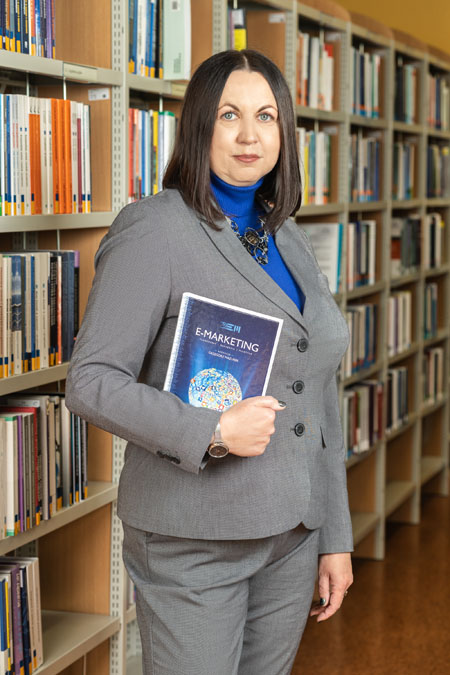
Dr. Izabela Michalska-Dudek is a Professor and Head of the Department of Marketing and Tourism Management at Wrocław University of Economics’ Jelenia Góra Branch. She specializes in customer loyalty mechanisms, consumer behavior in tourism, and digital transformation impacts on travel agencies. Her work emphasizes empirical studies on CRM systems, post-pandemic travel decision-making, and predictive modeling for loyalty programs. Research Interests: Customer Relationship Management (CRM), Virtualization in Tourism, Pandemic Impact Analysis, Retail Tourism (ROPO), and Machine Learning applications in loyalty analytics. She actively publishes in peer-reviewed journals and organizes international conferences like the 'Current Trends in Spa, Hotel and Tourism' series. Publications focus on analyzing socio-economic factors influencing travel behavior, crisis management strategies, and technological adoption in the tourism sector. Recent work explores how machine learning can uncover consumer loyalty motives and quantify pandemic-related behavioral shifts. No scientific awards listed. She supervises doctoral students and is open to socio-economic collaborations. Consultations available via MS Teams on Fridays.
Marjan Sirjani is a Professor at Mälardalen University, affiliated with the School of Innovation, Design and Engineering, and the Division of Computer Science and Software Engineering. Her research focuses on cybersecurity, formal verification, and cyber-physical systems, with notable contributions to actor-based modeling (e.g., Timed Rebeca) and tools like AFRA for model analysis. She specializes in integrating formal methods into safety-critical systems, including automotive cybersecurity, ROS2 robotics, and blockchain-based IoT systems. Her work emphasizes rigorous analysis of protocols, concurrency, and real-time constraints. Recent projects include the CRYSTAL framework for CPS assurance, Tiny Twins for runtime attack detection, and applying LLMs for automated test generation. She also explores semantic segmentation in construction and compositional analysis of distributed systems. Publications highlight advancements in protocol learning, controller synthesis for safety, and model-driven development. Her research bridges theoretical foundations (e.g., automata theory, temporal logics) with practical applications in autonomous systems, medical device interoperability, and smart mobility. Labs/Teams: Involved in the Rebeca tool development (AFRA) and collaborative projects on CPS security. Grants: Not explicitly listed but implied through project involvement.