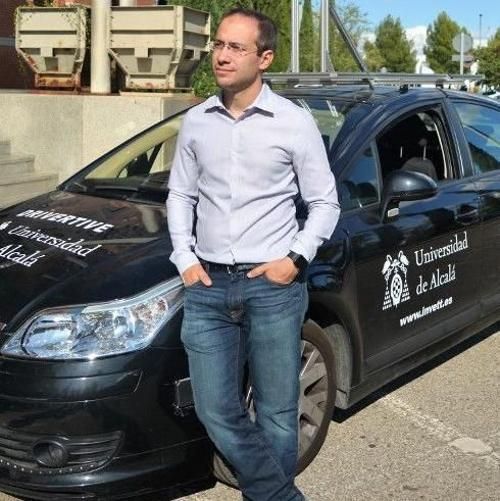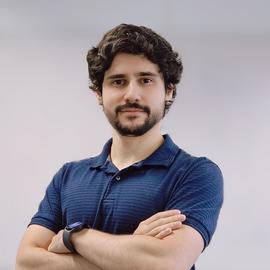
Antonio Guimarães is a postdoctoral researcher at the IMDEA Software Institute in Madrid, Spain. His research focuses on practical aspects of Fully Homomorphic Encryption (FHE), including verifiable FHE, fast bootstrapping algorithms, and efficient homomorphic evaluation of cryptographic primitives. He holds a Ph.D. in Computer Science from the University of Campinas (2019-2023), where he also completed his MSc (2017-2019) and Computer Engineering degree (2012-2016). During his Ph.D., he was a visiting student at Aarhus University (2022-2023). His work emphasizes privacy-preserving technologies and verifiable computation, with applications in secure cloud computing and encrypted machine learning. Education: Ph.D. in Computer Science, University of Campinas (2019-2023) Visiting Ph.D. Student, Aarhus University (2022-2023) MSc in Computer Science, University of Campinas (2017-2019) Computer Engineering, University of Campinas (2012-2016) His research interests include advancing FHE efficiency, developing verifiable computation frameworks for encrypted data, and exploring practical implementations of post-quantum cryptographic algorithms. He has presented work at venues such as CRYPTO, ASIACRYPT, and CHES, and contributed to open-source cryptographic libraries like MOSFHET and HELIOPOLIS. His recent projects focus on homomorphic evaluation of neural networks and optimizing FHE for real-world applications. His publications highlight contributions to bootstrapping algorithms, verifiable computation over approximate arithmetic, and privacy-preserving machine learning. These works emphasize balancing cryptographic security with computational efficiency. Grants and Collaborations: Collaborations include projects on secure transciphering for MPC and high-performance seismic data processing in cloud environments. His work often bridges theoretical cryptography with practical software implementations. Labs/Teams: His research is conducted within the IMDEA Software Institute’s cryptography group, focusing on applied cryptography and privacy-preserving technologies.