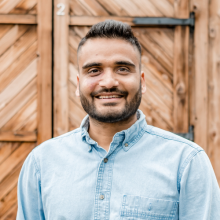
Mayank Chadhaمشاهده پروفایل
استادیار مدعو
Mayank Chadha is an Assistant Adjunct Professor in the Department of Structural Engineering at the University of California, San Diego. He holds a Ph.D. and M.S. in Structural Engineering from UC San Diego and a B.E. in Civil Engineering from PSG College of Technology, Anna University. His research focuses on integrating applied mechanics, machine learning, and Bayesian methodologies to address challenges in structural health monitoring (SHM), risk analysis, and optimal sensor design. He also explores the application of physics-constrained machine learning in hydrology and battery degradation modeling. Education: 2019: Ph.D. in Structural Engineering, UC San Diego 2023: Postdoctoral Fellowship, UC San Diego 2014: B.E. in Civil Engineering, PSG College of Technology Dr. Chadha’s research interests include structural health monitoring, applied mechanics, uncertainty quantification, and the development of decision-making frameworks for engineering systems. He has pioneered work on Bayesian model optimization, sensor placement strategies, and value-of-information analysis. His interdisciplinary approach bridges theoretical mechanics with practical data-driven solutions for modern engineering problems. His recent work emphasizes hybrid physics-based machine learning models for streamflow forecasting and battery RUL prediction, demonstrating the fusion of computational efficiency and physical principles. He has authored numerous articles on optimal sensor design, VoI metrics, and risk-informed decision-making in SHM systems. Scientific Awards: Gold medal for CBSE 12th exams (2010) Central Government Fellowship (2014) Gold medal for Civil Engineering proficiency (2014) In addition to academia, Dr. Chadha co-founded LogSpi LP, a quantitative investment hedge fund. He teaches courses on mechanics and signal processing, emphasizing foundational engineering principles and their real-world applications. His research also extends to the development of higher-order geometrically exact beam theories, with applications in computer graphics and shape sensing. He actively collaborates with the U.S. Army Corps of Engineers on projects involving inland waterway infrastructure and risk-based sensor design.