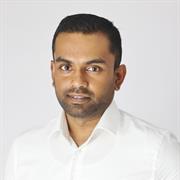
Niko Sünderhauf is a Professor in the School of Electrical Engineering and Robotics at Queensland University of Technology (QUT), specializing in robotics, computer vision, and autonomous systems. His research spans visual place recognition, simultaneous localization and mapping (SLAM), neural radiance fields, and out-of-distribution detection for robotics applications. His research interests focus on enabling robots to understand and navigate complex environments through advanced computer vision techniques. He has made significant contributions to visual place recognition, particularly for handling viewpoint and environmental changes. His work on switchable constraints has improved robustness in SLAM systems, while his more recent research explores neural radiance fields, Gaussian splatting, and integrating large language models with robotic perception. Prof. Sünderhauf's publication record demonstrates consistent research productivity with 115 publications spanning from 2005 to 2025. His recent work shows a clear progression from traditional SLAM techniques toward more advanced neural scene representations and integration with large language models. His research has been published in top venues including IEEE ICRA, CVPR, IROS, and the International Journal of Robotics Research. Among his scientific contributions are novel approaches to visual place recognition that work across seasons and viewpoints, robust SLAM techniques that handle outliers and non-linearities, and recent innovations in neural scene representations for robotics. His work on switchable constraints has been particularly influential in the robotics community. Prof. Sünderhauf actively supervises PhD students including Dimity Miller, Krishan Rana, and Jad Abou-Chakra, who frequently appear as first authors on publications. His collaborative network includes researchers from QUT and international institutions, demonstrating strong research leadership in the robotics community.