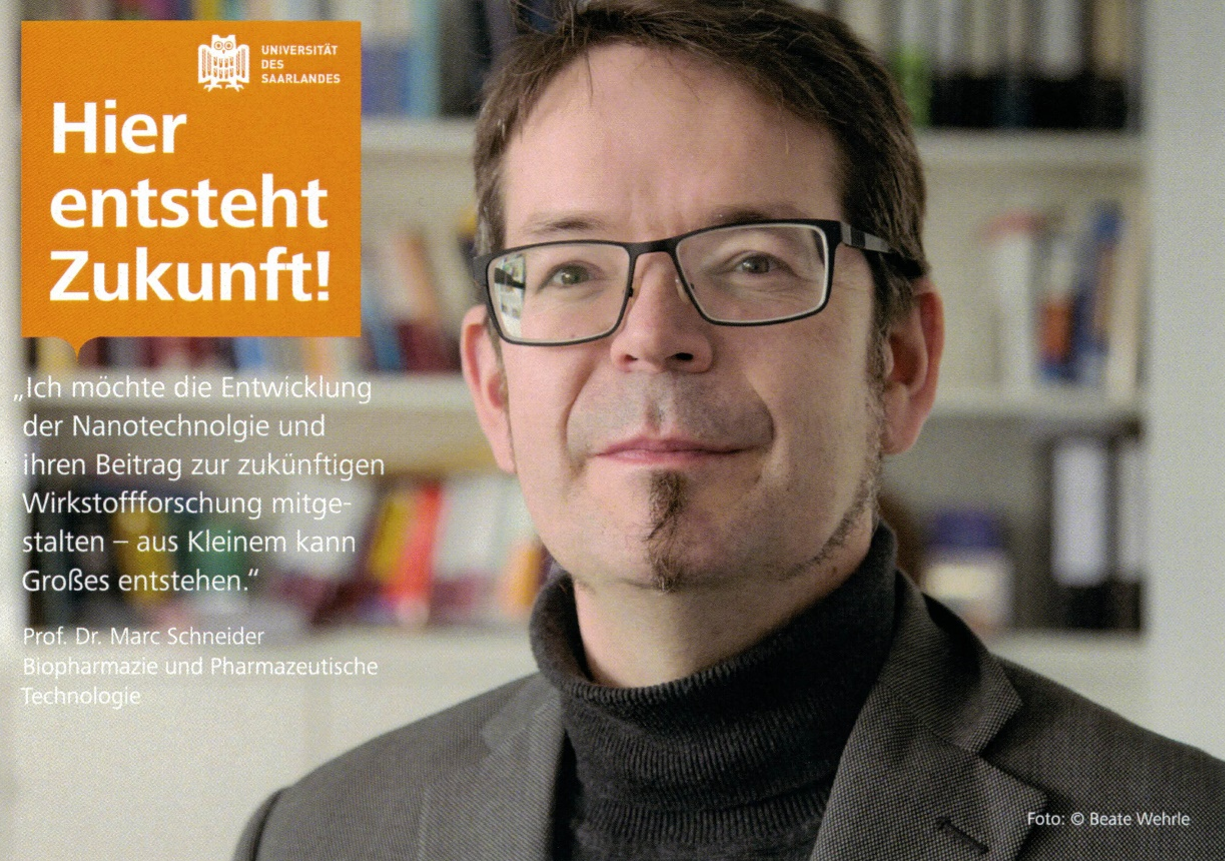
Prof. Dr. Marc Schneider holds a professorship in Biopharmaceutics and Pharmaceutical Technology at Saarland University's College of Pharmacy . His research focuses on colloidal drug delivery systems, particularly nanostructured and non-spherical particle engineering for overcoming biological barriers in pulmonary and transdermal applications. He leads an internationally recognized lab in Saarbrücken, collaborating with Helmholtz Institute for Pharmaceutical Research Saarland (HIPS) and trinational institutions. Research Highlights: Development of inhalable nano/microparticle systems Surface modification of gelatin nanoparticles Characterization of mucus-penetrating particles 3D printing for microneedle fabrication Atomic Force Microscopy (AFM) for nanoparticle analysis Selected Scientific Awards: European Journal of Pharmaceutics and Biopharmaceutics Best Paper Award (2018) for mucus-penetrating nanoparticles Recognized in 'Ausgezeichnete Orte im Land der Ideen' competition (2018) for 'Nano-Mais' drug delivery system Collaborative Networks: Co-editor for Advanced Drug Delivery Reviews special issue on biological barriers Key participant in trinational Master's program in Biomedicine with Strasbourg, Mainz, and Luxembourg Active in Controlled Release Society (CRS) conferences and local chapters
Axel Haase is a Carl von Linde Senior Fellow at the Technical University of Munich (TUM) and Director of the Institute of Medical Engineering (IMETUM). He holds a professorship in Experimental Physics (Biophysics) at the University of Würzburg. His research focuses on magnetic resonance imaging (MRI), including co-inventing the FLASH MRI technique and advancing biomedical applications like cardiac and neurological studies. He previously served as President of the University of Würzburg (2003–2009) and President of the European Society of Magnetic Resonance in Biology and Medicine (ESMRMB). Education: Diploma in Physics (1977), PhD (1980) from University of Giessen, Habilitation in Biophysical Chemistry (University of Frankfurt). Leadership Roles: Max Planck Institute of Biophysical Chemistry (1978–1989), Postdoc at University of Oxford (1982). Research Interests: MRI技术创新,包括快速成像技术、医学成像应用、生物医学工程。His work has led to patents and significant advancements in MRI methodologies. Awards: 包括Bavarian Academy of Sciences Fellow (2001)、ISMRM金质奖章 (1991)、DFG Heisenberg Fellowship (1987)等。 Labs & Teams: Director of IMETUM at TUM, leading interdisciplinary research in medical engineering and imaging technologies.
Prof. Markus Axer is a Professor and Deputy Head of the Structural and Functional Organisation of the Brain (INM-1) at the Institute of Neuroscience and Medicine (INM) within Forschungszentrum Jülich. His research focuses on connectomics, neuroimaging technologies (e.g., 3D-Polarized Light Imaging), and high-performance computing applications in brain architecture analysis. He leads the 'Fiber Architecture' working group, advancing microscopy techniques like scattered light imaging and MRI-histology correlation for studying brain microstructure. His work bridges experimental neuroscience with computational methods, aiming to decode brain organization at meso- and macroscales. Key achievements include developing the HippoMaps atlas of the human hippocampus and improving fiber orientation mapping in brain tissue. Awards include Fellowship in the Royal Netherlands Academy of Arts and Sciences (2024). Research emphasizes cross-modal data integration, with applications in Alzheimer’s disease biomarker validation and primate brain evolution studies. He collaborates with academic institutions like the University of Wuppertal and contributes to international initiatives like the BigBrain Analytics Learning Laboratory.
Prof. Dr.-Ing. Maria Francesca Spadea serves as Director of the Institute of Biomedical Engineering (IBT) at Karlsruhe Institute of Technology (KIT), part of the Helmholtz Association. Her leadership role includes overseeing research initiatives, teaching activities, and administrative responsibilities within the institute. Located in space 512, she maintains regular consultation hours on Wednesdays from 10:30-11:30 am by appointment. Professor Spadea's research spans several cutting-edge areas in biomedical engineering, with particular focus on medical image processing, artificial intelligence applications in healthcare, and radiomics. Her work bridges computational techniques with clinical applications, emphasizing practical solutions for medical imaging challenges. She has pioneered approaches in federated learning for medical image translation, particularly in CT/MRI synthesis for radiation therapy applications. Her research also extends to cancer cell analysis, vascular biomechanics, and medical robotics, demonstrating a broad yet cohesive research portfolio that addresses critical challenges in modern healthcare. Analysis of Professor Spadea's recent publications reveals a strong emphasis on AI-driven medical imaging solutions, particularly in the translation between different imaging modalities (like MRI-to-CT) using federated learning approaches that preserve patient privacy. Her work demonstrates growing specialization in radiation therapy applications, with multiple publications addressing synthetic CT generation for treatment planning. There's also a clear trajectory toward multi-institutional collaboration, as evidenced by her involvement in projects spanning multiple research centers across Europe. Professor Spadea actively mentors numerous students, including M. Krohmer Zabaleta, N. Skupien, and M. Destito, who have completed bachelor's and master's theses under her supervision. Her research group appears well-integrated within the broader Institute of Biomedical Engineering, collaborating extensively with colleagues like P. Zaffino and C.B. Raggio on multiple projects. The group maintains strong connections with clinical partners, as evidenced by publications addressing real-world medical challenges in radiation therapy, cardiology, and neurosurgery. The research activities of Professor Spadea's team are centered within the Institute of Biomedical Engineering at KIT, with particular focus on medical imaging processing and AI applications. Her laboratory appears to specialize in developing computational tools for medical image analysis, with recent work emphasizing privacy-preserving federated learning frameworks that enable multi-institutional collaboration without sharing sensitive patient data. The team maintains active collaborations with clinical departments, particularly in radiation oncology, as evidenced by numerous publications addressing CT synthesis for radiation therapy planning.
Professor Ghazaleh Tabatabai serves as Head of Department for Clinical and Experimental Neuro-Oncology at the Hertie Institute for Clinical Brain Research, University of Tübingen. She leads a multidisciplinary research group focused on translational neuro-oncology with active collaborations through the German Glioma Network, German Cancer Consortium (DKTK), European Organisation for Research and Treatment of Cancer (EORTC), European Association of Neuro-Oncology (EANO), and International Consortium on Meningioma (ICOM). Her research program centers on molecular mechanisms of tumorigenesis, therapy resistance, and treatment-induced vulnerabilities in nervous system tumors. The laboratory employs CRISPR screening technologies, molecular profiling, and preclinical models to identify therapeutic targets, with particular expertise in glioma and meningioma biology. Current projects span from discovery through validation to clinical application, including phase I/II trials of novel therapies such as CureVac's mRNA vaccine candidate CVGBM. Recent publications demonstrate leadership in molecular classification of meningiomas, CRISPR-based target discovery, immunotherapy development, and clinical trial design. Her work on the TRACE app for patient-reported outcomes and the PRIDE trial for dose-escalated radiation therapy represents significant clinical translation efforts. The 2024-2025 publication record shows strong productivity with high-impact papers in Neuro-Oncology, Nature Medicine, and Genome Biology. Elected spokesperson of the DFG Board for Neuroscience (2024) Active participation in EANO guideline development Leadership in multiple international consortia including ICOM Principal investigator for clinical trials including N2M2/NOA-20 umbrella trial Professor Tabatabai mentors a large research team including PhD students, medical doctoral candidates, and postdoctoral researchers. Her laboratory maintains active clinical collaborations across neurosurgery, radiation oncology, and medical oncology departments. She is featured in the 'Key To My Research' podcast discussing tumor intelligence and regularly presents at major neuro-oncology conferences including ASCO, EANO, and SNO.
Prof. Katia Parodi is a faculty member at the Ludwig-Maximilians-Universität München (LMU Munich) in the Faculty for Physics, leading the Chair of Experimental Physics – Medical Physics established in August 2012. Her research focuses on pre-clinical and clinical image-guided radiotherapy, advancing instrumentation for radiation interaction studies in tumor and normal tissues using beam modalities ranging from photons and hadrons to laser-based systems. She spearheads the ERC-funded project SIRMIO and collaborates with institutions like the Center for Advanced Laser Applications (CALA) and international Ion Beam Therapy Facilities. Key areas: radiation interaction, therapeutic strategies, ion radiography, ionoacoustics, prompt gamma tomography, MRI, and spectral CT. Developed a precision image-guided radiation research platform under the SIRMIO project. Network includes LMU University Hospital and other national/international collaborators. Scientific contributions recognized through the ERC Project SIRMIO. Contact: katia.parodi@physik.uni-muenchen.de.
Prof. Dr. Franziska Mathis-Ullrich is a Professor at Friedrich-Alexander-University Erlangen-Nuremberg (FAU) leading the Surgical Planning and Robotic Cognition Lab (SPARC) in the Department of Artificial Intelligence in Biomedical Engineering. Previously, she was an Assistant Professor at Karlsruhe Institute of Technology (KIT) from 2019 to 2023. Her research focuses on minimally invasive robotic systems, soft robotics, and embedded machine learning for surgical applications. She holds a PhD in Microrobotics from ETH Zurich (2017), with earlier degrees from the same institution. Education: B.Sc. and M.Sc. in Mechanical Engineering and Robotics (ETH Zurich, 2009–2012) Ph.D. in Microrobotics (ETH Zurich, 2017) Research Interests: Minimally invasive medical robotics, soft robotic systems, AI-driven surgical assistance, microrobotics, and robot-assisted surgery. Her work emphasizes translating robotics innovations into clinical applications through interdisciplinary collaboration. Key Awards: IEEE ICRA Best Paper Award in Medical Robotics (2014) IEEE BioRob Best Student Paper Award (2016) ICRA Microassembly Challenge First Prize (2014 & 2015) Forbes 30 under 30 (2017) Grants & Projects: Leading a Bavarian State Ministry-funded project on endometriosis diagnostics (€3M). Active in multidisciplinary collaborations with Erlangen University Hospital. Serves as Vice-President of the German Society for Computer- and Robot-assisted Surgery (CURAC). Labs & Teams: Directs the SPARC Lab, which develops cognitive robotic systems for surgical planning and execution. Collaborates with institutions like Max Planck, Fraunhofer, and Helmholtz.
Leonid Goubergrits is a Professor of Cardiovascular Modeling and Simulation at the Einstein Center Digital Future and Charité – Universitätsmedizin Berlin . With a background in applied mathematics and physics from the Moscow Institute of Physics and Technology, he has dedicated his career to applying computational fluid dynamics (CFD) to cardiovascular medicine since immigrating to Germany in 1995. His work bridges fundamental research and clinical applications, aiming to integrate numerical models into everyday medical practice to enhance diagnostics and reduce invasiveness. Doctorate at Technische Universität Berlin (2000) Habilitation at Technische Universität Berlin (2016) His research spans blood flow modeling in coronary vessels, cerebral aneurysms, heart valves, and the aorta, alongside artificial organ development and blood damage modeling . He leads a research group at Charité and the German Heart Center Berlin, focusing on patient-specific simulations and their translation to clinical settings. Recent publications highlight his work on deep learning integration for hemodynamic analysis, 4D Flow MRI validation , and medical device optimization using computational models. His team’s research includes virtual therapy planning for aortic valve replacements, hemolysis modeling , and pulmonary artery pressure sensors . Leonid actively contributes to education, redesigning TU Berlin’s Fluid Mechanics in Medicine curriculum and fostering interdisciplinary collaboration between engineers, physicians, and computer scientists. His vision emphasizes the digital transformation of medicine through computational modeling and simulation.
Jörg Wrachtrup is a Professor at the Department of Physics, Faculty of Mathematics and Physics, University of Stuttgart, and a Fellow at the Max Planck Institute for Solid State Research. He is recognized as one of the most cited physicists globally due to his groundbreaking work on diamond-based quantum sensors, particularly utilizing nitrogen-vacancy (NV) centers for ultra-precise measurements. His research focuses on advancing quantum sensing technologies with applications in neuroscience, medical diagnostics (e.g., next-generation MRI and NMR), and materials science. These sensors enable non-invasive, high-resolution detection of magnetic fields at the nanoscale, opening new frontiers in both fundamental physics and real-world technology deployment. Wrachtrup emphasizes interdisciplinary collaboration and early engagement with applied sciences and industry, advocating for partnerships between academia, Fraunhofer institutes, startups, and large enterprises to accelerate the commercialization of quantum technologies. He believes quantum sensing is ahead of quantum computing in terms of practical application and near-term impact. Scientific awards and recognitions are not mentioned in the provided text. He actively mentors students and leads a research group focused on quantum sensor development, though specific advisees are not listed. His lab collaborates closely with institutions like the Fraunhofer IAF, which develops diamond-based semiconductor qubits and sensor platforms. The team works on translating fundamental quantum phenomena into scalable, deployable technologies, with future goals including miniaturized, high-sensitivity sensors for integration into medical devices and potentially consumer electronics.
Despina Kontos, PhD is the Herbert and Florence Irving Professor of Radiological Sciences at Columbia University Irving Medical Center (CUIMC), with appointments in the Department of Radiology and the Herbert Irving Comprehensive Cancer Center. She serves as the Chief Research Information Officer for CUIMC, Vice Chair of Artificial Intelligence and Data Science Research in the Department of Radiology, and Director of Biomarker Imaging at NewYork-Presbyterian Hospital. Additionally, she holds appointments in the Departments of Biomedical Informatics and Biomedical Engineering. Dr. Kontos received her educational training from prestigious institutions: BS in Engineering from the University of Patras, Greece MSc and PhD in Computer and Information Sciences from Temple University Postdoctoral training in Radiology at the University of Pennsylvania Certificates in Biostatistics and Epidemiology from UPenn, Cancer Biology from Harvard, and AI for Decision Making from Wharton As a computer scientist with expertise in artificial intelligence and machine learning, Dr. Kontos focuses on developing computational methodologies to leverage imaging as quantitative biomarkers for personalized disease prediction, particularly in cancer. Her research program investigates how imaging data can be mined to extract sophisticated phenotypic signatures with diagnostic, prognostic, and predictive value. While her primary focus has been on breast cancer, her lab also pursues related research in lung cancers, evaluating the integration of CT radiomic features with liquid biopsy data to characterize tumor heterogeneity. Dr. Kontos founded and directs Columbia University's Center for Innovation in Imaging Biomarkers and Integrated Diagnostics (CIMBID), a multidisciplinary center dedicated to developing and integrating quantitative imaging and non-imaging biomarkers for personalized disease prediction. Through CIMBID, she has built a vibrant scientific ecosystem that brings together expertise across Columbia's campuses, linking basic science, engineering, clinical medicine, public health, and health services research. Analysis of Dr. Kontos's publication record reveals a strong focus on applying AI and machine learning to biomedical imaging, particularly for cancer risk prediction and personalized treatment. Her work demonstrates a progression from foundational methodological development to clinical translation, with increasing emphasis on multi-modal biomarker integration. Recent publications show expansion into new disease areas including Alzheimer's disease prediction, while maintaining her strong focus on breast and lung cancer applications. Dr. Kontos has received significant recognition for her contributions to the field: Academy for Radiology and Biomedical Imaging Research Distinguished Investigator Award (2020) Eastern Cooperative Oncology Group - American College of Radiology Imaging Network ECOG-ACRIN Young Investigator Award of Distinction for Translational Research (2014) Dr. Kontos has been highly successful in securing research funding, with numerous grants from federal agencies including the National Institutes of Health (NIH) and the Department of Defense (DOD), as well as private foundations such as the American Cancer Society (ACS) and the Radiological Society of North America (RSNA). Her leadership extends to mentoring students and postdoctoral researchers through her roles at CIMBID and the Department of Radiology. As the founding director of CIMBID, Dr. Kontos leads a multidisciplinary team that includes the Computational Imaging Biomarker Group (CBIG), the Laboratory of AI and Biomedical Science (LABS), and several other affiliated research labs. The center leverages Columbia's institutional strengths in engineering, data science, and clinical medicine to advance personalized healthcare through AI and imaging technologies.
Simone Kühn serves as Director of the Research Center for Environmental Neuroscience at the Max Planck Institute for Human Development in Berlin and holds the position of Heisenberg Professor at the University Medical Center Hamburg-Eppendorf since 2016. Previously, she led the Lise Meitner Group for Environmental Neuroscience at the Max Planck Institute (2019-2024) and currently directs the Psychiatric Environmental Neuroscience (PEN) working group, a collaboration between the MPIB and Charité-Universitätsmedizin Berlin since 2025. Her academic credentials include a Dipl.-psych from the University of Potsdam (2006), Dr. rer. nat. from the University of Leipzig (2009), and Habilitation in Psychology from Humboldt-Universität zu Berlin (2012). These qualifications established her expertise in the neural mechanisms underlying human-environment interactions. Dr. Kühn's pioneering research examines how natural versus built environments impact mental health, cognitive processes, and neural structures across the lifespan. Her work integrates environmental psychology, neuroscience, and clinical psychiatry to investigate how exposure to different environments shapes brain function and psychological well-being. She employs advanced methodologies including structural and functional MRI, virtual reality environments, and longitudinal study designs to uncover the neural pathways connecting physical environments to mental health outcomes. Her research has demonstrated that natural environments can reduce stress, enhance cognitive restoration, and positively influence brain structure, particularly in regions associated with emotion regulation and memory. Analysis of her extensive publication record reveals a consistent trajectory toward increasingly sophisticated investigations of environmental influences on the brain. Her recent work has expanded into virtual reality applications for mental health treatment, the neural mechanisms of architectural design preferences, and the impact of air pollution on brain health. She has pioneered experimental approaches to study environmental effects through controlled exposure studies, including the development of virtual nature environments that can be precisely manipulated to isolate specific environmental features. Her scientific contributions have been recognized through prestigious appointments: Election to the German National Academy of Sciences Leopoldina Membership in the DFG-Network WAS (Wirkungsforschung in Architektur und Städtebau) Service on the Psychology Review Board of the German Research Foundation (DFG) Fellowship at the German Institute for Economic Research (DIW) Early recognition through admittance to Studienstiftung des deutschen Volkes (2005) Dr. Kühn has mentored numerous doctoral and master's students whose theses explore diverse aspects of environmental neuroscience, from the impact of natural environments on stress physiology to the neural correlates of architectural preferences. Her research has been supported by substantial funding that has enabled large-scale investigations of environmental influences on brain health across different age groups and populations, including vulnerable individuals with mental health conditions. As leader of the Center for Environmental Neuroscience, she directs a multidisciplinary team of researchers who employ cutting-edge methodologies to investigate how environmental factors shape brain development, function, and mental health. The center's work has significant implications for evidence-based urban planning, therapeutic interventions using nature exposure, and understanding the neural basis of human-environment interactions in an increasingly urbanized world.
Dr. Markus Zimmermann is a researcher at the Institute of Neuroscience and Medicine (INM-4: Physics of Medical Imaging) at the Research Center Jülich. His work focuses on advancing quantitative MRI techniques, particularly in water content mapping, multiparametric imaging, and ultrahigh-field MRI applications. He contributes to developing methods for eddy current characterization, multi-exponential relaxometry, and rapid whole-brain protocols. His research addresses neurological and medical imaging challenges, including cerebral pathologies and neurobiological implications. Key areas of expertise include MRI parameter estimation, medical imaging algorithms, and the integration of advanced imaging techniques for clinical and neuroscience applications. His projects often involve collaborations to validate methodologies using in vivo/ex vivo experiments and super-resolution reconstruction. Dr. Zimmermann’s work aims to enhance diagnostic precision and understanding of brain physiology through innovative MRI technologies.
Prof. Dr. Katja Beesdo-Baum is a Full Professor of Behavioral Epidemiology at the Institute of Clinical Psychology and Psychotherapy, Faculty of Science, Technical University of Dresden. Her research focuses on the epidemiology and clinical aspects of mental disorders, integrating neurobiological, developmental, and environmental factors through large-scale observational and experimental studies. She holds editorial roles at journals like Child Psychiatry & Human Development and contributes to global initiatives such as the WHO’s ICD-11 clinical practice network. Her work spans anxiety disorders, depression, and prevention strategies in youth, with a strong emphasis on translational research and healthcare system integration. Education includes a Diploma in Psychology (2000) and a Dr. rer. nat. (2006), both from TU Dresden, followed by Habilitation in 2010. Professional experience includes postdoctoral training at the National Institute of Mental Health (USA) and leadership roles in clinical and research groups. Awards include the ECNP Fellowship and Dr.-Walter-Seipp Dissertation Award. Her research explores mechanisms linking stress, neuroendocrine systems, and mental disorders, with recent studies focusing on brain structure alterations in anxiety disorders (ENIGMA collaborations) and the efficacy of prevention programs. She investigates digital health tools, stigma reduction, and sociodemographic barriers to mental healthcare access in adolescents and young adults. Key Research Themes: Behavioral epidemiology, developmental psychopathology, neuroimaging, prevention science. Recent Trends: Machine learning in brain-based classification of anxiety disorders, longitudinal studies on stress biomarkers (e.g., cortisol, androgens), and implementation science for pediatric mental health services. Awards highlight her contributions to clinical guidelines (DSM-5 Task Force) and global mental health policy. Her grants and collaborations span European and international funding bodies, emphasizing interdisciplinary approaches to mental health challenges. Labs/Teams: Active in the ENIGMA Anxiety Working Group, BeMIND study (behavioral-mind health cohort), and Dresden-based clinical research networks.
Prof. Dr. Julia Schnabel is the TUM Liesel Beckmann Distinguished Professor and Helmholtz Distinguished Professor at TUM's TUM School of Computation, Information and Technology. Her research focuses on computational imaging and AI in medicine, including medical image processing, machine learning, motion modeling, and quantitative imaging. She holds IEEE, Ellis, and MICCAI Society fellowships, and has pioneered work in image reconstruction, artifact correction, and AI-based diagnostics. Educations: Bachelor/Master from TU Berlin (1993) PhD from University College London (1998) Postdocs at UMC Utrecht, King's College London, and UCL Her research interests span medical AI, deep learning for medical imaging, and clinical evaluation methodologies. Key contributions include frameworks for motion artifact correction in MRI, physics-informed neural networks, and benchmark datasets like NOVA for anomaly detection in brain MRI. She has authored over 100 publications, with recent work advancing unsupervised anomaly detection and federated learning in healthcare. Prof. Schnabel leads interdisciplinary projects at TUM and Helmholtz Zentrum München, focusing on AI-driven solutions for diagnostic and therapeutic challenges. Her labs develop tools for real-time cardiac imaging, histopathology segmentation, and trustworthy AI guidelines (FUTURE-AI initiative).
Sonja Schelhaas is a researcher affiliated with the European Institute for Molecular Imaging (EIMI) at the University of Münster. Her work focuses on molecular imaging technologies, particularly in oncology and neurological contexts. PhD in Medical Biochemistry (2007-2010) Postdoc at EIMI since 2010 Research Fellow in Anaesthesiology (2005-2006) Her research spans: PET tracer development for ion channels Molecular imaging of tumor microenvironments Applications of small animal PET in disease models Bacterial and inflammatory imaging Radiochemistry and multimodal imaging techniques Epigenetic regulation in cancer Recent publications highlight her contributions to: P2X4 receptor antagonists for PET tracers KCa31 channel imaging in cancer Bacterial detection via radiolabeled compounds FLT PET for tumor proliferation analysis Neurogenesis and blood-brain barrier studies PEGylated nanoparticle characterization Schelhaas has collaborated extensively in preclinical imaging projects, contributing to cancer research, infection monitoring, and neurodegenerative disease modeling. Her work appears in journals like Journal of Medical Chemistry , Cancer Research , and Molecular Imaging and Biology .