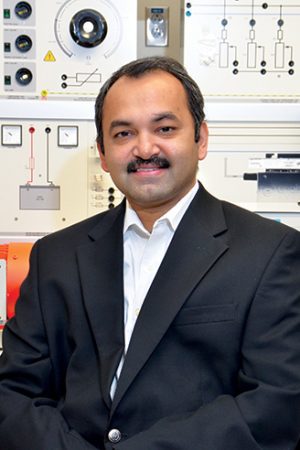
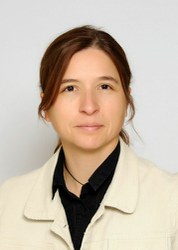
Dr. Madhav Manjrekar is an Associate Professor in the Department of Electrical and Computer Engineering at the University of North Carolina at Charlotte. He earned his Ph.D. from the University of Wisconsin–Madison in 1999. His research focuses on power electronics applications in utility systems, renewable energy interfaces, and cybersecurity of electricity infrastructure. Key areas include power quality improvement in microgrids, high-voltage direct current (HVDC) transmission, and advanced electrical machine design for electric vehicles and wind energy systems. His work emphasizes innovative solutions for energy storage integration, grid resiliency, and fault-tolerant power systems. Recent publications highlight advancements in DSTATCOM for microgrids, solid-state circuit breakers, and doubly salient electrical machines. He has contributed to projects like the US-Caribbean Super Grid and HVDC interconnectors for offshore renewable energy. Dr. Manjrekar’s research also addresses cybersecurity vulnerabilities in power infrastructure and explores next-gen semiconductor technologies like SiC MOSFETs. His interdisciplinary approach bridges power electronics, machine design, and grid stability, with applications in both academic and industry settings.
Matthias Bucher is a Professor at the Department of Electronics and Computer Engineering, Technical University of Crete. He specializes in analog/RF integrated circuits design, MOSFET compact modeling, and device characterization. His research focuses on nanoscale CMOS, wide-band semiconductor devices, and high-voltage MOSFETs. He leads the Electronics Laboratory and teaches courses such as Electronics II and CMOS Analog IC Design. Education: Ph.D. in Electrical Engineering, Swiss Federal Institute of Technology (EPFL), 1999 M.S. in Electrical Engineering, Swiss Federal Institute of Technology, 1993 Research Interests: Prof. Bucher’s work emphasizes charge-based compact models (e.g., EKV3), RF device modeling, and noise analysis in MOSFETs/JFETs. His contributions include open-source tools for Verilog-A modeling and parameter extraction methodologies for advanced CMOS technologies. Labs/Teams: He directs the Electronics Laboratory , focusing on nanoelectronics and high-reliability circuits. His team collaborates on semiconductor device modeling for aerospace and industrial applications. Grants/Awards: While not explicitly listed, his extensive publication record and leadership in open-source projects indicate sustained recognition in semiconductor research communities.
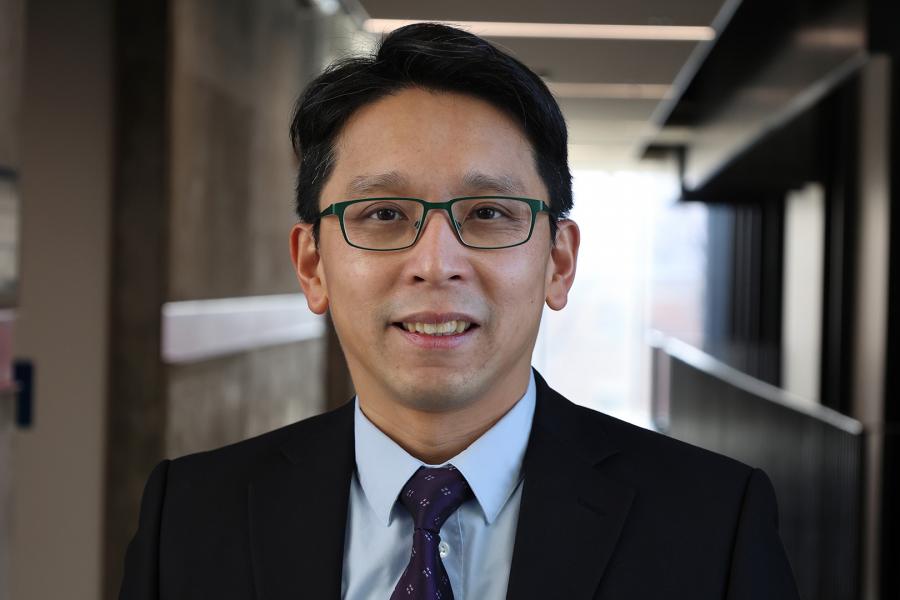
Dr. Carl Ho (Ngai Man) is a Full Professor and Canada Research Chair in Efficient Utilization of Electric Power at the University of Manitoba's Price Faculty of Engineering, Department of Electrical and Computer Engineering. Appointed Associate Head (Electrical Engineering) in July 2021, he leads the Renewable-energy Interface and Grid Automation (RIGA) Lab established with CFI funding in 2014. His educational background includes: PhD in Electronic Engineering (2007), City University of Hong Kong MEng in Electronic Engineering (2002), City University of Hong Kong BEng in Electronic Engineering (2002), City University of Hong Kong Dr. Ho's research focuses on power electronics applications for sustainable energy systems, with particular expertise in power conversion technologies for electric vehicles, renewable integration, and smart grid infrastructure. His work bridges industrial application and academic innovation, evidenced by over 40 IEEE journal publications, 80 conference papers, and 20+ patents. Current research emphasizes wide-bandgap semiconductor applications, power hardware-in-loop validation, and DC microgrid architectures for remote communities. Analysis of his recent publications reveals a strong trend toward practical implementation of power electronics solutions, with increasing focus on GaN/SiC devices, grid-forming converters, and modular architectures for microgrids. His work consistently addresses real-world challenges in efficiency, reliability, and cost-effectiveness across renewable integration, electric transportation, and power quality domains. Notable awards include: Second Place Winner for 2018 IEEE Transactions on Power Electronics Prize Paper Multiple IEEE JESTPE Star Associate Editor Awards (2022-2023) IEEE TPEL AE Excellence Award (2023) Best Student Team Regional Award in IEEE Empower a Billion Lives 2019 As an active mentor, Dr. Ho supervises numerous graduate students across multiple cohorts and leads significant research initiatives including NSERC Discovery Grants, MITACS collaborations with Power Integrations Inc., Research Manitoba Innovation Proof-of-Concept Grants, and Natural Resources Canada projects on zero-emission heavy vehicles. His RIGA Lab serves as a hub for industry-academic collaboration with Manitoba Hydro and transportation sector partners. The RIGA Lab, completed in 2016 and renovated in 2019, houses specialized equipment for power electronics prototyping, real-time simulation, and hardware-in-loop testing. Current projects include advanced wireless EV charging, GaN-based controller development, and DC microgrid solutions for remote communities, with recent recognition including a visit from Prime Minister Justin Trudeau in April 2023.
Thomas Ebel is Professor and Head of the Centre for Industrial Electronics at the University of Southern Denmark (SDU) , Institute of Mechanical and Electrical Engineering. A leading expert in power electronics, high-voltage engineering and capacitor technology, he directs large, multi-partner research projects and teaches/supervises at both graduate and PhD levels. Education & Career Path Prof. Ebel holds the academic title Dr. rer. nat. and has been appointed full Professor at SDU. He concurrently serves as Head of Section at the Centre for Industrial Electronics, orchestrating cross-disciplinary research teams and infrastructure. Research Interests Power Electronics & Power Conversion: advanced converter topologies, WBG devices (GaN, SiC), high-frequency magnetics, grid-forming control. Dielectric Materials & Capacitors: polymer and hybrid nanocomposite dielectrics, self-healing metallized film capacitors, aluminium electrolytic capacitors, lifetime modelling and reliability. High-Voltage Engineering & Breakdown Physics: breakdown mechanisms in nanocomposites, corona and partial discharge, insulation coordination. IoT & Data-Driven Monitoring: real-time condition monitoring, digital twins, data-driven RUL estimation for power components. Publication Trends Across 133 research outputs (2018-2025) the dominant themes are (i) construction and reliability of 700 V-class aluminium polymer electrolytic capacitors, (ii) GaN-based power converter optimisation, (iii) hybrid AC/DC microgrid control and harmonic mitigation, and (iv) nanocomposite dielectrics for next-generation capacitors. The 15 most recent articles (2025) reinforce these directions while adding socio-technical energy analytics and green-vehicle powertrains. Scientific Awards Tek Innovation Prize 2023 – awarded for outstanding contributions to power electronics research and industrial innovation. Advising & Funding Prof. Ebel currently supervises ~10 PhD candidates and post-docs including L. Tavares, M. A. Khan, R. Maheshwari, S. Mateen, A. N. Pinky and others. He is Principal Investigator or Head Coordinator of six active projects (2024-2027) valued at >€8 M, spanning ultra-high-efficiency drives, hydrogen-PtX converters, self-healing capacitors and hybrid power-plant concepts. Laboratory & Teams He heads the High-Voltage Power Electronics Laboratory at SDU, equipped with 700 V/200 A capacitor test rigs, GaN/SiC converter prototyping benches, and environmental chambers for accelerated ageing studies. The centre collaborates with 20+ industrial partners and coordinates the international IEA Wind Task 50 on hybrid power plants.
Labros Bisdounis is a Professor at the Department of Electrical and Computer Engineering, University of the Peloponnese, Greece. He previously held positions at the Technological Educational Institute of Western Greece, including Associate Professor, Full Professor, and Dean of the School of Technological Applications (2016–2018). He has extensive industry experience as a senior research engineer and project manager at Intracom S.A. (2000–2008), focusing on VLSI circuits and telecom applications. His research interests include CMOS circuit timing/power modeling, low-power/high-speed design, MOSFET modeling, and sensor applications. He has authored over 30 papers with 740+ citations and is an IEEE member. Education: Diploma in Electrical Engineering (1992), University of Patras Ph.D. in Electrical Engineering (1999), University of Patras Research Interests: CMOS circuit timing and power dissipation modeling Deep-submicron/nano-CMOS circuit design MOSFET device modeling Low-power embedded systems and SoC Sensor applications and organic electronics Leadership Roles: Dean of the School of Engineering, University of the Peloponnese (2023–present) Director of Training & Lifelong Learning Centre (2019–2019) Board Member, Hellenic NARIC (2016–2019) Collaborations: Active at the Hellenic Open University as a tutor in Computer Architecture and Digital Systems modules. Co-developed the AETHER framework for pervasive computing and contributed to energy-aware SoC designs for 5 GHz WLANs.
Dr. Ivana Kovacevic is a Lecturer at the Department of Information Technology and Electrical Engineering at ETH Zürich. Her research focuses on power electronics, semiconductor device modeling, and electromagnetic analysis of wide bandgap devices. ETH Zürich, Department of Information Technology and Electrical Engineering Contact: kovacevic@aps.ee.ethz.ch Her research explores SiC power MOSFETs, emphasizing their dynamic performance, reliability, and optimization through advanced modeling techniques like the Partial Element Equivalent Circuit (PEEC) method. She investigates parasitic extraction, thermal behavior, and stability issues in power modules, contributing to design improvements for high-efficiency systems. Her publications highlight trends in electromagnetic modeling, device-circuit interactions, and reliability analysis under extreme conditions. Key subfields include gate resistance dynamics, frequency-dependent capacitances, and multi-chip module design. Current projects involve virtual prototyping for power electronics and mission profile-based optimization of wearable power systems.
Alan Mantooth is a Distinguished Professor holding the Twenty-First Century Research Leadership Chair in Engineering within the Department of Electrical Engineering at the University of Arkansas, Fayetteville. He serves as Director of the National Center for Reliable Electric Power Transmission (NCREPT), Executive Director for GRAPES (NSF I/UCRC) and SEEDS (DoE Center), and Deputy Director of the NSF Engineering Research Center for Power Optimization of Electro-Thermal Systems (POETS). His educational background includes: B.S. in Electrical Engineering, University of Arkansas M.S. in Electrical Engineering, University of Arkansas Ph.D. in Electrical Engineering, Georgia Institute of Technology Dr. Mantooth's research centers on analog/mixed-signal IC design, power electronics CAD, and semiconductor device modeling with emphasis on harsh-environment applications. His pioneering work in silicon carbide (SiC) and gallium nitride (GaN) power systems has enabled high-temperature operation for electric vehicles and renewable energy infrastructure, significantly advancing reliability in extreme conditions. His 2025 publications reveal strong trends toward AI-driven power electronics (e.g., SolarFormer++ for PV profiling), wide-bandgap device modeling (β-Ga2O3, SiC), and innovative packaging solutions. Key themes include reliability engineering for extreme environments, multi-physics optimization, and explainable AI for safety-critical power systems. Major scientific recognition includes: IEEE Fellow (2009) for power electronic device modeling Three R&D 100 Awards (2009, 2014, 2016) for SiC power modules IEEE Power Electronics Society Technical Achievement Award (2019) Multiple university teaching/research awards including SEC Faculty Achievement Award (2015) As an exceptional mentor (UA Outstanding Mentor 2006-2008), he co-founded Lynguent and Ozark Integrated Circuits. His centers NCREPT, GRAPES, and SEEDS have secured major funding from NSF, DoE, and industry partners, supporting over 350 refereed publications and numerous patents. Current research focuses on AI-enhanced power electronics, recyclable packaging, and next-generation wide-bandgap device characterization. He leads the NCREPT test facility and multi-institutional teams developing grid-connected power electronic systems, secure energy delivery architectures, and thermal management solutions for high-power-density applications, with direct impact on electric transportation and renewable energy integration.
Daniel G Georgiev is a Professor in the Department of Electrical Engineering and Computer Science at the University of Toledo's College of Engineering. He has been on faculty since Fall 2006, following prior roles as a research faculty member at Wayne State University's Center for Smart Sensors and Integrated Microsystems (SSIM). Education : M.S. in Engineering Physics (Quantum Electronics and Laser Equipment) from Sofia University (1994), Ph.D. in Electrical Engineering (Electronic Materials and Devices) from the University of Cincinnati (2003). Research Interests : Dr. Georgiev's work focuses on laser modification and micro-structuring of materials, thin films of semiconducting oxides/nitrides (e.g., NiO, Zn3N2), glassy materials, metal whiskers (Sn, Cu), wide bandgap semiconductors (GaN, Zn3N2), photovoltaics, and biomedical device applications. His expertise spans device fabrication, material characterization, and radiation effects. Article Trends : Recent publications emphasize GaN-based power electronics, hybrid edge termination structures, threshold switching in nanocircuitries, and material innovations via reactive sputtering. Subfields include laser microstructuring, whisker suppression in Sn films, and doping strategies for nitride semiconductors. Collaborations : Co-authorship with researchers across institutions, including contributions to biomedical implants, II-VI nanocrystals, and chalcogenide glasses.
Dr Soroush Faramehr is an Associate Professor (Research) at Coventry University's Institute for Future Transport and Cities. He holds a PhD in Electrical Engineering from Swansea University (2015), specializing in wide bandgap semiconductor technologies. His research focuses on developing high-efficiency compound semiconductor devices for decarbonization in automotive, aerospace, renewable energy, and industrial sectors. He has over 10 years of R&D experience, with a strong publication record in peer-reviewed journals, successful grant acquisitions, and supervision of postgraduate researchers. Education: PhD in Electrical Engineering (Swansea University, 2015). Postdoctoral research at Swansea University before joining Coventry in 2019. Research Interests: Power semiconductor devices (GaN, SiC), magnetic sensors, thermal management, and E-mobility applications. His work aligns with UN Sustainable Development Goals related to climate action and sustainable infrastructure. Key Projects: Includes leadership in initiatives such as 'Gallium Nitride Smart Power Integrated Circuit Technology' (2021–2025) and 'GaN Hall Sensors' (2020). He has secured funding for projects like 'High-Voltage fast-charging efficient Electric vehicle Powertrains' (2025–2029). Advising: Supervises students researching topics like GaN HEMT switching behavior, thermal management in e-scooters, and second-life EV battery utilization. His advisees include Xuyang Lu, Arun Mambazhasseri Divakaran, and current students Louiza Mavrovounioti and Vartika Pandey. Publications: Over 30 articles in journals such as IEEE Access and IEEE Transactions on Power Electronics. Research spans CFD modeling, magnetic sensor development, and GaN device optimization.
Dr. Xiu Yao is an Associate Professor in the Department of Electrical Engineering at the University at Buffalo (UB), School of Engineering and Applied Sciences. She joined UB in 2015 and has held positions such as a research engineer at the University of Dayton Research Institute and a research intern at ABB Corporate Research Center. Her research focuses on power electronics, microgrid control, high-voltage DC transmission, and DC arc fault detection. Dr. Yao has received the 2016 US Air Force Summer Faculty Fellowship award for her work at Wright-Patterson Air Force Base. Education includes a PhD in Electrical Engineering from The Ohio State University (2015), an MS from Xi'an Jiaotong University (2010), and a BS from the same institution (2007). Her work emphasizes practical applications like modular multilevel converters and fusion power plant systems. Recent publications highlight advancements in DC microgrid security, wide-bandgap semiconductor devices (e.g., Ga2O3), and fault detection algorithms. Her research trends reflect a strong focus on integrating cybersecurity into power systems, optimizing HVDC systems, and enhancing fault detection through machine learning and observers. Awards and honors underscore her contributions to defense-related power systems. While no grants are explicitly listed, her work aligns with high-impact areas like renewable energy integration and high-voltage engineering.
Professor Milijana Odavic is affiliated with the University of Sheffield as a member of the School of Electrical and Electronic Engineering . Her research focuses on power electronics systems, particularly modular multilevel converters, fault-tolerant designs for aerospace and electric vehicles, and stability analysis of power electronics-dominated distribution systems. Recent publications highlight her work on: Modular multilevel converter topologies (boost/buck modes) Wide-bandgap semiconductors for ultra-efficient converters Robust stability theory for systems with parametric uncertainties She leads MEng/MSc teaching modules and contributes to the EPSRC Prosperity Partnership: New Partnership in Offshore Wind. Professional roles include Erasmus coordination and Athena SWAN team membership.
Katerina Raleva is a Full Professor at the Institute of Electronics, Faculty of Electrical Engineering and Information Technologies (FEIT), Ss. Cyril and Methodius University in Skopje, Republic of Macedonia. Her research focuses on semiconductor device physics, Monte Carlo simulations, and thermal effects in nanoscale devices. She holds a Ph.D. (2008) and M.Sc. (2002) in Electrical Engineering from her university, with a B.Sc. (1991) equivalent to an MS in the U.S. Her research interests include semiconductor device modeling, electronic circuit simulations, and nanotechnology. Collaborators include prominent figures like Dragica Vasileska (ASU) and Stephen M. Goodnick (ASU). She has authored books on self-heating effects in nanoscale devices and contributed chapters to handbooks on optoelectronic device modeling and nanophotonics. Raleva’s publications emphasize electrothermal modeling, phonon dissipation, and Monte Carlo simulations. Her work addresses critical challenges in nanodevice thermal management and high-performance electronics. She is involved in educational initiatives using cloud-based tools for microelectronics learning. Her affiliations include collaborations with TU Vienna, HEIG-VD Switzerland, and other institutions. Research labs and teams focus on nanoelectronics, semiconductor device simulation, and thermal modeling applications.
Dr. Ruiyun Fu serves as Assistant Professor in the Department of Electrical and Computer Engineering within Mercer University's School of Engineering. Her expertise spans power electronics, renewable energy systems, and semiconductor device modeling. Education: PhD in Electrical Engineering, University of South Carolina (2013) MS in Electrical Engineering, Huazhong University of Science and Technology (2007) BS in Electrical Engineering, Huazhong University of Science and Technology (2004) Her research focuses on power semiconductor device modeling (particularly SiC-MOSFET & GaN-FET), grid-connected power converters , renewable energy conversion systems , and high-frequency resonant inverters . She has developed innovative approaches for DC network protection using Z-source circuit breakers and advanced wireless power transfer techniques. Analysis of her 15 most recent publications reveals strong emphasis on DC power network security (33% of articles), semiconductor device modeling (27%), and wireless power transfer optimization (20%). The work demonstrates consistent progression from fundamental device modeling toward grid integration challenges, with increasing focus on cybersecurity aspects in recent years. Dr. Fu maintains active leadership in professional societies including IEEE Power Electronics Society, IEEE Industry Applications Society, and IEEE Women in Engineering. She serves as regular reviewer for multiple IEEE transactions and conferences including ECCE, APEC, and PES-GM. Her educational contributions include pandemic-responsive laboratory adaptations and STEAM outreach initiatives for women, reflecting commitment to both technical innovation and engineering education advancement.
David Sedarsky is an Associate Professor at Chalmers University of Technology, working within the Transport, Energy and Environment division of Mechanics and Maritime Sciences. His research focuses on applied optics and light-matter interaction for advanced imaging, with particular emphasis on characterization of dense sprays for diesel, aerospace, and automotive fuel injection systems. Dr. Sedarsky's research interests span laser-based diagnostics and imaging methods, optical measurements of turbulence, and novel analysis of optical signals for time-resolved dynamics. He specializes in the development of analytical and optical methods for visualization of fuel sprays and improvement of combustion in engines. His work combines experimental approaches with advanced data analysis techniques to understand complex fluid dynamics in spray formation and combustion processes. His publication record shows a strong focus on spray dynamics, fuel injection systems, and advanced optical measurement techniques. Recent work has expanded into electric vehicle powertrain efficiency, demonstrating the interdisciplinary nature of his research that bridges traditional combustion engineering with emerging sustainable transportation technologies. Dr. Sedarsky is actively involved in research projects including "Highly Efficient Electric Vehicle Part 2 (HEFE 2)" (2024-2026) and "HEFE - Energieffektivare elfordon" (2020-2024), both funded by the Swedish Energy Agency, focusing on energy conversion, propulsion systems, and combustion/spray technologies for more efficient vehicles.
Baoze Wei is an Associate Professor at Aalborg University's Department of Electric Power Systems and Microgrids, part of the Faculty of Engineering and Science. His research focuses on advanced control strategies for power electronics, microgrid stability, and energy management systems. He leads and collaborates on projects such as the Digital Twin-based Reliability Framework for Aviation Systems and Holistic Optimization of Green Fuel-Powered Microgrids. Key contributions include work on distributed energy systems, fault-tolerant architectures, and predictive maintenance for power electronics. His research emphasizes practical applications in renewable integration, smart grids, and industrial electrification. Wei has supervised one PhD student, Q. He, and contributed to projects funded by entities like Horizon JU and Huawei. Notable collaborations include work on hybrid-electric aircraft systems (HECATE) and advanced control algorithms for distributed converters. His research spans technical areas such as voltage source inverters, uninterruptible power systems (UPS), and DC shipboard microgrids. His publications reflect expertise in model predictive control, energy trading strategies, and condition monitoring. Current research trends include data-driven lifetime prediction for power electronics components and optimization of multi-energy systems. He actively participates in international conferences, contributing to both theoretical advancements and real-world system implementations.