Claire Delaplace serves as a Lecturer in the Department of Optimization and Cryptography with Artificial Intelligence at Université de Picardie Jules Verne's Faculty of Science. Her research focuses on cryptographic algorithm design and optimization within the OCIA research domain. Her primary research interests encompass: Post-Quantum Cryptography (particularly lattice-based and code-based systems) Syndrome decoding complexity and algorithms Multivariate polynomial system solving Hash function cryptanalysis AI-enhanced cryptographic optimization Finite field arithmetic applications Analysis of her recent publications (2020-2025) reveals a consistent focus on improving cryptographic algorithm efficiency, with particular emphasis on syndrome decoding variants, lattice reduction techniques, and multivariate equation solving. Her work frequently bridges theoretical complexity analysis with practical implementations, often addressing vulnerabilities in post-quantum cryptographic candidates. Dr. Delaplace maintains active collaborations with prominent researchers including Charles Bouillaguet, Pierre-Alain Fouque, and Antoine Joux, evidenced by her publication record in IACR venues and SIAM proceedings.
Peter Reinhard Hansen is the Latané Distinguished Professor of Economics at the University of North Carolina, Chapel Hill. He holds a M.Sc in Mathematics and Economics from University of Copenhagen and a Ph.D. in Economics from University of California, San Diego. Previously, he held academic positions at Brown University, Stanford University, and the European University Institute in Florence, Italy. His research focuses on econometrics, volatility modeling, and forecasting. Hansen is a leading researcher on forecasting and volatility modeling with major contributions including a new parameterization of correlation matrices, the Test for Superior Predictability, the Model Confidence Set, the Realized Kernel Estimator, and the Realized GARCH framework which won the Richard Stone Prize in Applied Econometrics. His work bridges theoretical econometrics with practical financial applications, particularly in developing methods for analyzing high-frequency financial data and volatility measures. Hansen's recent publications (2022-2025) demonstrate continued innovation in financial econometrics, with significant contributions to correlation modeling, multivariate GARCH frameworks, realized measures, and option pricing. His research spans traditional financial markets and extends to emerging areas like cryptocurrency volatility. Notably, he has also applied econometric methods to epidemiological problems, as evidenced by his 2022 paper on SARS-CoV-2 variant transmission dynamics. Hansen has received significant recognition for his work, including the Richard Stone Prize in Applied Econometrics and inclusion in Thomson Reuters/Clarivate's list of the World's Most Influential Scientific Minds four times. Richard Stone Prize in Applied Econometrics Thomson Reuters/Clarivate's list of the World's Most Influential Scientific Minds (4 times) Professor Hansen maintains active research collaborations with scholars including Chen Tong, Ilya Archakov, Yiyao Luo, and Asger Lunde. His current projects focus on new parametrizations of correlation matrices, asset pricing with time-varying pricing kernels, multivariate heavy-tailed distributions, robust correlations, and admissible tests for factor structures in high-dimensional covariance matrices. While specific grant information isn't provided in the text, his extensive publication record across top econometrics and finance journals suggests substantial research funding support. Hansen's work has established him as a leading figure in financial econometrics, with his Realized GARCH framework representing a major contribution to volatility modeling that has influenced both academic research and industry practice. His methodological innovations continue to shape how researchers analyze financial time series and volatility measures.
Marco Streng is an Associate Professor and PhD director at the Mathematical Institute of Leiden University. His research focuses on the intersection of number theory, algebra, and geometry with applications to cryptography. Research Interests: Number Theory: Specializing in complex multiplication, modular forms, and Diophantine approximation with emphasis on elliptic and hyperelliptic curves Algebraic Geometry: Working extensively with abelian varieties, genus two curves, and class invariants Cryptography: Applying theoretical results to practical cryptographic systems, particularly elliptic curve cryptography His research bridges pure mathematical theory with practical applications, particularly in cryptographic protocols. His publication record shows consistent contributions to understanding class invariants, modular units, and height functions across various algebraic structures. Academic Service: PhD director at the Mathematical Institute Organizer of the General Mathematics Colloquium Active participant in international conferences and workshops Dr. Streng maintains strong international collaborations, particularly with researchers in France, Germany, and the United States, as evidenced by his extensive conference participation across Europe and North America.
Johannes Walcher is a Professor of Mathematical Physics at Heidelberg University, affiliated with the Mathematical Institute. His research bridges theoretical high-energy physics and algebraic/analytic geometry, focusing on mathematical frameworks for fundamental physical theories and geometric structures inspired by physical insights. He has held positions at institutions including ETH Zurich, McGill University, and CERN before joining Heidelberg in 2015. Education: Diplom (1998) and PhD (2001) in Physics from ETH Zurich. Employment History: Postdoc at KITP (2001–2004), Member at IAS (2004–2008), SNF Professor at ETH Zurich (2008), and roles at CERN and McGill University before his current position. Research Interests: Walcher’s work centers on string theory, mirror symmetry, topological field theories, and their geometric applications. Key areas include: Mirror symmetry and D-branes in Calabi-Yau geometries Enumerative geometry and knot homology theories Supersymmetry and supergravity formalisms Hodge theory and geometric analysis Applications of spectral networks and BPS state counting Teaching & Supervision: Supervised over 30 doctoral and master’s students since 2008, including notable graduates like Dr. Sam Selmani and Dr. Adam Alcolado. Current students include Michael Bleher, Lukas Hahn, and Steffen Schmidt. Teaches advanced courses in string theory, differential geometry, and mathematical physics. Labs/Teams: Leads the Arbeitsgruppe Mathematische Physik at Heidelberg, organizing workshops on topics such as pure spinors and spectral networks. Collaborates with global institutions like the Simons Center and Perimeter Institute.
Andrew Heunis is a Professor at the University of Waterloo, cross-appointed with the Department of Statistics and Actuarial Sciences. He holds a BSc from the University of the Witwatersrand (Johannesburg) and an MSc from Imperial College, London. His research focuses on stochastic algorithms, system identification, nonlinear filtering, and stochastic differential equations. His work integrates advanced probability theory with applications in control systems, financial mathematics, and signal processing. Recent research emphasizes theoretical foundations of nonlinear filtering and stochastic optimization, with contributions to portfolio optimization and convergence analysis of stochastic algorithms. He has supervised numerous PhD and MASc theses, including studies on mean-variance portfolio optimization, stochastic control, and quantum annealing. Current students include Dian Zhu (PhD), Pradeep Ramchandani (PhD), and Alisa Tazhitdinova (MASc). Teaching responsibilities include courses on stochastic processes, linear systems, and probability theory at both undergraduate and graduate levels. Technical reports include work on convex duality in constrained portfolio optimization, extending his research into financial applications. No scientific awards are listed in the provided information.
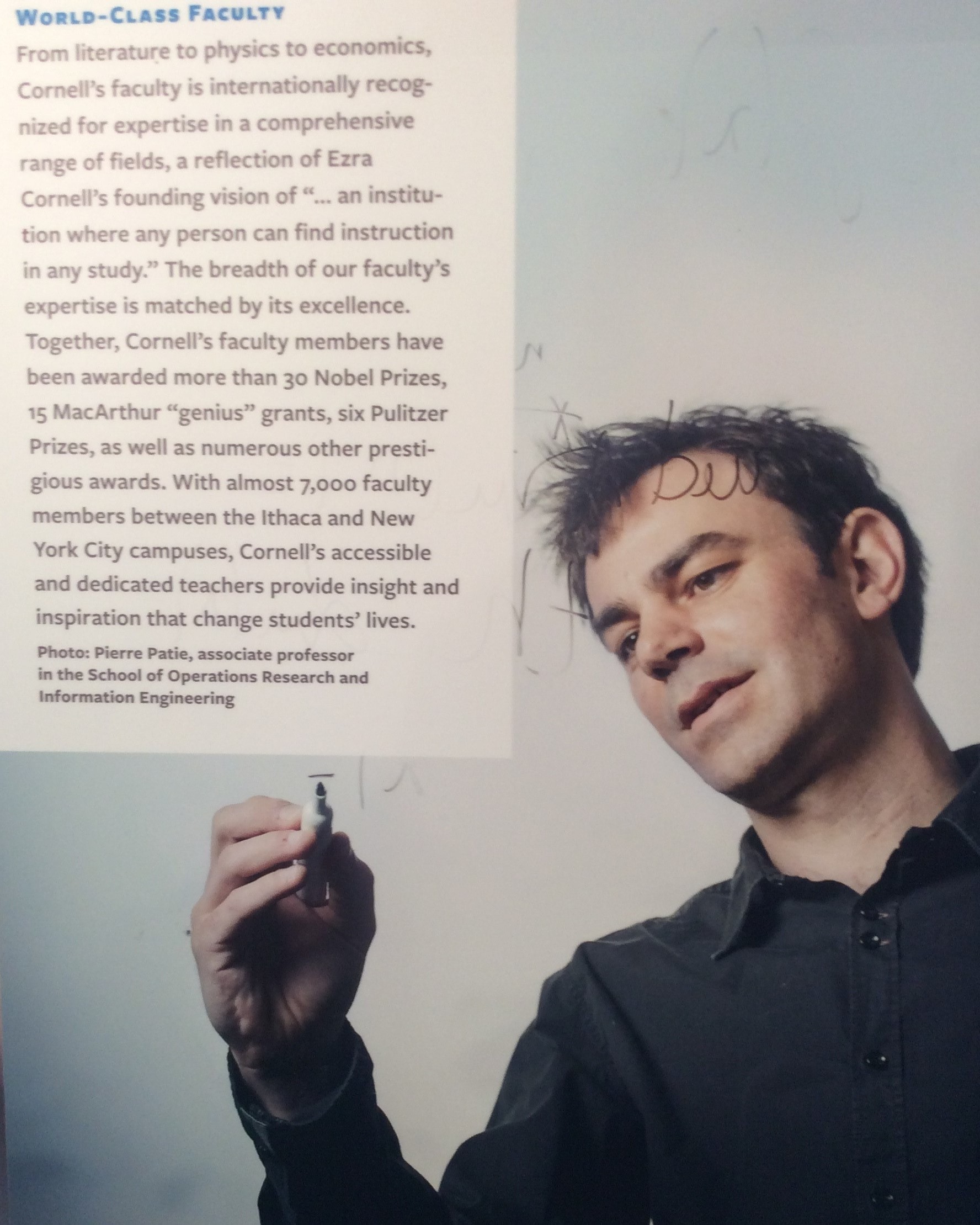
Pierre Patie is a Professor at Cornell University's School of Operations Research and Information Engineering (ORIE). His research focuses on stochastic processes, spectral theory, and their applications in financial mathematics, neurology, and mathematical physics. He explores topics such as isospectral classes of linear operators, first passage time problems, and hypocoercivity via spectral methods. His research interests include: Isospectral classes of linear operators (unitary conjugation, interweaving, weak similarity) Spectral theory of non-selfadjoint operators First passage time problems for Markov processes Subdiffusive processes and boundary crossing phenomena Financial mathematics and risk-neutral pricing Special functions and moment problems Pierre has advised numerous PhD students at Cornell and other institutions, including work on topics like non-reversible Markov chains, spectral expansions, and self-similar processes. He co-authored over 50 publications and collaborates with researchers globally. His work bridges probability theory, analysis, and applications in finance and neuroscience. Pierre co-organizes the Cornell Probability Seminar and the Finger Lakes Probability Seminar. He has contributed to conferences such as the Intertwining between Probability, Analysis and Statistical Physics workshop in Singapore (2024).
Prof. Keivan Mallahi Karai is an Assistant Professor of Mathematics at the School of Computer Science & Engineering, Constructor University Bremen. His work focuses on group theory, probability, harmonic analysis, and their applications in decision-making and cryptography. He holds a Ph.D. in Mathematics from Yale University (2006) and a B.Sc. from Sharif University of Technology (1999). His research explores dynamics of group actions, stochastic models, and geometric decision frameworks, with notable contributions to the Erdős–Ko–Rado property and applications of arithmetic groups in cryptography. Key research areas include analysis on groups, harmonic analysis applications in wave phenomena, and probabilistic methods in decision theory. Recent publications address spectral independence in random systems, geometric decision models (cube/disk models), and sofic approximations of groups. His work bridges pure mathematics with applied domains like financial modeling and cryptography. Professional experience includes a postdoctoral role at Universität Bonn (2006). Collaborations span stochastic decision-making frameworks, entropy in hypergroups, and extreme value laws for unipotent flows. Research trends emphasize interdisciplinary applications of abstract algebra and probability theory.
Yun (Tom) Liu is an Associate Professor of Mechanical Engineering at Purdue University Northwest, specializing in fluid mechanics and renewable energy. He earned his Ph.D. from Purdue University (2016) and joined PNW in 2017. His research focuses on bio-fluid mechanics, 3D flow visualization, and multiphase systems, with notable work on insect flight dynamics and wind turbine wakes. Education: Ph.D. in Mechanical Engineering, Purdue University, 2016 M.S. in Mechanical Engineering, University of Science and Technology of China, 2011 B.S. in Mechanical Engineering, University of Science and Technology of China, 2008 Research Interests: Combines experimental and numerical methods to study complex flows in biological systems, renewable energy, and industrial processes. Key areas include: Insect flight aerodynamics using Schlieren photography Wind turbine wake behavior and wind farm optimization Supercavitation and underwater propulsion systems Gas-stirred ladle furnace hydrodynamics Awards & Grants: NSF Major Research Instrumentation Grant (2019) Catalyst Grant Award ($7K), PNW (2018) Proposal Submission Grant, PNW (2020) Lab & Teams: Leads experimental fluid dynamics research using advanced techniques like PIV, Schlieren imaging, and neural network modeling. Collaborates on bio-inspired design and renewable energy systems.
Dr. Matias Duran Matute is an Assistant Professor at the Applied Physics and Science Education division of Eindhoven University of Technology, focusing on environmental fluid mechanics and transport phenomena in natural and indoor systems. His work combines laboratory experiments, numerical simulations, and theoretical analysis to study processes ranging from coastal sediment transport to airborne droplet dispersion. PhD in Fluid Dynamics (2010, TU/e) BSc in Physics (2004, University of Guadalajara) MSc in Physical Oceanography (2006, CICESE) Research interests center on environmental flows , including: Wadden Sea dynamics Vortex-driven sediment transport Shallow flow modeling Coastal pollution dispersion Indoor airflow optimization Deep learning for coastal transport prediction Recent publications analyze wave-induced particle drift, asymmetric vertical transport in shallow flows, and deep learning surrogate models for coastal environments. His work contributes to UN Sustainable Development Goals related to climate action and life below water. Recipient of NWO Veni Award (2013) 2019 NWO grant for Wadden Sea research Burgers Gallery Best Movie award (2023) As project manager for multiple initiatives including MIST and LOCO-EX, he supervises doctoral candidates and collaborates with institutions like NIOZ. Current courses include Environmental Fluid Mechanics and Machine Learning in Science.
Dr. Pranabesh Das is an Assistant Professor in the Department of Mathematics at Xavier University of Louisiana. He holds a Ph.D. in Mathematics from the Indian Statistical Institute, India. His research focuses on Number Theory, particularly Diophantine Approximations, Equations, and Transcendental Number Theory. He also explores applications in elliptic curve cryptography and random number generation. Dr. Das has been awarded prestigious grants including the AMS-Simons Research Enhancement Grant and an AARMS Postdoctoral Fellowship. He actively contributes to academic communities through organizing conferences like the Bayou Arithmetic Research Days 3 (BARD 3) and co-organizing seminars such as the Number Theory Seminar at Dalhousie University. His work has been published in journals like the International Journal of Number Theory and Mathematika. Education: Ph.D. in Mathematics from Indian Statistical Institute, India Dr. Das's research interests span theoretical and applied number theory, with a focus on solving Diophantine equations and exploring their implications in cryptography. He has delivered invited talks at institutions including the University of South Alabama and Louisiana State University, covering topics like multi-Frey-Helleguarch approaches and rational points on superelliptic curves. His recent grants support research in enhancing mathematical problem-solving techniques and fostering collaborative projects. He has organized food events in Canada and is involved in academic outreach through conferences and workshops. His publications address diverse topics from repdigits in recurrence sequences to rational solutions of superelliptic curves.
Behrooz Parhami is a Distinguished Professor in the Department of Electrical and Computer Engineering at the University of California, Santa Barbara, where he has been a faculty member since 1988. He previously served as Associate Dean for Academic Personnel in the College of Engineering from 2009-2012 and as Vice Chairman of the ECE Department from 1990-1992. Before joining UCSB, he was a professor at Sharif University of Technology in Tehran, Iran from 1974-1988. He received his PhD in Computer Science from UCLA in 1973. Professor Parhami's research focuses on computer arithmetic, parallel processing, and fault-tolerant computing. In computer arithmetic, he pioneered generalized signed-digit number systems as a unified framework for redundant representations. His work in parallel processing includes contributions to database processors, interconnection networks, and scalable architectures. In fault tolerance, he developed systematic data-driven methodologies for reliable hardware and software systems. He has also made significant contributions to adapting computer technology for Persian language computing. His scholarly output demonstrates consistent focus on fundamental computing principles. Recent publications show continued exploration of unconventional number systems, reliability analysis, and specialized computing architectures. His work bridges traditional computer architecture with emerging technologies including atomic-scale computing, neuromorphic systems, and novel memory technologies. His research maintains relevance through connections to both theoretical foundations and practical implementations. IEEE Life Fellow Fellow of Institution of Engineering and Technology Chartered Fellow of British Computer Society IEEE Centennial Medal (1984) Top-cited article award from Journal of Parallel and Distributed Computing (2010) IET Circuits, Devices & Systems Premium Achievement Award (2009) Sharif University Technology Association's Dr. Amin Lifetime Achievement Award (2024) Professor Parhami has graduated four PhD and numerous MS students. His teaching spans both undergraduate and graduate levels, with recent courses including ECE 1B (Puzzling Problems in Computer Engineering), ECE 252B (Computer Arithmetic), ECE 254B (Parallel Processing), and ECE 257A (Fault Tolerant Computing). He has authored six textbooks that have been widely adopted internationally, including works on parallel processing, computer arithmetic, and computer architecture. His consulting activities focus on high-performance digital system design and intellectual property issues. He is actively involved in promoting gender equity through UCSB's Men Advocating for Gender Equity (MAGE) group, which he currently chairs.
Bernhard Gittenberger is an Associate Professor at the Institute of Discrete Mathematics and Geometry at TU Wien. His research focuses on enumerative combinatorics, analysis of algorithms, and probability theory, particularly stochastic processes in combinatorial structures. He has advised numerous Master's and PhD students, contributing to advancements in discrete mathematics and algorithmic analysis. Affiliation: TU Wien, Institute of Discrete Mathematics and Geometry Roles: Academic Researcher, Educator, PhD Advisor His work encompasses lattice paths, tree structures, phylogenetic networks, and analytic combinatorics. He has been involved in multiple research projects, including FWF-funded initiatives and collaborations with institutions like Université de Versailles and Academia Sinica. Key contributions include studies on asymptotic enumeration, probabilistic methods in combinatorics, and algorithmic analysis of discrete structures. His scientific achievements include the Jubiläums-Studienpreis from the Austrian Mathematical Society in 1996.
Markus Kuba is a Professor (FH-Professor) at FH-Technikum Wien in Vienna, Austria, where he leads the Department of Applied Mathematics and Physics. He holds a habilitation (Privatdozent) from TU Wien's Faculty of Mathematics and Geoinformation, granting him the venia docendi. He is also a teacher at HTL-Spengergasse, a higher technical institute, specializing in mathematics and computer science. His academic journey includes a PhD in Mathematics from TU Wien (2006) and a habilitation in 2013. His research focuses on theoretical computer science, analysis of algorithms, analytic combinatorics, and random structures. Notable specializations include tree structures, urn models, multiple zeta values, and SAT-problems. His work bridges combinatorial theory with practical applications in network analysis and stochastic processes. Key contributions include studies on urn models, tree growth models, and interdisciplinary projects like integrating traffic simulation tools. His publications span prestigious journals such as Theoretical Computer Science , Combinatorics, Probability and Computing , and Journal of Combinatorial Theory . Teaching spans secondary schools and universities of applied sciences since 2009, with a focus on mathematics and programming. Collaborations include co-authors from institutions worldwide, reflecting his active role in international academic networks.
Laurent Feuilloley is a junior CNRS researcher (Chargé de recherche) at LIRIS, Université de Lyon 1 since 2022. He previously held postdoctoral positions at LIRIS, Universidad de Chile, and LIP6 at Sorbonne Université. His research focuses on Distributed Computing , Graph Theory , and Local Certification , with applications in Fault-Tolerant Systems and Algorithm Engineering . He collaborates extensively with researchers like Nicolas Bousquet, Franck Petit, and José Correa. Education: PhD in Computer Science (2018) at IRIF, Université Paris Diderot, supervised by Pierre Fraigniaud. Research: Works on graph algorithms, certification, and robustness in dynamic networks, with a focus on maximal independent sets and self-stabilizing systems. Scientific Contributions: His publications include lower bounds for local certification, robustness refinements in dynamic networks, and space complexity for leader election algorithms. He has received multiple Best Paper Awards at SAND 2023 and SSS 2022 Best Student Paper at OPODIS 2021 Best Reviewer Award at DISC 2020 Advising: Currently supervising Sébastien Zeitoun's PhD (co-advised with Nicolas Bousquet and Éric Duchêne) and Antonin Kiladjian's M1 internship (with Théo Pierron). He has also advised Guillermo Dinamarca's master thesis in 2019-2020.
Joe Webster is an Assistant Professor of Mathematics at Grinnell College. Previously, he served as a postdoctoral researcher at the University of Virginia. He holds a B.S. in Mathematics (with Physics minor) from the University of California, Davis (2013) and a Ph.D. in Mathematics from the University of Oregon (2021). His research focuses on p-adic numbers, combinatorics, and mathematical physics, particularly exploring asymptotic problems in homogeneous spaces and gauge theories. He has developed novel approaches connecting these fields to other mathematical domains such as the two-dimensional matrix-tree theorem. Teaching emphases include analysis, calculus, and Fourier analysis. Current courses are Calculus I (MAT 131) and Fourier Analysis (MAT 317). In Spring, he will teach Linear Algebra (MAT 215) and Foundations of Real Analysis (MAT 316). His pedagogical style emphasizes hands-on exploration through Desmos visualizations (e.g., Fourier series and Maclaurin series convergence). Research contributions include studies on log-Coulomb gas systems in p-adic settings and non-archimedean projective lines. Collaborations with A. Abdesselam and G. Uraltsev are ongoing in lattice gauge theories and spin models. His work bridges abstract algebraic structures with physical systems, demonstrating interdisciplinary innovation.