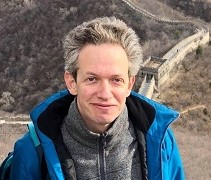
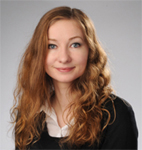
Ştefan Tohăneanu is a Professor in the Department of Mathematics and Statistical Science at the University of Idaho , affiliated with the College of Science. His academic journey includes a Ph.D. in Mathematics from Texas A&M University (2007), and M.S. degrees in Algebra (2001) and Analysis (2001) from the University of Bucharest, where he also earned a B.S. in Mathematics (1997). Research Focus: Commutative Algebra, Hyperplane Arrangements, Matroid Theory, and applications to Coding Theory, including generalized Hamming weights, Orlik-Terao algebras, and homological properties of ideals. Publications: Recent work explores Betti numbers, Jacobian ideals, logarithmic derivations, and connections between algebraic invariants and coding theory problems like minimum distance computation and error correction. Collaborations: Engages with global research networks through affiliations with institutions such as Texas A&M University, University of Bucharest, and University of Idaho.
Alexander Gorodnik is a Professor of Mathematics at the University of Zurich, focusing on the interplay between dynamical systems and number theory. His work bridges ergodic theory, homogeneous dynamics, and Diophantine approximation, with applications to arithmetic counting problems and geometric distribution of lattice orbits. Current lectures include MAT121: Analysis I and MAT221: Analysis III at the University of Zurich Co-author of the book The ergodic theory of lattice subgroups (Princeton University Press, 2010) Editor of the journal Ergodic Theory and Dynamical Systems His research explores Diophantine approximation through dynamical systems, investigating how orbits of group actions distribute in homogeneous spaces. Key topics include mixing properties , central limit theorems , and metric theorems for multiplicative approximation. Recent publications address automorphic density estimates , discrepancy in intrinsic Diophantine approximation , and effective equidistribution of translated measures. His work often employs tools from representation theory and spectral analysis . Current working group members include Zhiyuan Deng , Zouhair Ouaggag , and Yuval Yifrach . He has taught courses at institutions in Zurich, Bristol, Princeton, and Mumbai, with lecture materials covering topics from ergodic theorems to Každan's property (T) .
Paul A. Vojta is a Professor in the Department of Mathematics at the University of California, Berkeley . He has held this position since July 1992 and previously served as Associate Professor (1989-1992) and as a Miller Fellow (1987-1989). Ph.D. in Mathematics, Harvard University (1983) A.M. in Mathematics, Harvard University (1980) B.Math., University of Minnesota (1978) His research interests focus on Diophantine approximation , Nevanlinna theory (particularly its connections to Diophantine approximation), and Arakelov theory . These areas bridge number theory with complex analysis and arithmetic geometry. His publications span topics like integral points on semiabelian varieties , Siegel's theorem , and Schmidt's subspace theorem , reflecting a deep engagement with Diophantine geometry and value distribution theory. Scientific awards include: Frank Nelson Cole Prize in Number Theory (1992) NSF Graduate Fellowship (1978-1981) NSF Postdoctoral Fellowship (1984-1987) Miller Research Fellowship (1987-1989) High rankings in the Putnam Competition (Top 5, 1977; 8th, 1976; Honorable Mention, 1975) NSF Summer Support (1990-2012) Advising highlights include supervising Ph.D. theses of: Khoa Nguyen (2014), Seth Dutter (2009), Aaron David Levin (2005), Nirit Sandman (2004), Sinan Unver (2003), David Kerr McKinnon (1999), Thomas John Tucker (1998), and Xiangjun Song (1996).
Prof. Jürg Kramer is a Professor of Mathematics at Humboldt University of Berlin, affiliated with the Faculty of Mathematics and Natural Sciences and the Institute of Mathematics. His research focuses on Arakelov geometry, automorphic forms (particularly modular forms), and their intersections. Notable contributions include advancements in arithmetic intersection theory with logarithmic singularities and sup-norm bounds for modular forms. He is also deeply engaged in mathematics education, leading initiatives for teacher training and promoting mathematical talent through networks like the Berlin School Mathematics Network. Active in academic service, he served as EMS Education Committee Chair (2017–2022) and President of the German Mathematical Society (2013/14). His work bridges pure mathematics with pedagogical innovation, emphasizing public understanding through popular science publications. Research: Arakelov geometry, modular forms, L-functions, hyperbolic geometry methods Education: Teacher training programs, math talent promotion, textbook authorship Affiliations: Leibniz Institute for Science and Mathematics Education (IPN), EMS, Deutsche Akademie der Technikwissenschaften Key educational contributions include Felix-Klein teacher training programs and co-authoring standards for mathematics teacher education. His publications span advanced mathematical research and accessible expositions on topics like Fermat’s Last Theorem and Riemann Hypothesis.
Kirsten Wickelgren is a Professor in the Department of Mathematics at Duke University, affiliated with Trinity College of Arts & Sciences. Her research focuses on homotopy theory and arithmetic geometry, with support from the National Science Foundation through grants DMS-2405191 and DMS-2103838. She has held academic positions at Duke, Georgia Tech, and Harvard, teaching advanced courses in algebraic topology, algebra, and geometry. Her research explores intersections of algebraic topology and number theory, including motivic homotopy theory, quadratic forms, and enumerative geometry. Notable contributions include enriched counts of geometric objects over finite fields and arithmetic counts of curves in projective spaces. Wickelgren has advised numerous PhD students, including Chongyao Chen, Cameron Darwin, and Thomas Brazelton, and has mentored undergraduate and high school research projects. She has organized conferences such as the Abel Symposium 2025 and co-organized the Mathematics Employment Experience for High School Students at Duke.
Joseph D Rabinoff is an Associate Professor of Mathematics at Duke University's Trinity College of Arts & Sciences. His research focuses on non-Archimedean analytic geometry, tropical geometry, and their applications to algebraic and arithmetic geometry. He holds a Ph.D. in Mathematics from Stanford University (2009). Key research areas include non-Archimedean theta functions, Diophantine geometry, and the interplay between tropical and algebraic structures. He has led NSF-funded projects on non-Archimedean analytic geometry and number theory. His work bridges abstract algebraic geometry with computational and combinatorial methods. Rabinoff has presented at international conferences, including the Regensburg Days on non-Archimedean geometry and the Oberwolfach Tropical Geometry workshop. He serves as a referee for major journals such as the Journal of Algebra and Comptes Rendues Mathematiques.
Nathaniel Eldredge is a Professor and PhD Program Coordinator in the Department of Mathematical Sciences at the University of Northern Colorado (UNC), part of the College of Natural and Health Sciences. His research focuses on probability theory, stochastic processes, and geometric analysis, with specializations in sub-Riemannian manifolds, Lie groups, and partial differential equations. Eldredge holds a Ph.D. in Mathematics from the University of California, San Diego (2009), an M.A. (2005), and a B.S. from Harvey Mudd College (2003). Education: Ph.D. Mathematics, UC San Diego, 2009 M.A. Mathematics, UC San Diego, 2005 B.S. Mathematics, Harvey Mudd College, 2003 His research interests bridge probability and analysis, particularly in stochastic processes on geometric structures like Lie groups and sub-Riemannian manifolds. Recent work includes studies on hypoelliptic heat kernels, functional inequalities, and transportation inequalities in complex geometric settings. Publications span topics such as hypercontractivity, logarithmic Sobolev inequalities, and heat kernel analysis on stratified Lie groups. His work often intersects functional analysis and geometric analysis, with applications to stochastic modeling and mathematical physics. While no formal awards are listed, his extensive publication record reflects sustained contributions to stochastic and geometric analysis. Eldredge has advised the PhD program at UNC since 2018, following roles as Associate Professor (2018–present) and Assistant Professor (2013–2018). He previously held postdoctoral positions at Cornell University (2009–2013) and UC San Diego (2003–2009).
Mohammad Farajzadeh Tehrani is an Associate Professor in the Department of Mathematics at The University of Iowa. His research focuses on symplectic topology, complex algebraic geometry, and moduli spaces, with contributions to Gromov-Witten theory and normal crossings singularities. He is a Co-PI on the NSF-RTG grant DMS-2038103 and has organized conferences like the Frontiers of Geometric Analysis . He holds a Ph.D. from Princeton University (2012) under the supervision of Gang Tian, with prior roles at Stony Brook University and Cornell University. Education: Ph.D. in Mathematics, Princeton University (2007–2012) Double major in Pure Mathematics and Electrical Engineering, Sharif University (2002–2007) Member of Iranian Mathematics Olympiad team at Young Scholars Club (2001–2002) Research Interests His work bridges geometric analysis and algebraic geometry, particularly in: Symplectic topology and its applications to moduli spaces Normal crossings singularities and their smoothability Gromov-Witten invariants and symplectic sum formulas Logarithmic structures in Calabi-Yau manifolds Publications & Grants Recent work includes studies on BPS invariants, Kauffman bracket skein modules, and SL(2,C) character varieties. His research is supported by NSF grants and collaborations with institutions like Stony Brook and Yale. He also co-organized the NSF-funded Iowa City Math Club for high school students. Awards Best Paper Award for RIS-aided mmWave Beam-forming for Two-way Communications (2023) Labs & Teams He leads the Geometry and Topology group at Iowa, collaborating on projects such as the NSF-RTG grant and organizing international workshops. His teaching includes advanced courses in algebraic topology and differential geometry.
Daniele Faenzi is a Professor and Deputy Director at the Institute of Mathematics of Burgundy (IMB) , University of Burgundy. He specializes in algebraic geometry, vector bundles, moduli spaces, and related areas. Leadership: Deputy Director of IMB, responsible for ANR Fano-HK (2021-2026), EUR SupToPhAG (2021-2025), and BRIDGES (2022-2026). Collaborations: GDR GAGC (France), CAPES-COFECUB (Brazil), and Sino-French projects. Research focuses on vector bundles, moduli spaces, Fano and Hyperkähler varieties, logarithmic sheaves, and Cohen-Macaulay modules. His work connects algebraic geometry with commutative algebra, topology, and geometric invariant theory. Students: Supervised 13 PhD/post-docs (2010–2026) including Vladimiro Benedetti, Alan Muniz, and Felipe Monteiro. Teaching: Courses in algebra, mathematics for general degrees, and financial mathematics. Activities: Organized workshops in France, China, Japan, Switzerland, and Brazil (2023–2025).
Roles & Affiliations: Michael Flohr is a Researcher at the Institute of Theoretical Physics, part of the Faculty of Mathematics and Physics at Leibniz University Hannover. He holds the title of Privatdozent (PD Dr.), indicating advanced academic standing in German academia. His role includes safety officer responsibilities within the institute. Research Interests: Flohr specializes in Logarithmic Conformal Field Theory (LCFT), studying its applications to non-compact models, boundary conditions (e.g., D-branes in WZNW models), and connections to string theory. His work explores topics like four-point functions, Jordan cell representations, and modular properties of characters. He also investigates links between LCFT and physical systems such as the fractional quantum Hall effect and Seiberg-Witten theories. Notable interests include the theoretical underpinnings of dark matter and novel conformal field theory approaches to turbulence. Recent Research Trends: Flohr’s publications emphasize LCFT’s mathematical structure (e.g., operator product expansions, null vectors) and its applications in integrable systems, topological phases, and non-compact geometries. Collaborations with students focus on extending LCFT frameworks to local theories and analyzing boundary state constraints in non-rational models. Advising & Grants: Supervised students include Nils Carqueville, Anne-Lý Do, and Hendrik Adorf, whose work spans LCFT vertex algebras, D-brane factorization, and fermionic character expressions. Grants and funding details are not explicitly mentioned but likely tied to institutional support for theoretical physics research. Labs/Teams: Active within the Institute of Theoretical Physics, contributing to collaborative projects on conformal field theory, string theory, and quantum Hall systems. His research group engages with international workshops (e.g., EUCLID network meetings) and institutions like the Max Planck Institute for Mathematics.
Koustav Banerjee is a Researcher at the Research Institute for Symbolic Computation (RISC) of Johannes Kepler University (JKU Linz). He holds a PhD in Mathematics (2022) from RISC, JKU, focusing on analytic number theory and partition function analysis. His primary research areas include Theory of Partitions, Modular Forms, q-Series, Combinatorics, and Mathematical Analysis. His work addresses asymptotic expansions, inequalities, and combinatorial proofs related to partitions, Bessel functions, and modular forms. Notable contributions include error bounds for partition function asymptotics, proofs of Chen's conjectures on partition inequalities, and applications of the localization method to congruence families. Publications highlight his expertise in bridging analytic methods with symbolic computation. Recent articles explore partition function inequalities, Bessel function properties, and combinatorial structures like plane partitions and hook-type tableaux. His research often intersects algebraic geometry and discrete mathematics, yielding results with implications in theoretical physics and computer algebra systems. Affiliated with RISC since his PostDoc tenure, he collaborates on technical reports and publishes in journals like Rocky Mountain Journal of Mathematics , European Journal of Combinatorics , and Annals of Combinatorics . His work emphasizes rigorous mathematical proofs and computational verification in number theory.
Lukas Kühne is an Assistant Professor (Juniorprofessor) at Bielefeld University's Faculty of Mathematics. His research focuses on the intersection of combinatorics, algebra, and geometry, with specializations in hyperplane arrangements, matroids, polytopes, and computational methods. He actively contributes to software development for combinatorial mathematics, including the Oscar module for matroids and the CountingChambers.jl package. Education: PhD from Hebrew University of Jerusalem (2017-2020), Master's from University of Bonn (2014-2017), and Bachelor's from TU Kaiserslautern (2011-2014). His work has been supported by grants such as DFG SPP 2458 and SFB-TRR 358. Research interests include experimental methods in combinatorics, geometric realizability of matroids, and applications of discrete mathematics in algebraic geometry. Recent work explores simpliciality in arrangements, cosmological polytopes, and algorithmic approaches to hyperplane arrangement properties. Teaching responsibilities include courses on Linear Algebra, Discrete Mathematics, and Finite Reflection Groups. He organizes conferences such as the 'Dive into Research: Simpliciality in Arrangements and Matroids' and has participated in international workshops on combinatorial algebraic geometry.
Samuel Grushevsky is a Professor and Deputy Director at the Simons Center for Geometry and Physics (SCGP) at Stony Brook University, where he is affiliated with the Department of Mathematics in the College of Arts and Sciences. His office is located in SCGP 416 and he can be reached at 631-632-2820. Professor Grushevsky's research focuses on algebraic geometry, with particular emphasis on moduli spaces, abelian varieties, theta functions, and their connections to mathematical physics. His work bridges pure mathematics with theoretical physics, especially in areas related to string theory and integrable systems. He has made significant contributions to the Schottky problem, Teichmüller dynamics, and the geometry of moduli spaces of curves and abelian varieties. His research often involves intricate connections between algebraic geometry and complex analysis, with applications to theoretical physics. His recent publications demonstrate a sustained focus on the geometry of moduli spaces, particularly examining compactifications, stratifications, and the interplay between algebraic geometry and differential geometry. His work frequently addresses fundamental questions about the structure of moduli spaces of curves, abelian varieties, and differentials, with applications to mathematical physics. He has developed deep insights into the Schottky problem and has made significant advances in understanding the geometry of strata of differentials. Professor Grushevsky's research has been published in top-tier mathematics journals including Duke Mathematical Journal, Journal für die Reine und Angewandte Mathematik, Inventiones Mathematicae, and IMRN. His paper 'Compactification of strata of abelian differentials' (2018) has been cited 68 times, and 'Strata of k-differentials' (2019) has been cited 56 times, demonstrating significant impact in the field. In addition to his research, Professor Grushevsky is an active educator, teaching advanced graduate courses in areas such as Teichmüller dynamics, moduli of curves, and complex analysis. His teaching portfolio demonstrates deep expertise across algebraic geometry and complex analysis. He has collaborated extensively with leading researchers worldwide, including Riccardo Salvati Manni, Klaus Hulek, Martin Möller, and Matt Bainbridge, among others.
Ioana Ciotir is an Associate Professor (Maître de Conférence) in the Department of Mathematical Engineering at INSA Rouen, France, where she has been employed since 2014. She previously served as an Assistant Professor at the Institute of Mathematics at the University of Neuchâtel, Switzerland (2012-2014) and as an Assistant at the Department of Mathematics at "Alexandru Ioan Cuza" University of Iasi, Romania (2008-2012). Her research focuses on stochastic partial differential equations, homogenization theory, and optimal control problems, with applications to porous media flow, traffic modeling, and financial mathematics. Dr. Ciotir earned her Ph.D. in Mathematics from "Alexandru Ioan Cuza" University of Iasi, Romania in 2010, with a thesis titled "Stochastic Porous Media Equations." She later obtained her Habilitation à Diriger des Recherches (HDR) from the University of Rouen, France in 2022. Her academic journey includes additional training in educational methodologies and summer schools in mathematical finance. Her primary research interests span stochastic analysis and partial differential equations, with a focus on stochastic porous media equations, homogenization of stochastic processes, optimal control theory, and probabilistic representations. She investigates the behavior of stochastic processes with singular diffusivity, including fast and super-fast diffusion equations with various types of noise (Stratonovich, Itô, gradient-type). Her work extends to applications in physics (plasma diffusion), engineering (porous media flow), and social sciences (traffic flow modeling, pandemic economic impacts). Dr. Ciotir's publication record demonstrates consistent contributions to high-impact mathematical journals, with recent work focusing on regularity theory for stochastic diffusion equations, state-constrained control systems for porous media, and non-local models for traffic flow. Her research often involves international collaborations with institutions in Switzerland, Germany, Japan, and China, reflecting the interdisciplinary nature of her work. Among her scientific recognitions are the Thesis Prize for Applied Mathematics from ROMAI (2011) and the Doctoral and Research Supervision Bonus (PEDR) for the periods 2018-2021 and 2022-2025. She has successfully supervised multiple doctoral students through completion of their theses and currently mentors several Ph.D. candidates working on topics related to stochastic PDEs and control theory. Dr. Ciotir has secured significant research funding through projects such as Scale Op (2024-2028, with Siemens Gamesa Renewable Energy), DEFHY3GEO (2022-2025), M2SiNum (2018-2021), M2Num (2015-2019), and the ANR Project QUantum Turbulence Exploration by High-Performance Computing (ANR-18-CE46-0013). She serves as the Sustainable Development Representative for the LMI laboratory and the GM Department since May 2020, and has been elected to the LMI laboratory council (2017-2021 and 2021-2025). She is actively involved in the Mathematics Laboratory (LMI) at INSA Rouen, where she serves as the SMAI correspondent and Mathrice correspondent via FR CNRS 3335. Her international collaborations include partnerships with Siemens-Gamesa, ENSTA Paris, universities in Romania, Switzerland, Germany, and Japan, demonstrating her position within a broad academic network focused on applied mathematics and stochastic analysis.
Yen-Tsung Chen is an S. Chowla Assistant Research Professor in the Department of Mathematics at Pennsylvania State University. His research focuses on number theory in function fields, specifically arithmetic of Drinfeld modules, transcendence of special values, and Drinfeld modular forms. He completed his Ph.D. in Mathematics at National Tsing Hua University under Chih-Yu Chang in 2022. Upcoming professional activities include a visit to Texas A&M University (May–August 2025) and Concordia University (June 2025). His work explores advanced topics such as analytic continuation of polylogarithms, modular forms of arbitrary rank, and linear independence criteria in positive characteristic settings. He maintains an active research agenda with collaborations and international engagements in algebraic number theory. Contact details: Office 217 McAllister Building, University Park, PA 16802. Emails: ybc5485@psu.edu and ytchen.math@gmail.com .