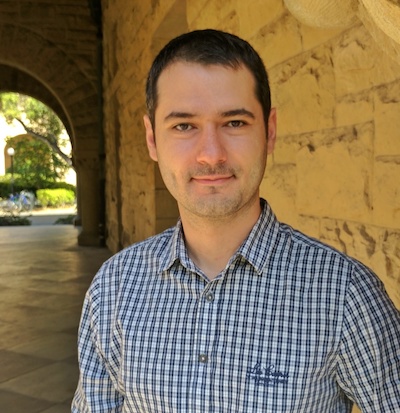
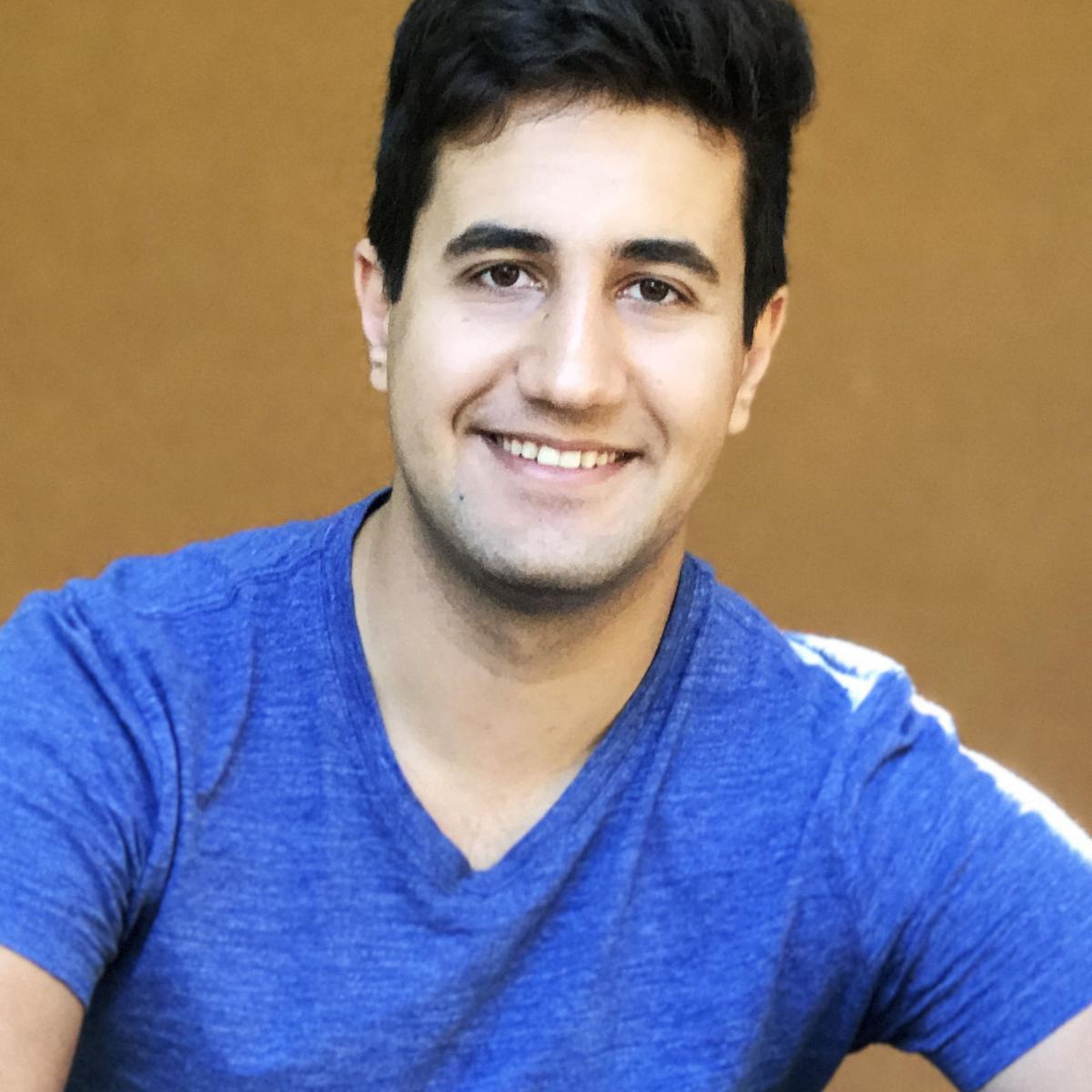
Martin Hildebrand is a Professor in the Department of Mathematics & Statistics at the University at Albany. His research focuses on Probability on finite groups and Combinatorics . Contact: Hudson 247A, (518) 442-4016, mhildebrand@albany.edu Courses: Spring 2025: Mathematics 367 (Discrete Probability), 468/555 (Mathematical Statistics). Fall 2025: Mathematics 403 (Actuarial Mathematics), 467/554 (Mathematical Statistics), 469 (Actuarial Exam P Preparation). His publications analyze random processes on finite groups, including Markov chains , random walks , and Chung-Diaconis-Graham processes , with applications in probability theory and combinatorics. Recent work (2022) explores symmetrized random processes, while earlier studies (2000-2014) address packing density, log-concavity, and convergence rates of random walks.
Andrew Barron is a Professor of Statistics & Data Science and Co-Director of Graduate Studies at Yale University, affiliated with the Applied Mathematics Program. His research focuses on statistical information theory, probability limit theorems, neural networks, and corporate political strategies, with interdisciplinary work in bioactive compound analysis. His recent publications span Bayesian computation, organizational theory, and food science. His research interests emphasize statistical methodologies, including neural network estimation, institutional work in corporate political activity, and the application of statistical theory to practical problems like adsorption processes in food chemistry. His work bridges theoretical statistics with applied domains such as policy advocacy and computational biology. Notable contributions include advancements in Bayesian inference, MDL estimators, and the study of meta-organizations. His articles reflect a blend of methodological innovation and real-world applications across multiple disciplines.
Dr. Priyanka Majumder serves as Assistant Professor Grade I in Data Science at the Indian Institute of Science Education and Research (IISER) Thiruvananthapuram since August 2022, following a Post-Doctoral Fellowship at IIT Bombay (2020-2022). She is affiliated with the School of Data Science and teaches core courses including Survival Analysis and Mathematical Statistics. Her academic credentials include: PhD in Mathematics (2020) from Indian Institute of Engineering Science and Technology, Shibpur, with thesis "Some Contributions to Probabilistic and Inferential Aspects of Reliability Theory" M.Sc. in Applied Mathematics (2012-2014) from same institution B.Sc. (Hons.) in Mathematics (2009-2012) from Scottish Church College, Kolkata Majumder's research integrates Applied Statistics and Probability Theory , specializing in Statistical Inference for Cluster Randomized Trials , Longitudinal Study Design , and Reliability Theory . Her work develops novel methodologies for Survival Analysis, Maintenance Policies, and Stochastic Orderings with applications in clinical trial optimization and healthcare analytics. Current projects focus on sample size determination in multilevel clustered studies. Her 14 publications (2018-2025) demonstrate evolving expertise from foundational stochastic orders to cutting-edge cluster trial methodology. Recent work emphasizes longitudinal cluster randomized trials (2022-2025), while earlier research established contributions to reliability theory and mixture distributions. Key journals include Statistics in Medicine , Naval Research Logistics , and Statistical Papers . Major recognitions: SERB Start-up Research Grant (2023) for cluster trial methodology Consecutive teaching awards at IISER TVM (2022-2024) DST-INSPIRE Fellowship (2015-2020) and Scholarship (2009-2014) CSIR-JRF qualification She mentors 3 PhD candidates and 5 Master's students in statistical methodology, with current projects on clinical trial design and reliability systems. Her SERB-funded project supports a JRF position for sample size determination research. She actively recruits graduate students through IISER TVM's PhD program and direct fellowship routes. Majumder leads a research group within IISER TVM's School of Data Science focused on statistical methods for healthcare applications. Her team collaborates with biostatisticians on clinical trial design and participates in international networks including the International Indian Statistical Association.
Murat A. Erdogdu is an Assistant Professor at the University of Toronto, holding joint appointments in the Department of Computer Science and the Department of Statistical Sciences. He is a faculty member of the Machine Learning Group and the Vector Institute, and holds a CIFAR Chair in Artificial Intelligence. Prior to this, he was a postdoctoral researcher at Microsoft Research New England. He earned his Ph.D. in Statistics from Stanford University, advised by Andrea Montanari and Mohsen Bayati, and holds an M.Sc. in Computer Science from Stanford. His research focuses on Machine Learning Theory, High-dimensional Statistics, Optimization, and Sampling. Erdogdu explores foundational aspects of these fields, with contributions to Langevin Monte Carlo methods, feature learning, and optimization algorithms in high-dimensional settings. His work bridges theoretical guarantees with practical applications, addressing challenges in non-convex optimization and sampling from non-log-concave distributions. Erdogdu's recent publications highlight advancements in robust feature learning, minimax linear regression, and analysis of sampling algorithms under functional inequalities. His research often intersects with statistical theory, algorithmic design, and computational efficiency. He has advised numerous PhD students and postdocs, contributing to the training of future researchers in machine learning and statistics. His affiliations with top-tier institutions and roles in prestigious programs like the CIFAR Chair reflect his impact in advancing artificial intelligence and statistical methodologies. Erdogdu's work is supported by grants and awards, though specific grants are not detailed in the provided materials.
Anna Korba is a researcher affiliated with ENSAE & CREST, Institut Polytechnique de Paris, France. She specializes in sampling methods through optimization of discrepancies, focusing on theoretical and applied aspects of optimal transport, Bayesian inference, and gradient flows. Research Interests: Machine Learning, Probability Theory, Variational Methods, Non-convex Optimization. Recent Work: Interpolating between MMD and χ² divergences, developing mollified interaction energy descent algorithms, and analyzing quantization errors in particle-based optimization. Collaborations: Joint work with researchers across institutions including UCL, CMU, and EPFL. Scientific Contributions: Her publications address challenges in sampling from non-log-concave distributions, fairness constraints in Bayesian neural networks, and geometric interpretations of gradient flows in Wasserstein spaces.
Chunhao Wang is an Assistant Professor in the Department of Computer Science and Engineering at an unspecified university. His research focuses on quantum algorithms, optimal control of quantum systems, and their applications in computational chemistry and machine learning. He has active NSF-funded projects on quantum control and continuous-time open quantum systems. Active NSF Grants: FET Small (2023-2026), CAREER (2023-2028) His work spans quantum computing, algorithm design, and solving high-dimensional problems in optimization and statistical mechanics. Recent publications highlight quantum speedups for classical algorithms and efficient simulation of non-Markovian systems. Collaborations include researchers like Li, X. and Wu, X.
Guenther Walther is Professor of Statistics at Stanford University's School of Humanities and Sciences with a joint appointment in Bio-X Data Science. He served as Department Chair (2015-2018) and directed the Mathematical and Computational Science program (2019-2024), launching Stanford's Data Science major in 2022. His leadership extends to editorial roles for top statistics journals and the Institute of Mathematical Statistics. Walther earned his M.A. and Ph.D. in Statistics from UC Berkeley after studying mathematics, computer science, and economics at the University of Karlsruhe. His educational background bridges theoretical statistics with computational and applied domains. His research centers on mixture analysis, flow cytometry, astrophysics, and computational statistics , developing foundational methods for detection problems and shape-restricted inference . Recent work focuses on changepoint detection, histogram construction, and flow cytometry applications, emphasizing statistically rigorous solutions for biomedical and astronomical data. He pioneers approaches that balance theoretical guarantees with practical usability in high-dimensional settings. Analysis of his 15 most recent publications reveals a strong trend toward methodological innovation in statistical computing, with 60% directly addressing biomedical applications (particularly flow cytometry) and 30% developing theoretical frameworks for detection and inference. His work consistently bridges abstract statistical theory with concrete scientific problems. Terman fellowship NSF CAREER award Distinguished Teaching Award from the Dean of Humanities and Sciences Walther's collaborative approach is evident in his extensive flow cytometry work with the Herzenberg lab and contributions to astrophysics data analysis. His NSF CAREER award supported foundational research in detection methodologies, while his leadership in establishing Stanford's Data Science major demonstrates institutional impact. Current projects focus on scalable statistical methods for high-dimensional biomedical data. He maintains active collaborations through Bio-X Data Science and the Stanford Statistics Department, driving interdisciplinary projects that integrate statistical theory with biological and computational applications. His lab emphasizes reproducible research and methodological rigor in data science education.
Dr. Rob Salomone is a Senior Research Fellow in Data Science at the Queensland University of Technology's (QUT) Centre for Data Science. He earned his Ph.D. in Statistics from the University of Queensland in 2018, focusing on advanced Monte Carlo methodology. Before joining QUT, he held research fellowships at the University of Queensland and UNSW Sydney. His research bridges statistics and machine learning, with an emphasis on developing robust computational techniques for large datasets and complex models. He specializes in creating scientific models that integrate advanced machine learning, domain expertise, and tailored computational methods to address intricate mathematical challenges. Salomone’s work spans Bayesian computation, Monte Carlo methods, and applications in computational biology and environmental systems. His contributions include advancements in nested sampling, CRISPR guide RNA optimization, and graph neural networks for anomaly detection. He also explores federated learning and uncertainty quantification in high-dimensional settings. Notable collaborations include work on agent-based tumor growth models and spectral subsampling for time series analysis. Though no formal students are listed, his research impact is evident through interdisciplinary projects and methodological innovations.
Luc Devroye is a Professor in the School of Computer Science at McGill University, Montreal. He joined McGill in 1977 after completing his PhD at the University of Texas in 1976. His research spans probabilistic analysis of algorithms, random structures, and typography. Notable contributions include work on random trees, data structures, and simulation methods. Affiliations : McGill University since 1977, School of Computer Science. Education : PhD in Computer Science from the University of Texas (1976), studies at the University of Leuven and Osaka University. Research Interests : Algorithms, probability theory, random graphs, data structures, and typography. Focus on average-case analysis, random tree structures, and simulation techniques. His work emphasizes theoretical foundations with practical applications, including contributions to random number generation and algorithmic efficiency. He advises students in theoretical computer science and maintains an active research agenda with over 500 publications. Teaching : Courses like COMP 252 (Algorithms), COMP 690 (Probabilistic Analysis of Algorithms). Students : Mentored numerous PhD and MSc students, many now in academia and industry.
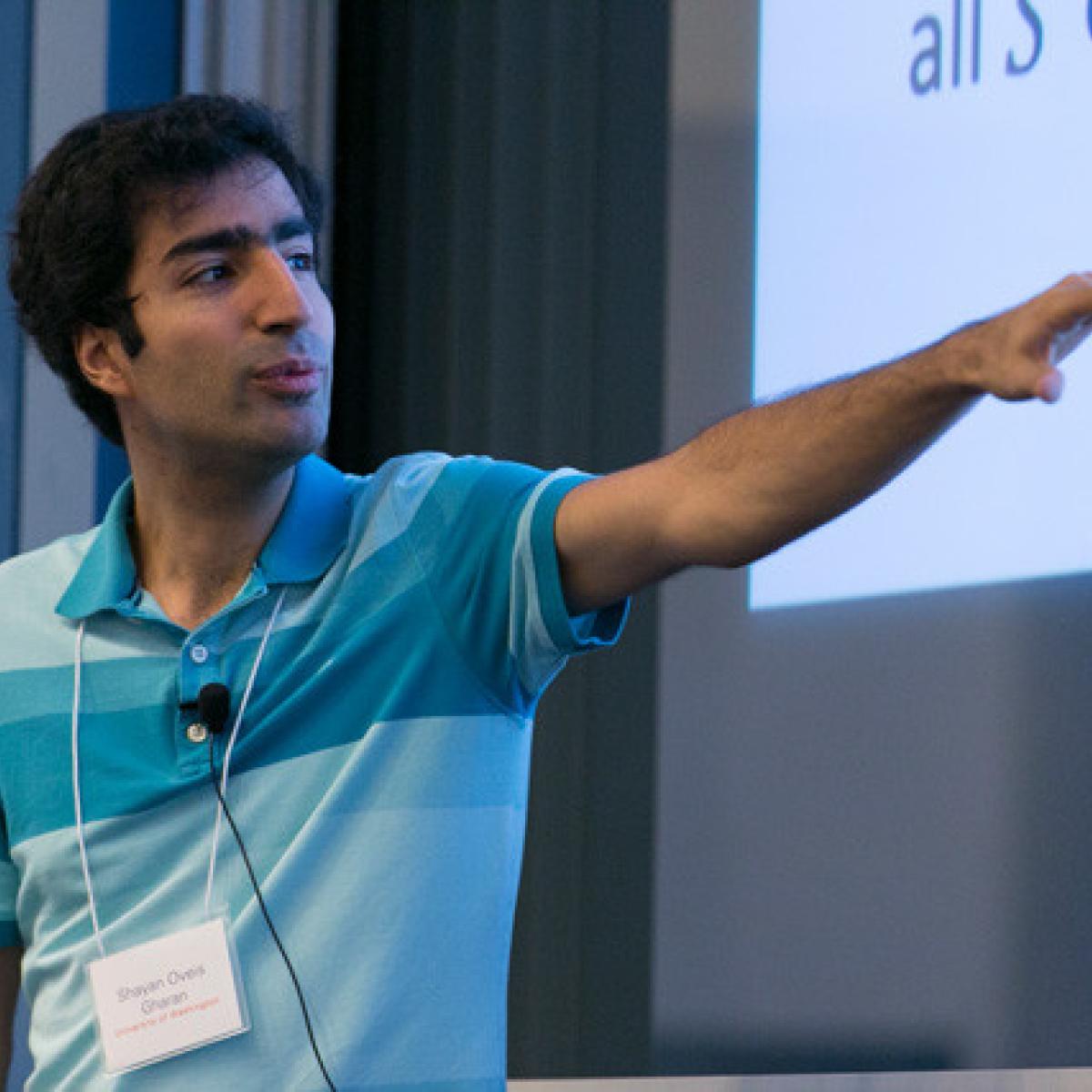
Shayan Oveis Gharan is a Professor in the University of Washington 's Computer Science and Engineering department. His work bridges algorithm design, applied probability, and spectral graph theory, with a focus on leveraging Markov Chains and polynomial paradigms in approximation algorithms. Education: PhD in Computer Science from Stanford University (2013) Research interests span theoretical computer science, combinatorics, and optimization. He explores how algebraic techniques, particularly log-concave and hyperbolic polynomials, can enhance spectral graph theory and counting/sampling algorithms. His studies on the Traveling Salesman Problem and matroid theory have redefined approximation bounds. Recent publications highlight advancements in trickle-down theorems, polynomial paradigms for graph sparsification, and high-dimensional random walks. These works intersect with fields like machine learning and computational complexity. Scientific awards include the 2025 Michael and Sheila Held Prize, 2022 Simons Investigator Award, and 2016 NSF Career Award. His students, such as Nathan Klein and Kuikui Liu, have transitioned to academic and industry roles.
Nima Anari is an Assistant Professor of Computer Science at Stanford University , where he works on theoretical computer science with a focus on algorithms, probability, and combinatorics. He is a member of the Theory Group and has been hosted by Amin Saberi during his postdoctoral research. Ph.D. in Computer Science from UC Berkeley (2017), advised by Satish Rao B.Sc. in Computer Engineering and Mathematics from Sharif University of Technology His research primarily centers around: Sampling algorithms and Markov chains High-dimensional expanders Geometry of polynomials Parallel computing techniques Applications to determinantal point processes His recent publications indicate strong trends in: Parallel sampling methods (2024 STOC, COLT) High-dimensional mixing time analysis (2023 STOC, FOCS) Polynomial-based algorithm design (2021 STOC, 2020 FOCS) Scientific recognition includes: STOC Best Paper Award (2019) Google Faculty Research Award NSF CAREER Award Sloan Research Fellowship Michael and Sheila Held Prize
Mary Cryan is a Senior Lecturer in the School of Informatics at the University of Edinburgh, where she has been a faculty member since July 2003. She is affiliated with the Laboratory for Foundations of Computer Science (LFCS) and conducts research in theoretical computer science, with a focus on algorithms, counting and sampling, random structures, learning theory, and pseudorandom generators. Her educational background includes a joint undergraduate degree in Computer Science and Mathematics from University College Dublin (1993), an MSc by research at UCD (1995), and a PhD from the University of Warwick (awarded 2000) under the supervision of Leslie Ann Goldberg. She held postdoctoral positions at BRICS, University of Aarhus (1999–2001), and the University of Leeds (2001–2003) working with Martin Dyer. PhD, University of Warwick (2000) MSc, University College Dublin (1995) BSc (Joint Hons), Computer Science and Mathematics, University College Dublin (1993) Her research interests lie in the design and analysis of algorithms, particularly randomized algorithms for counting and sampling combinatorial structures. She has made significant contributions to the understanding of Markov chains for sampling matchings, contingency tables, Euler tours, and phylogenetic trees. Her work often bridges theoretical computer science with probability and discrete mathematics. The trend in her publications shows a sustained focus on fundamental algorithmic problems involving random structures and probabilistic methods. Her work spans exact and approximate counting, mixing times of Markov chains, and learning models in phylogenetics. Recent work includes analyzing log-Sobolev inequalities for log-concave distributions and exact counting on bounded-treewidth graphs. She has supervised several PhD students, including Veselin Blagoev ("Counting and Sampling Acyclic Orientations", 2018), Páidí Creed ("Counting and Sampling problems on Eulerian graphs", 2010), and James Matthews (co-supervised, "Markov chains for sampling matchings", 2008). She has also been active in academic service, serving as Deputy Director of the Informatics Graduate School since August 2020. Her research has been published in top-tier venues such as FOCS, STOC, SIAM Journal on Computing, and Journal of the ACM. She regularly lectures courses such as "Informatics 2 - Introduction to Algorithms and Data Structures".
Yongxin Chen is an Associate Professor in the School of Aerospace Engineering at the Georgia Institute of Technology. He received his BSc in Mechanical Engineering from Shanghai Jiao Tong University (2011) and a PhD in Mechanical Engineering from the University of Minnesota (2016). Prior to joining Georgia Tech, he held positions as a Research Fellow at Memorial Sloan Kettering Cancer Center (2016-2017) and an Assistant Professor at Iowa State University (2017-2018). His research spans control theory, machine learning, robotics, and optimal transport. Key areas include developing efficient MCMC algorithms, advancing diffusion models for generative AI, and integrating uncertainty synthesis into control systems. He leads the Foundations of Learning And Intelligent Robots (FLAIR) lab, relocated to Georgia Tech's CODA building in 2024, focusing on systems that harmonize autonomy, stochastic control, and optimization. 2023 : Best Paper at NeurIPS and CoRL, plenary talks at ACC and MTNS. 2022 : Donald P. Eckman Award, plenary talk at ACC. 2021 : Simons-Berkeley Fellowship and Balakrishnan Award. 2020 : NSF CAREER Award. His recent publications emphasize diffusion models (e.g., DEIS, gDDIM, DiffCollage) and optimal transport applications. He has graduated three PhD students and mentors active researchers in generative AI, robotics, and control theory. Collaborations include institutions like Duke, University of Minnesota, and international visitors.
Shayan Oveis Gharan is the Lazowska Professor of Computer Science & Engineering at the Paul Allen School of Computer Science and Engineering, University of Washington. His research focuses on the design and analysis of algorithms using algebraic techniques, particularly through the lens of spectral graph theory and polynomial methods. He received his PhD from the Management Science and Engineering department at Stanford University in 2013, where his thesis won an ACM Doctoral Dissertation Award Honorable Mention. Before joining the University of Washington, he was a Miller Fellow at UC Berkeley for one and a half years. His research interests span algorithms , spectral graph theory , log-concave and real stable polynomials , and their applications to combinatorial optimization . His work has established deep connections between algebraic properties of polynomials and algorithmic problems, particularly in approximation algorithms and counting/sampling problems. He has made significant contributions to the Traveling Salesman Problem, matroid theory, and high-dimensional expanders. Oveis Gharan's recent publications reveal a strong focus on polynomial methods applied to combinatorial structures. His work on log-concave polynomials has led to breakthroughs in sampling and counting algorithms, while his research on spectral graph theory has produced improved approximation algorithms for fundamental optimization problems like the Traveling Salesman Problem. Major awards and honors: 2025 Michael and Sheila Held Prize 2024 Lazowska Endowed Professorship 2023 Smale Prize 2022 Simons Investigator Award 2021 Presburger Award 2019 Sloan Fellowship He has advised numerous PhD students including Nathan Klein (now Assistant Professor at Boston University), Kuikui Liu (now Assistant Professor at MIT), and Nima Anari (now Assistant Professor at Stanford). His research has been supported by prestigious grants including the NSF CAREER Award and ONR Young Investigator Award. Oveis Gharan has also been actively involved in the theoretical computer science community through program committee service for major conferences and editorial work for the SIAM Journal of Computing.
Abdelmalek Abdesselam is an Associate Professor in the Department of Mathematics at the University of Virginia. His research spans mathematical physics, quantum field theory, and combinatorics, with particular focus on renormalization group methods and their applications to probabilistic and combinatorial structures. His research interests include: Quantum Field Theory and Renormalization Group methods Mathematical aspects of statistical mechanics Combinatorial structures in physics, particularly related to permutations and group actions Algebraic combinatorics and invariant theory Probability theory with applications to physics Abdesselam's recent work has focused on log-concavity properties of combinatorial structures, particularly those related to commuting permutations, as well as connections between quantum field theory and combinatorial mathematics. His research demonstrates strong interdisciplinary connections between pure mathematics and theoretical physics. His scholarly contributions include service on editorial boards for prestigious journals: Member of the Editorial Board for Annales de l'Institut Henri Poincaré D, Combinatorics, Physics and their Interactions Section Editor for Annales Henri Poincaré Former Member of the Editorial Board for Journal of Mathematical Physics (2013-2015) Abdesselam has been active in the academic community through conference organization: Co-organizer for the conference "Recent Mathematical Advances in Classical, Quantum, and Statistical Mechanics" at U.Va (2013) Co-organizer for the thematic program "Combinatorics, geometry and physics" at the Erwin Schrödinger International Institute (2014) Co-organizer of the Quantum Field Theory Session at the 2012 International Congress on Mathematical Physics Co-organizer of the conference on "Combinatorial Identities and Their Applications in Statistical Mechanics" at the Isaac Newton Institute (2008) He has advised at least one PhD student, Ajay Chandra, who is now a Senior Lecturer at Imperial College London. His research has been supported by various academic institutions and has led to numerous publications in high-impact journals across mathematics and physics.