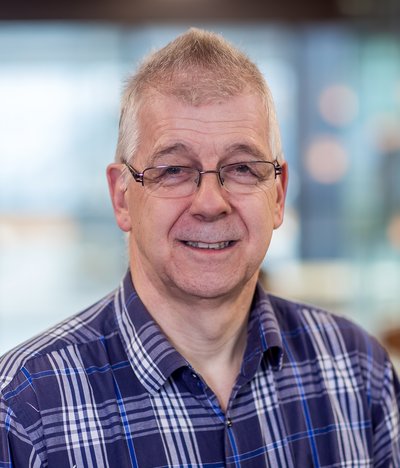
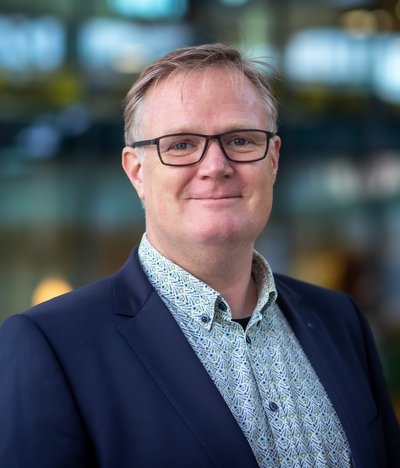
Cor Hurkens is an Assistant Professor in the Department of Mathematics and Computer Science at Eindhoven University of Technology (TU/e). His expertise spans operations research, combinatorial optimization, algorithm design, and applied mathematical modeling. Research Focus : Worst-case analysis of combinatorial algorithms, complexity of combinatorial problems, polyhedral theory, and local search approximation methods. Educational Contributions : Supervision of industrial projects and master projects, with a strong emphasis on mathematical modeling in the curriculum. Publications Analysis : His work addresses optimization problems in diverse domains, including Traveling Salesman Problem heuristics , path packing algorithms , optical router revenue maximization , and classification tree learning via column generation . Grants : Supported by the NWO Gravitation project NETWORKS (Grant Number 024.002.003).
A.J. van der Veen is a full Professor at the Signal Processing Systems department within the College of Electrical Engineering, Mathematics and Computer Science at Delft University of Technology. His research focuses on developing advanced algorithms for signal processing applications in medical imaging and wireless networks. Key research areas: Signal Processing , Biomedical Engineering , Tensor Decomposition Recent contributions include speckle denoising techniques in ultrasound imaging and novel phase-based distance determination methods for wireless networks. Active editorial roles in IEEE Signal Processing Magazine and IEEE Journal on Selected Topics in Signal Processing .
Koen Kok is a Full Professor in the Electrical Engineering Department at Eindhoven University of Technology , specializing in Intelligent Energy Systems . He pioneers research in applying distributed software technologies and AI to modernize electricity systems, with a focus on edge computing, market trade, and grid stability. Dutch Research Council (NWO) Perspective Grant (2021) for MegaMind Co-PI in EU projects: ValueFlex, EcoGrid.EU, SmartHouse/SmartGrid Co-author of 2025 publications on MARL algorithms, congestion management, and TSO-DSO coordination Recipient of Blue Tulip and Sustainia100 awards His research bridges technical and ethical aspects of AI in energy systems, emphasizing open-source deployment and commercialization. Current projects include hybrid local electricity markets, grid-edge data integration (MEGAMIND program), and congestion management frameworks combining tariffs and contracts. Recent work demonstrates: Attention-MADDPG algorithm outperforming peers in LEM simulations Seasonal peak tariffs' effectiveness in mitigating load synchronization Integrated TSO-DSO coordination for DER flexibility utilization He leads the MegaMind research program and contributes to EU policy alignment through technical-economic analysis.
Hermen Jan Hupkes is a Professor of Non-linear Analysis at the Mathematical Institute of Leiden University . His research bridges mathematical analysis with dynamical systems , focusing on discrete media and reaction-diffusion equations . Key Research Areas: Nonlinear stability of travelling waves in discrete and stochastic systems Functional differential equations of mixed type (MFDEs) in economics and biology Curvature-driven wave propagation on lattices Numerical algorithms for discrete reaction-diffusion models Recent Publication Trends emphasize nonlinear dynamics across discrete spatial structures , including stochastic stability , economic agent-based models , and biological pattern formation . His work on lattice differential equations and MFDEs has advanced tools like exponential dichotomies and Lin's method in discrete settings. Awards: Vici Grant (2025) for innovative research in non-linear analysis Advising and Collaborations include mentoring PhD candidates such as Christian Hamster and Mia Jukic, as well as interdisciplinary collaborations with computational imaging experts and biophysicists.
Robin de Jong is an Associate Professor at the Mathematical Institute of Leiden University in the Netherlands. His research spans Number Theory , Algebraic Geometry , and Arakelov Theory , focusing on heights, moduli spaces, and geometric invariants. Education: PhD in Mathematics, University of Amsterdam (2004) His work on moduli spaces of curves, Arakelov invariants, and Néron-Tate heights has produced significant contributions. Recent publications analyze tautological forms, Siegel-Jacobi forms, and Hodge-theoretic limits, reflecting his deep engagement with arithmetic and geometric frameworks. Scientific awards include the NWO TOP Grant (2014). He advises PhD candidates Zhelun Chen and Storm Wolters . Collaborations with Spencer Bloch, José Burgos Gil, and Farbod Shokrieh highlight interdisciplinary reach.
Jos H.V. den Ouden serves as a Researcher and Project Manager within the Electrical Engineering department at Eindhoven University of Technology (TU/e), affiliated with the Mobile Perception Systems Lab and Video Coding & Architectures group. His work bridges mobile networking, IoT infrastructure, and autonomous vehicle systems to advance connected mobility solutions. Education: Master of Science (MSc) in Engineering (Dutch "ir." designation) from TU/e, 2007 Thesis: "Study on the misalignment properties of a pushbelt variator" Research Interests: Den Ouden specializes in applying Internet of Things frameworks to autonomous driving challenges, with emphasis on remote operation systems, pedestrian behavior prediction, and 5G network integration. His work addresses critical safety requirements in automated mobility through local breakout architectures and user interface innovations, particularly focusing on road engineering applications for cooperative vehicle systems. Publication Trends: His 2018-2026 publications demonstrate evolving expertise from experimental cooperative driving validation toward AI-driven mobility solutions. Recent work explores trustworthy AI frameworks for CCAM development, while earlier research established foundations in IoT-enabled pedestrian detection and 5G remote driving architectures, consistently addressing mobile network service optimization. Project Leadership: Den Ouden has secured funding for six major initiatives: TOWR CST (2021-2027): Project communication officer Buurauto-Noom VCA (2021-2022): Project manager 5G-MOBIX (2018-2022): Project member for cross-border CAM corridors AUTOmated driving via IoT (2017-2020): Invoice contact Vision-based Driver Assistance (2016-2019): Project member Research Environment: As core personnel in TU/e's Mobile Perception Systems Lab, he contributes to Video Coding & Architectures research while teaching Automotive Sensing and Smart Vehicles courses. His work connects with industry through press features on autonomous vehicle testing and 5G remote driving demonstrations, positioning him at the intersection of academic research and real-world mobility innovation.
Eduardo Balbinot is a researcher at the Faculty of Science and Engineering , University of Groningen , specializing in Astronomy . His work focuses on Galactic Dynamics , Globular Clusters , and Stellar Streams , with significant contributions to the Euclid and Gaia space missions. Active in Photometry , Astrometry , and Black Hole Detection Collaborator on S5 Collaboration , Euclid Consortium , and Gaia Collaboration Research areas include Stellar Kinematics , Chemical Cartography , and Dwarf Galaxy Analysis . His recent publications analyze tidal tails , dormant black holes , and asymmetric galactic structures using advanced data from Gaia DR3 and Euclid Early Release Observations . Media coverage highlights his discovery of a 33 solar-mass black hole (2024) and analysis of stellar stream dynamics (2021). Collaborative datasets include Globular Cluster Morphology , Dormant Black Hole Catalogs , and Stellar Halo Photometry .
Kailai Li is a tenure-track Assistant Professor at the University of Groningen's Bernoulli Institute, where he leads the Agile Sensing and Intelligence Group (ASIG). His research develops novel methods for robotic perception, including continuous-time state estimation, sensor fusion, and visual navigation. Recent publications focus on Gaussian process representations for motion estimation and multi-robot collaboration using vision-language models. Dr. Li's lab maintains open-source projects like LiLi-OM (LiDAR-inertial odometry) and SFUISE (UWB-inertial fusion). Collaborations include Linköping University and industry partners. Current projects investigate trustworthy perception for autonomous systems under uncertainty and efficient representations for high-dimensional state estimation.
Uzay Kaymak is a Full Professor and Chair of Information Systems in Health Care at Eindhoven University of Technology (TU/e), with concurrent appointments at JADS Den Bosch, EAISI Foundational, and EAISI Health. His work bridges computational intelligence and healthcare, developing adaptive decision support systems through linguistic-numerical data fusion. His educational background includes: MSc in Electrical Engineering (1992, Delft University of Technology) Chartered Designer Degree in Information Technology (1995) PhD in Control Engineering (1998, Delft University of Technology) Research Interests: Professor Kaymak pioneers computational intelligence frameworks integrating fuzzy set theory with machine learning for intelligent decision support . His work spans data/process mining , reinforcement learning , and clinical decision modeling , with applications in financial systems, economic analysis, and healthcare. Recent focus includes serious games for diabetes management and AI-driven water infrastructure monitoring , emphasizing model interpretability and real-world implementation. Publication Trends: His 2023-2025 output reveals intensified focus on environmental AI applications (water systems, desalination) and healthcare informatics . Publications demonstrate consistent integration of fuzzy logic with deep learning for interpretable models, particularly in leak detection, river monitoring, and clinical alert systems. The work shows strong industry-academia collaboration with practical implementations in Dutch hospitals and water utilities. Scientific Awards: Best Industrial Paper Award (2020) Best Student Paper Award (2019) Advising and Grants: With 91 supervised students, Professor Kaymak leads major EU-funded projects including SmartDATA (2020-2025) for AI in connected systems, DiaGame (2019-2025) for diabetes self-management games, and GOAL (2018-2021) for gamified active lifestyles. His Eurostars project PADS pioneered reinforcement learning for programmatic advertising, securing significant industry partnerships with Shell and healthcare institutions. Labs and Teams: He co-leads the EAISI Health initiative and TU/e's Clinical Informatics program, collaborating with Jheronimus Academy of Data Science (JADS) and Zhejiang University. His interdisciplinary team combines AI researchers, clinical informaticians, and environmental engineers to develop deployable solutions for UN Sustainable Development Goals in health and clean water.
Hans Kuerten is a Full Professor and Chair of Computational Multiphase Flow at the Department of Mechanical Engineering, Eindhoven University of Technology (TU/e). He is also a part-time professor in Computational Multiscale Methods at the Faculty EEMCS, University of Twente. His work focuses on numerical simulation methods for single-phase turbulent flows, particle-laden flows, and phase-transitional flows, with applications in process technology including particle separation, steam injection, boilers, and inkjet printing. MSc in Theoretical Physics, University of Utrecht PhD, Eindhoven University of Technology Hans collaborates with institutions like ETH Zurich, Ohio State University, and Politecnico di Torino. He has held sabbaticals at these institutions and is affiliated with organizations including ERCOFTAC and the J.M. Burgerscentrum, where he serves as local director at TU/e. Hans's research spans multiscale problems in two-phase flows, particularly turbulence-particle/droplet/bubble interactions. His key areas include subgrid modeling in LES, DNS of particle-laden flows with evaporation/condensation, diffuse interface models for phase transition, and droplet dynamics on porous substrates. His work integrates spectral and finite volume methods with experimental research. His recent articles emphasize DNS and LES of multiphase flows, complex network theory for turbulence analysis, phase transition modeling, and industrial applications like inkjet printing and quenching. Techniques range from stochastic-deconvolution models to novel numerical methods for Navier-Stokes-Korteweg equations. ERCOFTAC Da Vinci Prize (Jury Member) ERCOFTAC Special Interest Group on Large-Eddy Simulation Physics Board, Lorentz Center Scientific Committee, ETMM Workshop Series International Organizing Committee, Direct and Large Eddy Simulation Workshops Hans supervises numerous research projects and students, including the active FIP 2.0: Complex Fluids on Complex Substrates (2020–2026). He has contributed to 215 research outputs and 91 supervised works, including PhD theses and datasets. His lab collaborates with semi-industry partners such as Océ, AkzoNobel, and TNO, focusing on sustainable technologies aligned with UN SDGs.
Federico Corradi is an Assistant Professor in the Electrical Engineering Department at Eindhoven University of Technology (TU/e), where he leads the Neuromorphic Edge Computing Systems Lab. He also holds the position of EAISI Foundational Assistant Professor at the Eindhoven Artificial Intelligence Systems Institute. His research focuses on neuromorphic computing and engineering, spanning from efficient computational models to novel microelectronic architectures for deep learning and brain-inspired algorithms. Dr. Corradi's academic background includes a Ph.D. in Neuroinformatics from the University of Zurich and an international Ph.D. from the ETH Neuroscience Centre Zurich (2015). Prior to joining TU/e in 2022, he worked at IMEC in the Netherlands (2018-2022) where he started a group focused on neuromorphic IC design. Before that, he was with Inilabs, a spin-off from the Institute of Neuroinformatics, developing event-based cameras and neuromorphic processors (2015-2018). His research interests center around understanding natural neural computation principles to develop energy-efficient sensing and computing technologies. Key areas include: Neuromorphic computing and engineering Spiking neural networks Event-based vision systems Energy-efficient microelectronic architectures Applications in robotics, machine vision, and biomedical signal analysis Dr. Corradi's recent publications demonstrate a strong focus on practical implementations of neuromorphic systems for edge applications. His work shows consistent innovation in translating theoretical neural models into efficient hardware implementations, with particular emphasis on handling temporal data and developing brain-realistic computational models. The research spans multiple domains including radar signal processing, optical computing, and error correction systems. He serves as an active review editor for Frontiers in Neuromorphic Engineering, IEEE, and IOP Science journals, and participates in technical program committees for several machine learning and neuromorphic conferences including ICTOPEN, AICAS, AIAI, ICONS, NEWCAS, DSD, and EUROMICRO. His work has received significant media attention with coverage from multiple news outlets and social media mentions. Dr. Corradi leads the Neuromorphic Edge Computing Systems Lab, which bridges theoretical neuroscience with practical engineering challenges, creating novel solutions for real-world problems. The lab's research has practical applications in robotics, autonomous systems, and biomedical technologies, reflecting his commitment to developing energy-efficient computing solutions that can operate effectively at the edge.
Bernadette van Wijk is an Associate Professor at the Vrije Universiteit Amsterdam, affiliated with the Faculty of Behavioural and Movement Sciences. She holds additional appointments as an Associate Professor in Neurocontrol, the Institute of Biomaterials, Biotechnology and Diagnostics (IBBA), and the Amsterdam Movement Sciences (AMS) - Rehabilitation & Development. Her work contributes to UN Sustainable Development Goals related to health and well-being. Her research focuses on neural mechanisms underlying motor control and Parkinson's disease, leveraging techniques such as local field potential (LFP) recordings, EEG/MEG, and computational modeling. Key interests include beta oscillations in basal ganglia circuits, adaptive deep brain stimulation (DBS), and sensorimotor integration during movement. She leads courses in Neuroscience and Neurowetenschappen, emphasizing translational research and clinical applications. Recent articles highlight her contributions to understanding reward-based motor learning, LFP-based physiomarkers in Parkinson’s, and the neural correlates of gait and arm swing. Her work emphasizes methodological rigor, such as artifact suppression in neurophysiological data and optimizing DBS electrode localization. Dr. van Wijk has supervised one PhD thesis and actively collaborates internationally on projects involving neurophysiology and clinical neuroscience. Her research bridges fundamental science and clinical practice, aiming to improve therapies for movement disorders.
Floor Harms is a Researcher in Anesthesiology at Erasmus University Medical Center, focusing on mitochondrial oxygenation, acute kidney injury, and hemodynamic monitoring in surgical contexts. Her work combines clinical research with advanced analytics to improve perioperative outcomes. Key investigations include predictive models for renal injury in cardiac surgery and AI-driven mitochondrial oxygen consumption analysis. Recent studies utilize porcine inflammation models and dynamic light scattering to assess microcirculatory changes. Her publications address anesthesia protocols, including liposomal bupivacaine applications for postoperative pain management.
Chris Hecker is an Associate Professor in Thermal Infrared Sensing at the University of Twente's Department of Applied Earth Sciences and affiliated with the International Institute for Aerospace Survey and Earth Sciences (ITC). He holds a PhD in Remote Sensing of Earth Resources (2012, with distinction) and an MSc in Earth Sciences from the University of Basel. His research focuses on thermal remote sensing for geothermal systems and critical raw materials, leveraging thermal infrared spectroscopy and hyperspectral imaging. Key projects include leading the ECOSTRESS project for geothermal anomaly detection and the KenGen collaboration in Kenya. He is also the founder of ITC's thermal infrared spectroscopic facilities and chairs the European Special Interest Group on Thermal Remote Sensing. Teaching involves advanced remote sensing courses and coordinating academic skills training for MSc students. Awards include NASA Science Team membership (2019-2022) and the Overijssel PhD award nomination (2013). His work contributes to UN SDGs related to affordable and clean energy (SDG 7) and climate action (SDG 13). Education: MSc Earth Sciences, University of Basel (1999) PhD Remote Sensing of Earth Resources, University of Twente (2012) Key Projects: ECOSTRESS NASA Science Team (2019-2022) KenGen Geothermal Collaboration (2019-2021) GEOCAP Indonesia-Netherlands Programme (2014-2019) Awards: PhD 'With Distinction' (2012) University of Twente Graduation Award (2015)
Bodo Manthey is an Associate Professor in the Department of Mathematics of Operations Research and the Digital Society Institute. His research focuses on algorithms, combinatorial optimization, and computational complexity. He has contributed to areas such as the Traveling Salesman Problem (TSP), clustering algorithms, and smoothed analysis of heuristics. His work bridges theoretical computer science and operations research, with a strong emphasis on algorithm design, approximation algorithms, and probabilistic analysis. Key research interests include the analysis of local search algorithms, approximation inefficiencies in optimization heuristics, and probabilistic models for algorithm performance. He has published extensively on topics like k-means clustering, TSP variants, and the application of smoothed analysis to understand algorithm behavior under realistic conditions. Manthey has organized multiple conferences and workshops, including the Cologne-Twente Workshop on Graphs and Combinatorial Optimization. His contributions to the field are reflected in over 100 research outputs, with recent work addressing the complexity of Euclidean clustering and the effectiveness of ant colony algorithms. His academic activities span editorial roles, committee memberships, and invited talks on topics such as random metrics in algorithm analysis. Despite the absence of explicitly listed awards, his prolific output and conference involvement highlight his significant contributions to theoretical computer science and operations research.