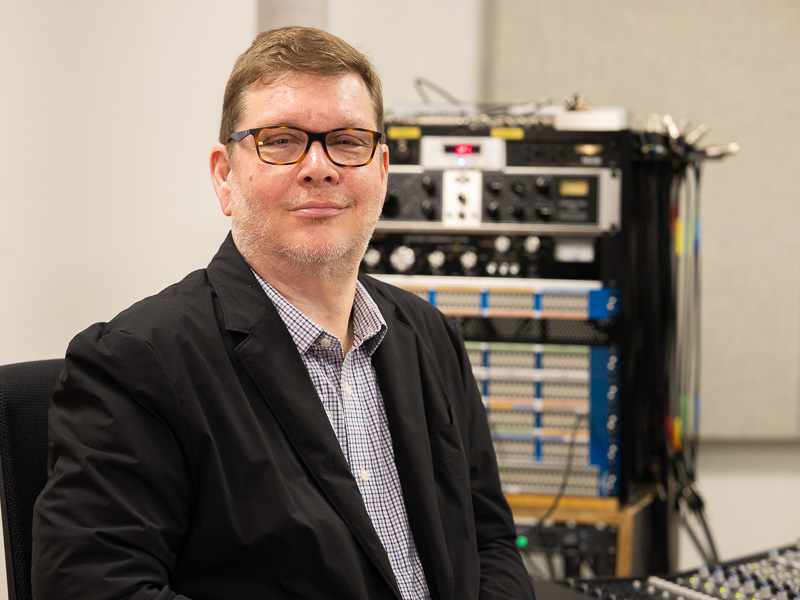
Dr. Jules Rawlinson is a Senior Lecturer in Digital Design at the Reid School of Music , University of Edinburgh. He serves as Programme Director for the MSc Sound Design and contributes to MSc Design and Digital Media, ESALA undergraduate courses, and the Reid School's MSc Digital Composition and Performance. PhD in Composition (University of Edinburgh, 2011) MSc Sound Design (University of Edinburgh, 2006) BA Combined Arts (Sunderland University) Jules investigates audiovisual composition , live electronics , and interactive performance systems , blending machine learning , virtual environments , and corpus-based sound synthesis . His work explores non-linear narrative structures , graphical scores , and political sound-art through collaborations like Raw Green Rust and projects such as Lie Still My Sleepy Fortunes and w[i]nd . His 15 most recent outputs span audiovisual installations , generative sound systems , and collaborative performances , focusing on virtual reality , spectral transformation , and digital improvisation . Jules co-founded the LLEAPP network and has secured grants from EPSRC and New Media Scotland's Alt-w Fund . He supervises PhD students Tim Bentley, Hal Xu, Benjamin Cantil, and Liam Peacock, with works showcased at festivals including Sonorities , Edinburgh International Film Festival , and Edinburgh Festival Fringe . His Requiem for Edward Snowden was featured in BBC Radio 3's Hear and Now and selected for Creative Scotland's Made In Scotland Showcase.
Dr. Ben Swift is a Senior Lecturer at the School of Cybernetics, ANU, specializing in AI, computational art, and cybernetics. He leads the Cybernetic Studio, an interdisciplinary collective exploring cybernetic systems through hardware/software/people collaborations. As a livecoding artist, he performs globally and co-founded the ANU Laptop Ensemble. His research spans generative AI, open-source tools like Extempore, and UX design. Education: PhD in Computer Science (ANU) Projects: Australia's Digital Economy (2022), The Augmented Web (2019) Research focuses on AI creativity, biofeedback interfaces, and computational music. His work bridges technical innovation with artistic expression, evident in projects like TSPNet and adversarial camera systems. Key contributions include Extempore’s development and studies in live coding disruption. Awards unspecified but recognized internationally for interdisciplinary impact.
R. Luke DuBois is an Associate Professor and Co-Chair of the Technology, Culture and Society Department at the NYU Tandon School of Engineering, where he also directs the Integrated Design & Media program and the Brooklyn Experimental Media Center. He holds a DMA in music composition from Columbia University and is a renowned artist, composer, and performer whose work explores intersections between technology, sound, and visual media. His research focuses on digital media, human-computer interaction, and emerging technologies applied to artistic expression and accessibility. Key roles include directing the SONYC initiative (addressing urban noise pollution via AI) and leading the NYU Ability Project (advancing disability studies through technology). He has collaborated with institutions like the Smithsonian and artists such as Maya Lin, and his work has been exhibited globally, including at the Sundance Film Festival and the Aspen Institute. DuBois co-developed the Jitter software suite for real-time data manipulation and performs in avant-garde groups like Bioluminescence and Fair Use. His artistic practice combines time-lapse phonography, interactive installations, and interdisciplinary projects that critique cultural ephemera while advancing accessibility in STEM and the arts. Recent contributions include browser-based tools for accessible music notation (SoundCells) and sonification techniques for calculus education. He serves on the Board of the ISSUE Project Room and has been featured in major publications like the New York Times and TED Conference talks.
Professor Dr. Johannes Ismaiel-Wendt is a faculty member at the Institute for Music and Musicology , part of the University of Hildesheim ’s School of Cultural Studies & Aesthetic Communication. He earned a doctorate in cultural studies, sociology, and musicology from the University of Bremen (supervised by Prof. Dr. Sabine Bröck and Prof. Dr. Alexander Weheliye) with his dissertation tracks'n'treks. Popular Music and Postcolonial Analysis (2011). Ismaiel-Wendt is a certified educator, known for blending research with live drum machine performances and sound lectures. From 2012 to 2018, he served as Junior Professor for Systematic Musicology and Music Sociology before being appointed University Professor in 2018.
Bruno Tucunduva Ruviaro is an Associate Professor in the Department of Music within the College of Arts and Sciences at Santa Clara University, where he has taught since Fall 2012. Originally from Brazil, Ruviaro is a composer and performer with a specialization in electronic music. Prior to joining Santa Clara, he studied and worked at the Center for Computer Research in Music and Acoustics (CCRMA) at Stanford University. Ruviaro's primary research focus is Music Composition with a strong emphasis on Electronic Music. His specific interests include electronic music composition, laptop orchestras, live-electronics, acousmatic music, and sampling & musical borrowing. He also explores secondary interests spanning theater, dance, linguistics, speech, radio art, Linux, intellectual (im)property issues, and the intersection of music & politics. His work demonstrates a consistent exploration of how technology transforms musical creation and performance. Ruviaro's scholarly output reveals a strong trajectory in electronic and computer music composition, with particular attention to laptop orchestras and musical borrowing practices. His recent works like Pós-Tudos and Mozart and the Elections demonstrate his continued innovation in contemporary composition, while publications such as From Schaeffer to* lorks and Intellectual Improperty reveal his theoretical engagement with the evolving nature of musical instruments and copyright in digital contexts. His compositions frequently incorporate technology in innovative performance setups, as seen in works utilizing smartphones and unconventional sound production methods. Ruviaro is the director of SCLOrk (Santa Clara Laptop Orchestra), continuing a tradition from his time at Stanford where he was part of SLOrk (Stanford Laptop Orchestra). He teaches courses including Intro to Electronic Music (MUSC 9), SCLOrk - Santa Clara Laptop Orchestra (MUSC 157), Music Theory III (MUSC 3), Experimental Sound Design (MUSC 115), Form and Analysis (MUSC 113), and Beginning Composition (MUSC 37), along with private composition lessons. His educational contributions include A Gentle Introduction to SuperCollider , making complex music programming more accessible to students.
Chris Arrell is an Associate Professor of Music and Director of the Laptop Ensemble Federation (H-CLEF) at the College of the Holy Cross. His expertise spans composition, music theory, sound synthesis, and computer music. He founded H-CLEF in 2015, fostering experimental music performance through technology. Education: D.M.A. in Music from Cornell University. Research focuses on blending acoustic and electronic elements, with works commissioned by institutions like the Fromm Foundation and Alte Schmiede. Notable honors include the Ettelson Composer’s Award and residencies at MacDowell Colony. Key works include Diptych (prepared piano duo), Breathless (piano trio), and Of Three Minds (soprano/piano/computer). His music frequently explores algorithmic processes and live electronics. Awards and recognition highlight his contributions to contemporary music, including commissions from NEXTET and the Pellegrini Festival. His collaborations, such as Walking in Altamira , reflect interdisciplinary innovation supported by the Ditson Foundation.
Peter Lucas Hulen is a Professor in the Music Department at Wabash College , where he has taught for nearly 25 years. His work bridges classical acoustic composition with experimental computer-generated electronic music, informed by his classical training and later shift toward digital techniques. Research interests include: Electronic music history Music technology pedagogy Digital synthesis methods (FM, subtractive, granular) Integration of acoustic and electronic sound Algorithmic composition Interdisciplinary applications His compositions explore: Microtonal scales using superparticular ratios Wireless performance interfaces Choral liturgy adaptation Cultural sound symbolism Speaker array design Temporal structure manipulation Recent works combine academic rigor with technical innovation: 2017: Homage and Refuge , Wobbly 2015: Organum IV 2014: Magnificat , Sitting 328b 2013: Les substances botaniques , Primitive 2012: Lamentationes Jeremiae I He developed a systematic electronic music curriculum including: History and Literature Computer Programming (Max/MSP) Performance Ensembles Theory and Composition
Martin Parker is a Senior Lecturer and Programme Director of the MSc in Sound Design at the University of Edinburgh 's Reid School of Music . A composer, improviser, and laptop soloist, his work explores intersections of computer music , sonic art , and live electronics , with international collaborations across theatre, symphony orchestras, and visual artists. PhD in Composition (2003), University of Edinburgh MA and BA in Music (University of Manchester) His research focuses on sound design for interactive environments, twenty-first century music technology , and improvisation . Recent projects include the BRAID Research Fellowship on AI and creativity, alongside 81 total research outputs spanning compositions, performances, and technical datasets. Current research trends include: Transdisciplinary approaches to sound Immersive audio systems Human-computer interaction in performance Real-time sound processing Supervision includes advising on PhD topics in acoustics , electroacoustic composition , and music for screen . Notable contributions include: Co-founding the Lapslap free improvisation trio Artistic Directorship of the Dialogues Festival since 2014 Development of the Sound Lab Edinburgh research infrastructure Scientific awards: BRAID Research Fellowship (2024–2025)
Trace E. Reddell is a Professor and Director of Emergent Digital Practices at the University of Denver’s College of Arts, Humanities and Social Sciences. He is affiliated with the Department of Media, Film & Journalism Studies and the School of Art and Art History, reflecting his interdisciplinary work at the intersection of digital media, sound, and theory. Education: Ph.D., English Literature, University of Colorado at Boulder, 1997 M.A., Creative Writing, University of Colorado at Boulder, 1989 B.A., English Literature, Texas Tech University, 1986 (Magna Cum Laude) Trace Reddell’s research and creative work center on the interactions of sound, cosmology, and the imagination. His expertise spans Sound Studies, Digital Media, Science Fiction, New Materialism, and Philosophy of Technology . He explores how sonic cultures—particularly in science fiction, psychedelic music, and audiovisual performance—shape new modes of being and understanding. His work integrates critical theory, media philosophy, and hands-on artistic practice, including live cinema and net.art. He teaches courses in sonic arts, expanded cinema, speculative cultures, and critical digital media. His publications reveal a strong trajectory in sound and media studies, with recent work focusing on sonic innovation in science fiction cinema, Afrofuturism, and cybernetic performance . His 2018 book, The Sound of Things to Come , is a landmark study in film sound, and he is preparing a sequel and additional books on psychedelic rock and space music. His upcoming MIT Press book, The Magic Circle: Sonic Substance in Psychedelic Music , further establishes his authority in sound culture. Scientific Awards: Dean’s Award for Excellence, AHSS Dean, University of Denver (2018) “Excellent Artists” Honorary Award, Art on the Net Competition, Tokyo (2001) George F. Reynolds Fellowship, University of Colorado (1994–1995) Wiegers' Appointment, University of Colorado (1994) Trace Reddell actively mentors graduate students, serving as a Ph.D. advisor and MFA thesis committee lead. He has directed numerous graduate research projects and served on dissertation and exhibition committees. He has secured multiple research grants from the University of Denver, including Faculty Research Funds and Creative Arts Material Funds, supporting projects like Sonic Science Fiction 2 and international academic exchanges. His creative work—ranging from live audiovisual performances to commissioned soundtracks—has been exhibited globally in venues from Amsterdam to Seoul. He also contributes to academic service through manuscript review for presses like Routledge and the University of Minnesota Press, and has held leadership roles including Graduate Director and Director of Digital Media Studies. Labs and Teams: He has been closely associated with the Boulder Laptop Orchestra (BLOrk), contributing live visual performances. His collaborative projects, such as microMacroCosm with Timothy Weaver, reflect his engagement with interdisciplinary artistic teams. He has also led visiting artist series and founded digital media outreach initiatives at the university.
Eldad Tsabary is an Associate Dean of Research and Graduate Studies at the Faculty of Fine Arts, Concordia University. He leads the SSHRC-funded Reflective Iterative Scenario Enactments (RISE) project and founded the Concordia Laptop Orchestra (CLOrk), which has performed internationally. His work spans electroacoustic music, live coding, and interdisciplinary collaboration, particularly with AI and global artistic networks. Doctorate in Music Education from Boston University Research interests include improvisation , neural synthesis , and browser-based collaborative platforms . His recent publications explore GAN-based transformation matrices , multilingual live coding environments , and evolutionary dynamics in laptop orchestras , reflecting his focus on technology-driven musical innovation. Notable scientific contributions include the SSHRC-funded RISE project and leadership in the Canadian Electroacoustic Community (CEC) and the International Conference on Arts and Humanities. He actively collaborates with the Milieux Institute and Gina Cody School of Engineering, emphasizing AI integration in the arts.
David Ogborn is a Professor in McMaster University’s Department of Communication Studies and Media Arts within the Faculty of Humanities. He coordinates the Networked Imagination Laboratory (NIL) and teaches across undergraduate and graduate programs including Media Arts, Communication and New Media, and PhD in Communication, New Media, and Cultural Studies. His work bridges computational arts, live coding, and interdisciplinary research. Education: Not explicitly mentioned Current Appointments: Professor at McMaster University Research focuses on live coding environments, networked musical ensembles, and computational creativity. He has developed platforms like Estuary (collaborative live coding), Seis8s (localized computer-music language), and EspGrid (synchronization protocol). His interests include improvisation in digital settings and software as artistic medium. Recent scholarly activity spans 2012-2022, covering live coding pedagogy, collaborative platforms, and networked music systems. He has secured SSHRC Insight grants and Canada Foundation for Innovation support for NIL. Teaching includes digital audio, game design, and doctoral seminars. The Cybernetic Orchestra (laptop ensemble) remains active since 2010 with global collaborations. Professional contributions include multiple software tools (Estuary, NIL, EspGrid), international performances at live coding festivals, and publications in journals like Computer Music Journal and Journal of Music, Technology and Education . No scientific awards are mentioned in available records.
Nick Hwang is an Assistant Professor of Communication at the University of Wisconsin-Whitewater, affiliated with the Department of Communication within the College of Arts and Communication. His research focuses on music technology, interactive media, and collaborative performance systems, emphasizing innovations in sound diffusion, telematic music, and digital instrument design. He actively engages in interdisciplinary projects such as the Collab-Hub system for remote musical collaboration and the RhumbLine project exploring zoomorphic musical robots. Dr. Hwang’s academic contributions span over a decade, with notable work on the Actuated Embedded Musical Instrument (AEMI) and web-based creative coding education. His teaching philosophy prioritizes student-centered learning, tailoring material to individual backgrounds while pushing technical and artistic boundaries. Though no awards or grants are explicitly documented here, his publications reflect a commitment to advancing technologies at the intersection of music, computing, and human interaction. His lab environments and collaborative projects foster experimentation with emerging tools like mobile node controllers (MoNoDeC) and spatial audio systems. While specific student advisees or grant details are not listed, his teaching within media and game development programs underscores a dedication to preparing students for evolving creative industries.
Luke Dahl is an Associate Professor of Composition and Computer Technologies in the Music Department at the University of Virginia, with a courtesy appointment as Assistant Professor in the Electrical and Computer Engineering Department. His work bridges music, technology, and human interaction, focusing on New Interfaces for Musical Expression (NIME), real-time collaboration systems, and gestural control in music. He holds a PhD in Computer-Based Music Theory and Acoustics from Stanford University’s CCRMA, an MA in Music, Science, and Technology from Stanford, and a BSE in Electrical Engineering from the University of Michigan. Dr. Dahl’s research explores the intersection of technology and musical practice through design, performance, and empirical studies. Notable projects include Modosc (a real-time motion-capture library) and Bf-Pd (a collaboration framework for digital ensembles). He has collaborated with institutions like Université de Lille and developed works such as SoundBounce and TweetDreams, which integrate live audience interaction and social media data into musical performance. Prior to academia, he contributed to audio technology at E-mu/Creative (reverb algorithms and patents) and Apple (iPod and laptop audio systems). His work spans patents, open-source libraries, and interdisciplinary projects at the forefront of music and technology.
Jeff Albert is the Interim Chair and Associate Professor in the School of Music at Georgia Tech’s College of Design. He holds a PhD in Experimental Music and Digital Media from LSU and degrees from Loyola University and the University of New Orleans. His work bridges jazz performance, improvisation, and music technology, with contributions to laptop orchestras and live computer music paradigms. Albert has performed globally, contributed to over 60 recordings, and was part of the Grammy-winning 2017 album *Porcupine Meat*. His research focuses on human-computer interaction in music and audio pedagogy. Education: B.M. (Loyola University New Orleans), M.M. (University of New Orleans), PhD (Experimental Music & Digital Media, LSU). Former roles include faculty positions at Loyola University, Xavier University, and the University of New Orleans. Research emphasizes improvisation frameworks, digital music systems, and performance technologies. Notable projects include founding the Laptop Orchestra of Louisiana (LOLs) and developing interactive musical partner systems. Awards include DownBeat Critics Poll recognition and Boston Globe's Top Jazz Album honor. Grants and collaborations include the Arts @ Tech Catalyst grant for *Sonic Ecology* (2025). Labs/teams include Georgia Tech Laptop Orchestra and involvement in festivals like Instigation Festival. His work spans academic publications, performances, and audio engineering.
Scott Wilson is a Professor of Composition and Electronic Music at the University of Birmingham's Department of Music. He directs the Birmingham ElectroAcoustic Sound Theatre (BEAST) and the Electroacoustic Studios, leading research in real-time interactive systems, audio spatialisation, and SuperCollider programming. His roles include coordinating the COMPASS Centre for Composition and teaching across undergraduate/postgraduate programs in composition and live electroacoustic music. Education: BFA (Simon Fraser), MA (Wesleyan), Mus.Doc (Toronto). His research focuses on acoustic/electroacoustic hybrids, spatial audio systems, and the development of SuperCollider. Key projects include the BEASTmulch spatialisation initiative and collaborations with ensembles like the Ligeti Quartet and BEER (Birmingham Ensemble for Electroacoustic Research). Recent performances include international showcases in Mexico, Colombia, and Thailand, highlighting works like Kelp Road and What if there's nothing you can do? . His compositional style emphasizes improvisation, network music, and live coding, with notable contributions to the SuperCollider Book (2nd ed., MIT Press, 2025). Active in Thai and Javanese music traditions, Wilson bridges experimental composition with cultural sound studies.