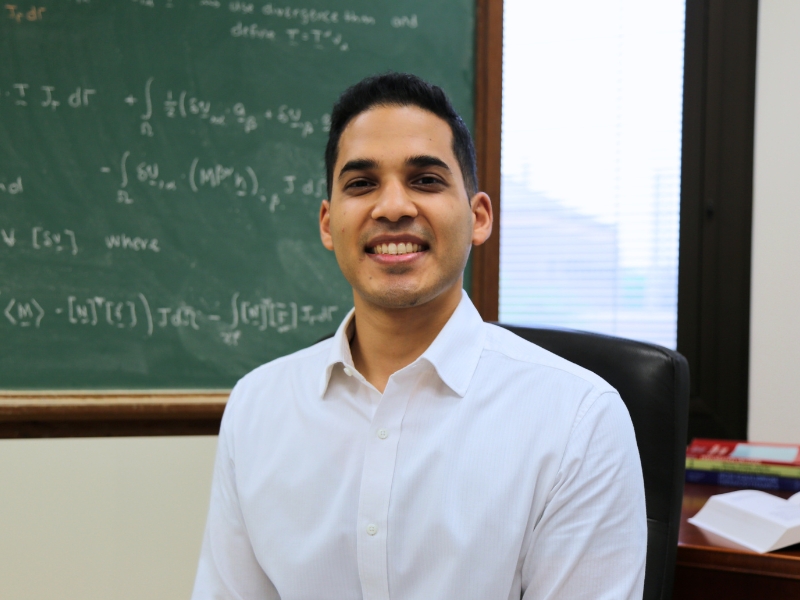
Amaresh Sahuمشاهده پروفایل
استادیار
Amaresh Sahu serves as an Assistant Professor in the Chemical Engineering Department at the University of Texas at Austin, leading the Sahu Lab which focuses on theoretical investigations of soft and living matter systems across multiple length and time scales. His research integrates concepts from chemical engineering, physics, computer science, and applied mathematics to address fundamental questions about how microscopic interactions produce emergent phenomena at larger scales. Dr. Sahu's educational background includes a Ph.D. in Chemical Engineering from the University of California at Berkeley (2022), where he worked with Professor Kranthi Mandadapu, followed by a postdoctoral fellowship in Physiology & Biophysics at Weill Cornell Medicine (2022-2023) with Professor Emre Aksay. He completed his undergraduate studies at Princeton University (2013) with a B.S.E. in Chemical Engineering and minors in Engineering Physics and Applied Mathematics, working with Professor Howard Stone. His research methodology combines analytical theory development with advanced numerical techniques including the finite element method and molecular dynamics simulations. A distinctive aspect of his work involves creating physics-based machine learning approaches that strictly adhere to fundamental physical laws and balance equations. The group frequently draws from continuum mechanics (both fluid and solid mechanics), transport phenomena, statistical mechanics, irreversible thermodynamics, and electrodynamics. Dr. Sahu's publication record demonstrates significant contributions to understanding biological membranes, with multiple papers in Physical Review Letters addressing membrane instabilities, non-equilibrium fluctuations, and computational methods. His recent work on the Arbitrary Lagrangian-Eulerian finite element method represents an important advancement in computational techniques for membrane dynamics. The Sahu Lab actively recruits graduate students through the UT Austin Chemical Engineering program and welcomes postdoctoral scholars and undergraduate researchers interested in theoretical and computational approaches to soft matter physics. The lab emphasizes deep scientific thinking over prior research experience, particularly for undergraduate students.