Laura Maria Lojo Rodriguez is a Professor in the Department of English and German Philology at the University of Santiago de Compostela , specializing in British literature and modernist/postmodernist fiction. She leads the Discourse and Identity research group (GI DI-1924), focusing on English language, literature, and culture through interdisciplinary frameworks. Her work intersects with the Humanities Research Institute (iHUS) . Her research spans: Gender and identity in Woolfian studies Migration narratives in contemporary short fiction Postcolonial themes in British-Irish literature Ecocritical and posthuman anxieties in Johnson's works Recent publications examine border politics, maternal discourses, and cross-cultural literary bonds. She has also contributed to translation studies, particularly Woolf's Spanish reception. Her academic output bridges literary theory with socio-political analysis.
Bruno Echauri Galván serves as Associate Professor in the Department of Modern Philology at the University of Alcalá (UAH), Spain, teaching core translation courses including Introduction to Translation Theory and English-Spanish Translation across multiple degree programs in Alcalá de Henares and Guadalajara. His research centers on Translation Studies and Reception Theory, with significant contributions to intersemiotic translation (particularly in children's literature), healthcare interpreting, and film adaptation reception. As an active member of the Research Group on Interdisciplinary Reception Studies, he investigates cultural reception, literary reception, and translation through frameworks including cultural mediation, censorship studies, and myth reception. Recent publications (2021-2024) demonstrate consistent innovation in translation pedagogy, including color-based translation assessment tools, service-learning translation projects, and pandemic-era teaching adaptations. His work on collaborative writing projects, mental health communication, and Carver-Lish translation controversies reveals methodological diversity across literary, audiovisual, and healthcare domains. Dr. Echauri Galván has participated in multiple research initiatives including the JOB AND MOVE student network project (2018), Homopoly strategic partnership (2016), and InterMed healthcare mediation project (2011), where he contributed expertise in intercultural communication and translation standards. He maintains active research leadership through the Interdisciplinary Reception Studies group, examining reception phenomena across cultural, literary, musical, and translational contexts while addressing contemporary issues like censorship and myth criticism.
Antonio Terrón Barroso is a predoctoral researcher at the University of Barcelona's ADHUC Research Centre (Theory, Gender, Sexuality) and UNESCO Chair on Women, Development, and Cultures. He holds a Postgraduate Certificate in Social Science Research (Aston University), Master's in Teaching (PGCE, King Juan Carlos University), dual Bachelor's degrees in Translation Studies (University of Granada) and Communication (Open University of Catalonia), and a Tourism Diploma (University of Granada). Research Focus: Gender violence discursive normalization in 19th-century peninsular women's press through digital humanities methodologies. Key subfields include national/gender identity construction via literature and cinema, multilingual translation dynamics, and transnational reception studies. Teaching Experience: International roles at University of Birmingham (Spanish Teaching Fellow), Panthéon-Assas University (Spanish Lecturer), Aston University (Spanish/Translation Teaching Assistant), Cardiff University (Spanish Associate Tutor), and University of Massachusetts Amherst (Hispanic Studies Visiting Teaching Associate). Scientific Awards: FPI Predoctoral Researcher Contract (MINECO) Key Collaborations: Working with Dr. Elena Losada Soler and Dr. María Xesús Lama López on the Género, violencia y representación project. Affiliated with the consolidated research group 'Women's Creation and Thought' (2021 SGR 01097).
Armando J. Pego Puigbó is a Professor at the Faculty of Philosophy , Universitat Ramon Llull (La Salle-URL), affiliated with the Department of Philosophy and Humanities and the Hall Research Group on Smart Society . His work intersects philosophy, cultural studies, and technology, particularly examining postmodern and postsecular paradigms. Key Projects : FILOCULTURA (2017–2021): Philosophy and culture in Catalonia Transformacions metadiscursives (2024): Metadiscursive interactions in philosophy and literature Research Trends : Recent articles explore intersections of religion and modernity (e.g., El estallido del cristianismo , 2024), existential themes in Qohelet (2024), and foundational philosophical concepts in postmodern contexts (2020). Publications span critical theory, literary analysis, and cultural philosophy. Contact : armandojesus.pego@url.edu
Inmaculada Delgado Jara is an Associate Professor of Greek Philology at the Facultad de Ciencias Humanas y Sociales, Universidad Pontificia de Salamanca, specializing in Biblical Studies and Patristics. Her academic profile shows extensive engagement with ancient Greek texts, particularly focusing on San Juan Crisóstomo, Erasmus of Rotterdam, and Septuagint studies. Her educational background includes a doctorate from Universidad Pontificia de Salamanca with the thesis "Sermones in Genesim de San Juan Crisóstomo estudio temático, estilístico y traducción" (1999), supervised by Dr. Alfonso Ortega Carmona. She is a member of the research groups "Humanismo, reformas y ciencia: del Medievo a la Ilustración" and "ICS. Innovación en Ciencias Sociales". Delgado Jara's research interests center on Greek Philology, Biblical Philology, Patristics, Septuagint Studies, Erasmus of Rotterdam studies, and San Juan Crisóstomo studies. Her scholarly work demonstrates deep expertise in ancient Greek language and literature, particularly as applied to biblical and patristic texts. She has made significant contributions to understanding the intersection of classical literature and early Christian thought. An analysis of her recent publications reveals a consistent focus on textual criticism, philological analysis of biblical and patristic works, and the reception history of classical texts in Christian contexts. Her work often bridges linguistic analysis with historical and theological interpretation, particularly examining how ancient Greek texts were transmitted, interpreted, and utilized in later periods. Her scholarly activity includes numerous books, edited volumes, and academic papers, with recent work focusing on Erasmus's biblical scholarship, San Juan Crisóstomo's homilies, and the Septuagint. Despite her extensive publication record, no specific scientific awards are mentioned in the available information. Delgado Jara is actively involved in academic supervision and research direction, as evidenced by her editorial work on major scholarly projects and her participation in academic conferences. Her work shows collaboration with numerous scholars across Spain and internationally, particularly in the fields of Biblical Studies and Renaissance Humanism.
Beatriz Naranjo Sanchez is a researcher at the University of Murcia, Spain, currently affiliated with the Translation, Didactics and Cognition research group and previously with the Translation, Lexicology and Writing Group. Her work bridges translation studies, cognitive psychology, and musicology through experimental methodologies. She earned her PhD from the University of Murcia in 2017 with the dissertation La influencia de la música sobre la calidad y la creatividad en traducción literaria (inglés-español, inglés-italiano) una aproximación estético-psicológica , supervised by Dr. Ana María Rojo López. Her research centers on psychological and emotional dimensions of translation processes, particularly examining how background music influences literary translation creativity, how anger affects decision-making with offensive content, and emotional processing in dubbing. She employs cognitive-experimental approaches to investigate narrative engagement, vocal qualities in emotionally charged scenes, and pandemic-related stressors on evaluative language translation. Analysis of her 2015-2023 publications reveals consistent focus on music-translation interactions and emotional variables, with methodological emphasis on laboratory experiments, psycholinguistic measurements, and cognitive assessments. Her work demonstrates interdisciplinary innovation through the fusion of aesthetic theory, cognitive science, and translation practice. Scientific awards: No awards documented in provided sources. Regarding advising and grants, while she supervises research within university groups, no specific students or funded projects were mentioned. Her institutional affiliation suggests collaborative research within translation psychology frameworks. She actively contributes to the Translation, Didactics and Cognition research group, which investigates cognitive-affective translation processes through experimental paradigms, likely involving lab-based studies on emotional and musical variables in professional translation contexts.
Jordi Redondo Sánchez is a Professor in the Department of Classical Phil at the University of Valencia, where he is affiliated with the Faculty of Philology, Translation and Communication. His academic work centers on Greek Philology, with a strong emphasis on classical reception, ancient Greek literature, and translation studies, particularly in Catalan and Iberian contexts. His research interests include Hellenistic poetry, epigram, tragedy, rhetoric, linguistic analysis of classical texts, and the transmission of classical culture through medieval and modern literature. He is a member of two research groups: the GIRLC (Research Group on the Reception of Classical Literatures) and GIRHA (Resources Innovation Group in Ancient History), reflecting his interdisciplinary engagement with both literary and historical dimensions of the ancient world. The majority of his recent publications (2021–2024) are critical reviews and literary analyses focusing on Euripides, Sophocles, Theocritus, Bion, Pausanias, and Herodotus, as well as studies on biblical translations such as the Montserrat Bible and the Interconfessional Catalan Bible. His articles often explore narrative motifs, translation variants, linguistic features, and the interplay between myth and literature across cultures and periods, demonstrating a consistent scholarly focus on philological precision and cultural continuity. He earned his PhD from the University of Salamanca in 1986 with a thesis on the linguistic study of Antiphon’s speeches, supervised by Dr. Antonio López Eire. No scientific awards or student advisement information is mentioned in the provided texts. His active research and publication record suggest ongoing contributions to classical scholarship, particularly in the areas of textual criticism, reception studies, and Iberian engagement with the classical tradition.
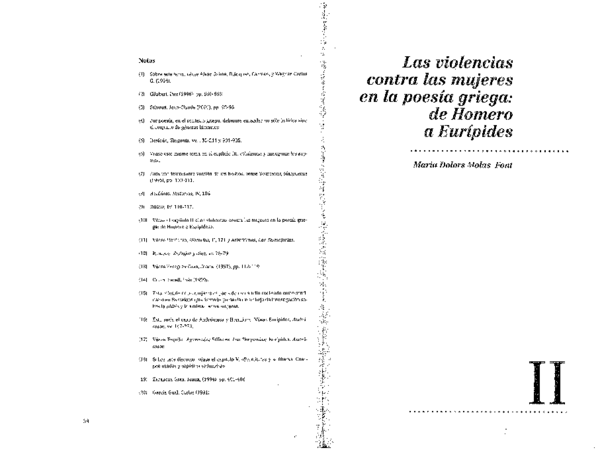
Maria Dolors Molas Font is an Associate Professor of Ancient History at the University of Barcelona and a researcher at the ADHUC-Research Center of Theory, Gender and Sexuality . She co-founded and coordinates the Tàcita Muta research group on women and gender in antiquity since 1998. Her work bridges Mediterranean protohistory and gender studies in antiquity. University of Barcelona (since 1998) ADHUC Research Center (since 2016) Her research spans various subfields, including: Archaeology of Childhood Feminist Archaeology Gender Dynamics in Antiquity Iberian World Studies Classical Reception of Women Violence in Ancient Societies Article themes reveal expertise in: Homeric and Euripidean textual analysis Roman Republican settlement archaeology Slavery and power structures in antiquity Transgressive practices in classical myth Perinatal archaeology in Iberian contexts Gendered interpretations of oratory
María Losada Friend is a Full Professor in the Department of English Philology at Pablo de Olavide University's Faculty of Philology and Translation in Seville, Spain. She serves as a Faculty Member within the HUM-857 Research Group focused on Interlinguistic Communication and Intercultural Interpretation: Identity Representations in Spain. Her research interests span English Philology, Irish Studies, Women's Representation in Literature, 18th-Century Literature, Translation Studies, Travel Writing, Gender Studies, and Spanish-British Cultural Relations. She has made significant contributions to understanding women's representation in historical contexts, particularly examining how foreign writers depicted Spanish women during critical periods like the Primo de Rivera dictatorship. Her work frequently explores the intersection of gender, national identity, and cultural representation in travel literature and historical texts. Her recent publications demonstrate a strong focus on women's travel writing about Spain, Irish studies in the Spanish context, and historical perspectives on female education. She has extensively analyzed texts by writers like Jenny Ballou, Lady Tenison, and Gertrude Vanderbilt Whitney, uncovering nuanced representations of Spanish society and gender roles. As an academic leader, she has contributed to doctoral programs in Philological, Translation and Cultural Studies and has supervised research in these fields. Her work connects historical literary analysis with contemporary cultural studies, creating important bridges between past representations and current understandings of cultural identity.
Israel Campos Méndez is a Professor in the Department of Historical Sciences at the University of Las Palmas de Gran Canaria's School of Arts and Humanities. Specializing in Ancient History with a focus on the socio-political-religious evolution of Eastern cults in the Roman Empire, he leads the GIR G9-History, Economy and Society research group. PhD Thesis: The god Mithras: analysis of the adaptation processes of his cult from ancient Iran to Rome (2005) Research Pillars: Mithraism, Roman provincial religion, Persian cultural influence, and classical archaeology Advising: Mentored 14 final degree projects and 5 master's theses on Greco-Roman history, religious practices, and heritage topics His scholarly work explores Mithraic cultic spaces, sensory experiences in Roman religions, and the historiography of Indo-Iranian-Roman religious connections. Publications span from 2010 to 2025, with a notable emphasis on architectural reuse and Persian-Roman cultural syncretism. Major contributions include studies on Mithraic terminology (2016), Achaemenid dance practices (2017), and systematic reviews of Mithraic cave symbolism (2023). His research bridges art history, linguistics, and archaeological analysis.
Pedro Luis Ladrón de Guevara Mellado is a Professor at the Universidad de Murcia, affiliated with the Department of French, Romanesque, Italian and Arabic Philology within the Faculty of Arts and Humanities. He holds a Ph.D. from the Universidad de Murcia (1987) with a thesis on Dino Campana's poetry. His research focuses on Italian philology, comparative literature, and the interplay between Spanish and Italian literary traditions. Key interests include the analysis of poets like Leopardi, Cernuda, and Campana, as well as cultural exchange studies and translation's role in canon formation. His work explores topics such as Italian influence on Spanish writers, the reception of Italian poetry in Hispanic contexts, and the aesthetic dimensions of narrative and poetic forms. Notable contributions include studies on Ramón Gaya’s Italian-inspired writings, the impact of Leopardi on Cernuda, and the symbolic use of color in Dino Campana’s verses. Publications span scholarly articles and reviews, with recent works analyzing cultural dimensions of exile and artistic migration. He actively contributes to academic networks, including the CERCLE European Cultural Center in Murcia, promoting interdisciplinary education and literary exchange.
M Teresa Ferrer Valls is a Professor of Spanish Literature at the Universitat de València, affiliated with the Department of Spanish Philology within the Faculty of Philology, Translation and Communication. She is a leading scholar in Spanish Golden Age theater, with a focus on Lope de Vega, courtly spectacle, and digital humanities applications in literary research. Her research interests span Spanish Golden Age theater, comedia nueva, early modern Spanish literature, neo-Latin literature, women dramatists of the 17th century, sacramental plays, and the cultural history of courtly performance. Her work often explores the interplay between literature, power, and historical context, particularly during the reigns of Philip III and IV. The most recent articles reflect a sustained engagement with digital tools for theater research, including databases like CATCOM and ASODAT, alongside critical editions and thematic studies on allegory, gender, and performance. Her publications demonstrate a consistent focus on archival discovery, digital methodology, and the reinterpretation of canonical and lesser-known works from the Spanish Golden Age. She has directed research projects funded by the Spanish Ministry of Education and Culture and has collaborated with institutions such as the Institució Valenciana d'Estudis i Investigació. Her academic work includes editing critical editions of plays and digital publications, contributing significantly to the preservation and accessibility of Spain’s theatrical heritage. Ferrer Valls leads the research group ELITE-PAC (Literary Writings: Heritage and Updates) and is instrumental in developing digital infrastructures for classical Spanish theater studies. Her projects, such as DICAT and ASODAT, aim to create comprehensive, federated databases that support scholarly research across institutions and disciplines.
Rocío Araceli Badía Fumaz is a Researcher at the Faculty of Spanish Language and Literary Theory , Complutense University of Madrid. She specializes in Literary Theory , Poetics , and Intermediality , with a focus on relationships between literature and music in contemporary Spanish works. Key research areas : Explicit poetics, authorship theory, intermedial analysis, neoplatonic influences in poetry Collaborations : Works with authors like Clara Marías and Ottmar Ette Projects : "Tomar la palabra" (Intertextuality and Intermediality in pedagogy) Recent publications explore: Intermediality models (intrinsic, extrinsic, referential) Poetic career of María Victoria Atencia Authorship conflicts in explicit poetics Neoplatonic influences in contemporary Spanish poetry Teaching focuses on literary theory didactics and Golden Tradition pedagogical applications.
Daniel Carlos Narvaez Torregrosa (born 1968 in Las Palmas) is a Professor of Audiovisual Narrative in the Audiovisual Communication Degree program at the University of Burgos, Spain. He belongs to the Department of History, Geography and Communication within the Faculty of Humanities and Communication. His academic focus centers on cinema history and aesthetics, with particular expertise in Spanish and European film history. Dr. Narvaez Torregrosa earned his PhD in Art History from the University of Murcia with a dissertation on 'History of Cinema in Alicante (1896-1931)'. His scholarly work demonstrates a deep engagement with the historical development of cinema across multiple geographical contexts, including Spain, Mexico, Central Europe, and Finland. His research consistently bridges historical analysis with cinematic aesthetics. His publications reveal a researcher deeply invested in how cinema reflects and shapes historical consciousness. The articles span from early cinema exhibitions in Spanish and Mexican cities to analyses of WWII representations in Central European cinema, and from studies of German expressionism to examinations of women's representation in historical film narratives. His work shows particular attention to how local contexts interact with broader cinematic movements. Dr. Narvaez Torregrosa has authored several significant books including 'Marin y Vaillard: Pioneers of the Film Industry and Their Era', 'Alicante se rueda (1902-2014)', 'The Beginnings of Cinematography in Alicante 1896-1931', 'The Defeat of the Third Reich Through Cinema', and 'The Beginnings of Cinema'. These works establish him as a leading scholar in Spanish film history. His research methodology consistently combines archival work with theoretical film analysis, creating rich historical narratives grounded in primary documentation. His work on early film exhibitions in Spanish cities demonstrates particular rigor in using local archives to reconstruct cinematic history. Dr. Narvaez Torregrosa's academic contributions extend beyond his publications to include curating exhibitions and contributing to public understanding of cinema history through accessible scholarly work that bridges academic and public audiences.
Maria de Los Angeles Rodriguez Alonso is a Professor at the Universidad de Murcia , affiliated with the Faculty of Arts and Humanities within the Department of Spanish Literature, Literary Theory and Comparative Literature . Her academic work focuses on critical discourse analysis and contemporary Spanish theater studies. Doctoral thesis: El discurso crítico sobre el teatro del franquismo a la transición (1966-1982) Research group: History and Epistemology of Literary Theory Research Interests span: Spanish Literature and Francoist Memory Comparative Dramaturgical Analysis Post-Transition Theater Evolution Critical Discourse Theory Publication Trends over the last decade reveal deep engagement with: Memory and Trauma in Spanish Theater Metaphorical Language in Performance Transatlantic Cultural Exchange Body Politics under Censorship