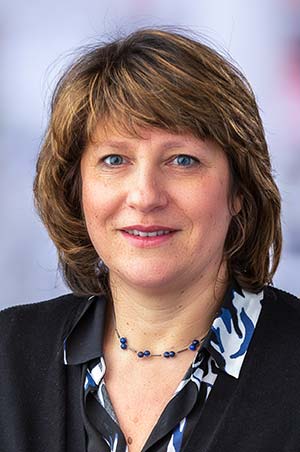
Mary Lanzerotti is a Collegiate Assistant Professor in the Bradley Department of Electrical and Computer Engineering at Virginia Tech. She specializes in signal processing, control systems, and medical evacuation technology. Her research focuses on hoist stabilization for MEDEVAC rescues, RF signal estimation, and material science involving liquid films. She is also deeply involved in educational initiatives, including hybrid course development and student advising strategies. Education: A.B. summa cum laude from Harvard College (1989), M. Phil. from the University of Cambridge (1991), M.S. and Ph.D. from Cornell University (1994–1997). Research Interests: Signal processing algorithms, mechanical stabilization of hoist systems, quantum computing verification, and integrated circuits design. Recent work includes gyroscopic data-driven control systems and multi-tier RF signal estimation methods. Service Roles: Member of faculty search committees, assessment committees, and the Graduate Honor System panel. Active in institutional accreditation and curriculum modernization efforts. Labs/Teams: Collaborates with interdisciplinary teams on projects involving aerospace rescue systems, laser material interaction studies, and microelectronics verification.
Michael P. Wellman is a Professor of Computer Science and Engineering at the University of Michigan, specializing in computational game theory and its applications to economics and finance. He has advised 28 PhD graduates and currently mentors 6 students, emphasizing independent research and tailored advising approaches. His work focuses on multi-agent systems, strategic interactions, and agent-based modeling of financial markets. He holds the endowed Lynn A. Conway Professorship and created the Morris Wellman Faculty Development Professorship. His research group meets weekly for progress reports, paper discussions, and practice presentations. Wellman encourages internships, teaching experience, and conference participation (e.g., ICAIF, AAMAS, EC) to foster career readiness. His scientific contributions span empirical game-theoretic analysis (EGTA), market manipulation detection, and cybersecurity strategies. He prioritizes student independence, collaborative problem-solving, and ethical considerations in AI-driven financial systems.
Tim Jenkinson is a Professor of Finance at the Saïd Business School, University of Oxford. He holds dual roles as a Professorial Fellow at Keble College and a Research Associate at the European Corporate Governance Institute. His expertise spans private equity, IPOs, and institutional asset management, with a focus on empirical research leveraging unique industry data. Education: B.A. in Economics from the University of Cambridge, Thouron Fellowship at the University of Pennsylvania, DPhil in Economics from the University of Oxford. Research Interests : Tim’s work examines private equity performance persistence, IPO pricing dynamics, and regulatory impacts on financial markets. His studies have been published in top journals like Journal of Financial Economics and Management Science . Key Contributions : Director of the Oxford Private Equity Institute, founder of the Private Equity Research Consortium, and frequent keynote speaker at global finance events. His research has won major awards, including the Harry Markowitz Prize (2016) and Commonfund Prize (2015). Engagement & Teaching : Teaches entrepreneurial finance to MBA/EMBA students and runs the Oxford Private Equity Programme. Recognized with the 2014 'Best Elective Teacher' award. Also serves on valuation committees for Schroder British Opportunities Trust and Oxford University Endowment Management. Professional Roles : Partner at Oxera (economic consultancy), former UK Treasury Select Committee advisor, and expert witness in high-profile litigation. His work bridges academia and practice, influencing policy and industry standards. Labs & Initiatives : Leads the Oxford Private Equity Institute and collaborates with the Oxford-Hyundai Motor Group Foresight Centre. Active in shaping future research through the Private Equity Research Consortium.
Olivier David Zerbib is an Assistant Professor of Sustainable Finance at CREST, ENSAE, Institut Polytechnique de Paris, and serves as an Associate Editor for the Review of Finance. His research bridges financial theory with environmental sustainability, focusing on market mechanisms for ecological challenges. His primary research areas include sustainable finance, environmental finance, and asset pricing, with specific expertise in green bonds, biodiversity valuation, and climate impact investing. He investigates how pro-environmental preferences influence pricing mechanisms, develops sustainable asset pricing models, and examines shareholder engagement strategies to curb greenwashing through quantitative methodologies. Analysis of his publications reveals a cohesive trajectory toward integrating environmental metrics into core financial frameworks, with significant contributions spanning green bond markets, sustainable CAPM development, and biodiversity economics. His work demonstrates methodological rigor through score-driven conditional betas and empirical validation across global markets. Dr. Zerbib's scientific recognition includes: #1 most cited article in the Journal of Banking and Finance over 3 and 5 years (2019) SUERF/UniCredit Research Prize (2018) Multiple Best Paper Awards at international finance conferences (2017-2020) European Investment Forum Research Prize Finalist (2021) He co-organizes the CMAP-CREST Quantitative Sustainable Economics and Finance seminar series with Patricia Crifo, Emmanuel Gobet, Peter Tankov, and Gauthier Vermandel, fostering collaboration between Ecole Polytechnique and ENSAE on quantitative approaches to sustainability challenges. His presentation record spans elite institutions including LSE, Yale, and the European Commission Joint Research Center.
Benjamin Born serves as Professor of Macroeconomics at Frankfurt School of Finance & Management and Research Director at the ifo Institute. He is a Research Fellow at CEPR and CESifo, advises the European Commission's DG ECFIN, serves on the European Parliament's Expert Group on Monetary Policy, and sits on the CEPR–EABCN Euro Area Business Cycle Dating Committee. Starting in September 2025, he will join the University of Bonn as Professor of Macroeconomics. Education PhD in Economics, 2011, University of Bonn, Germany MSc in Econometrics and Economics, 2007, University of York, UK BA/MA in Economics, 2006, University of Siegen, Germany Professor Born's research focuses on business cycles, fiscal and monetary policy, heterogeneous agent models, and empirical methods in macroeconomics. His work bridges theoretical modeling with empirical analysis, often using innovative data sources including firm surveys and social media data. He has made significant contributions to understanding how monetary policy affects different segments of the economy, how fiscal policy transmits through various channels, and how firms form expectations about the future. His recent publications reveal a strong trend toward analyzing heterogeneous effects in macroeconomics, particularly examining how different groups (firms, workers, consumers) respond differently to economic shocks and policies. His work increasingly incorporates social media data and novel survey methodologies to capture real-time economic behavior. A significant portion of his research addresses policy responses to the COVID-19 pandemic, including fiscal stimulus packages and lockdown effects. Professor Born is actively involved in the academic community, serving on the editorial boards of the Journal of Monetary Economics and the European Economic Review. He regularly organizes major academic conferences including the BASEforHANK Winterschool and the ifo Conference on Macroeconomics and Survey Data. Teaching and Supervision Currently teaches Macroeconomics II (first-year Ph.D. course at BGSE) Has taught Macroeconomics and Econometrics at all levels Supervises theses in macroeconomics and applied econometrics
Jiang Wang is the Mizuho Financial Group Professor at the MIT Sloan School of Management, where he has been a faculty member since 1990, progressing from Assistant Professor to his current named professorship. He holds appointments in the Finance department and maintains an active research program in financial economics. Massachusetts Institute of Technology, Sloan School of Management (2005-present) MIT Sloan School of Management: Assistant Professor (1990-1994), Associate Professor (1994-1998), Professor (1998-1999), NTU Professor (1999-2005) Wang's research focuses on financial economics, asset pricing, market liquidity, trading volume, and financial market microstructure , with significant contributions to understanding information dynamics in markets. His work bridges theoretical models with empirical analysis, particularly in Chinese capital markets. Wang has developed influential theories on liquidity, trading volume, and market efficiency that have shaped modern financial economics. His recent publications demonstrate continued scholarly productivity, with research spanning market uncertainty, circuit breakers, repo markets, and Chinese financial markets. Wang's work integrates theoretical modeling with empirical validation, maintaining relevance to both academic discourse and practical market concerns. China Economics Prizes (2018) Smith Breeden Prize (2007, 2006) New York Stock Exchange Award FAME Research Prize (2004) Trefftz Award, Western Finance Association (1990) Wang has advised numerous doctoral students and supervised significant research projects, though specific student names aren't listed in the available materials. His extensive grant history includes multiple NSF awards and industry-sponsored research. Wang has held leadership positions including President of the Western Finance Association (2017-2018) and Director of the China Center for Financial Research at Tsinghua University (2002-2014). His academic service includes editorial roles for major finance journals and advisory positions with institutions including the Federal Reserve Bank of New York, Nasdaq Stock Market, and China Securities Regulatory Commission.
Dimitrios P. Tsomocos is a Professor of Financial Economics at Saïd Business School and a Fellow in Management at St Edmund Hall, University of Oxford. He holds a BA, MA, MPhil, and PhD from Yale University and previously worked at the Bank of England. He serves on editorial boards including Annals of Finance and Economic Theory, and is a Senior Research Associate at the Financial Markets Group at the London School of Economics. His educational background includes: University of Oxford: M.A. by resolution, 2002 Yale University: Ph.D. in economics, 1996 Yale University: M.Phil. in economics, 1992 Yale University: M.A. in economics, 1990 Yale University: B.A. in economics, 1989 Professor Tsomocos is a mathematical economist specializing in Central Banking, Banking and regulation, Incomplete asset markets, Systemic risk, Financial instability, and Issues of new financial architecture. His research focuses on contagion, financial fragility, interbank linkages, and the impact of the Basel Accord using General Equilibrium models with incomplete asset markets, money, and endogenous default. He is working toward designing a new paradigm of monetary policy, financial stability analysis, and macroprudential regulation. His recent publications show a consistent focus on financial stability, banking regulation, and the interaction between monetary policy and financial stability. The research spans theoretical modeling of bankruptcy and default in general equilibrium frameworks, practical applications to bank regulation, analysis of commodity cycles in emerging economies, and policy responses to crises like the COVID-19 pandemic. His work frequently employs quantitative methods and general equilibrium modeling to address pressing issues in financial economics. His scientific achievements include: 2004 Bank Sabatell prize for the best work on the economics of banking (for "Book vs. Fair Value Accounting in Banking and Intertemporal Smoothing") Co-development of the Goodhart-Tsomocos model of financial fragility (2003) Testimony to House of Lords for the Economic and Financial Affairs and International Trade Sub Committee's report (2011) Appointment to Research Advisory Board, Central Bank of Russian Federation (2018) Professor Tsomocos has advised numerous PhD students and collaborated extensively with central banks worldwide. He has served as an economic advisor to a major political party in Greece and regularly provides commentary on the Greek economy. His research has had substantial policy impact, with the Goodhart-Tsomocos model implemented by more than ten central banks including the Bank of Bulgaria, Bank of Colombia, Bank of England, and Bank of Korea. He continues to collaborate with researchers from the ECB, Central Bank of the Russian Federation, and Bank of Chile on updated versions of his financial fragility model. He co-developed the Goodhart-Tsomocos model of financial fragility while working at the Bank of England, which has been implemented at various central banks globally. His research group at Oxford continues to refine this model and apply it to contemporary financial stability challenges.
Ronnie Sircar is the Eugene Higgins Professor of Operations Research and Financial Engineering at Princeton University , where he contributes to the Department of Operations Research and Financial Engineering (ORFE). His work spans financial mathematics, stochastic modeling, and applied probability, with a focus on market volatility, optimal investment strategies, and dynamic game theory. Email: sircar@princeton.edu Office: Sherrerd Hall, Room 208, Princeton, NJ 08544 His research interests include: Stochastic Volatility: Asymptotic analysis, calibration, and impact on option pricing and portfolio optimization. Mean Field Games: Applications to cryptocurrency mining, energy markets, and interbank network formation. Portfolio Theory: Forward performance processes, drawdown constraints, and risk-averse strategies. Credit Risk: Multi-name credit derivatives, CDO valuation, and risk measures. Energy Systems: Renewable reliability, unit commitment, and electricity market design. Recent publications emphasize mean field games in energy and blockchain, stochastic volatility in portfolio optimization, and machine learning applications for financial engineering. He has advised graduate students such as Giulia Crippa, Nicolas Garcia, and Burak Aydin, often collaborating with researchers including M. Soner, P. Chan, and A.M. Reppen.
Benjamin J. Keys is a Research Associate at the University of Pennsylvania's Wharton School within the Public Economics program. His work focuses on public economics, environmental economics, and financial risk management with particular emphasis on housing markets and climate change impacts. University of Pennsylvania - The Wharton School Public Economics Department His research explores: Climate risk capitalization in housing markets Mortgage insurance moral hazard Consumer credit card payment behaviors Emergency credit systems Regional economic redistribution through mortgages Email: benkeys@wharton.upenn.edu Scientific awards include: Fellowships on Consumer Financial Management
Prof. Dr. Peter Gomber is Chair of e-Finance at the Faculty of Economics and Business, Goethe University of Frankfurt, Germany. He serves as Co-Chairman and member of the Board of the 'efl – the Data Science Institute', an industry-academic partnership between Frankfurt and Darmstadt Universities and leading industry partners. Additionally, he is a member of the Exchange Council of the Frankfurt Stock Exchange, Supervisory Board of Clearstream Banking AG, and Research Fellow at the Leibniz Institute for Financial Research SAFE in Frankfurt. Prof. Gomber received his Ph.D. at the Institute of Information Systems at the University of Giessen in 1999 after graduating in Business Administration. Before joining Goethe University in 2004, he worked for five years as Director, Head of Market Development Cash Markets and Xetra Research at Deutsche Börse AG, where he developed new market models and products for cash market trading on Xetra. His research focuses on market microstructure theory, digital finance and fintech, regulatory impact on financial markets, and electronic trading systems. With over 150 publications in leading international journals, his work has significantly influenced the field, particularly his highly cited papers on the Fintech Revolution. His recent research examines market fragmentation, circuit breakers, research unbundling under MiFID II, and the application of AI in financial markets. Prof. Gomber's extensive publication record shows a clear evolution from traditional market microstructure and electronic trading systems toward digital finance, fintech innovations, and regulatory impact analysis. His work bridges technical aspects of financial markets with regulatory considerations, demonstrating how technological innovations interact with market structure and regulation. His scientific recognition includes: IBM Shared University Research Grant (2007) Reuters Innovation Award (2000) Best Paper Award of the Journal of the Association for Information Systems (2020) Best Information Systems Publications Award (2020) Top 1 and Top 3 most cited articles in Fintech research (2025 bibliometric analysis) Prof. Gomber has successfully supervised numerous PhD students, including Tino Cestonaro who won the Best PhD Paper Award 2025. He has acquired significant research funds from both public institutions and the private sector. Notably, a market model invention by Prof. Gomber was granted a patent by the United States Patent and Trademark Office, with two additional market model inventions filed for patent in Europe and the US. He leads an active research team at the Chair of e-Finance, including researchers like Benjamin Clapham, Micha Bender, and Tino Cestonaro. The team collaborates closely with the efl – the Data Science Institute and the Leibniz Institute for Financial Research SAFE, bridging academic research with practical applications in financial markets.
Christian Schlag is a Professor at the Finance Department of Goethe University Frankfurt’s Faculty of Economics and Business , where he also serves as Dean. He leads the Chair of Derivatives and Financial Engineering and coordinates young researchers at the Leibniz Institute for Financial Research SAFE. His research focuses on equilibrium asset pricing, derivative securities, and empirical capital market analysis. Research Trends : Schlag’s recent work explores volatility dynamics, climate risk in asset pricing, return predictability, and investor behavior. His 2023 publications examine time-varying consumption growth risk, equity factors, and individual stock volatility models. Earlier studies (2021–2015) address pricing kernels, welfare costs of temperature volatility, and model mis-specification in hedging. Student Placements : Former advisees hold positions at institutions like the European Central Bank, INSEAD, Australian National University, and Warwick Business School. His Chair of Derivatives and Financial Engineering collaborates with networks across Europe, North America, and Asia.
Ruth Etzioni is an Affiliate Professor in the Biostatistics Program and Public Health Sciences Division at the Fred Hutchinson Cancer Center. She leads the Etzioni Lab, focusing on cancer screening, early detection, and overdiagnosis analysis. Her work integrates statistical modeling, epidemiology, and clinical research to address critical questions in prostate and breast cancer control. Dr. Etzioni holds the Rosalie & Harold Rea Brown Endowed Chair and has received a $7.4M NIH Outstanding Investigator Award. Education: PhD in Statistics (Carnegie Mellon University, 1990), MS in Statistics (Carnegie Mellon, 1987), BS in Mathematics (University of Cape Town, South Africa). Research interests emphasize biomarkers, clinical trials, and epidemiological methods. She leads the Biostatistics Core for the Pacific Northwest Prostate Cancer SPORE and participates in the Cancer Intervention and Surveillance Modeling Network (CISNET). Her lab develops models to evaluate screening policies, quantify overdiagnosis, and inform healthcare disparities reduction strategies. Key achievements include groundbreaking work on prostate cancer screening's harm-benefit tradeoffs and contributions to multi-cancer early detection (MCED) frameworks. Recent studies address racial disparities in prostate cancer outcomes, metastasis trends, and the clinical utility of novel diagnostics like PSMA PET imaging. Awards include the Brown Endowed Chair (2020), NCI OIA Award (2023), and recognition for advancing cancer data science. Her lab collaborates with institutions globally and mentors students in biostatistics and translational data science.
Alexi Savov is the Marcus Nadler Professor of Finance and Economics at the New York University Stern School of Business and a Research Associate in Asset Pricing at the National Bureau of Economic Research. His research investigates the interplay between monetary policy, financial institutions, and asset markets, with a focus on banking stability and macroeconomic transmission mechanisms. Education: Ph.D. in Finance, University of Chicago Booth School of Business M.B.A., University of Chicago Booth School of Business B.A. in Mathematics and Economics (summa cum laude), Washington University in St. Louis Research Focus: Professor Savov's work centers on macro-finance, monetary policy transmission, and financial intermediation. He examines how central banking actions influence credit markets, asset prices, and banking stability, with empirical emphasis on deposit dynamics, housing markets, and risk premiums. Publications: His articles in top-tier journals explore themes including monetary policy's impact on housing, deposit-driven banking models, and shadow banking. Research often integrates theoretical frameworks with granular data to address systemic risks and regulatory implications. Awards and Honors: 2022 Journal of Finance Brattle Group Prize (Distinguished Paper) 2018 Journal of Finance Amundi Pioneer Prize (Distinguished Paper) 2011 Journal of Finance Smith-Breeden Prize (Distinguished Paper) WFA Best Paper Award in Financial Intermediations Yuki Arai Faculty Research Prize in Finance, NYU Stern
Stacey Jacobsen is an Associate Professor of Finance at the Cox School of Business, Southern Methodist University (SMU), and holds the Fabacher Endowed Professorship of Alternative Asset Management. She received her PhD in Finance from Indiana University in 2011 and an undergraduate degree from Texas Christian University. Prior to her academic career, she worked as an investment banking analyst and strategy associate. PhD, Finance, Indiana University Undergraduate, Texas Christian University Her research focuses on Empirical Corporate Finance and Market Microstructure , with a particular emphasis on liquidity analysis, corporate bond markets, and investor behavior. Her work combines empirical studies with quantitative finance methodologies to explore financial market dynamics, transaction cost analysis, and strategic corporate finance decisions. Stacey's publications in top-tier journals such as the Journal of Finance, Journal of Financial Economics, and Management Science reflect her expertise in liquidity measurement, market microstructure, and corporate finance. These works often bridge theoretical finance with real-world market outcomes, covering subfields like high-speed trading, market efficiency, and empirical analysis of financial strategies. She teaches FINA 6238 Financial Modeling , integrating her research insights into practical financial analysis tools.
Arman Eshraghi is a Professor of Finance and Investment at Cardiff Business School , with 15 years of academic and industry experience. He founded the Cardiff Fintech Research Group , leads the Digital Transformation Innovation Institute 's fintech theme, and co-directs the Behavioral Finance Working Group . He serves as Editor-in-Chief of International Review of Economics and Finance and Senior Editor in multiple journals. Key academic appointments: Cardiff University (2018–present), University of Edinburgh (2013–18) International fellowships: Development Bank of Japan, University of Canterbury (New Zealand), UCL Industry engagement: Federal Reserve Bank (NY), Alan Turing Institute, CFA Society UK, CityUK Research Focus: Behavioral finance, corporate finance, financial technology, and interdisciplinary accounting. His work examines retail investor psychology, fund manager behavior, CEO decision-making, and fintech impacts on financial markets. He has published in Review of Financial Studies , Harvard Business Review , and Financial Times . Scientific Contributions: EFMD Global, Emerald Literati, and European Financial Group awards Keynote speaker at global conferences (New York, London, Mumbai, Frankfurt) Media citations in Financial Times , BBC , Forbes , and Bloomberg Teaching & Leadership: Delivers award-winning MSc/MBA/PhD courses in UK, Europe, and Asia. Holds a Postgraduate Certificate in Academic Practice and Fellow of AdvanceHE. Designed executive programs for firms including Aetna CVS Health and Scottish Widows. Research Leadership: Co-organizes international conferences like the Cardiff Financial Technology Conference and European Financial Management Association Meeting . Supervises PhD students on topics spanning fintech, behavioral finance, and CEO lifestyle impacts.