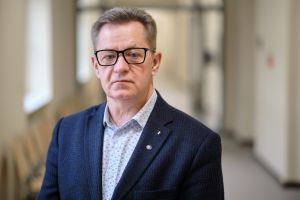
Professor Jacek Witkoś is affiliated with the Faculty of English at Adam Mickiewicz University (AMU), Poznań, Poland. Holding a Full Professor position since 2010, he contributes to syntactic theory, contrastive linguistics, and formal comparative analysis of English and Polish. MA in political science (1986) and English (1987), Ph.D. (1993) and D.Litt. (1998) in English Linguistics from AMU Headed significant research grants including OPUS projects on dative structures, complementizers, and Polish pronouns Former Vice Chancellor of AMU for Research and Foreign Affairs (2008-16) His research focuses on generative syntax, minimalism, and diachronic syntax, with applications to English-Polish contrastive linguistics. He has organized numerous international conferences like the Generative Syntax Section at Poznań Linguistic Meetings and the Workshop on Clausal Architecture. Scientific recognition includes: 1997 Minister of National Education's Award for outstanding research 1999 Rector of UAM 2nd prize 2019 Order of Polonia Restituta from the President of Poland Active in guest lectures at institutions like University of Vienna and University of Maryland, Witkoś maintains leadership roles in linguistic societies and editorial contributions to academic publications.
Ai Taniguchi is an Assistant Professor (Teaching Stream) in the Department of Language Studies at the University of Toronto Mississauga, specializing in English Language Linguistics and Online Teaching. Her academic journey includes a PhD in Linguistics from Michigan State University, where she worked under Marcin Morzycki, an MA in Linguistics from the same institution, and a BA (Highest Honours) in Linguistics and French from the University of Georgia. Her research expertise spans formal semantics and pragmatics, with particular focus on non-at-issue meaning, social meaning, and dynamic semantics. She explores what kinds of meaning exist in language beyond literal, at-issue meanings and how they can be formally modeled. Her work includes investigations of Japanese linguistic phenomena such as sentence-final particles, role language ( yakuwarigo ), and pejorative language use. Taniguchi's pedagogical work is equally innovative, combining linguistics with visual arts to create accessible educational content. She uses comics and other visual media to communicate complex linguistic concepts to broader audiences through her LingComics projects. Her teaching interests include equity, diversity, inclusion, and decolonization in linguistics education, public outreach, and innovative online teaching methods for large introductory courses. Her publications and research demonstrate a consistent pattern connecting formal linguistic theory with practical applications in education and public communication. She has co-authored Essentials of Linguistics (2nd edition), an open educational resource that makes linguistics accessible to wider audiences, reflecting her commitment to public linguistics and educational equity. LSA 2019: 5-Minute Linguist (winner) University of Toronto International Student Experience Fund (2022-2023) eCampusOntario Virtual Learning Strategy grant (2021-2022) As a teaching-focused faculty member, Taniguchi has developed numerous courses including LIN204 (English Grammar I), LIN205 (English Grammar II), LIN337 (Lexical Semantics), LIN338 (Pragmatics), and LIN452 (Communicating English Language Linguistics). Her pedagogical approach emphasizes authentic assessment, justice-centered curriculum development, and the integration of visual arts into linguistic instruction. Taniguchi maintains an active presence in both academic and public spheres, with media appearances, public lectures, and high school outreach programs in the Greater Toronto Area. Her work bridges the gap between specialized linguistic research and public understanding through creative communication methods.
Denise L Cloonan Cortez de Andersen is a Professor of Spanish and former Acting Department Chair at Northeastern Illinois University . Her academic work spans Second Language Acquisition , Spanish Linguistics , and Language Pedagogy , with a focus on dialectal variation, cultural assessment, and Freirean educational frameworks. Education Ph.D. in Linguistics, University of Delaware (1991) Doctoral Studies in Spanish Literature, University of Maryland (1985-1986) M.A. in Hispanic Literature, University of Delaware (1985) Graduate Studies, Centro de Estudios Hispánicos en Madrid and Bryn Mawr College (1983) B.A. in Spanish with Minor in English, University of Delaware (1983) Her research emphasizes heritage language learners , Strategic Interaction in language education, and the interface of Spanish and English in Chicago . She has published extensively on dialectal variation , reading comprehension assessment , and cultural pedagogy , including the book Contornos del habla (2009). Her work also explores language contact , phonology , and Freirean approaches to teaching. Advising roles include Teaching Certification for Professionals (TCP) mentorship and liaison to the College of Education . She has presented internationally on topics like regional literature and listening strategies , and served as a manuscript reviewer for educational texts.
Stefan Weninger is a University Professor and Head of the Department of Semitic Studies at the Center for Near and Middle Eastern Studies (CNMS) at Philipps University of Marburg. He has held a C4-Professorship for Semitistics in Marburg since 2001 and served as Managing Director of the CNMS from 2016-2020. His distinguished career includes leadership roles as 2nd Vice President (2015-2020) and subsequently 1st President (2021-2026) of the German Oriental Society, where he also serves as Speaker of the Semitistics Section. Weninger earned his doctorate in 1991 from Ludwig-Maximilians-Universität München with a dissertation on Qana'a in Arabic literature, followed by his habilitation in 1997 on the verbal system of Old Ethiopic. His academic journey includes research assistant positions at LMU from 1991-2001 before his appointment to Marburg. His scholarly work spans Semitic linguistics with particular expertise in Ethiopic languages, Classical Arabic, and Ancient South Arabian studies. Weninger's research interests focus on comparative Semitic grammar, historical linguistics, epigraphy, and lexicography. His work demonstrates exceptional depth in Ge'ez (Classical Ethiopic) studies, where he has produced foundational scholarship on its verbal system, grammar, and lexicon. His research extends to Arabic-Ethiopic language contact phenomena, Sabaean epigraphy, and the history of Orientalist scholarship. He has made significant contributions to understanding the linguistic relationships between Semitic languages and the historical development of writing systems in the Near East. Analysis of Weninger's recent publications reveals consistent focus on Ethiopic linguistics, particularly Ge'ez grammar and discourse structures, while also maintaining strong engagement with Classical Arabic studies and Ancient South Arabian epigraphy. His work shows a methodological blend of historical-comparative linguistics with textual criticism and philological analysis. The publications demonstrate increasing attention to the history of Orientalist scholarship alongside his core linguistic research, reflecting a mature scholarly perspective that bridges historical and linguistic approaches. 2nd Vice President of the German Oriental Society (2015-2020) 1st President of the German Oriental Society (2021-2026) Speaker of the Semitistics Section in the German Oriental Society (2017-present) As an academic leader, Weninger has supervised numerous doctoral students and research projects, including DFG-funded projects on Arabic and Ethiopic texts of the Testament of Abraham and Secundus Taciturnus. His editorial work includes serving on the advisory boards of Middle East - Topics & Arguments, Aethiopica, and Orientalistische Literaturzeitung, where he acts as section editor for Semitics. He has been instrumental in advancing Semitic studies through his leadership in academic societies and his comprehensive reference work, The Semitic Languages: An International Handbook.
Magnus Levin is a Professor at the Department of Languages, Faculty of Arts and Humanities, Linnaeus University. His primary teaching role is within the Non-fiction Translation Master Programme, and he is actively involved in interdisciplinary research initiatives such as the Linnaeus University Centre for Data Intensive Sciences & Applications (DISA) and the Linnaeus University English-German-Swedish Corpus (LEGS). His research spans two core areas: (1) language change and variation in English grammar and phraseology, including studies on tense formation, progressive aspect, collective noun agreement, and phraseological patterns like echoic binomials; and (2) corpus-based translation analysis , focusing on light verb constructions, complex modifiers, and punctuation across English, German, and Swedish. He has pioneered the use of virtual reality for corpus visualization and real-time social media data analysis through the Nordic Tweet Stream project. Recent publications highlight his expertise in cross-linguistic complexity (2024), acronym translation (2021), non-fiction translation (2019), and discourse markers in digital contexts (2016-2021). His work often intersects with Nordic English variation Multilingual corpus design Translation of phraseological units Language change in real-time data Levin collaborates extensively with researchers like Johan Ström Herold, Mirja Laitinen, and Joseph Tyrkkö, contributing to scientific publications in venues such as Languages in Contrast , World Englishes , and Corpus Linguistics and Changing Society . He has also co-edited volumes on contrastive linguistics and sports language analysis.
Dr. Naomi Nagy is Professor and Chair of the Department of Linguistics at the University of Toronto, Faculty of Arts and Science. She teaches courses on sociolinguistics, language variation and change, and heritage languages at both undergraduate and graduate levels. Her academic career spans over two decades with previous appointments at the University of New Hampshire and visiting positions at institutions worldwide. Ph.D. in Linguistics, University of Pennsylvania (1996) B.A. cum Laude in Linguistics (with Honors) and French, Dartmouth College (1989) Dr. Nagy's research focuses on sociolinguistics, particularly language variation and change in heritage language contexts. She specializes in understanding language contact through variationist sociolinguistic approaches, with particular expertise in Faetar (a Francoprovençal dialect), heritage languages, language contact phenomena, New England English dialects, phonetics, and sociolinguistic variation in Toronto's multilingual communities. Her work examines how languages change across generations in contact situations, with a focus on maintaining linguistic complexity in heritage language contexts. Her extensive publication record demonstrates consistent contributions to understanding heritage language variation across multiple languages including Italian, Russian, Korean, Tagalog, and Cantonese. Her research reveals that heritage languages maintain significant complexity and often follow similar patterns of variation as homeland varieties, challenging assumptions about simplification in heritage language grammars. Dean's Research Excellence Award, University of Toronto (2022) Dean's Excellence Award, University of Toronto (2016, 2017, 2021, 2022) LabEx Visiting Professor (Chaire Internationale 2022), Université de Paris (Spring 2022) Marco Polo Visiting Professor, University of Groningen (Summer 2015) Distinguished Visiting Professor, Queen Mary University London (March 2013) Dr. Nagy has successfully supervised numerous graduate students and secured significant research funding. She directs the Heritage Language Variation and Change (HLVC) Project, which has received multiple grants from the Social Sciences and Humanities Research Council (SSHRC), including Insight Grants for 'Ethnolinguistic variation and change: coordinating production and perception' (2018-2025) and 'Heritage languages speakers in Toronto -- what do they tell sociolinguists?' (2015-2022). Her research has involved over 50 students in its first two years and continues to expand. Dr. Nagy leads the Heritage Language Variation and Change in Toronto Project, which documents and analyzes variation in 10 heritage languages spoken in Toronto (Cantonese, Faetar, Hungarian, Italian, Korean, Polish, Portuguese, Russian, Tagalog and Ukrainian). She has also developed methodology and a corpus of recorded conversational data for these languages. Additionally, she has worked extensively on documenting Faetar, an endangered Francoprovençal language, creating a descriptive grammar, online teaching materials, and currently developing #FPglobal, a social media platform to support inter-dialectal communication in Francoprovençal.
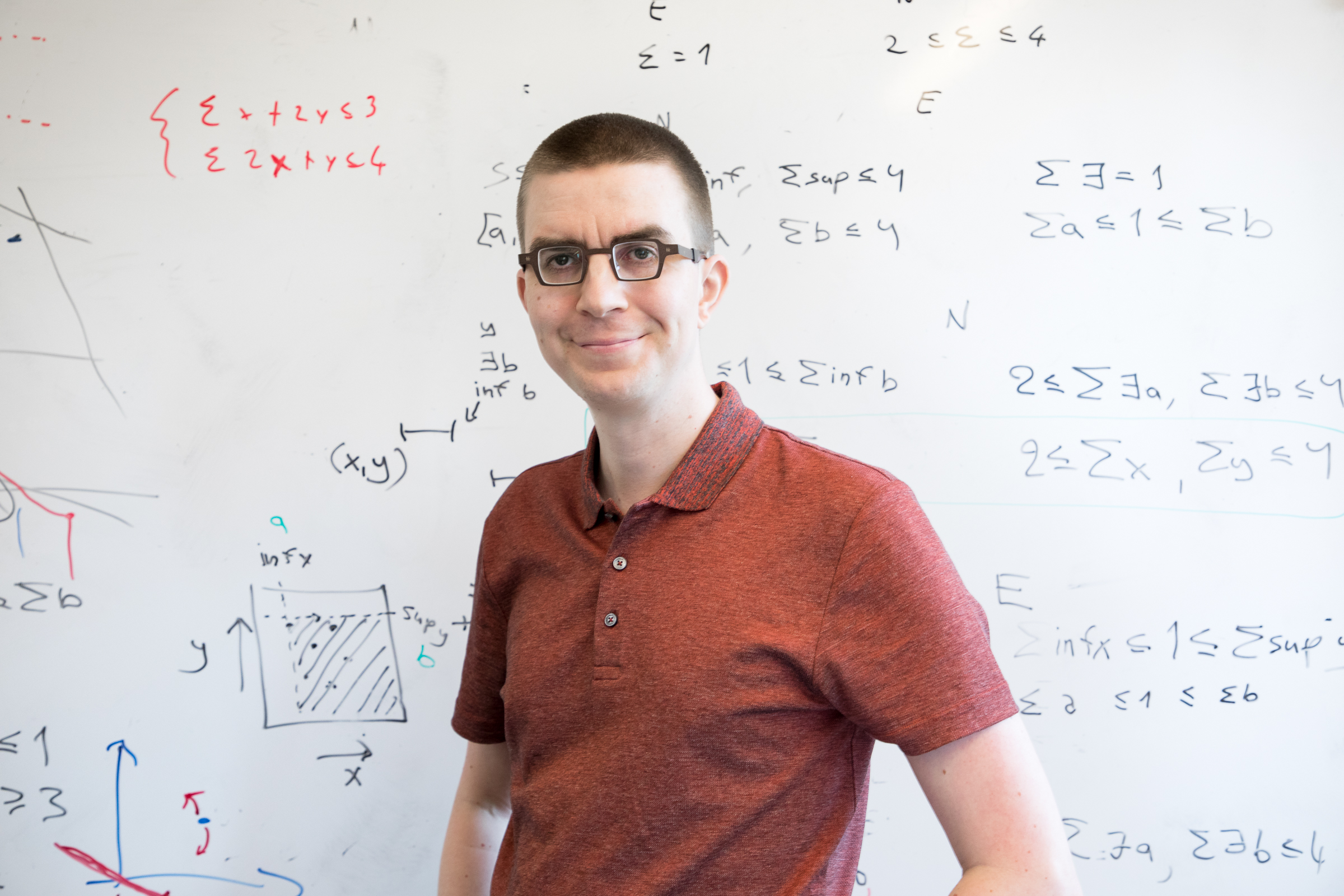
Jukka Suomela is an Associate Professor in the Department of Computer Science at Aalto University, Finland. His research focuses on the theoretical foundations of distributed and parallel computing, with a strong emphasis on locality and algorithmic complexity. Current roles: Associate Professor, Aalto University Research group: Distributed Algorithms Key conferences: PC Chair for DISC 2019, SIROCCO 2016, Local Chair for ALGO 2018 Steering Committee: Vice Chair, DISC Research Interests include distributed algorithms, local algorithms, parallel computing, graph algorithms, and computational complexity. His work explores fundamental limits of distributed systems and the role of locality in algorithm design. Notable Scientific Awards : FOCS 2019 Best Paper Award DISC 2012 & 2017 Best Paper Awards MSc Thesis Award 2006, University of Helsinki Best Junior Researcher 2008, University of Helsinki Nokia Scholarship 2008 Teaching includes Programming Parallel Computers (freely available), CS-E4510 Distributed Algorithms, and other courses in the Finnish Computer Science major/minor programs. His publications span distributed systems theory, graph algorithms, and interdisciplinary projects in linguistics and cultural analytics.
Prof. Dr. Biljana Babić is a full professor at the Department of Serbian Studies, Faculty of Philology, University of Banja Luka. Her research spans Serbian linguistics, Slavic philology, historical grammar, and translation studies, with a focus on the evolution of the Serbian language and its cultural contexts. Her research interests include: Historical Linguistics : Analysis of Old Serbian manuscripts, Cyrillic paleography, and morphological evolution. Sociolinguistics & Onomastics : Studies on loanwords, surnames, and language contact in the Balkans. Pedagogical Applications : Children's linguistic creativity and Serbian language education. Publications predominantly explore historical linguistics, Slavic philology, and sociolinguistics, with recurring themes in manuscript analysis, lexical semantics, and Balkan language contact. Her work often integrates cross-disciplinary approaches linking linguistics with cultural history. She leads key research projects: Serbian Language Competences in Diaspora (Int’l project, 2025). Resources of Serbian in Media Discourse (National project, 2024-2026). Past projects include studies on children's creativity and Slavic language preservation. Collaborates with interdisciplinary teams across Balkan institutions.
Christoph Kugelmeier serves as an außerplanmäßiger Professor (extraordinary professor) and chair representative at the Department of Classical Philology, University of Saarland. He has held this position since April 2021, representing the Chair of Classical Philology. Kugelmeier has been affiliated with the University of Saarland since 2000, initially as a research assistant, and was appointed extraordinary professor in March 2010. His academic career includes visiting professorships at universities in Hamburg, Greifswald, Komotini, and Santiago de Compostela. His research focuses on Greek lyric poetry, Greek comedy, Latin drama (particularly Senecan tragedy), ancient translation theory, ancient historiography, and Septuagint studies. Kugelmeier has made significant contributions to the study of the Book of Sirach, Senecan drama, and the linguistic aspects of biblical translations. His recent work increasingly examines the intersection between historical truth and fictional storytelling in ancient sources, as evidenced by his 2024-2025 publications on Nero, Agrippina, and historical 'fake news' in ancient contexts. Kugelmeier's scholarly output reveals a sustained focus on the theoretical and practical dimensions of ancient translation, with particular attention to the Septuagint and biblical texts. His publications span from detailed linguistic analyses of specific lexemes to broader investigations of translation theory in antiquity. Recent articles demonstrate his growing interest in how ancient historians constructed narratives about controversial figures like Nero, blending historical facts with literary conventions. praeses of Societas Latina (since 2023) Advisory Board member for Historical and Theological Lexicon of the Septuagint Editorial Board member for 'The Septuagint in its Ancient Context' Co-editor of 'Dramatische Antike' series Consultor of 'Vox Latina' journal (since 2003) Kugelmeier actively contributes to major scholarly projects including the Historical and Theological Lexicon of the Septuagint (HTLS) and the synoptic translation of the Book of Jesus Sirach. He serves as vice-chair of the Saarland branch of the German Classical Philologists' Association and has been involved with the research network 'Retorica & Antropologia' at the Pontificia Università della Santa Croce in Rome since 2019. His teaching encompasses ancient languages, literature, and translation theory, with notable public lectures on topics ranging from Homer's language to Latin in Harry Potter.
Anu Laanemets is an Associate Professor in Scandinavian Languages at the University of Oslo , specializing in Norwegian linguistics. Email: anu.laanemets@iln.uio.no Phone: +47 22854906 Office: Niels Henrik Abels vei 36, Henrik Wergelands hus, Oslo Research Interests include historical syntax, comparative linguistics, and corpus-based studies. Recent work explores pannekakesetninger (Norwegian pancake sentences) and existential constructions in Norwegian dialects. Publications highlight collaborations on treebank development and diachronic syntax analysis. She contributes to projects involving grammatical structures and linguistic variation. Completed Projects include research on Scandinavian language corpora and historical syntax patterns.
Cliodhna Hughes is a full-time Research Assistant in Phonetics at the University of Edinburgh , affiliated with the School of Philosophy, Psychology and Language Sciences and the Linguistics and English Language department. Her work focuses on speech production theories through the ERC-funded project 'PlanArt: Planning the Articulation of Spoken Utterances,' led by Professor Alice Turk, where she analyzes electromagnetic articulometry (EMA) data. Her research interests span: Speech Technology : Voice analysis, AI ethics, and surgical impacts on speech. Language Evolution : Cross-modal communication and word order harmony. Sociolinguistics : Gender expression in speech and first language acquisition. Medical Humanities : Intersections of healthcare and speech science. Cliodhna holds an MA (Hons) in Linguistics from the University of Edinburgh (2022) and is completing an MPhil in Speech and Language Technology at the University of Sheffield. Her recent publications address gender representation in speech , surgical effects on vocal acoustics , and linguistic patterns in silent gesture , reflecting interdisciplinary collaborations in speech science and sociocultural contexts. Current activities : Finalizing her contract on the PlanArt project (ERC-funded). Seeking research, healthcare, or AI policy roles in Europe starting September. Active in student leadership as National Chair of the Undergraduate Linguistics Association of Britain (ULAB).
Hans van de Velde is a Professor of Sociolinguistics at Utrecht University's Department of Languages, Literature and Communication and part of the Institute for Language Sciences . He also serves as a senior researcher at the Fryske Akademy , focusing on Frisian language studies. His research spans multiple areas including: Language variation and change Sociophonetics Standardization processes Minority languages Acoustic-phonetic analysis Language contact Recent scholarship highlights his work on: 2024 : Visible Vowels software for language transfer studies 2023 : Sociophonetics of rhotic sounds and Frisian-Dutch education policy 2022 : Frisian standardization and consonant analysis tools Contact: h.vandevelde@uu.nl
Giovanni Garofalo is a Full Professor of Spanish Language and Translation at the Department of Foreign Languages, Literatures, and Cultures at the University of Bergamo. He held previous positions as Associate Professor (2014–2020) and Assistant Professor at the University of Trieste (2004–2008) and the University of Bergamo (2008–2014). His research focuses on corpus-assisted discourse analysis , legal and political communication , and the discursive construction of gender in Spanish . University of Bergamo Department of Foreign Languages, Literatures, and Cultures Garofalo’s research explores specialized fields, including Spanish legal communication in criminal law, legislative language, and terminography. He has authored monographs on these topics and investigates argumentation across business , medicine , and politics . His recent publications analyze textual complexity, hate speech, and urban heritage discourses. Key trends in his work include the intersection of corpus linguistics with legal/political discourse, gender representation in Spanish media, and interdisciplinary collaborations with Spanish universities. Garofalo is a member of the Center for Research on Specialized Languages (CERLIS) and associations like AISPI and AELINCO . His teaching emphasizes Spanish discourse analysis , textual genres, and argumentation frameworks. Students engage with real-world texts and are trained in pragmatic and metadiscursive skills at C1+ proficiency. Garofalo’s methodological approach combines theoretical lectures with practical analysis via e-learning platforms.
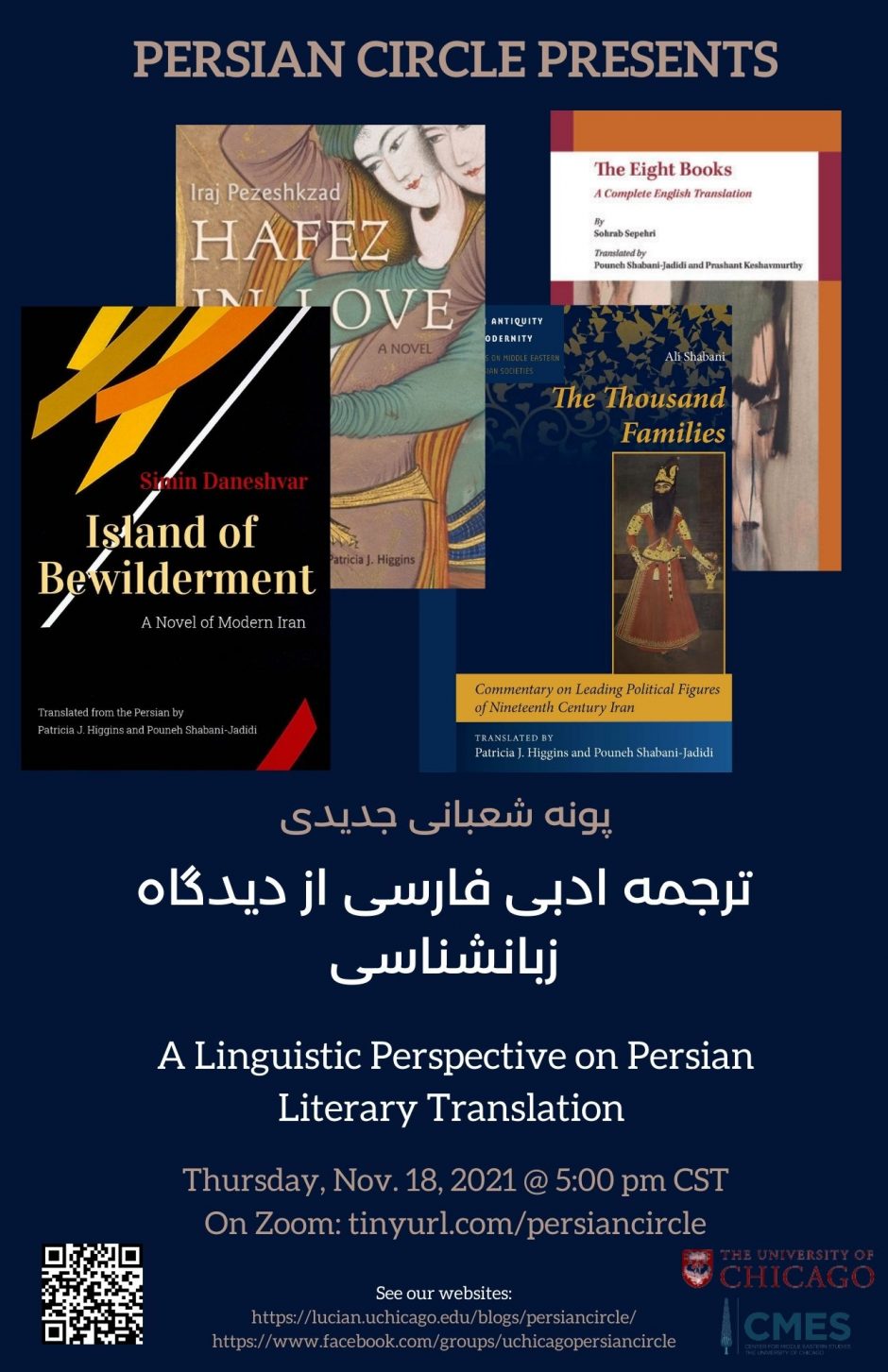
Pouneh Shabani-Jadidi is a Teaching Professor of Persian at the University of Chicago. Prior to this, she served as Senior Lecturer of Persian Language and Linguistics at McGill University (15 years) and Lecturer of Linguistics and Translation at Tehran Azad University (7 years). She holds two PhDs: a 2012 degree in Linguistics from the University of Ottawa, and a 2004 PhD in Applied Linguistics (Translation Focus) from Tehran Azad University. Persian language pedagogy Second language acquisition Literary translation theory and practice Psycholinguistic approaches to Persian syntax Translation metacognitive strategies Persian media language instruction Her publications include edited volumes like The Oxford Handbook of Persian Linguistics (2018) and The Routledge Handbook of Second Language Acquisition and Pedagogy of Persian (2020), along with co-translations of major Iranian literary works. She has presented extensively on linguistic approaches to Persian literary translation.
Dr Ivy Wong serves as a Bowland Research Fellow at the Department of Education, University of York, while concurrently holding an Assistant Professor position at Hong Kong Shue Yan University (currently on sabbatical). Her research program centers on second language acquisition, specifically investigating how cognitive linguistics-inspired instruction enhances grammar learning through innovative digital tools and pedagogical frameworks. Her academic credentials include: PhD in Applied English Linguistics, The Chinese University of Hong Kong (2015-2018) MPhil in Applied English Linguistics, The Chinese University of Hong Kong (2013-2015) BA in English, The Chinese University of Hong Kong (2011-2013) Dr Wong's research bridges cognitive theory with practical language pedagogy, specializing in concept-driven grammar instruction for challenging structures like prepositions and conditionals. She pioneers computer-assisted methodologies using animated schematic diagrams and Bayesian statistical modeling to analyze individual learning trajectories. Her work emphasizes open science practices, with research materials publicly accessible via Gorilla platform. Recent publications reveal a methodological evolution toward Bayesian approaches in replication studies and neurocognitive investigations, while maintaining consistent focus on translating theoretical linguistics into classroom applications. Key themes include technology-enhanced grammar instruction, cross-linguistic influences on L2 acquisition, and evidence-based material development. Her scholarly recognition includes: Bowland Research Fellowship (2023-2025) Fulbright Visiting Scholar award (2017-2018) Dr Wong has secured substantial research funding including the SCOLAR Language Fund (£110,203; 2021-2023) for developing the English Preposition Tutor and the Bowland Fellowship for her current conditional acquisition project. Her teaching portfolio spans undergraduate modules in Psycholinguistics and Second Language Acquisition to postgraduate courses in Cognitive Linguistics, demonstrating comprehensive mentorship across academic levels. She actively contributes to the Centre for Advanced Studies in Language and Education (CASLE) at York, collaborating on interdisciplinary projects that integrate computational methods with language education research.