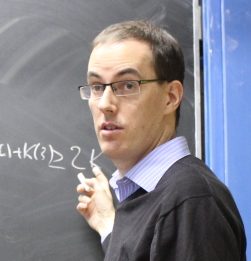
Yin Tat Lee is an Associate Professor at the Paul G. Allen School of Computer Science & Engineering , University of Washington, and a Senior Principal Researcher in Microsoft AI. His research spans convex optimization , convex geometry , graph algorithms , online algorithms , and differential privacy , with applications in machine learning and theoretical computer science.
Prof. Dr. Ralf Schindler is a Professor at the Institute for Mathematical Logic and Fundamental Research within the Department of Mathematics and Computer Science at the University of Münster. His primary research focuses on foundational aspects of mathematical logic, particularly in set theory and model theory. Schindler's research explores core areas including inner model theory, forcing techniques, large cardinals, determinacy axioms, and descriptive set theory. His investigations address fundamental questions about the structure of mathematical universes, consistency proofs, and connections between set theory and other mathematical disciplines. Recent work emphasizes applications of determinacy hypotheses and extensions of Martin's Maximum. Schindler's publications demonstrate consistent focus on advanced set theory concepts from 2000 to 2021. Key trends include deep investigations into inner models (especially core models and mouse constructions), forcing axioms and their consequences, determinacy hypotheses, and the interplay between large cardinals and descriptive set theory. His collaborative works frequently appear in premier logic journals. Schindler has received significant recognition for his contributions: Hausdorff Medal (2022) Dov Gabbay Prize (2024) He leads the research project EXC 2044 - A2: Groups, model theory and sets , which investigates applications of model theory to arithmetic geometry, topological dynamics, and group theory, while addressing fundamental questions in geometric group theory and set theory foundations.
Prof. Dr. Gerold Alsmeyer is a faculty member at the Institute of Mathematical Stochastics, Department of Mathematics and Computer Science, University of Münster. He is an active researcher with a focus on stochastic processes, particularly stochastic fixed-point equations and iterated function systems. His work is supported by his role as an Investigator in Mathematics Münster in the project EXC 2044 - C1: Evolution and asymptotics. His primary research interests include the theory of stochastic processes, branching processes, Markov random walks, renewal theory, and the asymptotic analysis of random structures such as random trees and polytopes. He has made significant contributions to the understanding of fluctuation theory, perpetuities, and the smoothing transform. His recent publications (2017–2023) reveal a sustained focus on theoretical probability, with recurring themes in random difference equations, iterated function systems, and limit theorems for stochastic processes. The work spans pure mathematical theory and applications in mathematical biology and combinatorics, indicating a broad yet deep research profile. Prof. Alsmeyer has supervised numerous doctoral and master’s students, including Viet Hung Hoang, Christopher Eick, Philipp Godland, and Fabian Buckmann, whose dissertations cover topics in branching processes, random walks, and stochastic fixed-point equations. He has no listed scientific awards in the provided texts. He teaches courses in probability theory, mathematical statistics, branching processes, and stochastic recursion equations, demonstrating a strong commitment to academic mentoring and education.
Christopher Deninger is a distinguished Professor in the Mathematical Institute at the University of Münster, Germany, where he leads research in Arithmetic Geometry and Representation Theory. His office is located in Room 413 of the Einsteinstr. 62 building, and he maintains active teaching responsibilities including courses in Representation Theory of Finite Groups, Linear Algebra, and specialized topics like Adic Spaces. Deninger's research spans multiple interconnected domains of modern mathematics, with a consistent focus on the deep connections between number theory and geometry. His work has evolved from classical arithmetic geometry to incorporate increasingly sophisticated connections with p-adic analysis, dynamical systems, and more recently proalgebraic fundamental groups. A unifying theme throughout his career has been exploring analogies between different mathematical structures, particularly those connecting analytic number theory with dynamical systems on foliated spaces. His recent publications reveal a continued expansion of his research program into new territories while maintaining connections to his foundational work. The most recent papers show increasing integration of algebraic topology concepts with arithmetic geometry, particularly through proalgebraic fundamental groups and their applications. The consistent thread throughout his decades of publications is the search for deeper structural connections between seemingly disparate areas of mathematics, particularly those bridging analysis, geometry and number theory. Professor Deninger has mentored an extensive number of doctoral students and postdoctoral researchers, as evidenced by the comprehensive list of former members in his working group. His collaborations span the international mathematical community, with numerous joint publications with leading mathematicians across Europe and beyond. While specific grant information isn't detailed in the available materials, his sustained publication record across decades suggests consistent research support for his mathematical investigations. The Mathematical Institute at Münster provides the institutional home for Deninger's research activities, where he maintains an active working group focused on arithmetic geometry and related fields. His office environment includes support staff and colleagues working in closely related mathematical domains, creating a vibrant research community centered around advanced topics in pure mathematics.
Zachary Kincaid is an Associate Professor in the Department of Computer Science at Princeton University's School of Engineering and Applied Science. His research focuses on program analysis, logic, and programming languages, with an emphasis on making program analysis compositional and robust. He received his PhD from the University of Toronto under the supervision of Azadeh Farzan. His work has been implemented in the Duet program analyzer, and he has an Erdős number of 3. Dr. Kincaid's research interests include: Compositional program analysis techniques Algebraic approaches to program analysis Termination analysis and ranking function synthesis Verification of concurrent and parallel programs Automated reasoning and decision procedures Analysis of numerical programs and loops His recent publications show a strong focus on developing novel techniques for program analysis that bridge theoretical computer science with practical verification tools, particularly in nonlinear analysis, quantified reasoning, and compositional verification. Dr. Kincaid has received research support from ONR grant N00014-19-1-2318 for his work on robust program analysis. He has advised graduate students including: Current: Jake Silverman, Nicolas Koh, Nikhil Pimpalkhare Graduated: Shaowei Zhu (PhD 2024, Researcher at Amazon), Charlie Murphy (PhD 2023, Postdoc at University of Wisconsin–Madison) Dr. Kincaid teaches courses including: COS 320 – Compiling Techniques (Spring 2024, 2022, 2020, 2019) COS 516 / ELE 516 – Automated Reasoning about Software (Fall 2025, 2022, 2018) COS 217 – Introduction to Programming Systems (Fall 2024) COS IW – Practical Solutions to Intractable Problems (Fall 2023, Spring 2023, 2018, 2017) COS IW – Little Languages (Spring 2018) COS 597D – Reasoning about concurrent systems (Fall 2016)
Prof. Dr. Georg Hein is a Professor in the Department of Mathematics at the University of Duisburg-Essen, Campus Essen. His office is located at WSC-O-3.58, Thea-Leymann-Str. 9, 45117 Essen, with office hours held every Tuesday from 2-3 PM and by appointment. He serves as Director of the Research Group Hein, focusing on Algebraic Geometry. His research centers on Algebraic Geometry with specific expertise in vector bundles, moduli spaces, elliptic surfaces, and sheaf theory. Hein's work demonstrates deep engagement with stability conditions, Fourier-Mukai transforms, and geometric invariant theory. His publications reveal a consistent focus on foundational structures in algebraic geometry, particularly through the lens of vector bundles on curves and surfaces. Analysis of his 15 most recent publications (2017-2007) shows a strong thematic continuity in moduli space theory and vector bundle classification. His work bridges abstract algebraic constructions with computational approaches, as evidenced by algorithmic developments for elliptic surfaces and lattice-theoretic investigations. The publications collectively emphasize stability criteria across diverse geometric contexts. Hein actively supervises PhD students including Asbjørn Michelsen, with former advisees Quyet Thang Truong and Dr. Dario Weißmann. He contributes to academic outreach through the Essen Math Circle for students, organizing weekly sessions for grades 5-13 covering advanced mathematical topics beyond standard curricula. His teaching portfolio includes courses such as Mathematische Miniaturen and Topologie .
Heiner Giefers is a Professor for Cloud Computing at the Department of Computer Science and Natural Sciences at Southwestphalia University of Applied Sciences since 2018. Prior to this position, he worked as a Research Staff Member at IBM Research - Zürich (2013-2018), focusing on hardware acceleration in cloud environments, implementation of big data algorithms on FPGAs, and development of hardware platforms for approximate and in-memory computing. Dr. Giefers received his doctorate (Dr. rer. nat.) from Universität Paderborn in 2012 with a dissertation titled "Design and Programming of Reconfigurable Mesh based Many-Cores." His academic journey at Universität Paderborn includes serving as an Academic Council Member (Akademischer Rat a.Z.) from 2008-2013 and as a Scientific Staff Member from 2006-2012, where he taught digital technology and computer architecture. Professor Giefers' research focuses on energy-efficient computing, particularly through hardware acceleration using FPGAs for cloud and AI workloads. His work spans cloud computing infrastructure, hardware-software co-design, approximate computing, in-memory computing, and energy-efficient implementations of machine learning algorithms. He has made significant contributions to the field of reconfigurable hardware for high-performance computing applications. His recent publications show a strong trend toward applying hardware acceleration techniques to artificial intelligence and machine learning workloads, with a particular focus on energy efficiency. His work bridges the gap between theoretical computer science and practical hardware implementation, often resulting in patented technologies that address real-world computing challenges in cloud environments. Best Paper Award for "Stochastic Matrix-Function Estimators: Scalable Big-Data Kernels with High Performance" (2016) Best Paper Award Nomination for "Energy-Efficient Stochastic Matrix Function Estimator for Graph Analytics on FPGA" (2016) Best Paper Award Nomination for "Analyzing the energy-efficiency of dense linear algebra kernels by power-profiling a hybrid CPU/FPGA system" (2014) Best Paper Award Nomination for "A Triple Hybrid Interconnect for Many-Cores: Reconfigurable Mesh, NoC and Barrier" (2010) Professor Giefers actively supervises numerous Bachelor's and Master's students, with over 50 completed theses covering topics from machine learning and cloud computing to IoT systems and hardware acceleration. He leads the "Energy-efficient AI" project (eki), which aims to increase the energy efficiency of AI systems through approximation techniques for FPGA implementation. Additionally, he collaborates with Prof. Dr. Christian Plessl on the "Digital teaching materials with Jupyter Notebooks" project, creating interactive learning materials that integrate teaching content, program code, and results into a single document. His work extends to practical applications through multiple patents related to FPGA implementations, neural networks, and memory systems, demonstrating his commitment to translating research into real-world solutions.
Michael Wibmer is a Lecturer in Pure Mathematics at the University of Leeds since 2023. Previously, he held positions at Graz University of Technology, the University of Notre Dame, the University of Pennsylvania, and RWTH Aachen University. He earned his PhD from the University of Heidelberg under the supervision of B.H. Matzat. His research focuses on algebraic, algorithmic, and arithmetic aspects of differential and difference equations, including Galois theory and algebraic groups. Key areas include algebraic methods in dynamical systems, symbolic computation, and connections to model theory and number theory. He organizes events like the Online Kolchin Seminar in Differential Algebra and co-organized workshops such as DART XI (2023) and the MSRI Summer School on Differential Equations (2022). Education: PhD in Mathematics, University of Heidelberg (2010), Habilitation in Mathematics, RWTH Aachen University (2015) Research Interests: Galois theory of differential equations, proalgebraic groups, difference algebraic groups, number theory, and symbolic computation Recent Activities: Organized the Algebraic Theory of Differential and Difference Equations workshop at Leeds (2024) His publications span topics like torsors under affine group schemes, regular singular differential equations, and étale difference algebraic groups, reflecting his expertise in algebraic structures and their applications to differential systems.
Dr. Arie Levit is a Senior Lecturer (tenure track) in the Department of Theoretical Mathematics at Tel Aviv University's School of Mathematics, a position he has held since 2021. Previously, he served as a Gibbs Assistant Professor at Yale University from 2017. His academic career centers on pure mathematics with emphasis on structural properties of discrete groups and dynamical systems. His educational background includes: B.A in Mathematics from the Hebrew University of Jerusalem (2004) M.A in Mathematics from the Hebrew University of Jerusalem (2012) Ph.D. in Mathematics from the Weizmann Institute of Science (2017) under Prof. Tsachik Gelander Levit's research spans discrete groups, geometric and analytic group theory, and ergodic theory, with significant contributions to lattice theory, invariant random subgroups, character rigidity, and group stability. His work integrates algebraic, geometric, and probabilistic frameworks to solve fundamental problems in classification and rigidity of group actions, particularly in non-Archimedean and hyperbolic settings. Analysis of his 14 publications (2014-2024) reveals evolving focus from foundational lattice theory toward contemporary stability phenomena and character theory, with 60% of recent work (2022-2024) addressing permutation stability, Hilbert-Schmidt representations, and ergodic properties of group actions. Key methodological threads include the application of ergodic theory to group-theoretic classification and the development of analytical tools for stability problems. His scholarly recognition includes: Klein Prize (2017) ISF-BSF research grant (2020) As principal investigator of the ISF-BSF grant, Levit leads research on group stability and ergodic theory. His extensive collaborations with Gelander, Lubotzky, and Lazarovich demonstrate active mentorship within the global mathematics community. His work is conducted within Tel Aviv University's Theoretical Mathematics department, which maintains strong international partnerships in geometric group theory and dynamics.
Arthur Bartels is a Professor at the Mathematical Institute, Department of Mathematics and Computer Science, University of Münster. He is a principal investigator in the CRC 1442 'Geometry: Deformations and Rigidity' and a key member of the Excellence Cluster 'Mathematics Münster', focusing on fundamental problems in topology and geometry. Research Interests: His work centers on topology , particularly algebraic K-theory , L-theory , and the Farrell-Jones conjecture . He investigates geometric rigidity , coarse geometry , and conformal field theory through operator algebras and higher categories. His research connects deep questions in group theory, manifold topology, and mathematical physics. Publication Trends: His recent work (2017–2022) shows a strong focus on conformal nets and higher categorical structures in quantum field theory, while continuing foundational work on isomorphism conjectures for K- and L-theory in geometric group theory. The articles reflect a dual expertise in abstract homotopy theory and concrete geometric analysis. Scientific Awards: No specific awards mentioned in the provided text. Advising and Grants: While no students are listed, he leads major research projects funded by the DFG, including CRC 1442 - C03 'K-theory of group algebras' and EXC 2044 - B2 'Topology'. These projects involve developing tools in index theory, surgery theory, and coarse geometry to study manifolds and group rings. Labs and Teams: He leads the 'AG Topologie' (Topology Research Group) at Münster and co-organizes the 'Advanced Seminar Topology' with colleagues. He is part of a large collaborative environment within Mathematics Münster, working closely with experts in analysis, geometry, and mathematical physics.
Lars Grasedyck is a Professor of Numerical Analysis at RWTH Aachen University. His research focuses on hierarchical matrices, tensor approximation, and numerical methods for partial differential equations and matrix equations. He has contributed to applications in biomedical engineering, particularly EEG/MEG inverse problems, and is involved in software development (HLIB, HLIB-pro). Education: Diploma and Ph.D. in Mathematics at Christian-Albrechts-Universität zu Kiel (1998, 2001), Postdoctoral work at Max Planck Institute, Leipzig (2002-2010). Research: Specializes in high-dimensional numerical methods, low-rank matrices, and tensors with applications in PDEs, uncertainty quantification, and biomedical modeling. Projects: Leads DFG-funded initiatives on adaptive tensor networks for parametric PDEs and tumor progression modeling. Advising: Supervises doctoral students including Thong Le, Maren Klever, and Dieter Moser. Software: Developed HLib and HLib-pro for hierarchical matrix computations. Conferences: Active in GAMM Fachausschuss Numerische Analysis, organizing workshops and symposia globally.
William Wulff is a Scientific Assistant at the Chair of Integrated Systems, Technical University of Munich (TUM), School of Computation, Information and Technology. He holds an M.Sc. in Computer Science and Engineering from the Technical University of Denmark (2021-2023) and a B.Eng. in Computer Engineering from the same institution (2017-2021), with an internship at CERN focusing on Embedded Systems and Compilers. Education : M.Sc. in Computer Science and Engineering (TUD), B.Eng. in Computer Engineering (TUD) Current Role : PhD candidate at LIS, TUM Research Interests include computer architecture (arithmetic circuits), error-correction schemes, asynchronous circuits, and linear codes for improving packet-drop resilience in wired networks, particularly low-latency implementations on SmartNICs. Contact : Email william.wulff@tum.de , Room N2139, Building N1, TUM Campus.
Prof. Dr.-Ing. Holger Blume serves as Vice President for Research and Transfer at Leibniz University Hannover while maintaining his academic position as Professor in the Architectures and Systems Section within the Faculty of Electrical Engineering and Computer Science. He holds multiple leadership positions including Chairperson of the Research Commission and Central Ethics Committee, Executive Board member of eNIFE (Leibniz Research Initiative for Neurosciences), and membership in both the Laboratory of Nano and Quantum Engineering and L3S Research Centre. His research interests span computer architecture, hardware design, signal processing, AI accelerators, hearing aid technology, and biomedical engineering. His work bridges theoretical computer science with practical applications in automotive systems, medical devices, and quantum engineering. Professor Blume's research demonstrates strong interdisciplinary connections between electrical engineering, computer science, and biomedical applications, with particular emphasis on hardware-oriented solutions for real-world problems. Analysis of his recent publications (2023-2025) reveals a strong focus on hardware acceleration for AI and signal processing applications, particularly in automotive radar/LiDAR systems and hearing aid technology. His work shows consistent innovation in RISC-V processor design, specialized hardware for mathematical functions, and biomedical applications of engineering principles. The research demonstrates a clear trajectory toward energy-efficient, specialized computing architectures for specific application domains. As Vice President for Research and Transfer, Professor Blume oversees significant research initiatives at Leibniz University Hannover, which hosts multiple Clusters of Excellence including PhoenixD (Photonics, Optics, and Engineering), QuantumFrontiers, and Hearing4all. The university participates in numerous collaborative research centers and junior research groups funded by DFG, BMBF, and EU programs. Professor Blume is actively involved in multiple research facilities including the Laboratory of Nano and Quantum Engineering and the L3S Research Centre. His work connects with Leibniz University's research focuses on optical technologies, quantum optics and gravitational physics, and biomedical research and technology. His leadership positions indicate strong involvement in shaping the research strategy and ethical framework of the university's scientific endeavors.
Dr. Robin J. Sroka is an Investigator in Mathematics Münster and a member of the Collaborative Research Center (CRC) 1442 Geometry: Deformations and Rigidity at the University of Münster. Affiliated with the Mathematisches Institut within the Faculty of Mathematics and Computer Science, his research focuses on Algebraic Topology and Geometric Group Theory, with particular emphasis on cohomology, homological algebra, and symplectic geometry. He contributes to projects such as the CRC's T1 program on K-Groups and Cohomology. His recent publications explore topics like Temperley-Lieb algebras, cohomology of arithmetic groups, scissors automorphism groups, and symplectic Steinberg modules. Sroka’s work bridges pure mathematics disciplines, combining algebraic structures with geometric and topological insights. His research often involves collaborations with leading mathematicians in the field, addressing foundational questions in algebraic topology and group theory. While no specific awards or grants are listed, his active participation in high-profile research initiatives underscores his contribution to advancing geometric and algebraic methodologies. Sroka’s academic webpage provides further details on his research and collaborations.
Dr. Benjamin Brück is an Investigator in Mathematics at the University of Münster, affiliated with the Faculty of Mathematics and Computer Science and the Institute for Mathematical Logic and Foundational Research. He is a member of the Collaborative Research Center (CRC) 1442: Geometry: Deformations and Rigidity. His research focuses on geometric group theory, algebraic topology, and model theory, with emphasis on cohomology of arithmetic groups, symplectic groups, and topological data analysis. Brück holds a PhD and has contributed to projects such as T1 (K-Groups and Cohomology) and T3 (Models and Universes) within the Mathematics Münster framework. His work bridges geometric and combinatorial structures, including studies on Coxeter complexes, handlebody groups, and persistent homology applications in cosmology. Recent publications include breakthroughs in the cohomology of SLn(Z), symplectic groups, and the interplay between graph complexes and cyclic operads. His research often intersects with algebraic geometry and geometric topology, addressing questions in arithmetic groups and topological invariants. No formal academic awards are listed, though his active participation in collaborative projects highlights his role in advancing interdisciplinary mathematical research. He is involved with the CRC Geometry initiative and contributes to the Graduate School’s academic programs.