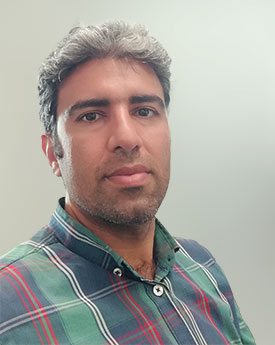
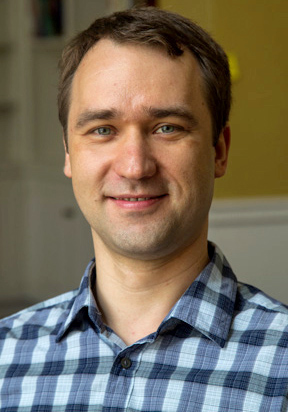
Dr. Abdollah Jalilian is a Research Associate in Spatio-temporal Epidemiology at Lancaster Medical School, part of Lancaster University's Faculty of Health and Medicine. His work focuses on developing statistical methodologies for analyzing spatiotemporal patterns in epidemiological data. Research Interests: His research integrates advanced statistical techniques with epidemiological studies, particularly in understanding disease spread dynamics and public health interventions. He applies spatial and temporal modeling to address challenges in healthcare analytics and infectious disease surveillance. Publications: His recent work includes a 2025 article in Biometrics , advancing composite likelihood methods for space-time point processes, which has implications for real-time disease monitoring systems. Consultancy: He contributed to the Evaluation of Virtual Ward deployment in NHS Trusts, demonstrating practical applications of his research in healthcare optimization. Advising & Grants: No specific advising or grant information is publicly listed here. Labs/Teams: Affiliated with Lancaster Medical School's research groups focused on health data science and epidemiological modeling.
Fatih Kizilaslan is a Research Fellow in the Department of Biostatistics at the University of Oslo, Norway, specializing in statistical models for high-dimensional and functional data. He holds a PhD in Mathematics from Gebze Technical University (2015) and has extensive academic experience, including roles as Associate Professor (2019-2023) and Assistant Professor (2016-2019) at Marmara University, Turkey. His research focuses on cure models, frailty modeling, and reliability analysis. He has conducted research at McMaster University (Canada) and the Gebze Institute of Technology (Turkey). His academic interests include survival analysis, statistical inference for extreme-value distributions, and applications of biostatistics in medical research. He is affiliated with the Statistical models for high-dimensional and functional data research group. His work emphasizes methodological advancements in stress-strength reliability, multicomponent systems, and record-based statistical models. Notable contributions include publications on cure models, frailty analysis, and reliability estimation in complex systems. His research bridges theoretical statistics with practical applications in biomedical and engineering contexts. He actively collaborates on projects involving high-dimensional covariates and predictive modeling for clinical outcomes.
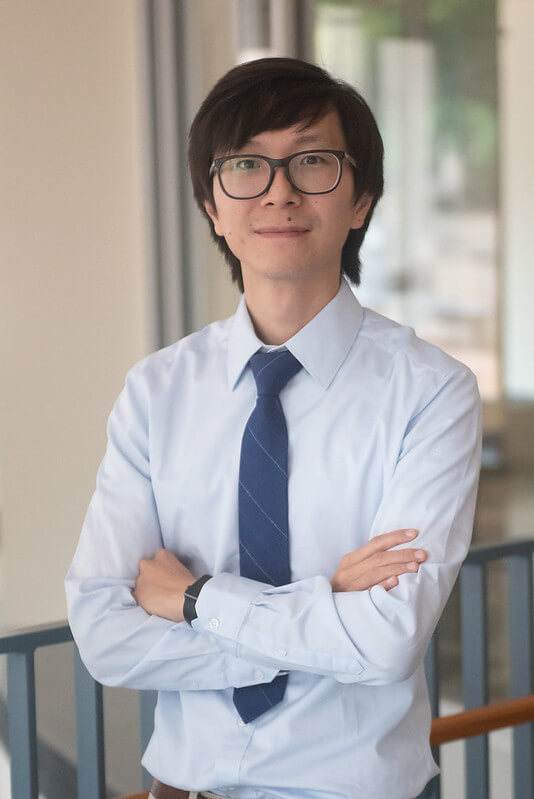
Ping An is a Teaching Assistant Professor at the University of Pittsburgh's Department of Physics. Their research focuses on particle physics, particularly using data from the Belle and Belle II experiments. Key areas include CP violation studies, lepton flavor violation searches, and precision measurements of hadron decays. They contribute to the Belle II collaboration's detector development and data analysis efforts. Research interests encompass experimental high-energy physics with a focus on quark flavor physics, B meson decays, and heavy quarkonium spectroscopy. Their work addresses fundamental questions in the Standard Model through analyses of rare decay channels and precision measurements of parameters like the CKM matrix elements. Recent publications emphasize angular analysis of B decays, branching fraction measurements, and searches for new physics via lepton flavor violation and resonance signatures. These studies leverage Belle II's advanced detector capabilities for high-precision particle tracking and event reconstruction.
Alexandra M. Carvalho is an Assistant Professor at the Department of Electrical and Computer Engineering, Instituto Superior Técnico (IST), Universidade de Lisboa. She is also a researcher at the Pattern and Image Analysis Group (PIA) within the Instituto de Telecomunicações (IT). Her academic journey includes a five-year degree in Applied Mathematics from IST (1998), a Master's in Computer Science (2004), and a PhD in Computer Science (2011), both from IST. Her research focuses on machine learning, bioinformatics, Bayesian networks, and medical informatics, with applications in healthcare, genomics, and longitudinal data analysis. Education: Bachelor’s in Applied Mathematics, IST, 1998 Master’s in Computer Science, IST, 2004 PhD in Computer Science, IST, 2011 Research interests emphasize structured motif discovery, probabilistic graphical models, survival analysis, and time-series data mining. Key contributions include algorithms for motif extraction in DNA sequences, dynamic Bayesian networks for disease progression modeling, and tools like GRISOTTO and RISO for bioinformatics. She has been awarded the Sartorius Innovation Award and recognition from BioMed Central for impactful publications. Her work spans interdisciplinary collaborations, including projects on cancer systems biology, pharmacokinetic modeling, and clinical decision support. She advises numerous MSc students and has secured grants from FCT and EU initiatives. Notable software contributions include AliClu for clinical data clustering and METEOR for outlier detection in time series. Labs/Teams: Active in the PIA Group and KDBio Group (INESC-ID), focusing on computational methods for biomedical data analysis.
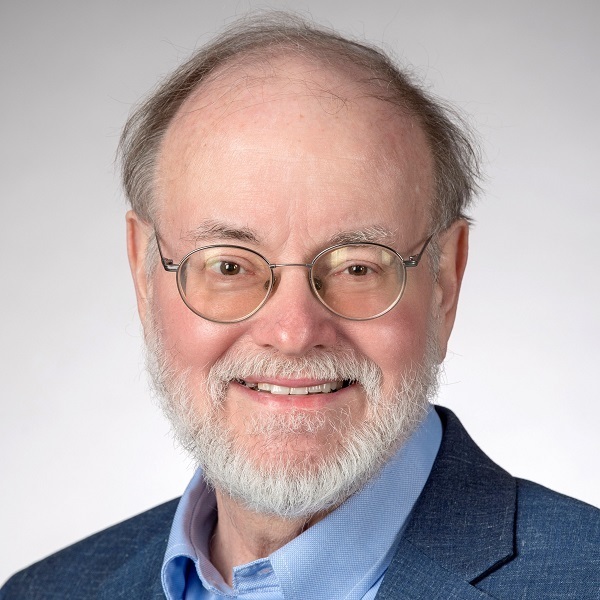
Richard Williams is Full Professor and former Chair of Sociology at the University of Notre Dame's College of Arts and Letters. His research explores quantitative methods, demography, urban sociology, and social psychology with specialized focus on racial disparities in housing markets, methodological issues in categorical data analysis, and bibliometric assessment of academic productivity. Professor Williams has secured over $300,000 in research funding from agencies including NSF and HUD, leading studies on mortgage lending discrimination and demographic patterns. His methodological innovations include developing Stata modules for ordinal regression and panel data analysis that have been widely adopted in social science research. Honors include the Stata Journal Editors' Prize (2015) for his work on marginal effects estimation, the Ganey Community-Based Research Award (2003), and Distinguished Service Award from Notre Dame's Faculty Senate (2018). His recent publications demonstrate sustained focus on advancing statistical methodologies for social science applications. As graduate advisor, Professor Williams has supervised 15 Master's theses and 9 doctoral dissertations examining topics ranging from housing segregation to fertility transitions. He maintains extensive professional service as Associate Editor for The Sociological Quarterly and Stata Journal, while previously chairing the ASA's Lazarsfeld Award Committee.
Pavel Cizek is Associate Professor of Econometrics at Tilburg University, specializing in robust estimation methods for complex econometric models. His methodological research advances techniques for panel data, limited dependent variables, and spatial analysis. Research focuses on: Semiparametric estimation with minimal distributional assumptions Bias correction for dynamic panel models Spatial dependence modeling Robust inference under data contamination Recent publications develop estimation frameworks for nonseparable panel models with index structures and spatial sample selection. Research has been supported by NWO grants and applied to financial economics problems. Supervises doctoral students in econometric theory. Teaches courses ranging from introductory statistics to advanced semiparametric methods.
Feike C. Drost is an Associate Professor in Mathematical Statistics and Quantitative Finance at Tilburg University's Department of Econometrics & Operations Research within the Tilburg School of Economics and Management. His research focuses on statistical aspects of financial models including semiparametric time series analysis, properties of diffusion models, and discrete-continuous time model relationships. Research Interests: Mathematical statistics, quantitative finance, time series analysis, financial modeling, semiparametric methods, and statistical properties of diffusion processes. Teaching: Current courses include Probability and Statistics, Statistics for Econometrics, Life Insurance, and Data Analysis. He has supervised numerous BSc, MSc, and PhD students. Recent Publications: Focus on unit root testing methodologies, panel data analysis, and asymptotic inference for financial models with cross-sectional dependencies and state-dependent intensities.
Raymond Ka Wai Wong is an Associate Professor and Director of the PhD Program in the Department of Statistics at Texas A&M University. He holds a PhD in Statistics from the University of California, Davis (2014), an MPhil from The Chinese University of Hong Kong (2010), and a BSc with minors in Mathematics and Risk Management Science (2008). His research focuses on causal inference, functional data analysis, low-rank modeling, reinforcement learning, and statistical learning with applications in astronomy, brain imaging, and genomics. Wong's professional roles include Associate Editor for Journal of Computational and Graphical Statistics , Journal of the American Statistical Association , and member of the Research Institute for Foundations of Interdisciplinary Data Science (FIDS). He has secured grants from NSF, NASA, and NIH, including leadership in projects like Virtual Assistant for Spacecraft Anomaly Treatment and phenomic selection in maize hybrids. His awards include Top Reviewer distinctions at NeurIPS (2023) and ICML (2020), and a 2016 Discussion Paper in the Annals of Applied Statistics. He has advised numerous doctoral students, with notable advisees receiving awards such as the ICSA Student Paper Award and Emanuel Parzen Fellowship. Wong’s recent work emphasizes methodological advancements in reinforcement learning (e.g., distributional off-policy evaluation) and matrix/tensor completion under informative missingness. His research bridges theoretical statistics with practical applications in interdisciplinary domains such as neuroscience, agriculture, and space exploration.
Max Mignotte is a Full Professor at the Department of Computer Science and Operations Research , Faculty of Arts and Sciences, Université de Montréal. He leads research in Image Processing, Remote Sensing, and Bayesian Inference , focusing on applications in medical imaging, computer vision, and data fusion. His work includes developing advanced algorithms for saliency estimation, multimodal change detection, and 3D reconstruction. Research Interests: Image processing techniques for medical diagnostics, remote sensing analysis, and machine learning-driven solutions for visual attention and segmentation. His methodologies often integrate Bayesian models and fusion strategies to address complex problems in computer vision and biomedical applications. Key Projects: Leading the Multi-Dimensional Scaling Maps for Saliency Estimation initiative. Developing Bayesian fusion models for remote sensing applications. Advancing 3D biplanar reconstruction of human limbs using statistical models. Grants & Teams: Principal investigator on CRSNG-funded projects, including New unsupervised Bayesian and energy-based models (2022–2028) and Bayesian fusion models (2016–2023). Collaborates with the Laboratoire de traitement d’images and interdisciplinary teams in biomedical research.
Debashis Mondal is an Associate Professor of Statistics & Data Science at Washington University in St. Louis, part of the Arts & Sciences School. He holds a PhD from the University of Washington (2007) and BSTAT/MSTAT from the Indian Statistical Institute. His research focuses on spatial statistics, computational science, machine learning applications in ecology and environmental sciences, and methodological advancements in statistical modeling. Education: PhD in Statistics, University of Washington, Seattle (2007) MSTAT in Statistics, Indian Statistical Institute BSTAT in Statistics, Indian Statistical Institute (2000) Research Interests: Spatial statistics and environmental applications Machine learning and computational methods Data-driven approaches in ecology and microbiology Methodological development for high-dimensional and spatial-temporal data Professional Recognition: Recipient of NSF Career Award (2013), Elected ISI Member (2016), and numerous service awards. His work bridges statistical theory and environmental science, with publications in top journals like Annals of Applied Statistics and Biometrika. Advising and Grants: Mentor to multiple PhD students (e.g., Si Liu, Paul Logan) and has supervised research leading to postdocs and industry roles. His grants include NSF funding for methodological research in spatial statistics. Professional Activities: Organized major conferences (e.g., Midwest Statistics Colloquium, International Indian Statistical Association Conference) and serves on editorial boards and award committees for leading statistical societies.
Haziq Jamil is an Assistant Professor in Statistics at Universiti Brunei Darussalam (UBD) within the Faculty of Science, Department of Mathematics. He concurrently serves as a Visiting Fellow at the London School of Economics and Political Science (LSE) Department of Statistics (2024-2027) and will transition to King Abdullah University of Science and Technology (KAUST) as a Research Specialist in August 2025, taking leave from UBD. His academic journey includes a PhD in Statistics (2018) and MSc in Statistics (2014) from LSE, and a BSc & Master in Mathematics, Statistics, Operational Research and Economics (2010) from Warwick University. His research spans statistical theory, methods, and computation with strong social science applications. Core interests include latent variable models, Gaussian processes, Bayesian statistics, and spatio-temporal modeling, particularly applied to Brunei's housing market and psychometric testing. He pioneered I-prior regression methodology using Fisher information kernels and developed bias-reduction techniques for Item Response Theory models. His publication record shows consistent output in high-impact journals with increasing focus on Brunei-specific applications since 2022. Haziq's 15 most recent publications (2022-2025) demonstrate methodological innovation in Bayesian computation, latent variable modeling, and spatial statistics, with growing emphasis on real-world applications in Brunei's housing market and educational assessment. Key trends include development of sparse Gaussian process models for property valuation, spatio-temporal analysis of Brunei's real estate, and bias-adjustment methods for psychometric models – reflecting his dual expertise in theoretical statistics and practical implementation. Teaching Excellence Award in Sciences (Universiti Brunei Darussalam, 2023) Arnold Zellner Thesis Award Honourable Mention (American Statistical Association, 2020) In-Service Training Scheme Scholarship (Brunei Public Service Commission, 2013-2018) Supreme Commander of Royal Brunei Armed Forces Scholarship (2006-2010) Best Student Award 2005 (Persekutuan Guru-Guru Melayu Brunei) Haziq serves as Graduate Programme Coordinator for Mathematics (2021-2025) and Faculty Liaison Committee member at UBD. His consultancy includes defense-related data analysis for Brunei's Ministry of Defence (2021-2022). He leads the Brunei R User Group (2024-2026) and maintains active research collaborations through the Bayesian Computational Statistics and Modelling (BAYESCOMP) group at KAUST. Current projects include open-source statistical tables, I-prior methodology R packages, and quantitative text analysis of Brunei's legislative council meetings. He directs multiple ongoing research initiatives including the Brunei housing market dataset covering 30,000+ transactions across three decades, Hamiltonian Monte Carlo educational tools, and quantitative analysis of Brunei's legislative proceedings. His work bridges theoretical statistics with practical applications in urban planning, defense analytics, and educational assessment within Brunei's unique socio-economic context.
Andriy Norets is a Professor in the Economics Department at Brown University. His research focuses on Bayesian econometrics, dynamic discrete choice models, and nonparametric estimation methods. He has contributed to advancements in econometric theory, particularly in areas such as posterior consistency, adaptive estimation, and computational methods for complex models. Key research themes include Bayesian nonparametric models, instrumental variable regression, and the development of efficient computational algorithms for variable dimension models. Norets has published extensively in top journals like Econometrica , Journal of Econometrics , and Annals of Statistics . His work emphasizes methodological rigor and practical applications, such as analyzing stock market trading activity and improving inference in nonstandard econometric problems. He also collaborates with co-authors like Ulrich Müller, Justinas Pelenis, and Debdeep Pati on projects spanning from theoretical foundations to applied econometric problems. Norets teaches courses including Undergraduate Econometrics and Graduate Econometric Theory II, demonstrating his commitment to both research and education in economic methodology.
Piotr Zwiernik is a Professor Agregat in the Department of Economics and Business at Universitat Pompeu Fabra (UPF), Barcelona, and a member of the BSE Data Science Center. He is currently on leave from the Department of Statistical Sciences and the Department of Mathematics at the University of Toronto. His research bridges statistics, algebraic geometry, and machine learning, focusing on graphical models, covariance estimation, tensors, and algebraic methods in statistics. Research Interests: Graphical Models Covariance Matrix Estimation Convex Analysis Tensors Algebraic and Combinatorial Methods in Statistics Statistical Learning Theory His recent publications span high-impact journals such as the Annals of Statistics , Biometrika , and Journal of the Royal Statistical Society . The work demonstrates a consistent trend in developing mathematically rigorous frameworks for understanding dependence structures, latent variable models, and high-dimensional inference, often leveraging tools from algebraic geometry and convex optimization. Key themes include total positivity, tensor methods, and the geometry of statistical models. Scientific Recognition: Editorial Board Member, Journal of the Royal Statistical Society Series B (JRSS-B) Editorial Board Member, Biometrika Editorial Board Member, Scandinavian Journal of Statistics Editorial Board Member, Algebraic Statistics Zwiernik actively mentors students and is seeking PhD candidates with strong mathematical backgrounds at UPF and the Institute of Mathematics of UPC. He has led the development of several open-source R packages, including golazo , MTP2binary , and StructuralEM , facilitating research in graphical models and latent structures. His work is supported by a network of collaborations with leading statisticians and has significant theoretical and applied implications in data science. Laboratories and Research Groups: Statistics@UPF BSE Data Science Center
Søren Højsgaard is an Associate Professor in the Department of Mathematical Sciences at Aalborg University, Faculty of Engineering and Science. His work bridges statistical theory, computational methods, and pedagogical innovation, with a strong focus on graphical models, Bayesian networks, and computer algebra systems in R. His research interests lie at the intersection of statistics, machine learning, and software development. He is particularly known for developing R packages such as caracas , gRbase , and sparta , which facilitate symbolic computation and efficient inference in probabilistic models. His work supports both advanced research and accessible teaching in data science. The recent publications highlight a consistent trend toward integrating symbolic mathematics with statistical computing, improving scalability in Bayesian network predictions, and enhancing statistics education through tools like Quarto and R. His contributions span theoretical algorithms, software implementation, and educational applications. Active contributor to open-source statistical software Focus on model-based prediction and symbolic computation Emphasis on teaching innovation using computational tools He has been involved in academic outreach through conference presentations and media engagement, discussing topics ranging from R programming to workplace safety modeling. His leadership role in the Department of Mathematical Sciences was recently highlighted in university communications. Søren Højsgaard leads and contributes to projects that combine rigorous statistical methodology with practical implementation, supporting both research and education in modern data science.
Isabelle Ewers is a researcher in Eukaryotic Microbiology at the Faculty of Biology, University of Duisburg-Essen, Germany. She specializes in phylogenetic placements for taxonomic assignment of environmental DNA, particularly focusing on colpodean ciliates and their evolutionary and ecological characteristics. Her research compares phylogenetic placement methods (EPA-ng, GAPPA) with pairwise alignment approaches (VSEARCH) to resolve taxonomic assignments in environmental sequencing data. This includes analyzing operational taxonomic units (OTUs) from Neotropical rainforest soils, evaluating likelihood weight ratios for placement accuracy, and measuring expected distances between placement locations to quantify uncertainty. Key findings include demonstrating that phylogenetic placement outperforms pairwise alignment for low-similarity sequences and establishing frameworks for interpreting multi-placement scenarios in microbial eukaryotes. Her work has implications for improving metabarcoding workflows and understanding protist diversity in understudied ecosystems.