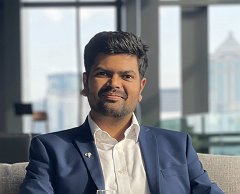
Aalok Thakkar is an Assistant Professor in the Department of Computer Science at Ashoka University, specializing in Programming Languages , Formal Logic , and Artificial Intelligence . He earned his Ph.D. in 2023 from the University of Pennsylvania , advised by Rajeev Alur and Mayur Naik. His research focuses on example-guided synthesis of relational queries , with applications in program verification, automated reasoning, and AI. Recent work includes the Mobius framework (OOPSLA 2023) and Relational Query Synthesis ⋈ Decision Tree Learning (VLDB 2023). Published in npj Digital Medicine (2021) on pandemic risk modeling Contributed to Natural Computing (2020) on Boolean network concurrency Workshop papers on synthesis algorithm complexity (SYNT 2022) and reactive systems (SYNT 2020) He was previously affiliated with Adobe Systems, Aptos Labs, Amazon AWS, and Bell Labs. Awards include the Alt Carbon Darjeeling Revival Fellowship . Teaching includes courses on Symbolic Logic , Rust programming , and Games on Graphs . He will host an IndiCS Seminar on Automated Synthesis in 2025.
Joost-Pieter Katoen is a full professor at RWTH Aachen University in Germany where he leads the Software Modeling and Verification (MOVES) group. Since 2013, he holds a distinguished professorship at RWTH Aachen University and is a member of the Academia Europaea. He also maintains a part-time association with the Formal Methods & Tools group at the University of Twente in the Netherlands. Professor Katoen's research primarily focuses on probabilistic programming, model checking, and formal verification. His work spans theoretical foundations of probabilistic systems, deductive verification techniques for probabilistic programs, and practical applications in software verification. He has made significant contributions to the development of algorithms for analyzing probabilistic models, including Markov chains and probabilistic automata. His research bridges theoretical computer science with practical verification challenges, particularly in the context of probabilistic systems. His recent publications reveal a strong focus on advancing probabilistic programming verification, with particular emphasis on generating functions, expected runtimes, and probabilistic bisimulation. The research trends show increasing sophistication in handling continuous distributions, parameter synthesis, and multi-objective verification problems. His work consistently appears in top-tier conferences including POPL, PLDI, SPLASH, and CAV. Scientific Awards and Recognition: Distinguished Professorship at RWTH Aachen University (since 2013) Member of Academia Europaea Professor Katoen has supervised numerous PhD students whose work spans various aspects of formal methods and probabilistic systems. His MOVES research group develops several verification tools including PROPHESY, PRINSYS, COMPASS, MRMC, and SMYLE. His editorial service includes membership on steering committees for major conferences such as CONCUR and ETAPS (where he serves as chair), and editorial boards for journals including STTT and PeerJ Computer Science.
Bengt Jonsson is a researcher at Uppsala University , Sweden, with a focus on formal verification, concurrency, and automata learning. His work addresses challenges in software testing, protocol verification, and concurrent systems analysis, often collaborating with institutions like KTH Royal Institute of Technology and academic peers such as Parosh Aziz Abdulla and Konstantinos Sagonas. Research Fields: Formal Verification, Concurrency, Automata Theory, Software Testing, Distributed Systems, Protocol Verification Recent publications highlight advancements in stateless model checking, dynamic partial order reduction, and automated detection of state machine bugs in protocol implementations. His 2023 CONCUR Test-Of-Time Award underscores his contributions to theoretical computer science. Collaborative efforts span network protocol analysis, cache performance modeling, and register automata learning, with practical applications in IoT security and multicore parallelization. Scientific Awards: CONCUR Test-Of-Time Award (2023)
Marcel Remon is a long-standing academic researcher affiliated with the University of Namur and active across diverse domains including statistical inference, pattern recognition, and participatory development. His career spans over three decades with notable contributions to algorithm design, multivariate statistics, and geographic information systems. Key Roles: Principal Investigator (PI) in projects related to pattern recognition and high-dimensional data analysis. Education: Doctor of Science from University of Namur (1983), focusing on axiomatic aspects of marginal likelihood theory. Research Trends: His work bridges computational methods with social applications, including educational technology , resilience frameworks , and ICT4D (Information and Communication Technologies for Development) . Recent publications emphasize pedagogy in digital eras and participatory governance. Project Highlights: Developed methodologies for 3D object recognition , uniformity tests in high-dimensional spaces , and citizen-driven GIS systems in the Philippines. Collaborated on EU-Africa ICT cooperation initiatives.
Jean-François Raskin is a Full Professor in the Computer Science Department at the Université Libre de Bruxelles (ULB) , where he has held tenure since 2002. His research focuses on formal verification , game theory , and quantitative analysis of reactive systems, with funding from the Fondation ULB and international projects like ERC, FP7, and FNRS. He received prestigious awards including an ERC Consolidator Grant (2011), IBM Faculty Award (2014), and ACM-SigSoft Most Influential Paper Award (2020). His research explores multi-player games with ω-regular objectives, Markov decision processes , and reactive synthesis under rationality constraints. Key contributions include algorithms for subgame perfect equilibria , regret minimization , and tools like SynthLearn for guided synthesis. He has served as PC co-Chair for major conferences (FORMATS, TACAS, CONCUR) and authored over 250 publications. Scientific Awards : ERC Starting Grant (2011) IBM Faculty Award (2014) Professeur Francqui de Recherche (2015-2018) ACM-SigSoft Most Influential Paper Award (2020) CONCUR'21 Best Paper Award Advising & Collaborations : Supervised 23 PhD students and mentored 15 postdocs, including Emmanuel Filiot and Mickaël Randour. Collaborated with institutions like IST Austria , MIT , and INRIA on formal methods and AI integration.
Steffen van Bergerem is a postdoctoral researcher at the Institute of Computer Science, Humboldt University of Berlin, within the Faculty of Mathematics and Natural Sciences. He is affiliated with the Chair of Logic in Computer Science under Prof. Dr. Nicole Schweikardt, where he conducts research in logic, complexity, and computational learning theory. His research focuses on the intersection of logic and computational complexity, particularly in finite model theory and descriptive complexity of learning. His work bridges theoretical computer science with machine learning foundations, aiming to characterize learning problems through logical definability. He has contributed to academic service through co-organizing the Logic Mentoring Workshop (with LICS 2023 and CSL 2024/2025) and participating in Dagstuhl seminars and research camps. He has served as a reviewer for major conferences including LICS, STACS, MFCS, and CSL. Reviewer, LICS 2024 Reviewer, STACS 2024 Reviewer, MFCS 2023 Reviewer, IPEC 2023 Reviewer, CSL 2023, CSL 2022 Reviewer, WoLLIC 2021 Steffen has mentored students at RWTH Aachen and Humboldt University, supervising bachelor’s and master’s theses, proseminars, and practical labs on topics such as information theory and search games on graphs. He has taught courses including Formal Systems, Automata, and Processes; Complexity Theory; and a graduate course on Graph Decompositions. He is active in open-source software development, contributing to projects like markdown-it and markdown-it-sanitizer, and maintains a GitHub presence with involvement in the logic-mentoring-workshop community.
Madhusudan Parthasarathy is a Professor in the Department of Computer Science at the University of Illinois at Urbana-Champaign, part of the College of Engineering. His research focuses on bridging theoretical logic with practical software systems, particularly in verification, trustworthy AI, and program synthesis. Research Interests: Software verification and formal methods Interpretable, Robust, and Trustworthy AI systems Program synthesis and machine learning Security and privacy Logic and automata theory Verified distributed systems (e.g., blockchains, smart contracts) Learning logical concepts from data His recent work emphasizes building correct-by-design systems, especially those incorporating AI/ML, and developing automated techniques for proving program correctness. He has developed influential tools such as VCDryad, Dryad, Strand, JIST, and Getafix. His publications span top venues like POPL, PLDI, CAV, and OOPSLA, with a strong trend toward integrating machine learning with formal reasoning, verifying ML systems, and synthesizing programs from specifications. Scientific Service: PC Member: POPL 2025, PLDI 2024, FSTTCS 2023, CONCUR 2023, OOPSLA 2022, CAV 2016, ICALP 2016 PC Chair: CAV 2012 ERC Member: PLDI 2017, POPL 2017 Co-chair: SYNT 2015 He actively mentors PhD students and postdoctoral researchers, with former advisees now at institutions like Purdue University, Google, and UT Austin. He has taught advanced courses such as CS521: Trustworthy AI Systems and CS474: Logic in Computer Science . His work is supported by collaborations across institutions, including the ExCAPE project with Illinois and UCLA.
Yi Wang is a Professor of Embedded Systems at the Department of Information Technology, Uppsala University , Sweden. He leads research in real-time and embedded systems with a focus on modeling, analysis, and implementation of safety-critical applications. He is affiliated with the Embedded Systems Group and serves as a Principal Investigator (PI) in major research centers such as UPMARC and projects like CUSTOMER (ERC Advanced Grant), CoDeR-MP, and CERTAINTY. Research Interests: Yi Wang’s work centers on Embedded Systems Design, Real-Time Scheduling, Multicore Programming, and Model-Checking of Real-Time Systems . His research addresses fundamental challenges in timing predictability, schedulability analysis, and the verification of complex real-time systems. He has made significant contributions to the digraph real-time task model, mixed-criticality systems, and timing analysis of ROS 2 systems. His work bridges theory and practice, often resulting in deployable tools and formal methods for industrial applications. Recent Research Trends: His most recent publications (2023–2025) focus on optimizing real-time performance in ROS 2, managing parallel task graphs with resource contention, improving GPU-based inference on embedded platforms, and enhancing timing predictability in multithreaded executors. These works reflect a strong trend toward applying formal real-time theory to modern robotics, AI integration, and multicore embedded architectures. Scientific Tools and Leadership: He is a key contributor to foundational tools in real-time systems: UPPAAL – Model checking for timed automata TIMES – Schedulability analysis and code generation CATS – Compositional analysis of timed systems TIMES-Pro – Based on the digraph real-time task model Advising and Research Funding: Yi Wang has supervised numerous PhD students and postdocs. He has led or participated in multiple large-scale funded projects supported by the Swedish Research Council (VR), the Swedish Foundation for Strategic Research (SSF), and the European Commission (FP7, ERC). These include UPMARC (10-year Linnaeus center), CoDeR-MP (with ABB and SAAB), SAVE++ (with VOLVO), and CREDO. Laboratories and Research Groups: He is a core member of the Embedded Systems Group at Uppsala University and leads research within the UPMARC center, which focuses on programming models and analysis techniques for multicore architectures. His lab develops formal methods and tools to ensure correctness and timing guarantees in embedded and cyber-physical systems.
Susan H. Rodger is a Professor of the Practice in the Department of Computer Science at Duke University , where she has served since 2008. She also holds the role of Director of Undergraduate Studies in the same department since 2018. Purdue University · 1989 Ph.D. in Computer Science N.C. State University · 1983 BS in Computer Science and Mathematics Her research focuses on Computer Science Education , particularly on tools and methods to enhance learning. She has contributed to the development of JFLAP and Alice , which are widely used for teaching automata theory and programming through animation. Her recent work explores Parsons Problems as a pedagogical approach to reduce novice programming challenges. Her publications highlight trends in interactive learning and multi-institutional studies , emphasizing the integration of empirical research with educational software. These works span topics like syntax mastery, algorithm design, and debugging techniques for beginners. Scientific Awards: IEEE Computer Society 2019 Taylor L. Booth Education Award Outstanding Educator 2014 She has advised numerous undergraduate research students , particularly in projects involving tools like Alice and JFLAP. Her grants include funding from the National Science Foundation, notably for the ACM Global Computing Education Conference and collaborative research on Peer Instruction in CS . She leads initiatives such as the Duke ACM-W chapter and Duke Grad Job Board, fostering student engagement and professional development in computing.
Pierre-Yves LOUIS is a Professor at Institut Agro Dijon, part of Université Bourgogne Franche-Comté, France. He serves as the main responsible for the Data & Digital Specialization (DN2A) for engineers at the Dijon Agro Institute. Previously, he was a Maître de conférences (Associate Professor) at Université de Poitiers from 2009 to 2020. His affiliations include CNU 26 (Applied Mathematics and Applications of Mathematics), the Department of Engineering and Process Sciences (DSIP), UMR PAM IAD/UBE/INRAE (Food and Microbiological Processes), and the Institute of Mathematics of Burgundy (UMR 5584 CNRS). His research focuses on applied probability, stochastic algorithms, learning/adaptive algorithms, MCMC methods, and stochastic simulations and modeling. He applies statistical methods to life sciences, including clustering, data analysis, and text mining. His work encompasses statistical computing with R programming, random models, random dynamics, and stochastic models for large interacting systems in physics and life sciences. He has made significant contributions to the study of random fields, Gibbs measurements, spin systems, interacting particle systems, and probabilistic cellular automata (PCA), with mathematical and probabilistic aspects of statistical mechanics. His recent book Probabilistic cellular automata (Theory, Applications and Future Perspectives) published by Springer demonstrates his leadership in this field. His recent publications reveal a strong interdisciplinary approach, applying probabilistic methods to diverse domains. He has developed theoretical advances in urn models and interacting stochastic processes while simultaneously applying these methods to medical problems (pain assessment, chronic conditions), sports science (athlete performance analysis in alpine skiing), and food technology (nutritionally balanced meal generation through the HOX project). This demonstrates his ability to bridge theoretical probability with practical applications across multiple disciplines. Winner of the mathematics aggregation competition Editor of Probabilistic cellular automata (Theory, Applications and Future Perspectives) published by Springer While specific students aren't named in available materials, his authorization to direct research indicates he supervises PhD candidates. He has successfully collaborated with various institutions across Europe, including notable projects like 'HOX, mathematics for smart meals' in collaboration with Wuji and co (My Chef is Smart) with AMIES support, creating AI to generate nutritionally balanced menus. His work demonstrates strong grant acquisition capabilities and successful industry partnerships. LOUIS is affiliated with several research groups including the PMB team at UMR PAM IAD/UBE/INRAE in Dijon, the SPOC team at the Institute of Mathematics of Burgundy (UMR 5584 CNRS), and participates in networks like MAthématiques de l'Imagerie, Apprentissage et GEométrie Stochastique (RT MAIAGES) and Alea network (CNRS GDRI). His collaborative approach is evident through his co-organization of numerous scientific events and his international visiting researcher positions at institutions including IMT Lucca, University of Padova, and EURANDOM at TU Eindhoven.
Dr. Fang Wang is a Senior Lecturer in the Department of Computer Science at Brunel University London, affiliated with the College of Engineering, Design and Physical Sciences. Holding a PhD in Artificial Intelligence from the University of Edinburgh, she transitioned from a senior researcher role at the BT Group's research center to academia in 2010. Education: PhD in Artificial Intelligence (University of Edinburgh) Professional Background: Senior Researcher at BT Group Her research spans Artificial Intelligence and its interdisciplinary applications, focusing on nature-inspired computing (swarm intelligence, evolutionary computing), multi-agent systems , neural networks , and computer vision with applications in network optimization, healthcare, and education. Recent work explores fault detection , deepfake exposure , and medical informatics . The 15 most recent publications reveal trends in machine learning for industrial diagnostics, multi-agent reinforcement learning with formal logic constraints, and vision-language systems for medical applications. Subfields include neural networks , temporal/spectral analysis , and human-computer interaction . Scientific Recognition : Gordon Radley Technical Premium Highly Commended award (BT) ACM Best Student Paper Award (International Conference on Autonomous Agents) As an educator, she teaches programming, algorithms, digital innovation, and project-based courses to undergraduates and MSc students, with class sizes ranging from 8 to 350. She supervises PhD students in topics like self-organizing agents, intelligent intrusion detection, and human action recognition.
Enea Zaffanella is an Associate Professor in Computer Science at the University of Parma , where he has been affiliated since 2000. His academic career spans from Fellow Researcher to Assistant Professor, culminating in his current role since 2006. He teaches courses in Programming Methodologies , Compilers , and Foundations of Computer Science at both undergraduate and graduate levels. PhD in Computer Science from School of Computing, University of Leeds (2002) Laurea in Computer Science from University of Pisa (1993) Research focuses on Static Analysis and Software Verification using Abstract Interpretation . Key contributions include theoretical frameworks for Constraint Logic Programs analysis, Convex Polyhedra abstractions, and Widening Operators design. His work bridges formal theory with practical implementations like the Parma Polyhedra Library (PPL) and its successor PPLite . Recent publications explore Hybrid Systems verification, Data Science linting tools (Pyra), and EVM Bytecode analysis. He received the Radhia Cousot Young Researcher Best Paper Award in 2019. Collaborations include academic Research Projects (PRIN, ESPRIT) and industrial partnerships through BUGSENG srl .
Sebastian Fischmeister is a Professor and NSERC/Magna Industrial Research Chair in Automotive Software for Connected and Automated Vehicles at the Department of Electrical and Computer Engineering, University of Waterloo. His research focuses on systems at the intersection of software technology, distributed systems, and formal methods, with applications in automotive systems, avionics, and medical devices. He has pioneered frameworks for scalable location-based pervasive computing and verifiable real-time communication schedules, contributing to the ASTM F29.21 standard. Education: Dipl.-Ing. in Computer Science (Vienna University of Technology, 2000), Ph.D. in Computer Science (University of Salzburg, 2002) Research Themes: Real-time embedded systems, runtime monitoring, security analysis, data analytics for validation, and performance evaluation. Scientific Awards: APART Stipend (2005) Ontario Early Researcher Award (2014) Multiple best paper and tool awards He is an ACM Distinguished Speaker and actively participates in organizing conferences such as ESCAR, RTSS, DATE, and ICPE. His work includes significant contributions to anomaly detection, cybersecurity in automotive networks, and runtime verification techniques under unreliable conditions.
Christine Largouët is a tenured Associate Professor in Computer Science at Institut Agro Rennes-Angers , where she leads the Computer Science Teaching Unit since 2006. She is an associate researcher with the DREAM team at IRISA (Institute for Research in Computer Science and Random Systems) and part of the LACODAM team at IRISA/INRIA. Her academic journey includes teaching positions at University of New-Caledonia (2003-2005) and research collaborations with INRAE, IRISA, and INRIA. HDR : Université de Rennes 1 (2019) PhD : Université de Rennes 1 (2000) Her research bridges Artificial Intelligence with Agroecology , focusing on: Learning Timed Behavioral Models Explainable AI for decision transparency Complex Systems Modelling and Analysis Data-Driven Decision Support frameworks Applications to Ecosystem Management and Precision Livestock Farming She employs formal methods like Timed Automata and Model-Checking to analyze agricultural systems and animal behavior patterns. Recent publications demonstrate her work on: Explainable AI interfaces for behavioral data interpretation Timed Automata for agricultural system modeling Machine Learning applications in swine nutrition and welfare Intrusion Detection Systems for agricultural IoT Environmental Modeling with formal verification Her methodological contributions include persistence-based discretization and role-adaptive explanation frameworks.
Frank Thuijsman is a Full Professor of Strategic Optimization and Data Science at Maastricht University's Department of Advanced Computing Sciences. He has held this position since 2016, following roles as Associate Professor (1995–2016) and Assistant Professor (1990–1995) at the same institution. His international engagements include visiting positions at UCLA, Hebrew University of Jerusalem, and fellowships at the Institute for Advanced Studies in Jerusalem. Education: Ph.D. in Mathematics, Maastricht University (1989) M.Sc. in Mathematics (with teaching qualification), Radboud University Nijmegen (1985) Research Focus: Thuijsman specializes in dynamic and evolutionary game theory with applications spanning economics, biology, and oncology. His work integrates operations research, stochastic processes, and mathematical modeling to address complex systems such as cancer treatment optimization, public goods games, and federated learning. A key theme is the translation of theoretical frameworks into practical solutions for healthcare and environmental policy. Publication Trends: His recent articles emphasize interdisciplinary approaches, particularly in cancer research (e.g., modeling tumor evolution and treatment resistance) and computational optimization (e.g., AGV scheduling and federated learning). Methodologically, they showcase advanced game-theoretic applications, spatial modeling, and adaptive control systems. Awards & Honors: Dual Silver Reimagine Education Awards (2018) for KE@Work program innovation Teaching Prize from FH Aachen (2013) Wynand Wijnen Education Prize nominee (2014, 2017, 2024) Leadership & Projects: Thuijsman founded the KE@Work program, connecting 200+ students with 70+ businesses. He currently leads a World Bank-funded initiative to develop a Computer Science curriculum at the University of Burundi. As Secretary-Treasurer of the Game Theory Society, he oversees global academic collaborations. His team at the Mathematics Centre Maastricht focuses on evolutionary dynamics and AI applications.