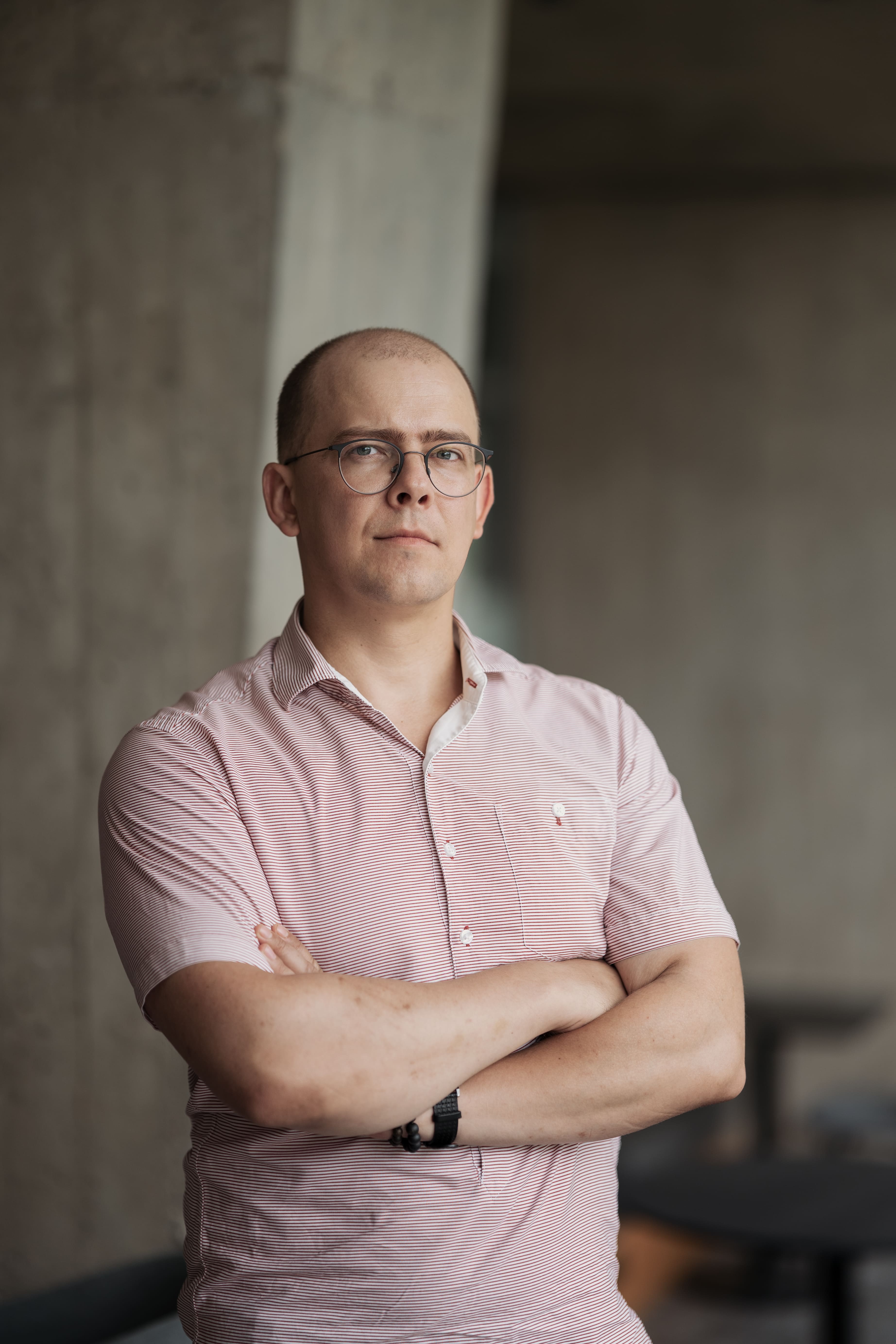
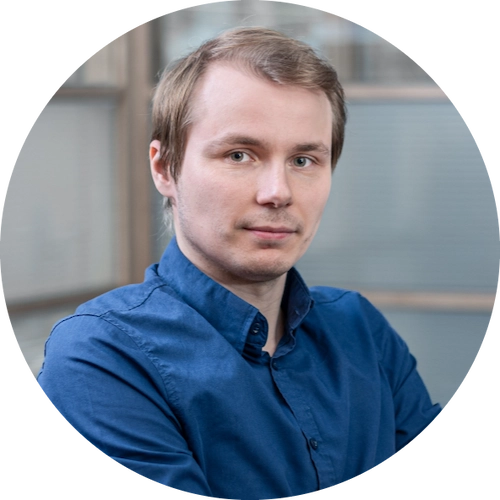
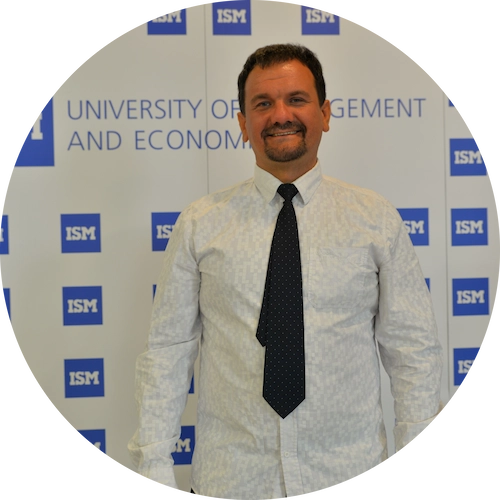
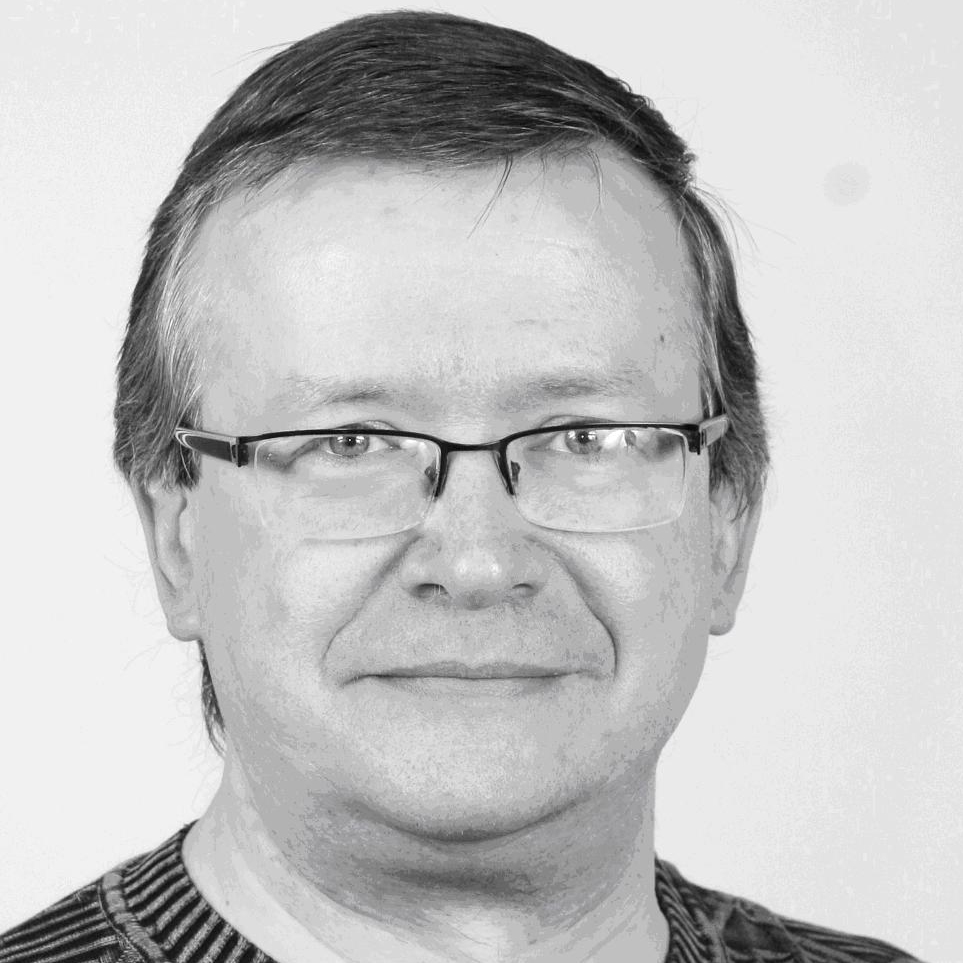
Dalia Breskuvienė is a PhD student and junior researcher at the Cognitive Computing Group of Vilnius University’s Institute of Data Science and Digital Technologies. Her research spans Machine Learning, Data Mining, and Fraud Detection , focusing on optimizing classifier training for highly imbalanced data in financial contexts. Doctoral Studies : Enrolled from 2021 to 2025 under supervisor Prof. Gintautas Dzemyda. Research Focus : Addresses challenges in fraud detection by innovating feature selection, encoding, and training strategies for imbalanced datasets. Publications : Explores autoencoders, clustering techniques, and concept drift in machine learning models. Conferences : Presented her work at annual Computer Science Engineering PhD Student Conferences in Vilnius (2022–2023).
Professor Igor Belov is a Senior Researcher and Professor at Vilnius University's Institute of Data Science and Digital Technologies, specializing in analytic number theory, information security, and mathematical modeling. His research spans theoretical mathematics with practical applications in finance and computer science, particularly focusing on zeta functions, prime number theory, and stable distribution models. Education: Doctor of Physical Sciences (Mathematics) from Vilnius University and Vilnius Gediminas Technical University (2004) Master's degree in Statistics from Vilnius University (1999) Bachelor's degree in Mathematics Applications from Vilnius University (1997) Professor Belov's research interests center on analytic number theory with emphasis on Riemann zeta function and Dirichlet L-functions, combinatorial analysis, information security, and mathematical modeling of financial data using stable distributions. His recent work explores fractal structures related to zeta functions, efficient algorithms for zeta function calculations, and applications of machine learning in financial document analysis and securities price forecasting. His publication record demonstrates a strong trajectory from pure mathematical research toward interdisciplinary applications. While maintaining a robust foundation in analytic number theory, his recent work increasingly bridges theoretical mathematics with practical computing applications, particularly in financial modeling and information security. This evolution reflects a strategic expansion of his research impact across multiple domains. Scientific Awards: 1st place at the Vilnius Young Mathematicians' Olympiad (1990) Honorable mention at the Lithuanian Young Mathematicians Olympiad (1991) Letter of Commendation at the Lithuanian Young Mathematicians Olympiad (1992) Professor Belov actively supervises doctoral research and has served on numerous dissertation defense committees. He currently mentors four doctoral students working on zeta function algorithms, financial forecasting, document recognition, and blockchain acceleration. His research has been supported by multiple grants including the LMT project P-SV-23-9 on Mandelbrot bulbs visualization associated with the Riemann zeta function. He has also participated in international research collaborations at CINECA supercomputing center and Karlsruhe Institute of Technology. As a member of the Smart Technologies Research Group, Professor Belov contributes to Vilnius University's leadership in mathematical research and its applications, particularly in the areas of zeta function analysis and computational finance.
Prof. habil. dr. Leonidas Sakalauskas is an Affiliated Scientist at the Smart Technologies Research Group within the Institute of Data Science and Digital Technologies at Vilnius University. His extensive research career spans mathematical modeling, stochastic programming, and statistical analysis with significant contributions across multiple disciplines. He maintains an active research profile with recent publications extending into 2025. Professor Sakalauskas' research focuses on stochastic programming, mathematical modeling, financial mathematics, statistical analysis, optimization, and queueing theory. His work demonstrates a consistent pattern of interdisciplinary research, bridging theoretical mathematics with practical applications in finance, social sciences, and computer science. He has developed innovative approaches to agent-based modeling, fractal analysis, and Monte Carlo methods, contributing significantly to both theoretical frameworks and practical implementations. His recent publications reveal a continuing evolution of research interests, with increasing emphasis on data science applications, computational social science, and advanced statistical modeling techniques. The articles demonstrate sophisticated methodological approaches to complex problems across diverse domains including financial modeling, social cohesion analysis, and network performance optimization. Throughout his career, Professor Sakalauskas has maintained a strong publication record in high-impact journals and conference proceedings, reflecting his ongoing engagement with the international research community. His work shows consistent methodological rigor combined with practical relevance across multiple application domains. Professor Sakalauskas has collaborated extensively with researchers across Lithuania and internationally, demonstrating strong teamwork and interdisciplinary engagement. His research has practical applications in financial modeling, social science analysis, and computational systems optimization, contributing to both theoretical advances and real-world implementations.
Tadas Žižiūnas is a researcher at the Faculty of Communication , Vilnius University , specializing in the intersection of 3D technologies , artificial intelligence , and cultural heritage preservation . His work focuses on developing automated systems for monitoring urban heritage, applying advanced digital methods to historical artifact analysis, and integrating spectroscopy with 3D modeling in archaeological contexts. Academic Qualification: PhD (2019) in cultural heritage research, Vilnius University Key research areas include digital urban heritage practices , AI-driven preservation tools , and 3D technology applications in archaeology . His publications demonstrate a consistent focus on technological innovation in heritage management, with projects funded by the European Regional Development Fund (2018–2022). His recent work explores democratization of heritage conservation through 3D scanning and AI, while earlier contributions examined spectroscopy for historical document analysis and augmented reality for preserving genius loci in urban settings. Notable projects include the Automated Heritage Monitoring of Urbanised Areas initiative, which combines AI with 3D digitization to assess risks to cultural assets.
Kristina Aldošina is a Senior Lecturer at ISM Business and Economics University since 2006, specializing in teaching Applied Mathematics, Mathematical Analysis, Programming, and related subjects. She holds a Master's degree in Mathematics and a teaching qualification in Mathematics and IT education. Her work focuses on integrating classical mathematical concepts with modern business and economic challenges through innovative teaching methods. Publications include co-authored textbooks such as 'Foundations of Static and Dynamic Optimization in Economics' (2021) and 'Economics and Finance Problems with Solutions' (2018), designed for students and educators. She actively participates in international teaching collaborations and teacher development programs, and has received multiple awards from ISM and the University. Her teaching philosophy emphasizes critical thinking and student engagement, often starting sessions with open-ended questions. She designs practical, industry-relevant problems to bridge classical mathematics and contemporary business needs, ensuring relevance for students' future careers.
Prof. Tadas Sharapov is the Director of the Economics and Data Analytics undergraduate program at ISM University of Management and Economics. He holds a PhD in Economics from Kaunas University of Technology, with prior studies in Management and Economics. His career spans academia and industry, including roles as a manager in construction contracting firms, business consulting for Danish and German companies, and leadership in Danish capital enterprises. He has served on ISM’s Board, Senate, and Labor Council, and currently chairs nonprofit and business organization boards. His research focuses on microeconomics (business efficiency, internationalization, crisis diagnostics) and macroeconomics (monetary policy, growth). Notable contributions include developing SME crisis intervention models and analyzing e-commerce impacts on business processes. He has authored/co-authored over 15 peer-reviewed articles, books, and case studies, emphasizing practical relevance in education and business. Teaching includes Microeconomics courses and mentoring students through their bachelor’s theses. His pedagogical approach prioritizes clarity and accessibility, blending theory with real-world applications.
Assoc. Prof. Pijus Krūminas is an Associate Professor and Program Director of Financial Economics at the ISM University of Management and Economics in Lithuania. His expertise spans political economy, game theory, and simulation-based education. He holds a Ph.D. in Economics from ISM and a Master's in Political Science from Vytautas Magnus University. His research focuses on intersections of political science and economics, particularly using game theory and simulations. He advises Lithuanian and European institutions on innovation and digitalization policy through Visionary Analytics. Collaborations include the European Commission’s Research and Innovation Directorate, the European Space Agency, and Lithuanian ministries. His teaching includes courses like Game Theory and Economic Shocks and Comparative Politics . His recent work emphasizes firm resilience in crises, energy decoupling in the Baltics, and policy design for innovation ecosystems. Grants and advising: He has led projects on innovation voucher schemes and resilience strategies, with publications spanning over 20 articles since 2013. His work bridges theoretical models with applied policy analysis across regional and global contexts.
Aleksandr Christenko is a Senior Researcher at Visionary Analytics, affiliated with ISM University of Management and Economics. His work bridges statistics, machine learning, and economic policy analysis to address labor market dynamics and EU-level challenges. BSc in Economics and Politics from ISM University MSc in Computer Modeling from Vilnius University His research interests include: Novel statistical approaches (survival analysis, synthetic control methods) Machine learning applications in labor markets Automation and AI impact on occupational mobility EU policy evaluation for training programs and innovation schemes Recent publications analyze automation's effects on work intensity, AI's role in occupational safety, and skill shifts during economic transitions. His teaching spans statistics, data mining, and econometrics, including courses like Financial Econometrics (GRAE018) and Research Methodology (GRAE001).
Dr. Mindaugas Kavaliauskas holds dual affiliations: he is a Visiting Professor at ISM and an Associate Professor at Kaunas University of Technology. His expertise spans applied mathematics, mathematical statistics, and machine learning, with a focus on applying these methods in medicine, industry, and business. Education: Bachelor's and Master's in Mathematics at Kaunas University of Technology PhD in Mathematics (2005) from the Institute of Mathematics and Informatics (Vilnius) Research interests include data analytics leveraging mathematical and machine learning techniques. He actively contributes to interdisciplinary projects, integrating statistical methods into diverse sectors. Teaching areas encompass multivariate statistical analysis, time series analysis, stochastic processes, and machine learning methods in economic forecasting.
John Antonakis is a Professor of Organizational Behavior at the University of Lausanne’s Faculty of Business and Economics (HEC). He also serves as a Visiting Scholar at ISM. His research focuses on charisma, leadership development, crisis management, and research methodology. Antonakis has secured over $2.45 million in research funding and has been recognized as a Clarivate-Web of Science Highly Cited Researcher (2019) and ranked in the world’s top 2% researchers by PLOS Biology (2020). His work spans prestigious journals like Science, Nature Human Behavior, and Academy of Management Journal. Notable contributions include studies on charismatic leadership’s economic impact, crisis rhetoric effects, and methodological critiques of statistical techniques. Antonakis has held editorial roles including Editor-in-Chief of The Leadership Quarterly and served on top journal boards. Media outlets such as the New York Times and BBC frequently cite his research. Key Research Themes: Charismatic leadership, crisis leadership, leadership measurement, and statistical methodology. Recent Focus: Deep learning applications in leadership detection, gender gaps in venture funding, and pandemic leadership strategies. His publications emphasize rigorous experimental design and transparency in research practices, contributing to methodological advancements in organizational studies.
Roma Kačinskaitė is a Professor at the Department of Mathematics and Statistics within the Faculty of Informatics at Vytautas Magnus University. Her research focuses on analytic number theory, probability theory, and gender equality policies in education. Doctor of Sciences (2002) ORCID: 0000-0003-2656-1052 Scopus ID: 6504101661 Her work spans zeta function theory (Riemann, Hurwitz, Matsumoto classes), joint universality theorems, and computational mathematics. Recent supervised theses explore topics like: ICT integration in calculus pedagogy Discrete universality theorems for zeta function classes Functional independence of periodic zeta functions Public-key cryptographic algorithms Computer-assisted evaluation of Hurwitz zeta function values Student advising emphasizes mathematical olympiads, zeta function analysis, and computational methods. Publications reflect interdisciplinary approaches combining pure mathematics with educational innovation and cryptographic applications.
Ričardas Krikštolaitis is a Professor at Vytautas Magnus University's Faculty of Informatics, Department of Mathematics and Statistics, where he has served since 2012. He earned his Doctor of Physical Sciences degree in 2001 and was appointed as Chief Researcher in 2023. Research Interests Data Analytics Energy Security Reliability and Risk Analysis Mathematical Statistics Applied Mathematics Panel Data Analysis Student Advisees Asad, Daiva (2024): A prototype for learning data analysis and prediction Jokšaitė, Deimantė (2022): Statistical investigation of factors determining inflation Servaitė, Dovilė (2022): Identification of anomalies in system log data Targonskytė, Monika (2018): Statistical analysis of employment rate dependence from socio-economic indicators Micikevičiūtė, Agnė (2017): Statistical investigation of company’s X activity data
Dr. Alytis Gruodis is a Senior Research Fellow (0.5 FTE) at the Institute of Chemical Physics within Vilnius University's Faculty of Physics. His research spans molecular electronics, quantum chemical simulations, and computational chemistry with a focus on conformational studies and molecular structure-property relationships. His scientific interests center on conformational studies , ground state/excited state geometry optimization , and understanding the role of substituents for polar molecular compounds . His work bridges theoretical chemistry with practical applications in semiconductor materials and optoelectronic devices. Dr. Gruodis has made significant contributions to the understanding of molecular charge transport, semiconductor materials design, and quantum chemical modeling approaches. Analysis of his publication record reveals a strong focus on molecular electronics applications, particularly in the development of organic semiconductor materials for solar cells and light-emitting devices. His research demonstrates expertise in quantum chemical calculations applied to complex molecular systems, with special attention to structure-property relationships that govern electronic behavior in organic materials. Dr. Gruodis has served as Editor-in-chief for the scientific journal "Innovative Infotechnologies for Science, Business and Education" from 2008 to 2018, and has been Editor-in-chief of the journal "Applied Business: Issues and Solutions" since 2022, demonstrating leadership in academic publishing. His collaborative research spans multiple international partnerships, with publications in high-impact journals including Journal of Physical Chemistry, Advanced Functional Materials, and Dyes and Pigments. His work shows consistent productivity across decades, with recent publications focusing on novel semiconductor materials, quantum chemical simulations, and applications of artificial intelligence in materials science.
Prof. habil. dr. Gintautas Dzemyda is a leading Lithuanian computer scientist, Professor and Senior Researcher at Vilnius University Institute of Data Science and Digital Technologies (VU DMSTI), and Head of the Cognitive Computing Group . He is simultaneously affiliated with the Institute of Mathematics and Informatics (MII) in Vilnius, where he has built an internationally recognized scientific school in visual data analysis. Education & Qualifications 1984 – Candidate of Technical Sciences (PhD equivalent), thesis on “Problem Structure Analysis – a Tool for More Effective Optimization”. 1997 – Habilitation Doctor of Technical Sciences, dissertation on “Isolation of Necessary Knowledge to Improve Optimization Efficiency”. 1992 – Associate Professor, Institute of Mathematics and Informatics, Vilnius. 1998 – Professor, Kaunas University of Technology. Research Interests Prof. Dzemyda’s research integrates data science, artificial intelligence, optimization, and cognitive computing . Core topics include dimensionality reduction, multidimensional data visualization, neural-network–based analytics, parallel and distributed computing, multi-criteria decision support, and advanced AI applications in medicine (ophthalmology, cardiology, oncology). His work has pioneered Lithuanian capabilities in visual analytics and large-scale data exploration. Publication Trends Across 270+ refereed works and 2 Springer monographs (2013, 2023), recent outputs (2021–2025) emphasize geometric multidimensional scaling for big-data visualization, deep learning for pancreatic-cancer detection on CT images, reinforcement learning for autonomous navigation, and fraud-detection techniques for highly imbalanced financial datasets. These contributions appear in Springer LNCS/LNNS, Informatica, Journal of Global Optimization, Engineering Applications of Artificial Intelligence , and other top venues. Awards & Recognition Lithuanian State Science Prize (2001 & 2021) Honorary Doctor of the University of Latvia (2019) Knight's Cross of the Order “For Merit to Lithuania” (2007) Doctoral Supervision & Committees He has mentored 28 doctoral graduates (15 direct, 13 through academic descendants) and currently supervises: Dalia Breskuvienė – Classifier training-set optimization Modestas Motiejauskas – Emotion recognition in photographs Victor Bulava – Machine-learning methods for cyber-incident early detection He also chairs or serves on doctoral and habilitation committees at VU, KTU, VGTU, VMU and MII. Laboratory & Projects As Head of the Cognitive Computing Group , Prof. Dzemyda coordinates several national and EU projects, including the current Lithuanian Research Council grant “Geometric Method for Multidimensional Scaling” (S-MIP-20-19, 2020-2022) and the SMART programme project “CognitiveSTATS” (2021-2023) focused on combating misinformation during pandemics. His team develops open-access tools for large-scale data visualization and contributes to the MIDAS national research-data archive.
Prof. Dr. Virginijus Marcinkevičius is a Professor at Vilnius University , serving as the head of the Smart Technologies Research Group and the Artificial Intelligence Laboratory within the Institute of Data Science and Digital Technologies . He is also a Senior Researcher , Project Lead Researcher , and Group Leader . Based in Vilnius, Lithuania, he has been instrumental in advancing research in machine learning , artificial intelligence , cybersecurity , and natural language processing . Research Interests: Machine Learning & AI Cybersecurity & Threat Detection Natural Language Processing Hyperspectral Imaging & Remote Sensing Autonomous Systems & Robotics Big Data & Cloud Computing His work spans both theoretical and applied aspects, including IoT security , visual analytics , and intelligent decision support systems . Recent projects include the development of propaganda detection systems , hyperspectral unmixing algorithms , and autonomous driving agents . Doctoral Supervision: He has supervised 19+ PhD students and 5+ consultants , covering topics from machine learning in cybersecurity to neural machine translation and autonomous UAV navigation . Projects & Grants: He has led or contributed to 15+ national and EU-funded projects , including: CognitiveSTATS – COVID-19 data literacy platform Propaganda and Disinformation Research – ML-based detection DAMIS – Data mining system for national research Raštija 2 – Lithuanian language resource integration Publications: He has authored or co-authored 60+ peer-reviewed publications in journals like IEEE Access , Informatica , Frontiers in Psychology , and Machine Vision and Applications . Professional Memberships: He is a member of the Lithuanian Computer Society , Lithuanian Mathematical Society , and Lithuanian Operations Research Society .