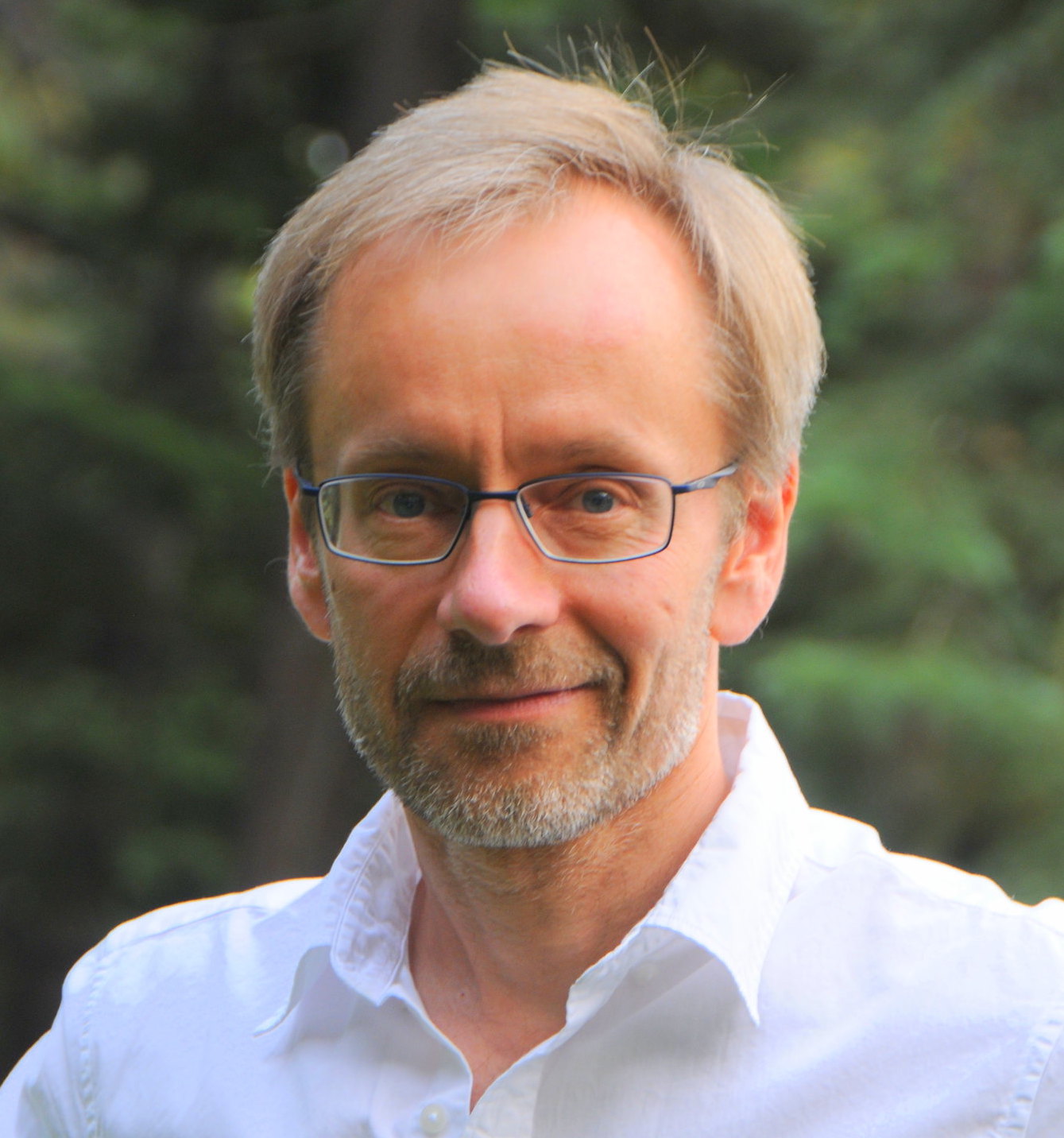
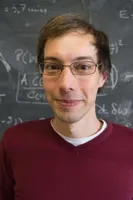
Christian Pascal Hirsch is an Associate Professor for Data Science and Statistics at the Department of Mathematics, Aarhus University. His research focuses on random networks inspired by biology and health sciences, utilizing techniques from topological data analysis and stochastic geometry. He is affiliated with the Stochastics group, AU DIGIT Centre, and AU Quantum Campus. Research Interests: Topological data analysis, large deviations theory, spatial random networks, and stochastic geometry. His work includes studies on percolation theory, Gibbs measures, and applications to neural networks and geometric functionals. Publications span journals such as the Journal of Applied and Computational Topology, Journal of Statistical Physics, and Stochastic Processes and Their Applications, covering topics from network topology to Poisson approximation.
Christian Hirsch is an Associate Professor for Data Science and Statistics at Aarhus University, where he studies random networks motivated from biology and health sciences through techniques from topological data analysis and stochastic geometry. He is a member of the Stochastics group at the Department of Mathematics and holds additional affiliations as an Associate Fellow of the Aarhus Institute for Advanced Studies, and with the AU DIGIT Centre and the AU Quantum Campus. Current Position: Associate Professor for Data Science and Statistics, Aarhus University Previous Positions: Assistant Professor at University of Groningen and University of Mannheim Postdoctoral Experience: Aalborg University, LMU Munich, WIAS Berlin Education: PhD from Ulm University Christian Hirsch's research focuses on the statistical foundations of topological data analysis, large deviations theory in stochastic geometry, and percolation theory of spatial random networks. His work bridges theoretical mathematics with practical applications in data science, particularly in analyzing complex structures through topological methods. He investigates how topological features form and disappear in growing data structures, developing statistical tests to determine whether observed patterns are significant or merely random occurrences. His recent publications reveal a strong trend toward applying topological data analysis to increasingly complex structures, with significant focus on statistical validation of topological features. Hirsch has made substantial contributions to understanding the probabilistic behavior of persistent homology, developing functional central limit theorems and large deviation principles for topological functionals. His work spans theoretical foundations in stochastic geometry while finding applications in materials science, neural networks, and wireless communication systems. As an educator, Hirsch teaches graduate courses including Topological Data Analysis, Stochastic Geometry, Monte Carlo Simulation, Markov Decision Processes, Probability Theory, and Stochastic Processes. He has supervised numerous PhD, MSc, and BSc students, with several of his former students securing academic positions at institutions like University of Leiden, Tokyo Institute of Technology, and Budapest University of Technology. Hirsch leads a research group within the Stochastics group at Aarhus University, collaborating extensively with researchers across Europe and North America. His work demonstrates how topological methods can provide rigorous statistical insights into complex data structures, making significant contributions to both theoretical mathematics and practical data analysis techniques.
Timo Seppäläinen is a Professor and the John and Abigail Van Vleck Chair of Mathematics at the University of Wisconsin-Madison since 2005. He is affiliated with the Mathematics Department under the College of Letters & Science. Education: Ph.D. in Mathematics (1991) from the University of Minnesota M.Sc. in Industrial Engineering and Management (1986) from Aalto University High School Diploma (1980) from Helsinki I Normal School Research Interests: His work primarily focuses on probability theory , encompassing topics such as motion in random media, first- and last-passage percolation, interacting particle systems, and large deviation theory. He has contributed to graduate-level stochastic analysis and authored lecture notes on the corner growth model , exclusion processes, and renewal theory. His research has been supported by the National Science Foundation and the Wisconsin Alumni Research Foundation. Scientific Awards and Honors: 2000 Prix Institut Henri Poincaré-Gauthier Villars 2010 Fellow of the Institute of Mathematical Statistics 2011 Van Vleck Research Prize 2014 IMS Medallion Lecturer and Invited Speaker at International Congress of Mathematicians 2015 Vilas Faculty Mid-Career Investigator Award 2015-2016 and 2023-2024 Simons Fellow in Mathematics 2016 Van Vleck Chair of Mathematics 2017 Fellow of the American Mathematical Society Teaching and Editorial Work: He teaches undergraduate and graduate courses in probability theory and stochastic processes, including Math 632 , Math 733-734 , and Math 735 . He has served on editorial boards and organized probability seminars.
R K Bansal is a Professor in the Department of Electrical Engineering at Indian Institute of Technology Kanpur (IIT Kanpur). He has been actively contributing to the fields of Detection Theory and Information Theory for several decades with a strong academic background including a PhD from University of Connecticut (1987). His research interests include: Universal data compression with applications Sequential detection of a change in distribution Robust detection Ergodic theory and large deviation theory applications Stochastic processes Dr. Bansal's recent publications primarily focus on data compression algorithms, particularly variations of the Lempel-Ziv algorithm, and detection theory applications. His work demonstrates a strong theoretical foundation with practical applications in information processing and analysis, showing consistent research activity from the 1980s through 2013. He has received significant recognition for his teaching excellence: Letter of commendation from Director on best teaching (2011) Outstanding tutor for Mathematical Statistics (BSO209) based on student feedback (1998-II) Consistently high teaching evaluations exceeding institute averages Dr. Bansal has advised students and maintained active research in his specialized areas, though specific names of current advisees are not mentioned in the available information. His research has been published in prestigious venues including IEEE Transactions on Information Theory. His laboratory is located in room 202 ACES (Advanced Centre for Electronic Systems) at IIT Kanpur, serving as the base for his research activities in detection theory and information theory applications.
Federico Bonetto is a Professor at the School of Mathematics , Georgia Institute of Technology. His research spans equilibrium and non-equilibrium statistical mechanics , chaotic systems , and mathematical physics . Research Themes : Fermi surfaces in interacting fermion systems Chaos and large deviations in billiards Fourier's law in anharmonic oscillators Game theory applications to economic models Teaching : Regular instructor of courses like Partial Differential Equations , Linear Algebra , and Probability & Statistics since 2002. Publications : Over 40 works since 1995, focusing on Kac models, thermostatted systems, and statistical mechanics of coupled maps. Recent articles (2019-2025) explore non-equilibrium entropy decay , fermionic criticality , and monetary policy experiments .
Arijit Chakrabarty is a Professor at the Theoretical Statistics and Mathematics Unit of the Indian Statistical Institute, Kolkata, India. His research focuses on random matrix theory, heavy-tailed distributions, large deviations, and long-range dependence. He can be reached via email at arijit.isi@gmail.com. Research Interests: Random matrix theory, Heavy-tailed distributions, Large deviations, Long-range dependence, Spectral analysis, Stochastic processes Publications Trends: His 15 most recent articles span random matrix theory, large deviations, Gaussian processes, and free probability. Key topics include eigenvalue analysis in random graphs, excursion lengths in Gaussian processes, and clustering of extremes in memory regimes. Lecture Notes: He has produced educational materials on Measure Theoretic Probability, Martingale Theory, and Probability Theory, partially in collaboration with Arup Bose and Rajat Hazra. These notes are accessible online and reflect his teaching contributions.
Michael Cates is the Lucasian Professor of Mathematics at the University of Cambridge, leading the Soft Matter research group in the Department of Applied Mathematics and Theoretical Physics (DAMTP). He has held prestigious roles, including Royal Society Research Professor (2007-2022) and Professor of Natural Philosophy at the University of Edinburgh (1995-2015). His research focuses on soft matter physics, active matter, rheology, and non-equilibrium statistical physics, with a recent ERC Advanced Grant on Active and Driven Systems. Cates has received awards such as the Bingham Medal (2016), Dirac Medal (2009), and recognition by the US National Academies of Sciences and Engineering. His research interests span the flow dynamics of colloids, polymers, and gels; shear-thickening rheology; and theoretical models of active matter, including phase separation and collective motion. He also contributed to pandemic modeling during the RAMP initiative. His work bridges fundamental physics with applications in materials science and biophysics. Grants & Awards: ERC Advanced Grant (ADNeSP, completed) Royal Society Research Professorship (2007-2022) Over 11 major scientific awards, including Bingham Medal and Dirac Medal Labs & Teams: Heads the Soft Matter group at DAMTP, collaborating on interdisciplinary projects in active matter and complex fluids.
Alice Guionnet is a French mathematician and Research Director at the CNRS, affiliated with the Unité de Mathématiques Pures et Appliquées (UMPA) at École Normale Supérieure de Lyon since 2005. Her research focuses on random matrix theory, probability theory, and their applications in statistical mechanics and large deviations principles. She completed her doctorate in 1995 with a thesis on spin glass dynamics, supervised by Gérard Ben Arous. Her work includes groundbreaking contributions such as the Single Ring Theorem (2009) and studies on large deviations for eigenvalues of Wigner and heavy-tailed matrices. She has been honored with the Oberwolfach Prize (1998), Loève Prize (2009), and Blaise Pascal Medal (2018), and was elected to the French Academy of Sciences in 2017. Key research interests include non-linear Wigner spiked models, spectral phase transitions, and free probability. She has authored over 80 publications, including influential papers on matrix models, eigenvector delocalization, and stochastic processes in disordered systems. Her ERC Project LDRAM (Large Deviations in Random Matrices) explores asymptotic behaviors of random matrix ensembles. Education: PhD from École Normale Supérieure (1995), MSc in Mathematics (ENS Paris, 1989). Labs/Teams: UMPA Lyon, collaborations with CNRS and international institutions. Grants/Awards: Simons Investigator (2012–2015), CNRS Silver Medal (2010).
Dr. Tobias Grafke is Associate Professor of Mathematics at the University of Warwick, specializing in applied and computational mathematics. His research develops tools to analyze stochastic systems in fluid dynamics, climate science, and active matter. Current projects focus on predicting rare events like AMOC collapse and turbulence proliferation using large deviation theory and numerical methods. Recent articles (2023-2025) investigate noise-induced climate tipping points, rogue wave mechanics, and scalable algorithms for stochastic PDEs. Grants include an EPSRC New Investigator Award (2020) and NSF/EPSRC joint funding. Teaches MA3J4 (Mathematical Modelling with PDE) and MA2K4 (Numerical Methods).
S. R. Srinivasa Varadhan is the Frank Jay Gould Professor of Science and Professor of Mathematics at the Courant Institute of Mathematical Sciences, New York University. His primary affiliation is with the Mathematics Department, where he has held prominent academic roles since joining NYU. Varadhan's research focuses on probability theory and its interplay with analysis, particularly stochastic processes and their connections to partial differential equations. He earned his Ph.D. in Mathematics from the Indian Statistical Institute (1963), following earlier degrees from Presidency College, Madras (M.A. 1960, B.A. 1959). His teaching spans advanced topics in probability, real variables, harmonic analysis, stochastic calculus, and mathematical finance, as evidenced by course materials from 2000 onward. Varadhan’s work emphasizes large deviations theory, limit theorems, and applications to statistical mechanics. His publications address foundational questions in probability and its analytical underpinnings. He has contributed extensively to educational materials, including lecture notes on stochastic processes and advanced probability.
Mark C. Kruse is a Professor in the Department of Physics at Duke University, within Trinity College of Arts & Sciences. His research focuses on High-Energy Particle Physics, particularly the analysis of data collected by the ATLAS detector at the Large Hadron Collider (LHC). With the Higgs boson discovered by ATLAS and CMS collaborations in July 2012, his work now centers on discovering models beyond the Standard Model of particle physics. Dr. Kruse's educational background includes: Ph.D. in Physics from Purdue University (1996) M.S. in Physics from University of Auckland, New Zealand (1988) B.S. in Physics from University of Auckland, New Zealand (1986) Professor Kruse's research primarily investigates phenomena beyond the Standard Model of particle physics. His work with the ATLAS detector at the LHC focuses on Higgs boson properties, top quark physics, and searches for new particles and forces that could explain dark matter and other cosmic mysteries. He has been instrumental in analyzing data from proton-proton collisions at various energy levels to uncover potential deviations from established physics theories. His research group at Duke actively contributes to the international effort to understand fundamental particles and their interactions at the highest energy scales accessible to humanity. Analysis of Professor Kruse's recent publications reveals a strong focus on Higgs boson physics, top quark measurements, and searches for physics beyond the Standard Model. His work with the ATLAS collaboration spans multiple areas including precision measurements of known particles, searches for exotic decays, and investigations of quark-gluon plasma. The research demonstrates increasing sophistication in data analysis techniques as the LHC continues to deliver higher luminosity and energy collision data. Professor Kruse has received several notable awards and recognitions: Dean's Leadership Award from Duke University (April 2013) Sir Thomas Lyle Fellowship from University of Melbourne, Australia (2013) Bass Society of Fellows at Duke University (May 2012) Shared recognition for the Discovery of the Top Quark (July 2019) As a dedicated educator and mentor, Professor Kruse has advised numerous students through independent study courses (PHYSICS 493) and thesis projects (PHYSICS 495). He has secured substantial research funding including the REU Site for Undergraduate Research in Nuclear Particle Physics (2022-2027) and the Support and Maintenance for the ATLAS Transition Radiation Detector at CERN (2025-2027). His grants consistently support both graduate and undergraduate research opportunities, reflecting his commitment to training the next generation of physicists. Professor Kruse is a key member of the ATLAS collaboration at CERN, where he serves as the US ATLAS Transition Radiation Tracker Level 3 Manager. His research group at Duke University works closely with international collaborators on data analysis and detector operations. The team contributes significantly to the ongoing physics program at the LHC, particularly in areas related to Higgs boson characterization and searches for new physics phenomena.
Kyle Dawson is a Professor of Physics and Astronomy at the University of Utah, where he has been employed since 2009. He currently serves as both a full Professor and Director of Graduate Studies in the Department of Physics and Astronomy, having progressed from Assistant Professor (2008-2015) to Associate Professor (2015-2019) before achieving his current position in 2019. His institutional affiliation places him within the College of Science at the University of Utah, a major research university in the western United States. Dawson earned his BA in Physics from Cornell University in 1998, followed by a PhD in Physics from the University of California, Berkeley in 2004. After completing his doctoral studies, he served as a postdoctoral researcher at the Lawrence Berkeley National Laboratory before joining the University of Utah faculty. His educational background in physics provided the foundation for his transition into observational cosmology, where he has made significant contributions through large-scale spectroscopic surveys. Professor Dawson's research focuses on observational cosmology through large spectroscopic surveys designed to measure the fundamental properties of the universe. He is currently the co-Spokesperson for the Dark Energy Spectroscopic Instrument (DESI), a major cosmological survey that has produced numerous high-impact publications in 2024-2025. Previously, he served as Principal Investigator for the Extended Baryon Oscillation Spectroscopic Survey (eBOSS), which concluded in 2020 with final cosmological measurements. His work centers on measuring baryon acoustic oscillations to constrain cosmic expansion history, dark energy properties, neutrino masses, and to test General Relativity. His research group employs techniques including galaxy clustering analysis, quasar astrophysics, and large-scale structure mapping to address fundamental questions in cosmology. The analysis of Dawson's recent publications reveals a strong focus on extracting cosmological constraints from the DESI survey data. His work spans multiple aspects of cosmological analysis, including baryon acoustic oscillation measurements, full-shape power spectrum analysis, imaging systematics mitigation, and cross-correlation studies with cosmic microwave background data. The publications demonstrate collaborative work with large international teams and contribute to increasingly precise measurements of cosmological parameters, with particular attention to dark energy equation of state, neutrino masses, and potential deviations from General Relativity. Professor Dawson has secured significant research funding throughout his career, including multiple grants from the Department of Energy (DOE), NASA, and the National Science Foundation. His grant portfolio includes leadership roles in major cosmological surveys like DESI and eBOSS, as well as support for postdoctoral researchers and graduate students. His research group has mentored numerous students who have gone on to successful careers in academia, industry, and data science fields. Dawson leads a vibrant research group at the University of Utah focused on cosmological data analysis from large spectroscopic surveys. His current team includes two postdoctoral researchers (Angela Berti and Sarah Eftekharzadeh) and a graduate student (Allyson Brodzeller). The group specializes in galaxy clustering analysis, quasar astrophysics, and machine learning applications to spectroscopic data. The research environment fosters collaboration with international teams working on DESI and related cosmological surveys, providing students with opportunities to engage with cutting-edge cosmological research and large-scale data analysis techniques.
Lenka Zdeborová is an Associate Professor at EPFL, jointly affiliated with the School of Basic Sciences and School of Computer and Communication Sciences. She leads the Laboratory of Statistical Physics of Computational Systems, where her research bridges statistical physics, machine learning, and computational biology. Education: PhD in Physics, Université Paris-Cité (2012) MSc in Fundamental Physics, École Normale Supérieure (2009) BSc in Physics, École Normale Supérieure de Lyon (2007) Her work focuses on phase transitions in learning algorithms, high-dimensional statistics, and neural network theory. Current projects investigate fundamental limits of machine learning, dynamics of graph neural networks, and applications to biological systems. Recent publications explore attention mechanisms in transformers, neural network depth advantages, and Bayes-optimal learning. Methodological innovations include cavity methods for hypergraphs and analysis of high-dimensional inference problems. Supervises doctoral students researching statistical physics approaches to machine learning and optimization. Teaches graduate courses in data science and machine learning for physicists.
Eunsuk Kang is an Associate Professor in the Software and Societal Systems Department at Carnegie Mellon University's School of Computer Science. Their research focuses on the intersection of software engineering and formal methods, emphasizing rigorous modeling and analysis techniques to create safe, secure, and reliable systems. PhD in Computer Science from MIT Postdoctoral scholar at NSF ExCAPE program Former connected vehicles researcher at Toyota Their research interests span software design, requirements engineering, modeling, specification and verification, system safety, security, and cyber-physical systems (CPS). Recent projects explore robustness in evolving environments, specification engineering, automated reasoning for complex systems, and safety/resilience mechanisms in ML-based CPS. Publications highlight advancements in Signal Temporal Logic decomposition, LTL specification learning, and requirement-driven adaptation frameworks. Selected scientific contributions include: tl;dr: Chill, y’all – AI will not devour SE (Onward! Essays 2024): Critical perspective on AI integration in software engineering FairSense (ICSE 2025): Long-term fairness analysis for ML-enabled systems AlloyMax (ESEC/FSE 2021): Relational specification satisfaction techniques As an educator, Kang teaches graduate courses in software design and formal methods, including: 17-423/723: Designing Large-Scale Software Systems 17-614 & 624: Formal Methods 17-445/645: Software Engineering for AI-enabled Systems 17-651: Models of Software Systems Service activities include: Program co-chair for SEAMS 2026 Co-organizer of Dagstuhl Seminar on Specification Engineering Co-organizer of International Workshop on Designing Software Program committee member for ICSE, OOPSLA, ASE, and specialized conferences Notable research collaborations include work with: Ben-hau Chia (PhD student) Parv Kapoor (PhD student) Yiliang (Leo) Liang (PhD student) Sumon Biswas (Postdoc) Rômulo Meira-Góes (Postdoc)
Benjamin Fehrman is an Assistant Professor in the Department of Mathematics at Louisiana State University, specializing in stochastic analysis with a focus on stochastic partial differential equations and their applications to statistical physics. His research encompasses diffusion processes in random environments, stochastic homogenization, and randomized optimization algorithms in machine learning. His research interests center on the mathematical theory of stochastic partial differential equations, particularly those arising in statistical physics. Fehrman investigates fluctuating hydrodynamics, non-equilibrium systems, and the connection between interacting particle systems and their continuum limits. His work often involves developing well-posedness theory for challenging SPDEs with conservative noise structures and analyzing large-scale behavior in random media. Analysis of his recent publications reveals a strong focus on conservative stochastic PDEs and their connection to interacting particle systems, particularly the zero-range process and symmetric simple exclusion process. His research shows increasing attention to large deviation principles, kinetic formulations of skeleton equations, and the mathematical foundations of fluctuating hydrodynamics. The interdisciplinary nature of his work bridges probability theory, partial differential equations, and mathematical physics. Fehrman's research has been supported by prestigious grants including the National Science Foundation DMS-Probability Standard Grant 2348650, the Simons Foundation Travel Grant MPS-TSM-00007753, and the Louisiana Board of Regents RCS Grant 20130014386. He has supervised PhD students Andrea Clini (University of Oxford, 2020-2024) and Shyam Popat (University of Oxford, 2021-present), as well as postdoc Simone Floreani (University of Oxford, 2022-2023). Fehrman has also organized significant academic events including the "Interacting Particles, Fluctuating Systems, and SPDEs" workshop at the University of Oxford in June 2023, funded by an EPSRC Early Career Fellowship. His teaching portfolio includes advanced courses in stochastic analysis, stochastic differential equations, and stochastic homogenization at both Louisiana State University and the University of Oxford, where he previously held a position.