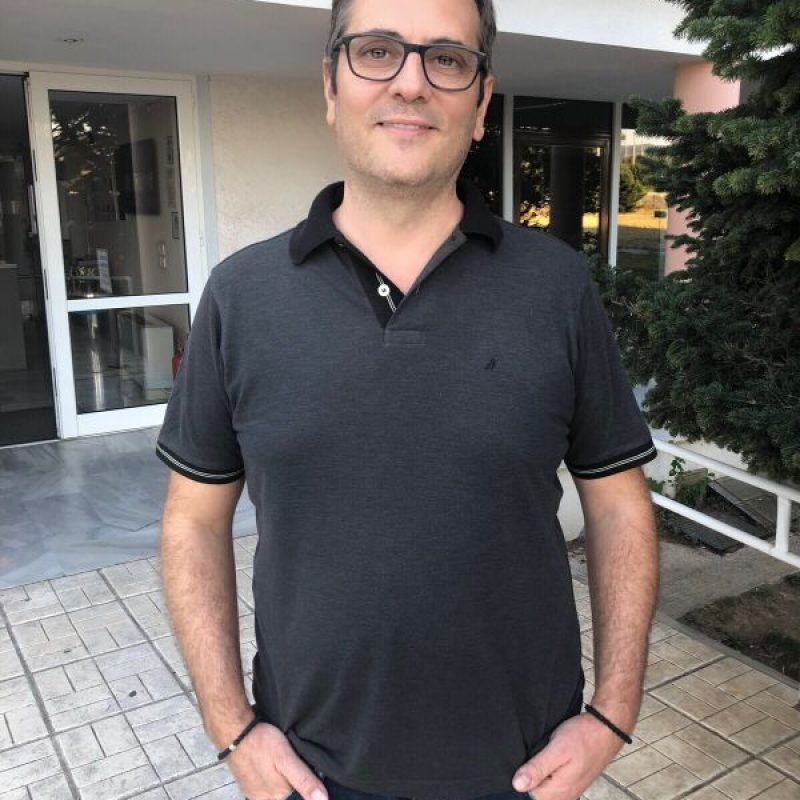
Dr. George Stamou is a Professor at the School of Electrical and Computer Engineering of the National Technical University of Athens (NTUA), serving as Director of the Artificial Intelligence and Learning Systems Laboratory (AILS). His expertise spans knowledge representation, machine learning, neural networks, and semantic technologies. He leads interdisciplinary initiatives such as the postgraduate program 'Data Science and Machine Learning' (2018–2022). Research Interests: Focuses on knowledge graphs, interpretable AI, semantic web applications, and multimodal learning. His work integrates formal logic systems (e.g., description logics) with modern deep learning techniques, addressing challenges in explainability, bias detection, and ethical AI applications. Publications: Over 150 articles in AI journals/conferences with an h-index of 34 (Google Scholar). Notable contributions include datasets like CHORDONOMICON (music analysis), GOSt-MT (gender bias in MT), and methodologies for counterfactual explanations in machine learning. Awards & Committees: Active in W3C and RuleML standardization bodies. Co-organized major AI conferences. Recognized for contributions to semantic interoperability and knowledge-based systems. Labs & Teams: Directs AILS-NTUA lab and collaborates with CISRI (Computer & Information Systems Research Institute). Engages in EU projects like CultureLabs (cultural heritage digitalization) andsmarty4covid (health data analysis).
National and Kapodistrian University of AthensGreece
Alvin Cheung is an Associate Professor in the Computer Science Division at UC Berkeley's EECS department. He is affiliated with the Data Systems and Foundations group, Programming Systems group, Sky Lab, and SLICE Lab, and serves as a faculty affiliate at the Berkeley Institute for Data Science. He advises the Data Science Discovery Program and provides technical guidance to industry partners. His research spans data management, programming languages, and scalable software systems, with emphasis on helping users process large datasets efficiently. Key innovations include verified lifting (applying formal methods and ML to infer program properties) and systems for optimizing database-backed applications and geospatial analytics. Recent work explores LLM-driven code optimization and transpilation techniques. His publications (2023-2025) show strong trends in ML-enhanced systems, verified compilation, and data management tools. Articles frequently integrate formal methods, program synthesis, and hardware-aware optimizations across domains like databases, distributed computing, and HCI. Scientific Awards: ACSIC Rock Star Award (2025) Dahl-Nygaard Junior Prize (2024) VLDB Early Career Research Contribution Award (2023) IEEE TCDE Rising Star Award (2020) Sloan Fellowship (2019) NSF CAREER Award (2017) 20+ additional honors Advising & Grants: He mentors PhD/MS students (e.g., Lily Liu at OpenAI, Chenglong Wang at Microsoft Research). Research is funded by: NSF DOE ONR ARO Intel Notable grants include ONR Young Investigator Award and ARO Early Career Program Award. Labs & Teams: Leads projects in Berkeley's Data Systems/Programming Systems groups and collaborates with Sky Lab/SLICE Lab. Manages labs focused on verified compilation (e.g., Tenspiler) and data infrastructure (e.g., Spatialyze).
Foundation for research and technology-hellasGreece
Michalis Mountantonakis is a Postdoctoral Researcher at FORTH and Laboratory Teaching Staff in the Department of Computer Science at the University of Crete, Greece. He holds a PhD (2020), MSc (2016), and BSc (2014) in Computer Science from the University of Crete, all with top grades. His research focuses on Large-Scale Semantic Data Integration, Linked Open Data, and Semantic Web technologies, with over 45 publications in top venues like ACM VLDB, ISWC, and ECML. He has been awarded the prestigious SWSA Distinguished Dissertation Award (2020) and the Maria Michael Manasaki Fellowship (2020). His work includes tools like LODsyndesis and LODChain, addressing challenges in knowledge graph connectivity and validation of AI-generated content. Education: PhD in Computer Science (2016-2020), University of Crete (Excellent GPA 9.74/10) MSc in Computer Science (2014-2016), University of Crete (Excellent GPA 9.87/10) BSc in Computer Science (2010-2014), University of Crete (2nd in class with GPA 8.42/10) Research Interests: His work bridges semantic web technologies with modern AI challenges, emphasizing large-scale data integration, knowledge graph applications, and validation frameworks. He has contributed to cultural heritage informatics, machine learning-augmented semantic systems, and cross-lingual NLP solutions. Recent trends include leveraging LLMs for query generation and semantic enrichment while ensuring factual accuracy through knowledge graph-driven validation. Key Achievements: Developed LODsyndesis, a global-scale semantic integration service Pioneered real-time validation of ChatGPT responses using RDF knowledge graphs Won Best Paper Award (ISWC 2022) for entity enrichment techniques Recipient of Stelios Orphanoudakis Undergraduate Fellowship (2013-2014) Participated in Roche Continents 2019 (top 100 European science students) Grants & Labs: His research has been supported by GSRT/HFRI. He collaborates with FORTH-ICS and leads projects in EU-funded initiatives like iMarine and BlueBridge. Current work focuses on governance models for ontologies, interoperable thesaurus creation (e.g., FoodEx2), and semantic analytics for cultural heritage datasets.
National and Kapodistrian University of AthensGreece
Zhenjiang Hu is a Chair Professor and Dean of the School of Computer Science at Peking University. He serves as Director of the Programming Languages Laboratory and has held significant academic positions including Professor at the National Institute of Informatics and University of Tokyo. BS and MS from Shanghai Jiaotong University (1988, 1991) PhD from University of Tokyo (1996) Lecturer/Assistant Professor at University of Tokyo (1997) Associate Professor at University of Tokyo (2000) Full Professor at National Institute of Informatics (2008) Full Professor at University of Tokyo (2018-2019) Professor Hu's research primarily focuses on programming languages and software engineering, with special emphasis on functional programming, bidirectional transformation, and software adaptation. His work explores transformational programming approaches for automatic program optimization, systematic parallelization of sequential programs, efficient manipulation of structured documents, and bidirectional model transformation for software development. His research has significantly advanced the field of bidirectional programming, developing foundational theories and practical applications that enable more reliable and maintainable software systems. His recent publications demonstrate a strong trajectory in bidirectional programming, program synthesis, and graph processing. The research shows increasing sophistication in handling program transformations, with growing emphasis on practical applications in software engineering contexts. His work increasingly integrates formal methods with practical programming language design, creating systems that maintain theoretical soundness while addressing real-world software development challenges. The research spans multiple venues including top conferences like PLDI, POPL, ICFP, and OOPSLA, reflecting its broad impact across programming language research. Fellow of JFES (Japan Federation of Engineering Society, 2016) ACM Distinguished Scientist (2016) Member of Academia Europaea (2019) IEEE Fellow (2020) Member of Engineering Academy of Japan (2020) Professor Hu actively mentors students and has welcomed excellent candidates to join his group through Peking University's International Elite PhD Program and Boya Postdoctoral Fellowship Program. He serves on numerous program committees for major conferences including PLDI, POPL, ICFP, and OOPSLA, and holds editorial positions for prestigious journals such as Journal of Functional Programming and Science of Computer Programming. His leadership extends to conference organization, having served as PC Chair for CNCC 2024 and General Co-Chair for SoICT 2019. As Director of the Programming Languages Laboratory at Peking University, Professor Hu leads a research team focused on advancing programming language theory and practice. His lab has developed influential frameworks like BiGUL for bidirectional programming and Fregel for graph processing. The laboratory maintains strong international collaborations and contributes to both theoretical foundations and practical implementations in programming languages and software engineering.
Christos Tryfonopoulos is an Associate Professor and Head of the Department of Informatics & Telecommunications at the University of the Peloponnese, where he leads the Software and Database Systems (SoDa) Lab. His academic career spans prestigious institutions including the Max-Planck Institute for Informatics in Germany, where he led the P2P and Information Management research area from 2006-2009, and the Technical University of Crete, where he completed his PhD and MSc degrees. His research interests focus on information management, distributed systems, digital libraries, and data/user anonymity. His work bridges theoretical foundations with practical applications across diverse domains including environmental monitoring, cybersecurity, cultural heritage, and medical informatics. He has developed innovative frameworks for pollution prediction, cyber-threat intelligence, and academic expertise mapping that demonstrate the interdisciplinary nature of his research. Professor Tryfonopoulos has published over 80 papers in top-tier journals and conferences including TOIS, TKDE, SIGIR, and SIGMOD. His recent work shows a strong trend toward applying machine learning techniques to information management problems, with publications spanning environmental science, cybersecurity, and bibliometrics. His research group has developed several significant tools including VeTo+ for expert set expansion, inTIME for cyber-threat intelligence, and Hydria for cultural heritage analytics. Candidate for best research paper in ESWC 2016 conference Honorable mention for best poster (3rd place) in ESWC 2012 conference Award as Distinguished Scientist Excelling in Research Abroad (2008) Best student paper award in ECDL 2005 conference Heraclitus PhD fellowship from Greek Ministry of Education (2002-2005) National Scholarship Foundation of Greece (IKY) scholarship (1998) Professor Tryfonopoulos has supervised 5 PhD students (3 in progress), 19 MSc students, and 31 BSc students. He has led or participated in 13 competitive EU and national research projects including ENIRISST+ for shipping and transport infrastructure, WeCare for student support structures, and FORESIGHT for cybersecurity simulation. His current research focuses on intelligent infrastructure for transportation logistics, cyber-threat intelligence systems, and educational technologies for data science.
National and Kapodistrian University of AthensGreece
Michael Eichberg is a Professor at Technische Universität Darmstadt, Germany, where his work centers on software engineering, static analysis, programming languages, and secure software development tools. He is the principal architect of the OPAL framework for Java bytecode analysis and has an extensive publication record spanning PLDI, ICSE, ESEC/FSE, ISSTA, ASE, FSE, SOAP, and other premier venues. Research Interests: Static program analysis and its scalability to real-world code bases Software security, particularly cryptographic API misuse and Android app repackaging detection Concurrent and parallel programming models, including deterministic concurrency in Scala Software architecture conformance, drift and erosion detection, and rule reuse Development of open extensible tools and frameworks (OPAL, LectureDoc, QScope, Sextant, XIRC, IRC) Publication Trends: His recent work (2015-2022) demonstrates a strong focus on empirical evaluation of static analysis techniques, modular composition of analyses, and security-related program understanding. Key themes include unsoundness in call graph construction, purity and immutability analyses, parallelization of static analyses, and large-scale studies of cryptographic API misuse. Tools & Frameworks: OPAL – A flexible Java bytecode analysis and manipulation framework (core developer until 2019) LectureDoc 2 – Web-based lecture material authoring and presentation system QScope – Open extensible metrics framework for modern software projects Sextant – Eclipse-integrated software exploration tool XIRC/IRC – Frameworks for enforcing system-wide properties and architectural constraints
National and Kapodistrian University of AthensGreece
Isambo Karali is an Assistant Professor in the Department of Informatics and Telecommunications at the National and Kapodistrian University of Athens, a position she has held since November 2007. Prior to this, she served as a Lecturer at the same department from September 1999 to November 2007. Her academic career spans over three decades with significant contributions to knowledge representation, uncertainty reasoning, and semantic web technologies. Dr. Karali's educational background includes: PhD in Informatics (1995) from the University of Athens MSc in Computer Science (1988) from University College, University of London Bachelor of Mathematics (1986) from the Department of Mathematics, University of Athens Dr. Karali's research focuses on Knowledge Representation and Reasoning with Uncertainty, Artificial Intelligence, Logic Programming, and Object-Oriented Programming. She has made significant contributions to applying Dempster-Shafer theory for handling uncertainty in Semantic Web applications. Her work bridges theoretical foundations of logic programming with practical applications in knowledge representation, particularly in distributed and heterogeneous environments. She has supervised numerous PhD and master's theses in these areas. Her recent publications demonstrate a strong trend toward integrating uncertainty reasoning with Semantic Web technologies, particularly using Dempster-Shafer theory and fuzzy logic. Her work addresses challenges in managing imprecise and uncertain information in large-scale knowledge systems, with applications in recommendation systems, news analysis, and semantic search. The interdisciplinary nature of her research connects artificial intelligence, knowledge representation, and web technologies to solve complex information management problems. Dr. Karali has been actively involved in research funding and collaboration: Principal Investigator for "Handling uncertainty in data intensive applications on a distributed computing environment (cloud computing)" under the "Thalis" Program Scientific Responsible for "Artificial Intelligence and Logic Programming Techniques for Knowledge on the World Wide Web" at the National and Kapodistrian University of Athens Scientific Responsible for "Semantic Web and Logic Programming - Application to Guided Search" at the National and Kapodistrian University of Athens Participant in multiple EU research projects including MISSION, COSMOS, ADDSIA, PARACHUTE, APPLAUSE, and EDS As an educator, Dr. Karali has taught core undergraduate courses including Object-Oriented Programming and Logic Programming, as well as graduate courses on Knowledge Technologies and Artificial Intelligence. She has supervised numerous PhD and master's students, with a focus on uncertainty reasoning, semantic web technologies, and logic programming applications. Her mentorship extends to student competitions, including guiding the Department's team in the Microsoft ImagineCup 2009. Dr. Karali has also contributed to the academic community through service activities, including membership on program committees for conferences like IEEE ICTAI, reviewer for prestigious journals, and organizational roles in academic events. From 2000 to 2012, she was responsible for the Department's website, contributing to its architecture design and system development.
Nikos Spanoudakis is an Assistant Professor at the Department of Electronic Engineering of Hellenic Mediterranean University , with concurrent research collaboration at Technical University of Crete . He holds a PhD in Computer Science (Artificial Intelligence) from Paris Descartes University (2009, "Très Honorable"), an MSc in Organization and Administration from Technical University of Crete, and a Diploma in Computer Engineering and Informatics from University of Patras. Research Focus: Multi-Agent Systems (AOSE, Computational Argumentation), Model-Driven Engineering , Smart Buildings , IoT , and Artificial Intelligence Applications in Ambient Intelligence, Finance, and Education Key Contributions: Created ASEME Methodology and AMOLA Language for agent modeling, developed Gorgias-B argumentation framework, and designed Kouretes Statechart Editor for robotic behavior specification His recent publications reveal a strong trend in Explainable AI (2023: Explainable Argumentation as a Service ), Smart Energy Systems (2025: Engineering IoT-Based Open MAS for Large-Scale V2G/G2V ), and EdTech Innovations (2024: Role Assignment in Programming Courses ). He has received prestigious ACM Senior Member (2023) and IEEE Senior Member (2012) distinctions, along with teaching recognition (2021) from Technical University of Crete. Academic Leadership: Serves as Editor for Springer Nature's Computer Science journal and has reviewed for 15+ top-tier publications including IEEE Intelligent Systems and Journal of Web Semantics Conference Involvement: Program Committee Member for 20+ international conferences (IJCAI, ECAI, AAMAS, AAAI) and organizer of multiple European Agent Systems Summer Schools
National and Kapodistrian University of AthensGreece
Panagiotis Stamatopoulos is an Assistant Professor at the Department of Informatics and Telecommunications, National and Kapodistrian University of Athens, where he has been employed since 1993. He holds a PhD in Computer Science (1988) and a Diploma in Physics (1982) from the University of Athens. His research spans artificial intelligence, constraint programming, natural language processing, machine learning, and optimization. Specific interests include: Hybrid approaches combining constraint programming with operations research Natural language understanding for database access Parallel processing and distributed constraint solving Multi-agent systems and web intelligence applications His publications show consistent focus on constraint satisfaction algorithms, text summarization techniques, educational timetabling systems, and AI applications in diverse domains like sports analytics and robotics. Recent works demonstrate increased attention to NLP evaluation metrics and multimodal learning. He has supervised numerous diploma theses and led projects funded by the European Union (EDS, APPLAUSE, PARACHUTE, PARROT), University of Athens, and Olympic Airways. Stamatopoulos teaches undergraduate courses in Introduction to Programming and Logic Programming, plus postgraduate courses in Advanced Artificial Intelligence. He previously taught Artificial Intelligence, System Programming, and Expert Systems.
National and Kapodistrian University of AthensGreece
Peter O'Hearn is a Professor of Computer Science at University College London and Research Scientist at Meta AI (FAIR), renowned for co-developing separation logic which bridges theoretical computer science and industrial-scale program analysis. His dual affiliation exemplifies the synergy between academic research and practical tool development that characterizes his career. His research interests focus on program verification , separation logic , static analysis , and his recent groundbreaking work on incorrectness logic as a complementary approach to traditional verification. O'Hearn pioneered the concept of local reasoning which enables modular verification of large codebases by focusing only on relevant memory regions, forming the theoretical foundation for Facebook Infer. His publications reveal a consistent trajectory from foundational theory to industrial application, with recent work emphasizing Scalable verification for million-line codebases Compositional reasoning for concurrent systems Practical deployment of formal methods in developer workflows Bug-oriented reasoning through incorrectness logic His research consistently addresses the tension between theoretical soundness and practical applicability in program analysis. Notable scientific awards include: 2021 IEEE Cybersecurity Award for Practice 2016 Gödel Prize for separation logic 2016 CAV Award for outstanding contributions POPL 2019 Most Influential Paper Award Fellow of the Royal Society (FRS) Fellow of the Royal Academy of Engineering (FREng) O'Hearn has made substantial contributions to industrial practice through Facebook Infer, which analyzes millions of lines of code daily across Meta's codebase. His work on continuous reasoning integrates formal verification into developer workflows, while his recent focus on incorrectness logic addresses the critical need for effective bug detection in large systems. He maintains active leadership in the programming languages community through conference organization and keynotes.
Foundation for research and technology-hellasGreece
Yannis Tzitzikas is Professor of Information Systems at the University of Crete and Affiliated Researcher at FORTH-ICS. He directs the Centre for Cultural Informatics and Semantic Access & Retrieval group, developing frameworks for large-scale semantic integration. His research enables exploratory analytics over RDF knowledge graphs, with applications in marine science and cultural heritage. Recent projects include BlueCloud (EU H2020) for marine data services and 4CH for cultural heritage preservation. Awarded six best paper/reviewer awards including ISWC'2022 and MTSR'2020. He coordinates the University of Crete's Open Data initiative and serves on ERCIM's executive committee.
Prof. Georgios Matsopoulos is a Professor at the Department of Information Transmission Systems and Materials Technology, School of Electrical and Computer Engineering, National Technical University of Athens (NTUA). He holds a Master's in Biomechanics and a PhD from the University of Strathclyde, Glasgow. As Director of the Biomedical Technology Laboratory, his expertise spans biomedical informatics, medical imaging, and healthcare data systems. His research focuses on diagnostic support systems, medical data fusion, biosignal processing, and AI-driven health technologies. Education: Bachelor's: School of Electrical & Computer Engineering, NTUA Master's: Biomechanics, University of Strathclyde PhD: University of Strathclyde Research Interests: Development of decision support systems, medical imaging analysis, health information systems, and AI applications in healthcare. He emphasizes large-scale medical data processing, radiomics, and clinical decision frameworks. His over 300 publications (2025-2021) highlight advancements in AI-driven diagnostics, medical robotics (e.g., HERON ontology), and telehealth systems. He leads projects like TeleRehaB DSS for stroke rehabilitation and the Retention project for heart failure monitoring. Grants/Projects: Extensive experience in managing research programs across public and private sectors, including EU-funded initiatives in medical AI and robotics. Labs & Teams: Oversees the Biomedical Technology Laboratory, focusing on translational research in biomedical engineering and digital health.
Dr. Ioannis Magnisalis serves as a Researcher and Academic Associate at the International Hellenic University, functioning as Research Associate and Manager within the DORG Research Group. He maintains active collaborations with the Greek Open Source Software Organization (EL/LAK), International University of Greece, and Aristotle University of Thessaloniki on e-Government R&D initiatives, while his primary professional focus remains with the European Commission's data strategy implementation. His research spans eGovernment , Open Data , Linked Data , Semantic Web , Business Semantic Standards , Metadata , Data Analysis , and e-Learning . Specializing in metadata frameworks and semantic technologies, he applies analytical tools (R, Python, SQL, NoSQL) to analyze large-scale survey data including Eurobarometer and Covid-19 datasets, with emphasis on developing interoperable standards (ESCO, CPSV, IMS, BPMN) for public sector data ecosystems. His 2020-2024 publications reveal consistent focus on digital transformation frameworks across public administration and education sectors, with recurring themes in data-centric service provision, government big data ecosystems, and AI applications. Key contributions include systematic reviews on digital transformation barriers and innovative frameworks like DaLiF for data lifecycle management, demonstrating strong interdisciplinary integration of semantic web technologies with practical governance challenges. As a core member of the DORG Research Group, he contributes to projects including JustReDi (addressing resilience and digital transition in Greek regions) and GR digiGOV-innoHUB (delivering digital skills education and transformation workshops), leveraging his expertise in IMAPS (Interoperability Maturity Assessment) for public service evaluation.
Christos Doulkeridis is a Professor at the Department of Digital Systems, University of Piraeus, Greece. He specializes in parallel and distributed query processing, large-scale data management, and spatio-temporal data systems. His work focuses on optimizing big data frameworks for mobility analytics and distributed knowledge discovery. He holds a PhD from Athens University of Economics and Business (2007) and has been involved in several EU-funded projects like EMERALDS, Green.DAT.AI, and MobiSpaces as Principal Investigator or Coordinator. Education: PhD in Informatics (2007), Athens University of Economics and Business M.Sc. in Information Systems (2003), Athens University of Economics and Business Diploma in Electrical and Computer Engineering (2001), National Technical University of Athens Awards: Best Paper Awards at SIGSPATIAL, SSTD, EuroVA Marie-Curie and ERCIM Fellowships SemEval 2017 Task 4 & 6 competition wins His research interests include scalable data processing frameworks, mobility data analytics, and spatio-temporal query optimization. He leads projects like MobiSpaces (Horizon Europe), aiming to create energy-efficient data spaces for mobility data. He has published over 100 papers in top venues like EDBT, SIGMOD, and ICDE, focusing on distributed systems, query processing, and machine learning applications in data management. Teaching: He teaches undergraduate and graduate courses in data structures, data analysis, big data processing, and database systems at the University of Piraeus. His courses integrate practical tools like Spark and Hadoop for real-world data challenges.