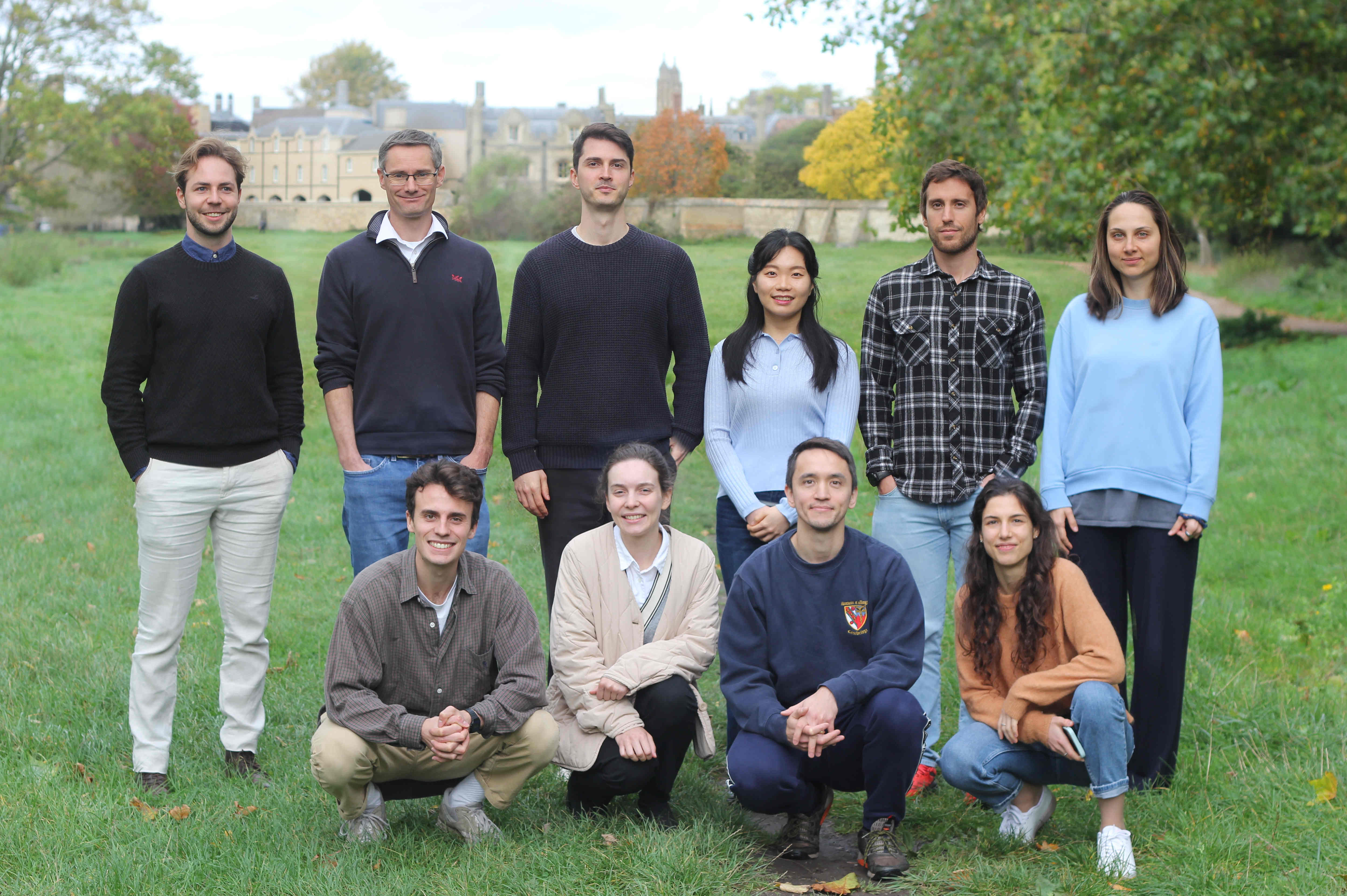
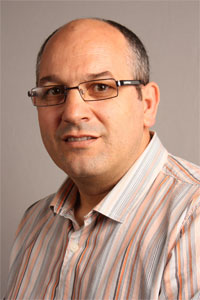
Richard E. Turner is a Professor of Machine Learning at the University of Cambridge's Department of Engineering and Research Lead for AI for Weather Prediction at the Alan Turing Institute. He serves as Cambridge Lead for the EPSRC Probabilistic AI Hub and previously held roles including Visiting Researcher at Microsoft Research, Co-Director of the AI4ER CDT, and Course Director for the Machine Learning and Machine Intelligence MPhil program. Current research focuses on probabilistic machine learning fundamentals, environmental prediction (weather/climate), and spatio-temporal modeling combining deep learning with Bayesian methods Supervised 26 PhD students (13 graduated) and 7 research assistants/associates Secured over £30M in research funding from EPSRC, Microsoft, Toyota, Google, DeepMind, Amazon, and Improbable Featured in BBC Radio 5 Live's The Naked Scientist, BBC World Service's Click, and Wired Magazine His recent publications demonstrate expertise in diffusion models for PDE simulations, Gaussian Processes for environmental applications, and Bayesian methods for spatio-temporal forecasting. Key trends include climate modeling using ML, neural PDE solvers, and scalable probabilistic inference. Awards : Cambridge Students' Union Teaching Award for Lecturing; supervised Qualcomm Innovation Fellowship winner Collaborations : Microsoft Research (AI4Science), Alan Turing Institute, EPSRC Probabilistic AI Hub Turner leads the Turner Group within Cambridge's Machine Learning Group, focusing on uncertainty-aware ML for scientific applications. Current research assistants work on topics like meta-learning, Bayesian inference, and climate science applications.
Professor Wayne Luk is a Professor of Computer Engineering at the Department of Computing, Faculty of Engineering, Imperial College London. He leads the Programming Languages and Systems Section and the Custom Computing Research Group, and directs the EPSRC Centre for Doctoral Training in High-performance Embedded and Distributed Systems and the Centre for Advanced Financial Engineering. He previously served as a Visiting Professor at Stanford University from 2006 to 2009. His research spans FPGA acceleration, quantum computing, deep learning optimization, and algorithm-hardware co-design, with affiliations to the CRUK Convergence Science Centre and the Engineering Secure Software Systems group. His research interests include computational modeling for particle physics, causal discovery in agent-based systems, and high-throughput digital electronics. Notable contributions include FPGA-accelerated algorithms for neural networks, quantum circuit simulation, and Bayesian optimization frameworks. His work emphasizes practical applications of reconfigurable hardware in fields like medical imaging, high-energy physics, and financial systems. Professor Luk is a Fellow of the Royal Academy of Engineering, IEEE, and BCS. His publications focus on advancing hardware-aware machine learning, FPGA-based acceleration techniques, and scalable design methodologies. His research bridges theoretical computer science with applied engineering, addressing challenges in real-time systems, embedded computing, and next-generation computing architectures. His academic leadership includes directing interdisciplinary centers and training programs, fostering collaboration across computing, engineering, and physics. Current projects explore quantum computing tools, causal inference systems, and high-performance graph neural networks for particle physics applications.
Dr. Tan Viet Tuyen Nguyen is a New Frontiers Fellow (Lecturer) in AI at the University of Southampton, specializing in Human-Centered Artificial Intelligence and Social Human-Robot Interaction. His research focuses on multimodal learning for robots to adapt their behavior to human social needs, with applications in healthcare, education, and service environments. Prior to this role, he was a Research Associate at King’s College London and a Research Assistant on the EU-funded CARESSES project, developing culturally-aware assistive robots for elderly support. Education: PhD in Information Science (Robotics) from Japan Advanced Institute of Science and Technology. He has organized conferences such as the IEEE RO-MAN 2022 special session on nonverbal communication and served as a reviewer for top-tier robotics and AI conferences. Research Interests include: Human-Robot Collaboration, Multimodal Perception, Generative AI for Social Interaction, and Context-Aware Robot Behavior Generation. His work has been recognized with awards including the Best Paper Award at ROMAN 2022 and the Prospective Research Award at ICServ 2023. Teaching Responsibilities include courses on Biologically Inspired Robotics, High-Level Programming, and MSc/Undergraduate project supervision. He currently oversees two PhD students and collaborates on projects like 'Exploring the impact of AI-driven writing of engagement in climate change' and 'Bridging Generations and Cultures through Generative AI.' Labs/Teams: Member of the Agents, Interaction and Complexity Centre and the Centre for Robotics Research at Southampton.
Laura Toni is an Associate Professor in the Department of Electronic and Electrical Engineering at University College London's Faculty of Engineering Sciences. She serves as the leader of a research team focused on advanced signal processing and machine learning applications, documented at https://lasp-ucl.github.io . Additionally, she holds prestigious affiliations as an ELLIS (European Laboratory for Learning and Intelligent Systems) Member and Turing Fellow Alumni. PhD in Electrical Engineering, University of Bologna (2009) MS in Electrical Engineering, University of Bologna (2005) Professor Toni's research spans theoretical and applied aspects of machine learning with particular emphasis on graph-based approaches. Her work integrates signal processing techniques with modern AI methodologies to address complex problems in communication systems, multimedia processing, and scientific discovery. She has made significant contributions to reinforcement learning theory, graph signal processing, and their applications across diverse domains including drug discovery and immersive technologies. Analysis of her recent publications reveals a strong focus on graph-based machine learning approaches, with increasing emphasis on reinforcement learning applications. Her work demonstrates a progression from theoretical foundations to practical implementations, particularly in multimedia processing, network science, and drug discovery applications. Many of her recent papers combine graph neural networks with diffusion models and reinforcement learning for complex prediction and generation tasks. Professor Toni has received notable recognition through her ELLIS membership and Turing Fellow Alumni status, which represent significant achievements in the European AI research community. ELLIS (European Laboratory for Learning and Intelligent Systems) Member Turing Fellow Alumni As an academic leader, Professor Toni supervises postgraduate students and leads a research team at UCL, focusing on cutting-edge projects at the intersection of signal processing and machine learning. Her team has secured research funding through various channels including European initiatives and industry partnerships, enabling them to pursue ambitious projects in graph learning, reinforcement learning, and multimedia processing. The team actively collaborates with institutions worldwide, including previous connections with UCSD and EPFL. Professor Toni leads the LASP research group at UCL (https://lasp-ucl.github.io), which focuses on Large-scale Adaptive Signal Processing for intelligent systems. The team comprises researchers working on graph signal processing, reinforcement learning, and multimedia applications, with strong connections to both theoretical foundations and practical implementations across various domains including healthcare, communications, and immersive technologies.
Dr. Meng Fang is a researcher specializing in Artificial Intelligence with a focus on Reinforcement Learning, Large Language Models, and their applications in medical QA, game theory, and causal inference. Their work combines technical innovation with practical problem-solving in safety-critical and domain-specific contexts. Key research areas: Social bias in AI, data augmentation, embodied agents, and model-based reinforcement learning Teaching: Coordinated module COMP532 - Machine Learning and BioInspired Optimisation (2024-25). Recent publications address challenges in offline RL robustness, vision-based safe reinforcement learning, and strategic game generalization.
Prof. Jose Such is a Professor of Computer Science at King's College London (KCL), affiliated with the KCL Cybersecurity Centre and the Informatics Security Hub. His research focuses on cybersecurity, AI ethics, privacy engineering, and conversational systems. He leads major projects such as REPHRAIN (Phase I & II) and SAIS, funded by EPSRC, addressing privacy, adversarial influence, and secure AI assistants. His work contributes to UN Sustainable Development Goals related to privacy and digital security. Key research areas include large language models (LLMs), smart home security, multi-user privacy conflicts, and ethical AI governance. Prof. Such has published over 80 peer-reviewed papers, with recent emphasis on mitigating privacy risks in conversational AI and developing safety benchmarks for LLMs. He oversees research projects involving multi-disciplinary teams, integrating technical solutions with legal and ethical frameworks. Notable outputs include the MalProtect malware defense system and the CASE-Bench evaluation framework for AI safety. His datasets and tools, such as SkillVet and ELVIRA, address privacy risks in voice assistants and cloud services. Prof. Such collaborates globally, with recent work exploring cross-cultural privacy practices in smart homes and the security challenges faced by marginalized groups. His research bridges technical innovation with societal impact, advocating for transparent and accountable AI systems.
Mustafa A. Mustafa is a Senior Lecturer (Associate Professor) in the Department of Computer Science at The University of Manchester, where he leads the Trusted Digital Systems Cluster as part of the university-wide Centre for Digital Trust and Society. His academic journey spans prestigious institutions including The University of Manchester, where he completed his PhD, and KU Leuven in Belgium, where he served as a post-doctoral research fellow. Dr. Mustafa earned his educational qualifications through an impressive academic path: a B.Sc. in communications from the Technical University of Varna, Bulgaria (2007), an M.Sc. in communications and signal processing from Newcastle University, UK (2010), and a Ph.D. in computer science from The University of Manchester, UK (2015). His doctoral research focused on "Smart Grid Security: Protecting Users' Privacy in Smart Grid Applications," laying the foundation for his subsequent research career. Dr. Mustafa's research expertise centers on information security, data privacy, and applied cryptography with particular focus on smart grid systems, smart city applications, e-health, and IoT. His work addresses critical challenges in securing peer-to-peer electricity trading markets, smart metering infrastructure, electric vehicle charging systems, and health data management. He has developed innovative solutions for keyless car sharing systems, frictionless authentication mechanisms, and privacy-preserving protocols for data collection and distribution. His scholarly contributions demonstrate a consistent trajectory toward increasingly sophisticated privacy-preserving techniques applied across multiple domains. Recent work shows a growing integration of artificial intelligence and machine learning approaches with traditional cryptographic methods, particularly in federated learning systems and large language model verification. His research bridges theoretical cryptography with practical implementations in energy systems and healthcare applications. Dr. Mustafa's scientific achievements have been recognized with several prestigious awards: Winner of the Student Video Competition at IEEE SmartGridComm 2017 for "Secure and Privacy-friendly Local Electricity Trading" Best Paper Award at SECURWARE 2017 Distinguished Achievement Award as Postgraduate Research Student of the Year nominee by the School of Computer Science of The University of Manchester (2015) Dame Kathleen Ollerenshaw Research Fellowship (2018-2023) As an academic supervisor, Dr. Mustafa has mentored numerous graduate students through their PhD and Master's research, with a particular focus on privacy and security challenges in emerging technologies. His current supervision portfolio includes research on privacy-friendly multi-agent systems for smart grids, security for IoT in e-health, vulnerability detection in IoT cryptography, and bot detection systems. He has secured significant research funding through multiple competitive grants including EnnCore: End-to-End Conceptual Guarding of Neural Architectures (EPSRC, 2020-2024), SCorCH: Secure Code for Capability Hardware (EPSRC, 2019-2023), and SNIPPET: Secure and Privacy-friendly Peer-to-peer Electricity Trading (FWO-SBO project, 2019-2023). Dr. Mustafa leads the Trusted Digital Systems Cluster within the Centre for Digital Trust and Society at The University of Manchester. His research group comprises PhD students, postdoctoral researchers, and collaborators working on cutting-edge security and privacy solutions. The team maintains strong international collaborations, particularly with KU Leuven in Belgium, and contributes to standards development as evidenced by Dr. Mustafa's role as an expert in the IEC/SYC/WG 3 "IEC Smart Energy Roadmap."
Björn Ross is a Lecturer in Computational Social Science at the University of Edinburgh's School of Informatics, where he is affiliated with the Institute for Language, Cognition and Computation. He serves as Director of the SMASH research group and is part of the management team for the Centre for Doctoral Training in Natural Language Processing (CDT in NLP). His educational background includes: PhD (2019) from the University of Duisburg-Essen MSc in Computer Science (2016) from the University of Münster Exchange year (2014-2015) at the University of Strasbourg BSc in Information Systems (2013) from the University of Münster Ross's research focuses on computational social science, particularly using natural language processing, social network analysis, and agent-based modeling to study social media phenomena. His work examines misinformation, hate speech, bot activity, and the ethical implications of computational methods. He also investigates how social media can be leveraged for social good, especially in crisis communication contexts. A significant portion of his recent research addresses bias and fairness issues in AI systems, particularly regarding marginalized communities and LGBTQ+ identities. His work spans both technical development of computational methods and critical examination of their societal impacts. Analysis of his recent publications reveals a strong trend toward examining bias in AI systems, particularly regarding marginalized communities. His work spans multiple methodologies including computational analysis of social media data, development of NLP techniques, and critical examination of AI ethics. He frequently collaborates across disciplines, working with researchers in computer science, social sciences, and healthcare domains. His professional recognition includes: Best Paper Award at the Hawaii International Conference on System Sciences (HICSS) in 2018 Associate Editor for Business & Information Systems Engineering Active membership in professional organizations including AIS, ACL, and ACM Ross currently supervises multiple PhD students including Agostina Calabrese, Eddie Ungless, Sandrine Chausson, Wendy Zheng, Seraphina Goldfarb-Tarrant, and Mahmoud Ibrahim. At the University of Edinburgh, he teaches courses such as 'Text Technologies for Data Science' and 'Evidence, Argument and Persuasion in a Digital Age,' reflecting his expertise at the intersection of computational methods and social implications.
Dr. Zhibao Mian is a Lecturer in the School of Computer Science at the University of Hull, UK, and previously held an Associate Professor position at Northwest Normal University. He specializes in trustworthy AI, machine learning, and intelligent maintenance systems. His research integrates AI with IoT, blockchain, and digital twins in Industry 4.0/5.0 contexts. He leads projects on predictive maintenance for offshore wind turbines and AI-driven sustainable energy solutions. Dr. Mian holds a PhD from the University of Hull and an MSc from the University of Nottingham. Research interests include AI ethics, model-based safety analysis, and RCM. He has secured grants such as the CPHC-funded study on AI in software education and oversees multiple PhD scholarships. Notable roles include Editorial Board member of the American Journal of Artificial Intelligence and Reviewer for high-impact journals/conferences like JSS and IEEE. He is a Senior Fellow of the Higher Education Academy and received the Royal Academy of Engineering's 2024 Exceptional Talent designation. Recent publications (2023-2025) focus on ordinal networks, outlier detection, Belt and Road trade analysis, and carbon emissions modeling. He actively advises PhD students on topics like UAV-based anomaly detection and predictive maintenance frameworks.
Francesco Fabiano is a Research Fellow at the Department of Computer Science, University of Oxford, and an Affiliated Faculty Member at New Mexico State University. He previously served as Assistant Professor at New Mexico State University (2023–2024) and held Adjunct Professor roles at Saint Joseph’s University and University of Parma. His research spans neuro-symbolic AI, multi-agent systems, epistemology, and autonomous planning. Postdoctoral Research Associate at University of Oxford (2025–present) Ph.D. in Computer Science from University of Udine (2018–2021) Master’s Degree in Computer Science from New Mexico State University (2017–2018) Bachelor’s Degree in Computer Science from University of Parma (2013–2016) His work focuses on neuro-symbolic architectures that integrate formal logic with machine learning, particularly for multi-agent epistemic planning and ethical decision-making frameworks . He explores hybrid systems combining System-1/System-2 cognitive paradigms to enhance AI trustworthiness. Recent publications analyze knowledge representation in neuro-symbolic systems, the role of large language models in planning, and heuristic optimization in multi-agent epistemic solvers like EFP. His work also addresses ethical AI and explainable data-to-text frameworks . Best Ph.D. Thesis Award by GULP (2022) He collaborates with IBM Watson Research Lab on cognitive theory-inspired AI paradigms and contributes to open-source planning tools like EFP. His teaching experience includes courses in Applied Machine Learning , Automated Planning , and LaTeX programming .
Dr. João Henriques is a Research Fellow of the Royal Academy of Engineering (RAEng) at the Visual Geometry Group (VGG), University of Oxford. His research focuses on advancing computer vision, deep learning, and robotics, particularly in areas like 3D scene understanding, reinforcement learning, and multi-agent systems. He is renowned for developing the KCF and SiameseFC visual trackers, which won the VOT Challenge and are deployed in consumer hardware. His work spans 3D geometry, self-supervised learning, causal inference, and neuro-symbolic systems. Key contributions include methods for egocentric video analysis, unsupervised reconstruction, and robot navigation. He leads the VGG's research on neural feature fields, hierarchical scene understanding, and real-time 3D perception. Recent publications emphasize 3D-aware segmentation, universal place recognition, and neuro-symbolic world modeling for robotics. His research often bridges theoretical guarantees with practical applications, such as medical imaging and autonomous systems. Dr. Henriques collaborates with industry and academia on AI ethics, friendly AI, and interpretable learning. His lab hosts DPhil students advancing creative AI applications, such as generative models for gameplay design and LLM evaluations in real-world editorial workflows.
Tim Rocktaschel is a Professor of Artificial Intelligence in the Department of Computer Science at University College London (UCL), where he has been working since 2018. He was promoted to Professor in October 2023, having previously served as an Associate Professor (2021-2023) and Lecturer (2018-2021) at the same institution. His educational background includes a Doctorat from University College London (2017) and a Diplom Informatiker from Humboldt-Universitat Berlin (2012). Rocktaschel's research focuses on the cutting edge of artificial intelligence, with particular emphasis on reinforcement learning, evolutionary computation, and open-ended learning systems. His work explores how AI systems can learn more efficiently through better exploration strategies, environment design, and the integration of language models with reinforcement learning frameworks. His recent publications reveal a strong trend toward developing more efficient and generalizable AI systems. The research spans unsupervised environment design, prompt engineering for self-improving systems, exploration strategies in reinforcement learning, and the application of language models to enhance policy learning. His work often bridges theoretical AI concepts with practical implementations, as evidenced by tools like GriddlyJS for reinforcement learning development. Rocktaschel maintains an active presence in the AI research community with numerous publications in top venues including NeurIPS, ICML, and the Journal of Artificial Intelligence Research. His work on zero-shot generalization, pragmatic understanding in language models, and open-ended learning environments has garnered significant attention in the field. He is actively involved in developing tools and datasets for the AI community, such as the large-scale NetHack dataset, which provides a complex environment for testing reinforcement learning algorithms. His research continues to push the boundaries of what's possible in artificial intelligence, particularly in creating systems that can learn and adapt in complex, open-ended environments.
Sanjay Modgil is a Professor of Artificial Intelligence at King's College London's School of Informatics, specializing in argumentation theory, non-monotonic logic, and AI applications in medicine. He contributes to ethical AI research aligned with UN Sustainable Development Goals. Research Interests Argumentation Theory Non-monotonic Logic Normative Reasoning Agent Reasoning AI in Healthcare Human-AI Collaboration His recent publications focus on depth-bounded reasoning, ethical debates, and large language models. He leads EPSRC-funded projects like CONSULT and RESPECT, emphasizing responsible AI technologies and multimorbidity management systems.
Professor Sebastian Stein is a faculty member in the Electronics and Computer Science department at the University of Southampton, specializing in artificial intelligence and multi-agent systems. He holds a PhD from the University of Southampton (2008) and an MEng in Computer Science from the University of Warwick. His research focuses on citizen-centric AI, mechanism design, and applications in smart energy, transportation, and disaster response. He leads or collaborates on projects such as the EPSRC-funded 'Citizen-Centric Artificial Intelligence Systems' and 'Future Electric Vehicle Energy networks supporting Renewables (FEVER)'. Education: PhD in Multi-Agent Systems (University of Southampton, 2008), MEng Computer Science (University of Warwick) Research Groups: Agents, Interaction and Complexity research group His work emphasizes incentive engineering in dynamic systems, sequential decision-making under uncertainty, and societal challenges like smart mobility and electric vehicle infrastructure. Key awards include the Blue Sky Ideas Award (AAMAS-2021) and Best Demonstration Award (AAMAS 2025). He currently supervises multiple PhD students in computer science and engineering.
Professor Francisco Chiclana is a leading academic in Computational Intelligence and Decision Making at the School of Computer Science and Informatics, De Montfort University (UK). As founder of DIGITS (De Montfort University Interdisciplinary Group in Intelligent Transport Systems), he pioneered research in trust-driven decision frameworks and fuzzy systems. PhD and BSc in Mathematics from University of Granada Coordinated DMU's REF 2014 submission in Computer Science and Informatics Co-developed DMU's Doctoral Training Programme in Intelligent Systems His research focuses on fuzzy preference modelling , consensus reaching processes , and social network analysis for decision support systems. Recent work explores AI applications in trust propagation, power-asymmetric conflict resolution, and large-scale group decision frameworks. Key publications include 15+ peer-reviewed articles in journals like IEEE Transactions on Fuzzy Systems and Information Sciences , covering topics from type-2 fuzzy logic to Nash bargaining compensation mechanisms . His Greenfield-Chiclana Collapsing Defuzzifier won third prize at DMU's Creative Thinking Awards 2010. Outstanding PhD Award (University of Granada, 2000) Finalist in DMU-THE OSCAR AWARDS for Research Excellence (2012) As supervisor of 8+ current and completed PhD students, including Sarah Greenfield and Sergio Alonso Burgos, he has shaped next-generation researchers. His £145K EPSRC-funded project (2006-2009) extended fuzzy logic applications in consensus modelling.