Joy Muth is a researcher affiliated with the Department for Teacher Education, contributing to the fields of educational psychology and student motivation. Her work intersects with English language learning and classroom practices. Education: BSc, MSc Key Collaborators: Marko Lüftenegger, Maximilian Hofleitner, Flora Fassl Her research focuses on: Self-efficacy and intrinsic motivation in education Mindset and achievement goals in student development Impact of autonomy-supportive teaching and ICT integration on motivation Recent publications highlight: 2025: Analysis of adolescent depression and school functioning in Zeitschrift für Bildungsforschung 2025: Critique of standardized testing impacts in Learning and Individual Differences 2024: ICT use in English language learning contexts in Sustainability She actively presents at academic conferences, including topics on schadenfreude and teachers' mindset systems.
Mathias Benedek is an Associate Professor at the Institute of Psychology, Faculty of Natural Sciences, University of Graz, Austria. He directs the Creative Cognition Lab and is actively involved in several research networks, including the "Complexity of Life" profile area, the "Brain and Behavior" research network, and the "FUTURE EDUCATION" research network at the University of Graz. His research focuses on the cognitive and neural mechanisms underlying creative thinking, with particular emphasis on the role of memory processes, metacognition, and eye movement patterns during creative ideation. Dr. Benedek's work bridges psychological theory with empirical research methods including eye tracking, neuroimaging, and computational modeling of creative processes. His research has important implications for understanding how creative potential develops and how it can be assessed and nurtured in educational and professional contexts. Dr. Benedek's publication record demonstrates a consistent focus on creative cognition across multiple dimensions. His recent work has expanded into emerging areas such as human-AI collaboration for creative tasks, automated assessment of creativity using large language models, and the relationship between physical activity and creative performance. His research shows a strong trajectory toward more ecologically valid methods for studying creativity in real-world contexts, moving beyond traditional laboratory paradigms. Seraphine Puchleitner Anerkennungspreis (PhD Supervision Award), University of Graz, 2021 William-Stern-Preis, German Psychological Society, 2019 Research Prize, University of Graz, 2017 Research Prize (Publication Category), Initiative Gehirnforschung, 2016 Berlyne Award, Division 10, American Psychological Association, 2015 Dr. Benedek has demonstrated strong commitment to mentoring the next generation of researchers, as evidenced by his 2021 PhD Supervision Award. His research has been supported by multiple grants from national and international funding bodies, though specific grant details are not provided in the available information. His professional service includes leadership roles in the Initiative Gehirnforschung Steiermark since 2010 and active membership in several psychological societies across Europe and North America. Dr. Benedek leads the Creative Cognition Lab at the University of Graz, which employs a multidisciplinary approach to studying creative processes. The lab integrates methods from cognitive psychology, neuroscience, and computational modeling to investigate the mechanisms underlying creative thought. Current research projects examine the relationship between eye movements and internal cognitive processes, the development of automated assessment tools for creativity, and the application of creativity research to educational contexts.
Univ.-Prof. Martin Pinzger is a Professor at the Department of Informatics Systems, Alpen-Adria-Universität Klagenfurt. He serves as Head of Department and Member of the Senate, actively contributing to academic governance. Research Focus: Automating Software Engineering Tasks, Mining Software Repositories, Program Analysis, Software Evolution and Visualization Recent Work: Developing tools for API evolution analysis, cybersecurity AI (CAI), robotics benchmarking (RobotPerf), and dependency validation His research combines empirical studies with tool development for software maintenance and security. Current projects address challenges in REST API breaking changes, cloud security certifications, and robotic system performance evaluation. Publications since 2023 demonstrate continued engagement with topics spanning AI-driven code segmentation, microservice API evolution, and cybersecurity tool development. Key trends include cross-disciplinary applications of NLP to software engineering and security-focused tool creation. Contact: martin.pinzger@aau.at
Philipp Haindl is a lecturer at the Department of Computer Science and Security at St. Poelten University of Applied Sciences. His work focuses on software engineering, cybersecurity, and AI integration in education and manufacturing. Software Engineering Cybersecurity Artificial Intelligence DevOps Quality Assurance Research Interests: Dr. Haindl explores software metrics, inter-service security in microservices, and AI tools like ChatGPT in programming education. He investigates quality models and non-functional requirements in DevOps environments. Publications: Recent work includes studies on ChatGPT's impact in software engineering education, systematic reviews of microservice security, and frameworks for human-AI teaming in manufacturing.
Prof. Georg Jäggle is a Professor of Vocational Education at the University College of Teacher Education Vienna (PH Wien), specializing in educational robotics, STEM pedagogy, and sustainability education. He leads the Department of Vocational Education within the Institute for Secondary Level Vocational Education (I:SBB). His work integrates technology-enhanced learning environments, focusing on project-based methodologies to bridge gaps between education and industry needs. Key projects include the Recycling Heroes initiative (2022–2024), which employs citizen science to promote circular economy awareness, and the EU-funded ER4STEM project (2017–2018), fostering STEM engagement through robotics. Prof. Jäggle holds a Dipl.-Ing. (FH) and a Dr. in engineering education, with prior industry experience as an engineer and vocational school teacher. His research emphasizes digital competence development, intergenerational learning, and inclusive education strategies. He has coordinated interdisciplinary teams across 10+ EU and national projects, including RoboCoop (2018–2022) and Makers@school (2017–2019), which implemented robotics and maker culture in schools. His teaching spans applied mathematics, engineering, and automation technology at both academic and vocational levels. Research interests include technology integration in vocational training, lifelong learning frameworks, and the impact of educational robotics on student motivation. Recent publications (2022–2024) explore STEM career self-efficacy, sustainability curriculum innovation, and cross-generational robotics collaboration. He currently serves in the Center for Research Management (Zentrum Forschungsmanagement) at PH Wien, advancing applied research in MINT (STEM) education and educational technology.
Matteo Bosco is a PreDoc Researcher at the Department of Software Technology and Interactive Systems, TU Wien, within the Virtual and Augmented Reality group. His work focuses on advancing human-computer interaction in immersive environments, particularly through conversational agents, neurotechnology integration, and circular economy frameworks. He contributes to the Circular Twin research project, addressing sustainable building design through digital twins and generative algorithms. Education & Roles: PreDoc Researcher (PhD candidate) at TU Wien Research Interests: His primary areas include: VR/AR interfaces enhanced by large language models BCI-driven human-robot interaction systems Procedural building design using conversational AI Sustainable architecture via circular twin frameworks He explores how immersive technologies can bridge human-centric design with computational efficiency, emphasizing accessibility and environmental sustainability. Key Projects: Circular Twin (2022–2025): Developing digital ecosystems for circular buildings using BIM and VR. Neurotag Visualization Media: Comparing AR/VR/monitor-based BCI interfaces. Labs & Teams: Active in the Mixed Reality Lab and collaborates with the Virtual Meeting Room initiative at TU Wien.
Manuel Wimmer is a Full Professor and Head of the Department of Business Informatics – Software Engineering at Johannes Kepler University Linz, Austria. He also serves as the Program Director for the Business Informatics master's program since 2019. His academic leadership extends to representing JKU Linz in the AutomationML society and leading significant research initiatives. Dr. Wimmer received his Ph.D. and Habilitation from TU Wien. His academic journey includes: Research associate at the University of Malaga, Spain Visiting professor at the University of Marburg, Germany Visiting professor at TU Munich, Germany Assistant professor at the Business Informatics Group (BIG), TU Wien, Austria Professor Wimmer's research focuses on Model-Driven Software Engineering and its applications, particularly in the emerging field of Digital Twins . His work bridges theoretical foundations with practical industrial applications, with special emphasis on model transformations, runtime modeling, and the integration of artificial intelligence techniques into model-driven approaches. More recently, he has been exploring the intersection of model-driven engineering with quantum computing, investigating how modeling principles can be applied to quantum software development. His recent publications reveal a strong trend toward Digital Twin engineering, with approximately 40% of his 2023-2025 publications focusing on various aspects of Digital Twin technology. Another significant strand of his work involves the application of AI and machine learning techniques to enhance model-driven engineering processes. The emergence of quantum software engineering as a research direction is also notable in his most recent publications, demonstrating his ability to identify and explore cutting-edge research frontiers. From 2017-2023, Professor Wimmer led the Christian Doppler Laboratory on Model-Integrated Smart Production (CDL-MINT), where he developed engineering approaches for digital twins. He is also the co-author of the influential book "Model-driven Software Engineering in Practice" (2nd edition, 2017). Professor Wimmer is actively involved in the organization of major scientific events including the IEEE International Conference on Quantum Software (QSW) and the International Conference on Engineering Digital Twins (EDTconf), demonstrating his leadership in these emerging research communities. His research has practical applications across various domains including smart cities, industrial automation, tunneling/construction, and quantum computing. The MATISSE project represents a significant multi-partner effort to develop a framework for federated digital twins of industrial systems.
Roman Franz Froschauer is a Professor of Production Informatics at the Upper Austria University of Applied Sciences, Research Center Wels. Since 2018, he has served as Director of Studies for the Master's program in Robotic Systems Engineering and leads the Smart Automation & Robotics research group. His career spans academic and industrial roles, including senior software development and project management at AlpinaTec Technical Products GmbH (2010-2016). Education: Ph.D. in Computer Science (2010) from Johannes Kepler University Linz; Master's in Industrial Informatics (2005) from Upper Austria University of Applied Sciences. Research Areas: Software engineering for intelligent automation systems, human-robot interaction (HRI), control systems, and applications of IEC 61499 standards. His work focuses on proactive collaboration, trajectory planning, and user-centered design for assistive robots in office and industrial settings. Scientific Activities: Active in peer-review, conference organization, and technology development. Projects include VRoboCoop (human-robot trust), MARIE (office robotics), and Autility (automated utility vehicles). Key Contributions: Frameworks for modular manufacturing (PlugBot), skill-based engineering, and intralogistics automation (ATLAS).
Martin Voracek is a Professor of Psychological Research Methods at the University of Vienna, Faculty of Psychology, where he serves as Deputy Head of the Department of Cognition, Emotion, and Methods in Psychology. He is also Head of School and Speaker for the Vienna Doctoral School CoBeNe, Director of Doctoral Studies for Psychology, Cognition, Behaviour and Neuroscience, and Chair of the University of Vienna Ethics Committee. Professor Voracek specializes in meta-analysis and systematic reviews, focusing on methodology for research synthesis and integration, including publication bias and evidence distortion in empirical research. His work also encompasses individual differences research, particularly biological bases of personality and behavior, and suicide research. His extensive publication record spans topics including psychological methods, mindfulness studies, digit ratio research (2D:4D), and cross-cultural psychological measurement. Voracek's research output demonstrates a clear trend toward large-scale, multinational collaborative studies, particularly in developing measurement-invariant psychological instruments across diverse populations. His recent work has focused on validating scales across 65 nations and 40+ languages, examining constructs like life satisfaction, self-compassion, body appreciation, and nature connectedness. His methodological expertise is evident in numerous meta-analyses and systematic reviews across diverse psychological domains. Among his notable scientific contributions are leadership roles in the Network of Open Science Initiatives at Psychology Departments (NOSI) and serving as Editor-in-Chief of the Journal of Individual Differences. His work has significantly advanced methodological approaches to psychological research, particularly in meta-analysis and research synthesis. Professor Voracek supervises numerous theses and leads doctoral education through the Vienna Doctoral School CoBeNe. His teaching portfolio includes courses on research approaches in cognitive psychology, master's thesis seminars, and specialized research seminars focusing on metascience, meta-analysis, scientific discourse analysis, and language neuroscience.
Elizabeth J. Erling is Professor of English Language Education at the University of Education Upper Austria (PH Oberösterreich) and Elise-Richter Senior Postdoctoral Fellow at the University of Vienna. She directs the project "Understanding disparities in English language education" (Udele), which investigates the potential contribution of language education to social justice and seeks solutions to improve students' experience of learning English at school. Her research focuses on English language education, particularly examining how language education can contribute to social justice. Her work addresses disparities in English language education in Austria, with a special focus on diverse, multilingual students from migration backgrounds. She has conducted extensive research on teachers' beliefs and practices, plurilingual pedagogies, and the role of language education in promoting equity. Her research also extends to international contexts, particularly Bangladesh, where she has studied the status and economic significance of English, as well as its role in development. Dr. Erling's publications reveal a strong focus on addressing inequities in language education. Her recent work examines how teaching practices can be adapted to better serve multilingual students, particularly in the context of the COVID-19 pandemic. She has also published extensively on English language education in Bangladesh, exploring how English functions in migration contexts and development initiatives. Her research consistently connects language education to broader social justice concerns, examining how educational practices can either perpetuate or address systemic inequalities. Elise-Richter Senior Postdoctoral Fellowship at the University of Vienna Dr. Erling directs the project "Understanding disparities in English language education" (Udele) and has received research funding for her work on language education and social justice. While specific details about her advising are not provided in the available information, her publications suggest she collaborates with numerous researchers across Europe and Bangladesh on projects related to language education and social equity. Dr. Erling is actively involved in research teams investigating language education disparities, particularly through her Udele project. She collaborates with researchers across multiple institutions in Austria and internationally, with a notable focus on Bangladesh. Her work bridges educational research with social justice initiatives, aiming to develop practical solutions for improving English language education for diverse student populations.
Ruth Breu is a Full Professor and Dean of the Faculty of Mathematics, Computer Science and Physics at the Universität Innsbruck, where she also leads the Quality Engineering research group. She has been a key figure in the Department of Computer Science since 2002 and served as its Head from 2013 to 2024. Her academic journey began with a PhD summa cum laude from the University of Passau in 1991, followed by a habilitation at the Technical University of Munich in 1999. Her research interests include: Quality Engineering Model and Security Engineering Requirements and Software Development Processes Enterprise Architecture Management Threat Intelligence and Digital Twins Her recent publications reflect a strong focus on model-based systems, automated programming assessment, security engineering, and digital twins in construction and energy systems. She frequently collaborates with researchers such as Michael Felderer, Clemens Sauerwein, and Philipp Zech, contributing to advancements in software testing, threat intelligence sharing, and cyber-physical systems. Notable awards include her PhD awarded summa cum laude. She has also been actively involved in national research governance, serving on the board of the Austrian Science Fund (FWF) from 2011 to 2020. She co-founded Txture GmbH in 2017 and holds advisory roles at Universität Passau and FH OST. Ruth Breu advises several students and leads a vibrant research group. Her leadership extends to organizing workshops and contributing to major conferences in software engineering and enterprise modeling. She is deeply engaged in both academic and applied research, bridging theory and practice in IT quality and security.
Marlies Temper is a Professor at St. Pölten University of Applied Sciences, serving as Academic Director for the Data Intelligence (MA) and Data Science and Artificial Intelligence (BA) programs. She is Deputy Head of the Department of Computer Science and Security and a member of the UAS Board from 2023 to 2026. Her roles include leading educational initiatives, conducting research, and managing continuing education programs. Academic Director, Data Intelligence (MA) Academic Director, Data Science and Artificial Intelligence (BA) Deputy Head, Department of Computer Science and Security Continuing Education Officer Marlies Temper's research focuses on Artificial Intelligence , Cybersecurity , and Big Data Analytics . She explores the ethical implications of AI, develops gamified models for security training, and investigates continuous biometric authentication methods. Her work bridges the gap between theoretical advancements and practical applications in AI-driven security solutions. Her recent publications highlight trends in AI Security (e.g., risk frameworks), Biometric Authentication (e.g., touch dynamics), and Cybersecurity Education (e.g., gamified simulations). She emphasizes the responsible use of AI and Big Data while addressing technical and ethical challenges.
Eveline Crone is a Professor of Neurocognitive Developmental Psychology at Leiden University (2009–present) and holds a special appointment as Professor of Neurocognitive and Affective Adolescent Development at the University of Amsterdam (2009–present). She chairs Leiden's Department of Developmental Psychology and founded the Brain and Development Laboratory. Education: Master's (1999) and PhD (2003) from University of Amsterdam Postdoctoral: University of California, Davis (2003–2005) Her research focuses on adolescent brain development, particularly: Cognitive control and decision-making mechanisms Neurocognitive and affective development Risk-taking and social perspective-taking Functional neuroimaging of school-aged children and adolescents Publications from 2004–2012 span neuroscience, developmental psychology, and cognitive science, with sub-fields including longitudinal neuroimaging, reward sensitivity, fairness processing, and social cognition in adolescence. Scientific honors include: Membership in the Royal Netherlands Academy of Arts and Sciences (2013) ERC Starting Grant (2010) National awards (Huibregtsen, Heymans, Ruigrok) Early Career Awards (2011) She has secured over €5 million in competitive grants (NWO, ERC, ESF) and authored two popular science books on adolescent brain development, including Het sociale brein van de puber (2012) and Het puberende brein (2008). Her lab combines academic research with public outreach via media appearances and lectures.
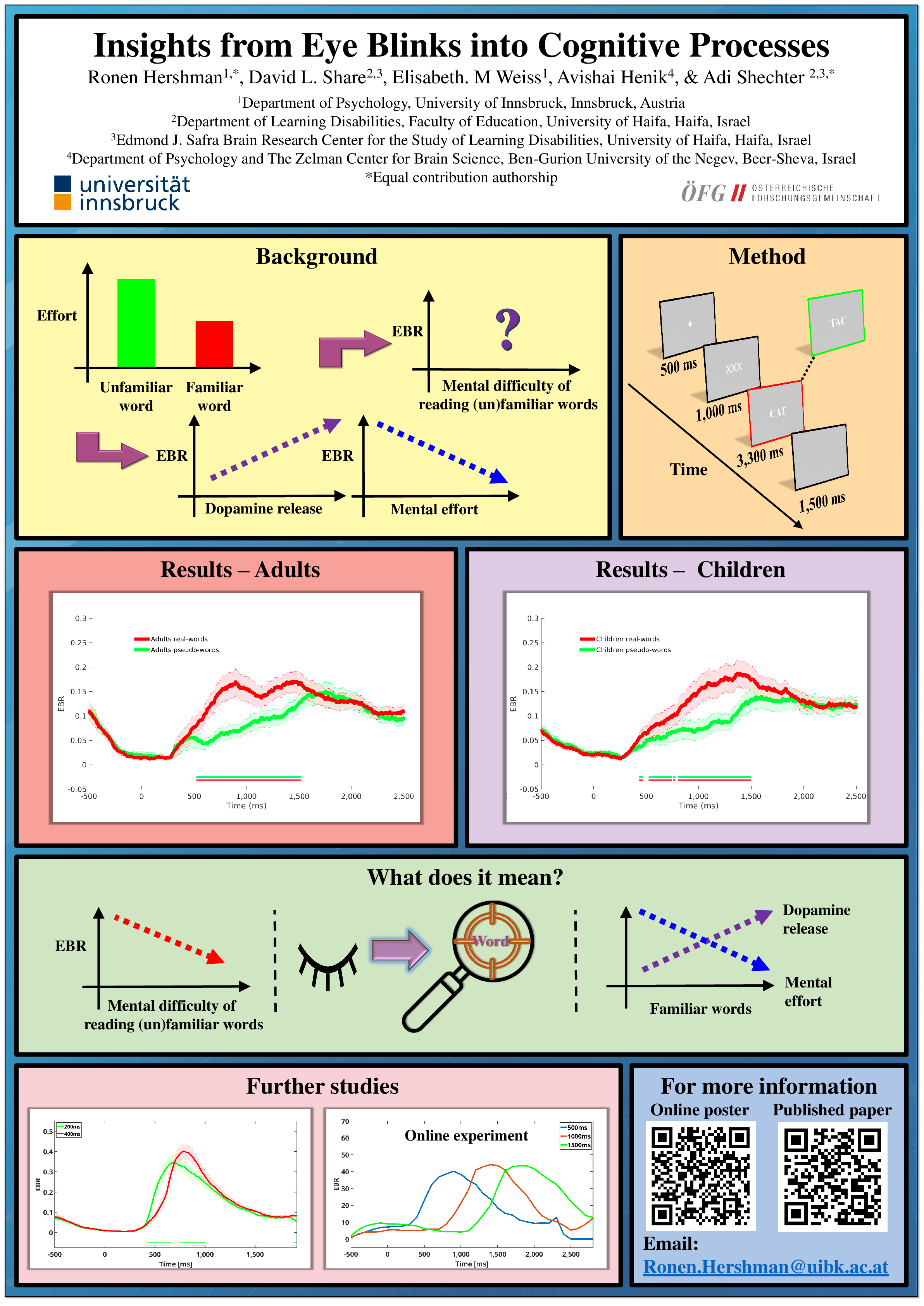
Ronen Hershman is a Research Fellow at the Department of Clinical Psychology I, University of Innsbruck. He specializes in cognitive psychology research with a focus on pupillometry, eye movements, and cognitive control mechanisms. His work primarily investigates numerical processing and conflict resolution using Stroop task paradigms. His research interests center on: Cognitive control mechanisms in conflict tasks Pupillometry as an indicator of cognitive effort Numerical cognition and processing Eye movement patterns in cognitive tasks Development of methodological tools for pupillometry analysis Hershman's publications demonstrate a consistent focus on cognitive conflict paradigms, particularly Stroop task variations, with an emphasis on temporal analysis of pupillary responses. His methodological work includes developing CHAP, an open-source pupillometry analysis software that has become a significant contribution to the field. He has taught courses including Research Seminar, Specific Clinical Research Methods, and specialized seminars on pupillometry and eye movement methodologies. His teaching portfolio includes both graduate and undergraduate level instruction in statistics and research methods.
Stefan Rass is a full Professor at Alpen-Adria-Universität Klagenfurt (AAU), with additional affiliation at Johannes Kepler University Linz (JKU). He holds the academic title Univ.-Prof. (Universitätsprofessor) and possesses advanced degrees including PD (Privatdozent), Dipl.-Ing. (Diplom-Ingenieur), and Dr. (Doctor). His research spans multiple institutions and projects, with a focus on security and risk management through game theory applications. Professor Rass's research interests center around Security and Risk Management, Decision and Game Theory for Security, Security Infrastructures (including Key Distribution and Management, PKI, and Authentication), Unconditional and network security, Applied Quantum Cryptography, and Complexity Theory and Statistics in Security. His work bridges theoretical computer science with practical security applications, particularly in quantum networks and critical infrastructure protection. His recent publications demonstrate a strong trend toward interdisciplinary security research, combining game theory with quantum cryptography, robotics security, and AI-powered penetration testing. The articles reveal increasing focus on practical applications of theoretical security concepts, with notable work in quantum networks, deniable encryption techniques, robotics security benchmarking, and AI-assisted security testing. His research shows consistent evolution from theoretical foundations toward real-world implementation challenges. Professor Rass leads multiple ongoing research projects including Machine Learning for Risk Management, Safe and Secure Robotic Systems Engineering (SEEROSE), Simulation and analysis of critical network infrastructures in cities (ODYSSEUS), and security for cyber-physical value networks Exploiting smaRt Grid systems (synERGY). These projects, primarily funded by FFG (Austrian Research Promotion Agency), demonstrate his leadership in securing critical infrastructure and developing next-generation security frameworks.