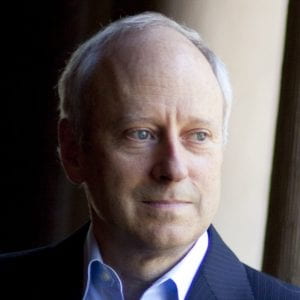
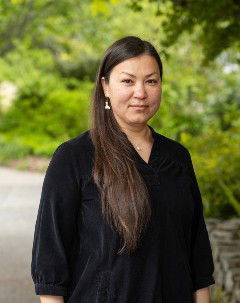
Elisabeth Enoksen serves as an Assistant Professor at the Department of Teacher Education and Outdoor Studies, Norwegian School of Sport Sciences, where she teaches in bachelor's programs for outdoor education, health and nature guiding, physical education teacher training, and part-time outdoor education studies. Her educational background includes: Master's degree from NIH (Norwegian School of Sport Sciences) in 2014 Dr. Enoksen's research centers on learning outdoor leadership and integrating Indigenous Sami perspectives into outdoor education. She investigates how traditional Sami knowledge systems, particularly reindeer herding practices, create culturally rich learning environments in nature-based education. Her work emphasizes the pedagogical applications of friluftsliv (outdoor life) across primary education, health contexts, and diverse environmental settings including winter, coastal, and forest landscapes. Analysis of her 2018-2024 publications reveals a dominant focus on Indigenous knowledge systems within outdoor education, with recurring themes of Sami cultural revitalization through place names, reindeer herding as pedagogical practice, and decolonizing approaches to nature-based learning. Her scholarship consistently bridges theoretical frameworks with practical applications in leadership development, environmental education, and culturally responsive teaching methodologies.
Bronwyn Wood is an Associate Professor at the School of Education , Victoria University of Wellington. She specializes in education policy , citizenship education , and youth sociology , with a focus on social sciences education and youth politics . Her work examines democratic education in superdiverse schools, ethical challenges in participatory research, and resistance to neoliberalism in teacher education. Current Projects: Civic potential of climate mobility (2022–2024, HUMANE-CLIMATE), Critical Times: Producing the global graduate in a pandemic (2021–2024). Grants: Half-truths, lies, and hoaxes (2024–2026, Victoria University of Wellington), Social Sciences assessment programme (2023–2026, University of Otago). Scientific Awards : Royal Society Te Aparangi Early Career Research Excellence Award (2019) Early Career Excellence Award (2016) Postgraduate Student Essay competition winner (2010) Teaching : Courses include Education Policy and Practice (2024–2025), Youth, Society and Education , and Contemporary Education Policy . Supervises research on topics like single mothers’ navigation of education systems and climate policy in local communities .
Jared Coleman is an Assistant Professor of Computer Science at Loyola Marymount University. He holds a Ph.D. in Computer Science from the University of Southern California and both a B.S. and M.S. in Computer Science from California State University Long Beach. Previously, he worked as a Member of Technical Staff (MTS) at Aerospace Corporation. Education: Ph.D. in Computer Science, University of Southern California B.S. & M.S. in Computer Science, California State University Long Beach Research Interests: Cooperative multi-agent systems Distributed and decentralized computing Online algorithms Distributed ledger technology Internet of things (IoT) Artificial intelligence and large language models Language revitalization, particularly Owens Valley Paiute Community Engagement: Member of the Big Pine Paiute Tribe of the Owens Valley Active in revitalizing the Owens Valley Paiute language
Dr. Leilani Sabzalian (Alutiiq) is an Assistant Professor at the University of Oregon within the College of Education and Critical and Sociocultural Studies in Education department. She co-directs the Sapsik'wala Teacher Education Program and serves on Oregon's American Indian/Alaska Native State Advisory Committee . Education : PhD in Critical and Sociocultural Studies (2015) MEd in Educational Leadership (2003) BA in Educational Studies (2002) Her research focuses on: Indigenous education Native feminist theories Curriculum studies Teacher training for anticolonial practice Elementary social studies reforms She has published extensively on decolonizing K-12 curricula, including her 2020 Outstanding Book Award (AERA) and 2019 book Indigenous Children's Survivance in Public Schools . Her recent Google Scholar articles (2025-2023) explore: Indigenous futurities in curriculum Relational knowledge systems Language revitalization in education Colonial dynamics in outdoor learning Selected scientific awards: 2021 Williams Council Fellowship 2020 AERA Outstanding Book Award 2019 Oregon Indigenous Educator of the Year Multiple dissertation and publishing fellowships As an advisor, she mentors students through: The Sapsik'wala Program Collaborative projects with Oregon's Office of Indian Education Professional development for implementing Tribal History/Shared History curriculum
Paolo Frascà is an Assistant Professor, Teaching Stream in the Department of Italian Studies at the University of Toronto's Faculty of Arts & Science. He serves as the Coordinator of ITA250 & ITA350 Language Courses and is actively involved in multiple academic initiatives across the university. His work spans across three primary domains of scholarship and teaching, with significant contributions to Italian language pedagogy, Italian-Canadian studies, and sexuality and gender studies. Dr. Frascà earned his Hon. BA, MA, and PhD all from the University of Toronto, demonstrating his deep connection to the institution where he now teaches. His educational trajectory at U of T has prepared him for his multifaceted role as both educator and researcher within the Canadian academic landscape. His research focuses on three interconnected areas: Italian language pedagogy , where he develops sociocultural and experiential approaches to teaching Italian language and culture; Italian-Canadian studies , particularly examining the histories, languages, and cultural production of the Italian-Canadian community; and sexuality and gender studies , with specific attention to Queer theories and the Italian gay liberation movement of the 1970s. His scholarship frequently explores the intersections between these fields, particularly the relationship between migration and queerness. Frascà's publications reveal a consistent commitment to interdisciplinary scholarship that bridges language education, cultural studies, and social justice. His work spans from sociolinguistics and dialectology to analyses of queer representation in Italian cinema and literature. He frequently employs innovative methodologies, including photo essays and collaborative interdisciplinary projects, to examine migration, mobility, and cultural identity, with a particular focus on subverting crisis narratives attached to global migration. 2024 Outstanding Achievement Award, Faculty of Arts & Science, University of Toronto 2024 Jackman Scholars-in-Residence, Jackman Humanities Institute & Victoria College 2024 Emerging Project Grant, Queer and Trans Research Lab 2024 Arts & Science Experiential Learning Faculty Fellowship 2024 Explore Grant, Social Sciences and Humanities Research Council of Canada 2023 Insight Grant, Social Sciences and Humanities Research Council of Canada As a community-oriented educator, Frascà oversees numerous experiential and cultural activities through his role as Language Coordinator. He serves on the Steering Committee and as Affiliated Faculty at the Mark S. Bonham Centre for Sexual Diversity Studies and co-leads the Global Languages Initiative. His commitment to social justice is evident in his integration of discussions on equity and decolonization into his courses, reflecting his belief that language education should address broader societal issues. Frascà is actively involved with several research initiatives, including co-directing projects at the Frank Iacobucci Centre for Italian-Canadian Studies focused on Indigenous-Italian-Canadian Connections and Queer Italian-Canadian Artists. He also contributes to the Endangered Language Alliance of Toronto and the Centro Interuniversitario di Ricerca Queer, demonstrating his commitment to linguistic diversity and queer scholarship. His work documenting rare dialects still spoken in Toronto has received media attention, highlighting the linguistic diversity of the city's Italian-Canadian community.
Karolina Rosiak is an Assistant Professor at the Department of Celtic Languages and Literatures, Faculty of English, Adam Mickiewicz University in Poznań. Her work focuses on Polish migrants' interactions with the Welsh language and culture, examining language revitalization, sociolinguistic perceptions, and Celtic-Polish connections. BA (2004), MA (2006), PhD (2010) in Celtic Studies from Poznań Postgraduate studies in Contemporary International Migrations (2021) Research areas span Welsh language revitalization , language ideologies , migrant language acquisition , and Celtic literary traditions . Her work analyzes Welsh language socialization , neo-speaker communities , and polish-welsh cultural relations . Recent publications explore demographic impacts on minority languages , phonetic misperceptions , and literary translation dynamics . Awards include multiple Erasmus+ grants for Welsh language research. Guest reviewer for journals like International Journal of Multilingualism and Ethnography Editor-in-Chief of Studia Celtica Posnaniensia Conference organizer for Poznań Celtic Studies events
Immaculada Fàbregas-Alégret is a Professor at Université Bretagne Sud, where she serves as Director of the Heritage and Creation in Text and Image (HCTI) research unit. Her academic career spans over four decades, including a French doctorate (1998) and HDR (2013) in Romance Languages and Literatures, with a focus on Catalan and Occitan philology. Key roles: Director of HCTI, Permanent collaborator at Pompeu Fabra University's IULA, Vice-President of the French Association of Catalanists Research focus: Her work bridges Catalan verbal morphology, sociolinguistic codification, and cross-cultural studies between Catalonia and Brittany. She has pioneered studies on linguistic truncation in Spanish and Catalan while examining parémiology in medieval Catalan and Occitan texts. Publications overview: 15+ years of research on Catalan neology, linguistic standardization, and intercultural dialogues Academic service: Active in language policy through CNU memberships and CAPES jury roles, with organizational leadership in international Catalanist colloquia.
Jean-Marc Serme serves as Assistant Professor in Indigenous Studies and US Studies at the University of Western Brittany (UBO), France. He is affiliated with the Heritage and Creation in Text and Image (HCTI, EA 4249) research laboratory and acts as Delegate for North America at IdA-Brest, the local branch of the Institute of the Americas. Serme's research explores the Hawaiian language revitalization movement in the context of sovereignty struggles. He investigates how Hawaiian language immersion schools, when integrated into public education, create confrontations between knowledge systems. This work connects educational practices with broader social and cultural dynamics, reshaping epistemologies and fostering innovation in Indigenous and non-Indigenous educational methodologies. His publication record demonstrates a consistent focus on Indigenous studies, particularly Hawaiian and Chamoru communities. Key themes include language revitalization, sovereignty movements, educational equity, and the interplay between cultural preservation and state systems. His work spans historical, political, and sociolinguistic analyses, highlighting tensions between legal frameworks and lived inequalities. Within HCTI, Serme leads the research project “Structures and systems in the Americas” alongside Marie-Christine Michaud. This project examines Indigenous resistance, urban Indigenous identities, and the structural systems shaping the Americas, contributing to decolonial scholarship and educational innovation.
Nicole Brabant is a Saskatchewan-born, Vancouver-based Cree Métis artist and educator affiliated with Emily Carr University of Art + Design as a Lecturer. She holds an MFA from the University of British Columbia and has previously worked as a Curatorial Assistant at the Mackenzie Art Gallery and as an instructor in Art, Art History, Cultural Studies, and English at universities in Regina and Vancouver. Research Interests: Exploration of Indigenous language preservation through text-based prints Impact of colonialism on intergenerational cultural knowledge transfer Genealogical research and family archives Integrating traditional and contemporary techniques in Print Media, Drawing, and Media Arts Artistic Themes: Her works like astum (come here) and kiya (you) focus on Indigenous language revitalization, particularly Michif and Cree, while projects like Real Indian Hair critique colonial representation through personal and cultural symbols. Earlier series like NW Resistance examine historical Indigenous resistance movements. Collaborative Projects: Recently facilitated youth-led digital media art programs at the UBC Museum of Anthropology and Leave Out Violence BC, emphasizing community engagement and cross-generational dialogue.
Michael Sandel serves as the Anne T. and Robert M. Bass Professor of Government at Harvard University, teaching political philosophy. He is globally renowned for his free online course "Justice," viewed by tens of millions worldwide, and for his influential books on democracy, ethics, and markets translated into over 30 languages. His work critically examines moral challenges in modern society through accessible public engagement. Sandel's research spans democracy, ethics, and justice across historical and contemporary contexts. He investigates the moral limits of markets, bioethics, human rights, public law, religion in politics, and technology governance. His scholarship employs historical and normative methods to advocate for revitalizing democratic citizenship through reasoned public discourse about the common good, emphasizing that "we need to rediscover the lost art of democratic argument." Honors include: Membership in the American Academy of Arts and Sciences Invitation to deliver the Tanner Lectures on Human Values at Oxford University He previously served on the President’s Council on Bioethics, contributing to national bioethics policy. Sandel maintains an active advising role for Harvard graduate students as part of his professorship, though specific advisees aren't listed in the source. His research is supported through Harvard's institutional funding and public engagement initiatives, including freely accessible course materials that function as global educational resources.
Soile Päivikki Hämäläinen is a Postdoctoral Fellow at the Regional Knowledge Center for Children and Youth, North (RKBU North) within the Faculty of Health Sciences at UiT The Arctic University of Norway. Her work bridges indigenous knowledge systems with contemporary healthcare approaches, focusing on cultural practices as pathways to wellbeing in Northern Norway. Dr. Hämäläinen's research interests center on indigenous health knowledge systems, particularly examining Sámi yoik as embodied health knowledge and its applications in wellbeing practices. Her work explores Kven cultural identity formation, minority mental health, and the intersection of traditional healing practices with modern healthcare systems. She investigates how cultural preservation contributes to psychological resilience among minority communities, with special attention to the experiences of Kven/Norwegian-Finnish youth navigating identity in contemporary Norwegian society. Analysis of her recent publications reveals a consistent focus on decolonizing research methodologies and centering indigenous knowledge systems. Her work demonstrates how traditional practices like yoik serve as embodied health knowledge that transcends Western biomedical frameworks. There's a clear trajectory toward participatory, community-driven research that empowers minority communities to shape their own narratives and wellbeing approaches. Dr. Hämäläinen is actively involved in the KASUTA project ("to grow up"), which investigates the needs of youth with Kven/Norwegian-Finnish background when accessing educational and mental health services. She collaborates extensively with Anita Salamonsen and other researchers across multiple projects focused on minority mental health and cultural identity. Her research takes place within UiT's Regional Knowledge Center for Children and Youth, North (RKBU North), which serves as a hub for interdisciplinary collaboration between researchers, healthcare providers, and community members working to improve child and youth mental health services in Northern Norway with particular attention to indigenous and minority populations.
Ekaterina Zmyvalova is a Postdoctoral Researcher at the Department of Economics, Geography, Law and Tourism (EJT) at Mid Sweden University (MIUN) . Holding a PhD, her work focuses on indigenous rights , particularly Sámi communities in Russia, with expertise in language rights in education , human rights under conflict , and Arctic legal frameworks . Education: Doctor of Philosophy (PhD) from Umeå University (2024 thesis on Sámi language rights). Her research spans legal analysis of Sámi educational policies , impacts of the Ukraine war on indigenous groups , and maritime rights of Arctic communities . Publications in journals like Arctic Review on Law and Politics and edited volumes address indigenous language preservation and state-indigenous legal tensions . She contributes to Arctic governance through symposium organization and policy critique. Recent articles examine 2024 Polar Law Symposium participation, 2023 asylum cases for Sámi activists, and 2022-2020 studies on educational implementation barriers and maritime rights . Her work combines qualitative field research with policy-oriented legal scholarship , emphasizing indigenous pedagogy , cross-border rights , and cultural autonomy under geopolitical stress .
Tetyana Dzyadevych serves as Assistant Professor in the Russian Department at Grinnell College, specializing in contemporary Ukrainian and Russian cultural production from the late Soviet period through the post-Soviet era. Her research interrogates how literature and visual arts shape political identities and national consciousness in Eastern Europe, with particular emphasis on decolonization processes and epistemological frameworks within cultural texts. Ph.D. in Slavic Studies, University of Illinois at Chicago (2019). Dissertation: "Political Subjectivities in Contemporary Russia and Ukraine through the Lens of Literature". Completed graduate concentrations in Gender and Women Studies and Central and Eastern European Studies. Ph.D. in Eastern Slavic Literatures, Maria Curie-Sklodowska University of Lublin, Poland. Dissertation: "The Russian Empire as Self and Other in the Literary Works of Adam Mickiewicz, Alexander Pushkin and Taras Shevchenko." Master of Cultural Studies (Honors), National University of Kyiv-Mohyla Academy, Ukraine. Field: Theory and History of Literature, Comparative Studies. Specialist Degree in Philology, Ukrainian State Pedagogical University. Field: Ukrainian and Russian Languages and Literature. Her scholarly work bridges Russian/Ukrainian literary analysis , postcolonial theory , and visual culture studies , examining how artistic production navigates imperial legacies and constructs new political subjectivities. Current projects include monograph research on post-Soviet literary responses to political transformation ( Voices of Political Revival ) and edited collections addressing nostalgia in Eastern European arts. Her methodological approach combines close textual reading with cultural anthropology to reveal how aesthetic forms mediate historical trauma and identity formation. Recent publications demonstrate escalating focus on Ukrainian decolonization narratives , indigenous language politics in Russia , and gendered representations of historical violence . She employs comparative frameworks across Russian, Ukrainian, and Central European contexts while increasingly incorporating feminist and postcolonial lenses. Her work on Crimea and Soviet propaganda films reveals how cultural artifacts serve as battlegrounds for competing historical memories and political claims. Professor Dzyadevych teaches courses on contemporary Ukrainian culture, Soviet/Russian film propaganda, and advanced Russian language, while organizing the Eastern European Film Club to foster campus engagement with the region's cinematic heritage. Her active research agenda suggests ongoing scholarly contributions to understanding cultural politics in times of geopolitical rupture.
Peter Adds is a Teaching Professor in Te Kawa a Māui - School of Māori Studies at Victoria University of Wellington, where he has worked since 1984. His primary tribal affiliation is to Te Āti Awa in Taranaki, and his academic background combines anthropology and archaeology with deep knowledge of Māori culture and history. Professor Adds earned his MA (Hons) from the University of Auckland. His academic journey has focused on Māori Studies, with particular attention to Indigenous knowledge systems, Treaty of Waitangi issues, and Māori cultural heritage. His research interests span Māori heritage, Māori history, Māori culture, Māori archaeology, Treaty of Waitangi, and Treaty settlements. Professor Adds explores how Indigenous knowledge systems interact with Western academic frameworks, particularly examining threshold concepts in Māori Studies education. His work addresses the challenges of applying Western educational theories to Indigenous knowledge contexts and investigates the decolonizing potential of Māori perspectives, including in areas like Māori atheism as a decolonizing project. He has also contributed significantly to understanding New Zealand's early settlement history and archaeological sites like Wairau Bar. Professor Adds' publications reveal a consistent focus on Māori epistemology, Treaty education, and Indigenous methodologies. His work demonstrates how Māori Studies functions as a transformative discipline that challenges Western academic paradigms while creating space for Indigenous knowledge. Recent publications increasingly address contemporary issues like religious change among Māori communities and the application of threshold concepts in Indigenous education. Professor Adds has received research funding including the "MAI ki Poneke" grant from the University of Auckland (2021-2022). While specific major awards aren't detailed in the available information, his sustained contribution to Māori Studies over nearly four decades represents significant scholarly recognition. As an educator, Professor Adds supervises Masters and PhD students and serves on advisory committees. His teaching portfolio includes courses on contemporary Māori society, Māori customary concepts, and the peopling of Polynesia. He has developed innovative approaches to student engagement, such as the Te Kawa a Māui Atlas project, which involves students in creating a digital cultural atlas of Māori Studies. His research on Māori student transitions into Māori Studies has informed teaching practices that better support Indigenous students. Professor Adds maintains strong connections with his iwi, Te Āti Awa ki Taranaki, serving on their committee since 2019. His work bridges academic scholarship with community engagement, particularly in areas of Treaty education and Māori cultural revitalization.
Dr. Tatiana Degai is an Assistant Professor in the Department of Anthropology at the University of Victoria, Canada. Her work integrates Indigenous knowledge systems with academic research, focusing on the North-Pacific/Arctic regions and the Itelmen People of Kamchatka. Expertise: Indigenous research methodologies, ethics, community-engaged research, language revitalization, and sustainability in northern climates. Courses Taught: ANTH 306 (Indigenous Storytelling Traditions), ANTH 318 (Ethnographic Research Methods), ANTH 333 (Indigenous Visions on Sustainability), ANTH 370 (Indigenous Languages and Cultures), ANTH 483 (Arctic Anthropology). Her research emphasizes Indigenous data sovereignty, climate change resilience, and the co-production of knowledge through community collaboration. She applies Indigenous storywork approaches to center Indigenous epistemologies in addressing geopolitical, linguistic, and environmental challenges. Dr. Degai's publications highlight interdisciplinary efforts in sustainability, cultural preservation, and Arctic governance. She collaborates with Indigenous knowledge holders across Siberia, the Pacific Northwest, and Arctic regions to advance decolonized research frameworks.