Timothy M. Hospedales is a Professor of Artificial Intelligence at the Institute of Perception, Action and Behaviour within the School of Informatics at the University of Edinburgh . He also serves as VP AI and Head of Samsung AI Research Centre Europe . His research focuses on efficient and robust AI , emphasizing meta-learning , lifelong transfer-learning , and domain adaptation in both probabilistic and deep learning frameworks. Applications span computer vision , vision and language , reinforcement learning for robotics , and finance . Professor at University of Edinburgh (2020–present) ELLIS Fellow (2021) Head of Samsung AI Research Europe (2020–present) Founding Director of Applied Machine Learning Lab at QMUL (2012–2016) His work includes pioneering contributions to meta-learning , few-shot learning , and self-supervised methods , with notable awards such as the Best Paper Prize at ICML AutoML 2018 and Best Student Paper at ICPR 2018 . He has co-authored 15+ recent papers on topics like Vision-Language Models , Medical AI Fairness , and Diffusion Model Optimization . He served as Program Co-Chair for BMVC 2018 and AAAI 2022 , and authored a book on Visual Adaptation in the Deep Learning Era (2022). Co-Chair, BMVC 2018 Guest Editor, IET CV Special Issue (2016) Keynote Speaker at TASK-CV Workshop (ECCV 2016) Special Issue on Fewer Labels (IEEE PAMI 2020) His leadership extends to organizing workshops like the Learning-to-Learn Workshop at ICLR 2021 , Meta-Learning Workshop at NeurIPS 2020 , and Domain Generalisation Workshop at ICLR 2023 . Current projects include Meta-Omnium (CVPR 2023) for general-purpose meta-learning and MetaAudio (ICANN 2022) for few-shot audio classification benchmarks.
Rajeev Alur is the Zisman Family Professor in the Department of Computer and Information Science at the University of Pennsylvania, leading the School of Engineering and Applied Science. He is the Founding Director of the ASSET Center for Trustworthy AI and a member of the PRECISE Center. His research focuses on formal methods for system design, integrating AI, cyber-physical systems, and machine learning with logical reasoning to ensure safety in autonomous systems. Alur has held leadership roles in major NSF projects like ExCAPE and has directed the Embedded and Multi-Scale Systems (EMBS) program. His research interests span formal verification, temporal logics, programming abstractions, and synthesis techniques. Notable contributions include the development of Nested Words (visibly pushdown languages), streaming string transducers, and tools like AutomataTutor for education. He has advised over 60 PhD students and postdocs, many of whom now hold academic and industry leadership positions. Alur’s awards include the 2024 Knuth Prize and the 2016 Alonzo Church Award. His work on Verisig and compositional verification of neural networks has advanced safety-critical AI applications. He teaches foundational courses like CIS 2620 and develops educational tools, emphasizing both theoretical rigor and practical impact. Key projects include the ASSET Center’s focus on trustworthy AI, integration of logical specifications in reinforcement learning, and formal verification of closed-loop systems with neural components. His publications span over 350 papers, with recent work addressing neurosymbolic learning, security in large language models, and efficient neural network verification.
Prof. Roger Wattenhofer is a Full Professor at the Department of Information Technology and Electrical Engineering, ETH Zurich, Switzerland, and Deputy head of the Computer Engineering and Networks Lab. He holds a doctorate in Computer Science from ETH Zurich (1998) and has held positions at Brown University and Microsoft Research before returning to ETH. His research focuses on distributed computing, wireless networks, and algorithmic systems design, with contributions to Byzantine agreement protocols, blockchain technologies, and neural network architectures. He teaches courses such as Distributed Systems and Computational Thinking. Education: Ph.D. in Computer Science (ETH Zurich, 1998). Research interests include distributed systems, network algorithms, and the intersection of machine learning with distributed computing. His work spans both theoretical foundations and practical implementations, addressing challenges in fault tolerance, consensus mechanisms, and algorithmic efficiency. Recent publications explore topics like adversarial robustness in voting systems, privacy in reinforcement learning, and generative music models. He actively contributes to open-source frameworks and benchmarks for neural algorithmic reasoning.
Judy Hoffman is an Associate Professor in the College of Computing at Georgia Institute of Technology, with a joint appointment in the School of Interactive Computing and affiliation to the Machine Learning Center . She received tenure in April 2025 after joining Georgia Tech as an Assistant Professor. Her research focuses on enabling AI systems that are reliable, fair, and resource-efficient. PhD in Electrical Engineering and Computer Science (2016, UC Berkeley) Postdoctoral Fellowships at Stanford (2017) and UC Berkeley (2018) Former Research Scientist at Facebook AI Research Her work intersects computer vision and machine learning , with specialization in domain adaptation , adversarial robustness , and algorithmic fairness . She has published over 40 peer-reviewed articles, including the award-winning DeCAF (ICML 2024 Test of Time Award) and co-founded Women in Computer Vision (2015), which has sponsored ~40 women annually to premier conferences. ICML Test of Time Award (2024) NSF CAREER Award (2022) PAMI Distinguished Young Researcher (2023) Samsung AI Researcher of the Year (2021) Dr. Hoffman has served as Program Chair for CVPR 2023, Associate Editor for T-PAMI (2021-2023), and co-organizer of workshops at major AI conferences. She has delivered over 70 invited talks and contributes to open-source projects like cycada_release (567 stars) and lsda (47 stars).
Roberto Navigli is a Full Professor in the Department of Computer, Control and Management Engineering at Sapienza University of Rome, where he leads the Sapienza NLP Group. He has held academic positions at Sapienza since 2007, progressing from Researcher to Associate Professor, and now Full Professor. Navigli is internationally recognized for his groundbreaking work in multilingual natural language processing and computational semantics. His research spans multiple areas within Natural Language Processing, with a particular focus on multilinguality , lexical semantics (Word Sense Disambiguation and induction), sentence-level semantics (Semantic Role Labeling and Semantic Parsing), and Large Language Models . As the leader of the Minerva LLM project, he pioneered the development of the first pretrained LLM in Italian. His creation of BabelNet, the largest multilingual encyclopedic computational dictionary covering 271 languages and about 14 million concepts, represents a landmark achievement in computational linguistics. Professor Navigli's recent publications demonstrate a strong focus on advancing multilingual capabilities of language models, addressing challenges in semantic understanding across languages, and developing robust evaluation frameworks. His work on Italian LLM optimization, lexical ambiguity in machine translation, and cross-lingual safety gaps reflects his commitment to building more accurate and reliable language technologies that work effectively across diverse linguistic contexts. AAAI Fellow (2025) EurAI Fellow (2024) ELLIS Fellow (2024) ACL Fellow (2023) Outstanding Paper Awards at ACL 2024, ACL 2023, and NAACL 2021 Best Resource Paper Award at ACL 2022 Prominent Paper Awards from the Artificial Intelligence Journal (2023, 2017) META Prize 2015 for BabelNet Professor Navigli has successfully secured substantial research funding, including two prestigious ERC Grants (MultiJEDI ERC Starting Grant 2010-2016 and MOUSSE ERC Consolidator Grant 2017-2023, totaling around 3 million euros), PI of PRIN 2017 and PRIN 2020 projects (overall 1.4 million euros), and a Google Focused Research Award (around 300k$). He has mentored over 30 PhD students, many of whom have gone on to successful careers in academia and industry. His leadership extends to major international conferences, serving as General Chair of ACL 2025 and Program Co-Chair of ACL-IJCNLP 2021. As the director of the Sapienza NLP Group and co-leader of the Transversal Project on Large Language/Multimodal Models in the FAIR (Future Artificial Intelligence Research) project, Professor Navigli oversees a vibrant research ecosystem focused on advancing the state-of-the-art in natural language understanding across languages. His spinoff company, Babelscape, translates academic research into practical applications for industry.
Xavier Serra is a Full Professor at the Department of Engineering at Universitat Pompeu Fabra (UPF), Barcelona. He is the founder and director of the Music Technology Group (MTG), and leads the UPF-BMAT Chair on AI and Music. He also coordinates the Master in Sound and Music Computing and serves as President of the Phonos Foundation. His research focuses on audio signal processing, sound and music computing, and computational musicology, emphasizing open science and open innovation. Education: BSc in Biology, University of Barcelona (1981) Master in Music, Florida State University (1983) PhD in Computer Music, Stanford University (1989) Research Interests: Audio Signal Processing Data-Driven and Knowledge-Driven Methodologies Music Information Retrieval Cultural Music Analysis (e.g., Carnatic/Turkish/Andalusian Music) Music Education Technology Notable Projects: CompMusic (ERC Advanced Grant, 2010-2017): Multicultural computational music analysis Open datasets: Freesound, Saraga, FSD50K Technologies: Reactable, Vocaloid, Essentia API Recent Trends in Articles: Focus on AI-driven audio processing (neural fingerprints, generative models), cross-cultural music analysis, and explainable music difficulty estimation. Awards: ERC Advanced Grant (2010) for CompMusic Project. Labs/Teams: Director of MTG, Phonos Foundation, and UPF-BMAT Chair. Active in open-source projects and international collaborations.
Gail E. Kaiser is a Professor of Computer Science and the Director of the Programming Systems Laboratory (PSL) in the Computer Science Department at Columbia University. She has been with Columbia University since 1985, becoming a full Professor in 1998. Prof. Kaiser's research spans software engineering, program analysis, software testing, and software security, with recent focus on addressing challenges in AI/ML systems testing and security. Prof. Kaiser received her PhD in Computer Science from Carnegie Mellon University in 1985 and her ScB in Computer Science and Engineering from MIT in 1979. Her dissertation at CMU was titled "Semantics for Structure Editing Environments" under advisor Nico Habermann, and at MIT she completed "Automatic Extension of an Augmented Transition Network Grammar for Morse Code Conversations" under advisor Al Vezza. Prof. Kaiser's research interests primarily focus on software engineering following a systems building approach, with recent emphasis on static and dynamic program analysis techniques to improve software reliability and security. Since 2005, she has investigated testing "non-testable" programs, particularly in machine learning, data mining, and scientific computing applications where traditional testing oracles are insufficient. She has developed novel techniques and tools for detecting bugs and verifying repairs in complex systems. Concurrently, she has worked on collaboration environments for computational scientists, creating knowledge sharing and domain-aware environments to support scientific workflows. Prof. Kaiser's recent publications demonstrate a strong focus on the intersection of software engineering and artificial intelligence. Her work addresses critical challenges in testing AI systems, code understanding through deep learning, vulnerability detection, and educational tools for computational thinking. There's a clear evolution from traditional software engineering topics toward AI/ML applications, with particular emphasis on metamorphic testing for non-testable systems, code similarity analysis, and educational applications. Prof. Kaiser has received numerous prestigious awards throughout her career: Distinguished Journal Award (10 Years) from 18th IEEE International Conference on Software Testing, Verification and Validation (ICST), April 2025 Best Research Paper Award at 24th IEEE International Conference on Source Code Analysis & Manipulation (SCAM), October 2024 Distinguished Reviewer Awards for ASE 2024 and FSE 2024 ACM SIGSOFT Distinguished Paper Award for "CONCORD: Clone-aware Contrastive Learning for Source Code", July 2023 Best Student Paper Award at ICCE 2021 Multiple ACM SIGSOFT Distinguished Paper Awards dating back to 2014 Presidential Young Investigator in Software Engineering and Software Systems from NSF (1988-1993) Prof. Kaiser has chaired Columbia's doctoral program since 1997 and served on editorial boards including IEEE Internet Computing and as a founding associate editor of ACM Transactions on Software Engineering and Methodology. Her lab has been continuously funded by major agencies including NSF, NIH, DARPA, ONR, NASA, and numerous companies. Current grants include significant NSF funding for secure containers architecture, learning semantics of code for software assurance, and finding semantic security bugs. As Director of the Programming Systems Laboratory (PSL), Prof. Kaiser leads research in software systems, program analysis, and software testing. The lab has developed numerous tools and techniques for software reliability and security, with recent focus on challenges in AI/ML systems. Her work bridges theoretical foundations with practical applications, often resulting in deployable tools that address real-world software engineering challenges.
Karthik R. Narasimhan is a Professor at Princeton University's School of Engineering and Applied Science in the Department of Computer Science. Previously, he earned his PhD from MIT under Regina Barzilay and served as a visiting research scientist at OpenAI during 2017-18. His research focuses on the intersection of language and decision-making, building autonomous agents that learn from both experience and human knowledge. His research spans multiple high-impact areas including language agents (Text-DQN, CALM, ReAct, Tree of Thoughts), reinforcement learning (h-DQN, Multi-Objective RL), and AI safety (Toxicity in ChatGPT, DataMUX). He has developed critical datasets and benchmarks such as WebShop, InterCode, SWE-bench, and SILG that have become standard evaluation tools in the field. Current work emphasizes agent capabilities, software engineering automation, and multimodal interaction. His publication trends show strong focus on practical agent deployment (SWE-agent, Tree of Thoughts), safety evaluation (Probing AI Safety), and efficiency improvements (DataMUX). Recent work increasingly addresses real-world challenges in software engineering, security, and human-AI collaboration through rigorous benchmarking. Co-author of foundational GPT (2018) paper Key developer of Text-DQN (2015), CALM (2020), ReAct (2022), Tree of Thoughts (2023) Creator of influential benchmarks: WebShop (2022), SWE-bench (2023), InterCode (2023) He actively advises students through Princeton's computer science program, with research supported by multiple grants focused on autonomous agent development and language-based decision systems. His GitHub repositories (nlp-datasets, text-world-player) demonstrate strong community engagement in open-source research tools. Current projects include advancing language agent capabilities through Reflexion (2023) and Tree of Thoughts (2023) frameworks while addressing critical safety and efficiency challenges.
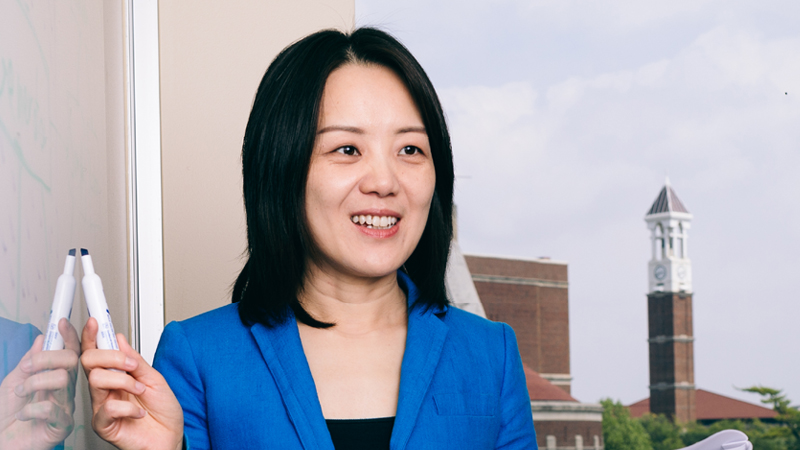
Lin Tan is a Professor of Computer Science at Purdue University , holding the Mary J. Elmore New Frontiers Professorship . She joined Purdue in 2019 after serving as a Canada Research Chair and associate professor at the University of Waterloo. She is an ACM Distinguished Member and IEEE Senior Member . Education: PhD in Computer Science, University of Illinois Urbana-Champaign BS in Computer Science and Technology, Zhejiang University Research Interests: Professor Tan’s research lies at the intersection of software engineering , artificial intelligence , and security . Her work focuses on software-AI synergy , software dependability , defect detection & repair , and software text analytics . She leverages machine learning and natural language processing to enhance software reliability, and conversely uses software techniques to improve the dependability of AI systems. Her recent projects include building binary foundation models (Nova), evaluating large language models for code generation and repair, and developing interactive debugging tools that reduce debugging time by one-third. She also explores robot task planning with LLMs and automated front-end development . Awards & Honors: Best Paper Award Finalist, ICRA 2025 ELATES Fellow, 2024-2025 ACM SIGSAC Distinguished Paper Award, CCS 2024 J.P.Morgan AI Faculty Research Awards (2020, 2021, 2022) ACM SIGSOFT Distinguished Paper Awards (ASE 2020, MSR 2018, FSE 2016) Canada Research Chair (2017) Ontario Early Researcher Award (2015) NSERC Discovery Accelerator Supplements Award (2015) Google Faculty Research Awards (2010, 2014) IEEE Micro Top Picks (2006) Advising & Funding: Professor Tan currently advises eight PhD students and has graduated 20+ PhD and Master’s students now thriving in academia (York University, Concordia University, University of Alberta) and industry (Microsoft, Meta, Amazon, Google). Her group is generously supported by NSF , Meta/Facebook Research Awards , J.P.Morgan AI Faculty Awards , and NSF REU programs. Labs & Teams: She leads the Software Reliability & AI Lab at Purdue, recruiting postdocs, PhD, MS, and undergraduate researchers year-round. Lab interests span binary recovery , LLM-based program repair , testing deep-learning libraries , and data-free model extraction .
Stephen Marglin is the Walter S. Barker Professor of Economics at Harvard University, Department of Economics. His research critically examines foundational assumptions of economics, particularly how economic theories marginalize community and cultural values. He explores labor-surplus economies, cost-benefit analysis, and macroeconomic adjustment processes. His work challenges mainstream economics through publications like The Dismal Science: How Thinking Like an Economist Undermines Community (2008). Marglin also advises governments and international agencies on economic policy, including recent tax reform work in Puerto Rico. His teaching integrates standard economics with critical perspectives, focusing on modernity's cultural impact and globalization. Research interests include development economics, economic theory, and the interplay between economic systems and cultural values. His articles span Keynesian theory reinterpretation, labor dynamics, and critiques of neoclassical economics. Marglin collaborates with his spouse, anthropologist Frédérique Apffel-Marglin, blending economic and cultural analyses. Personal interests include gardening, animal husbandry, and family life. He has held roles such as adviser to governments and institutions, emphasizing policy relevance. His academic contributions are translated into multiple languages, reflecting global influence.
Rafał Jończyk is an Assistant Professor at the Department of Pragmatics, Faculty of English, Adam Mickiewicz University in Poznań, Poland, where he conducts research at the intersection of psycholinguistics, affective neuroscience, and bilingualism. His work primarily investigates how emotional processing differs between native and second languages using neurophysiological methods, particularly EEG. With a Ph.D. in English Linguistics from Poznań (2015) and postdoctoral experience at Pennsylvania State University, he has established himself as a leading researcher in bilingual emotional processing. His research interests span Affective Neuroscience , Experimental Pragmatics , Psycholinguistics , Bilingualism and Emotion , and the Neurophysiology of Creativity . His methodology heavily relies on EEG to examine language processing, with particular focus on emotional language comprehension and production in bilingual contexts. His work has demonstrated how bilinguals process emotional content differently in their native versus second languages, revealing reduced sensitivity to negative content in the second language. Jończyk's research program has evolved from early work on hemispheric specialization for emotional words to sophisticated EEG studies of emotional anticipation and metaphor processing in bilinguals. His most recent work explores hyperscanning methodologies to study real-time bilingual communication and the neural correlates of creative thinking in bilingual contexts. His publications show a clear progression from foundational studies of emotional word processing to increasingly complex investigations of emotional communication in naturalistic contexts. Cognitive Neuroscience Society Post-doctoral Fellows Award (2018) START scholarship for most talented young Polish scientists (2018) Scholarship from the Minister of Science and Higher Education (2020) Travel Grant Award for International Symposium on Bilingualism (2013) As Principal Investigator, Jończyk leads two major National Science Center projects examining psychophysiological correlates of affective language processing in bilinguals (2016-2018) and neurophysiological correlates of emotional speech production in bilingualism (2021-2025). He also participates in multiple international collaborations including NSF-funded research on divergent thinking in engineering education. His editorial roles include Topic Editor for Brain Sciences and Associate Editor for Applied Psycholinguistics, reflecting his standing in the field. He teaches courses in Psycholinguistics, Emotions in Social Communication, and Creativity and Language at the university level.
Daniel E. Ho holds multiple prestigious positions at Stanford University: William Benjamin Scott and Luna M. Scott Professor of Law Professor of Political Science Professor of Computer Science (by courtesy) Senior Fellow, Stanford Institute for Economic Policy Research Senior Fellow, Stanford Institute for Human-Centered Artificial Intelligence Faculty Fellow, Center for Advanced Study in the Behavioral Sciences He serves on the National Artificial Intelligence Advisory Commission (NAIAC), as Senior Advisor on Responsible AI at the U.S. Department of Labor, and as a Public Member of the Administrative Conference of the United States (ACUS). Ho earned his J.D. from Yale Law School and Ph.D. from Harvard University, completing a clerkship with Judge Stephen F. Williams on the U.S. Court of Appeals for the District of Columbia Circuit. His research bridges artificial intelligence, law, and public policy with emphasis on: Regulatory governance frameworks for AI systems Fairness and bias mitigation in algorithmic decision-making Environmental enforcement using satellite imagery and computer vision Methods for estimating racial disparities without direct demographic data Legal AI reliability and statutory research systems Analysis of his 2025 publications reveals a consistent focus on practical AI governance tools addressing real-world regulatory challenges. Key themes include developing benchmarks for legal applications, mitigating hallucination in legal AI tools, and creating systems for statutory research. His work demonstrates strong integration of technical AI methods with policy implementation, particularly in environmental enforcement and fairness assessment. As Director of the Regulation, Evaluation, and Governance Lab (RegLab), Ho leads interdisciplinary research partnerships with government agencies. While specific grant details aren't provided, RegLab's operational model indicates substantial research funding for policy-relevant AI projects. No student advisees are mentioned in available materials. Ho's leadership extends to national advisory roles where he shapes federal AI policy through evidence-based recommendations, particularly regarding environmental protection and civil rights enforcement mechanisms.
Kimon Fountoulakis is an Associate Professor at the University of Waterloo. His research focuses on Machine Learning on Graphs and Numerical Optimization, with a strong emphasis on algorithmic methods for graph-structured data. He holds a Ph.D. from The University of Edinburgh (2015), an M.Sc. from The University of Edinburgh (2010), and a B.Sc. from Athens University of Economics and Business (2009). His work spans theoretical foundations and practical applications in graph algorithms, optimization, and machine learning. Research interests include graph neural networks, local graph clustering algorithms, and algorithmic reasoning. His contributions address challenges in graph representation learning, message-passing architectures, and scalable optimization methods. Notable themes in his publications include improving counting abilities of vision-language models, analyzing graph convolutions, and developing flow-based clustering techniques with statistical guarantees. His work often bridges theory and practice, with applications in network analysis, pandemic containment strategies, and high-performance computing. While no specific grants or awards are listed, his research demonstrates significant contributions to graph-based machine learning and optimization. He maintains a research group at the University of Waterloo, with a focus on developing open-source tools and frameworks for graph algorithms. His lab’s work emphasizes local graph clustering methods and their scalability in real-world networks.
Andreas Geiger is a Professor and Head of the Department of Computer Science at the University of Tübingen, Germany. He leads the Autonomous Vision Group (AVG) within CyberValley and is a core faculty member of the Tübingen AI Center. His roles also include PI in the ML in Science Excellence Cluster and the CRC Robust Vision, as well as ELLIS Fellow and coordinator of the ELLIS PhD program. He specializes in machine learning models for computer vision, robotics, and autonomous systems, with applications in self-driving cars, VR/AR, and scientific document analysis. Educational background: While not explicitly detailed, his positions imply a Ph.D. in Computer Science or related field. His work spans interdisciplinary collaborations with institutions like ETH Zürich, Microsoft, and the University of Bonn. Research focuses on 3D scene understanding, Gaussian splatting, generative models, and reliable autonomous systems. Notable contributions include the KITTI dataset and foundational work in neural radiance fields. Awards include the Sage 10-Year Impact Award (2024), ERC Starting Grant (2019), and IEEE PAMI Young Researcher Award (2018). Key projects include the Scholar Inbox paper recommender platform, ReSim (reliable world simulation), and advancements in 3D scene generation (e.g., UrbanCAD, PrITTI). His lab maintains a strong focus on open-source tools and datasets, such as the CARLA Route Generator. Grants and funding include support from Vector Stiftung (MINT innovation program) and EU initiatives like the ML in Science Cluster. His team collaborates internationally, with recent work presented at CVPR, SIGGRAPH, and NeurIPS.
David Duvenaud is an Associate Professor at the University of Toronto , holding a Canada Research Chair in Generative Models and a Schwartz Reisman Chair in Technology and Society . He is cross-appointed to the Department of Computer Science and Department of Statistical Sciences . A Sloan Research Fellow and founding member of the Vector Institute , his work bridges deep probabilistic models , AI safety , and scientific computing . PhD in Machine Learning (University of Cambridge, 2014) Postdoc in Hyperparameter Optimization (Harvard University, 2016) Co-founded Invenia (energy forecasting company) His research spans foundational Neural Ordinary Differential Equations (NeurIPS 2018 Best Paper) and Automatic Chemical Design (ACS Central Science 2018) to recent work on AGI governance (2025) and AI safety (2024). Key contributions include stochastic variational inference , implicit differentiation frameworks , and antisymmetrization layers for quantum Monte Carlo. Recent publications (2024-2025) focus on systemic existential risks from AI , many-shot jailbreaking attacks , and epistemic uncertainty quantification . His group trains energy-based models with scalable MCMC samplers and develops invertible neural architectures (e.g., Residual Flows NeurIPS 2019). He also explores human-AI alignment through LLM Processes (NeurIPS 2024) and Sycophancy in Language Models (ICLR 2024). Canada Research Chair (2025) NSERC Grant (2025) Sloan Research Fellow (2021) Schwartz Reisman Chair (2021) Best Paper Award (NeurIPS 2018) Distinguished Paper Award (ICFP 2021) His students include James Requeima , Jesse Bettencourt , and Raymond Douglas . He teaches courses on Statistical Methods for Machine Learning and Differentiable Inference . Current work (2025) investigates systemic human disempowerment through incremental AI capabilities and sabotage risk mitigation via hyperparameter-aware evaluations.