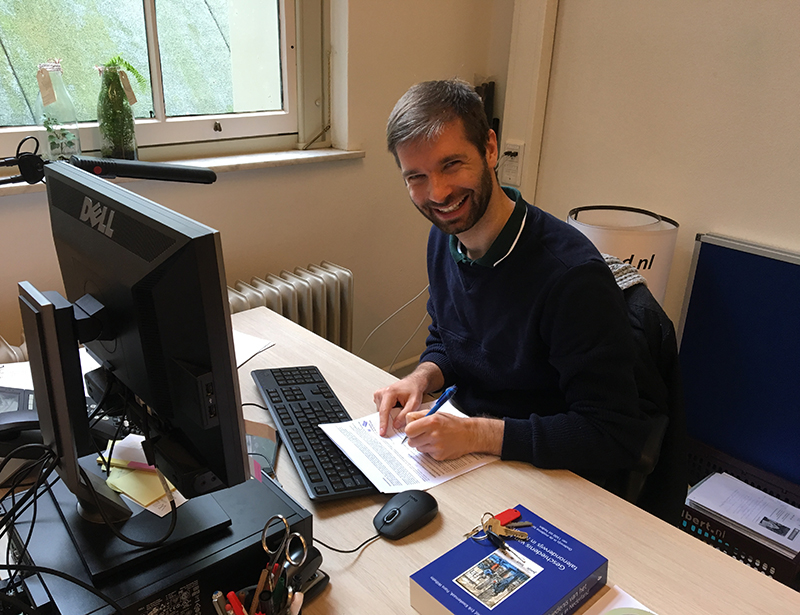
Michal Korenar is an Assistant Professor in Linguistics at the Department of Dutch Linguistics , Faculty of Humanities , University of Amsterdam. His research focuses on bilingualism, neuroplasticity, and second language acquisition, particularly how multilingual experiences affect brain structure and cognitive functions. Research Trends : Recent studies analyze subcortical neuroplasticity in multilinguals, neural adaptations in interpreters, and the cognitive benefits of language mixing. Key themes include the Dynamic Restructuring Model, code-switching effects, and structural brain changes related to bilingualism. Contact : m.korenar@uva.nl | +31 (0)20 525 4635
Henning Radke is a Lecturer at the University of Amsterdam (UvA), Faculty of Humanities, Department of German and Scandinavian Languages & Cultures. He works half-time for UvA teaching German as a foreign language and sociolinguistics, while also serving at the Germany Desk of the Duitsland Instituut Amsterdam (DIA), where he promotes Dutch-German academic exchange through scholarships and outreach programs. MA in European Languages (2013), Freie Universität Berlin BA in Dutch Philology and Communication Science (2010), Freie Universität Berlin His research focuses on multilingualism, language contact, and computer-mediated communication (CMC), particularly in diasporic contexts like the German-Namibian community. He investigates code-switching, non-standard varieties like Namdeutsch, and the role of digital platforms in preserving and evolving linguistic practices. His work spans Suriname, South Africa, and Ukraine, examining how language variation manifests across urban/rural and digital/face-to-face communication modes. Notable projects include the PHF teaching method (project-based learning, hybrid formats, flipped classroom) and studies on diaspora communities in Namibia and Suriname. He employs mixed-method approaches combining participant observation and CMC data analysis to explore sociolinguistic dynamics. DIA Scholarship Program development Student ambassador initiatives Preparatory workshops for Dutch students in Germany Henning also contributes to digital material development for German language education and is currently preparing a dissertation on German language variation in Namibia.
Prof. dr. Judith Rispens is a Professor in Dutch Linguistics at the Faculty of Humanities of the University of Amsterdam . Her research focuses on the intersection of language acquisition, statistical learning, and developmental disorders such as dyslexia and developmental language disorder (DLD). She employs experimental and neurocognitive methods, including ERP and MMN responses, to investigate how children and adults process language and acquire linguistic structures. Email: J.E.Rispens@uva.nl Office: Spuistraat 134, Room 417, Amsterdam Research interests include: Statistical learning mechanisms in language acquisition Neurocognitive processes in developmental dyslexia and DLD Second language learning (L2) and cross-linguistic studies Pragmatic abilities in multilingual exposure Computational modeling of language acquisition Her recent work explores how input consistency and speaker informativity influence word learning, with a focus on children with neurodevelopmental disorders. Publications span topics like morphological processing, grammatical proficiency, and the role of memory in language acquisition.
Arjen Versloot is a full-time Professor of Frisian Linguistics at the Faculty of Humanities , University of Amsterdam . His research focuses on historical linguistics, phonology, morphology, and sociolinguistics within Germanic languages, particularly Frisian, Old English, and their interactions with Dutch and other regional languages. Research Interests : Historical development of Frisian and Germanic languages Phonological and morphological constraints Language contact and bilingualism Dialectology and sociolinguistic variation Language policy and preservation Publications highlight comparative studies across Germanic varieties, phonological evolution, morphosyntactic analysis, and sociolinguistic impacts of multilingualism. His work spans corpus-based historical dialectology, computational modeling of language change, and interdisciplinary approaches to linguistic documentation. Contact: a.p.versloot@uva.nl
Prof. dr. M.A. Neerincx is a Professor at Delft University of Technology in the Faculty of Electrical Engineering, Mathematics and Computer Science, where he leads research in the Interactive Intelligence department. His work spans multiple interdisciplinary domains focusing on human-AI interaction, social robotics, and health informatics. His research focuses on: Human-Robot Interaction and Social Robotics Explainable AI and Inclusive Design Persuasive Technology and Behavior Change Health Informatics and Digital Health Interventions Human-AI Teaming and Collaborative Systems Cognitive Modeling and Memory Systems Neerincx's recent publications demonstrate a strong focus on ethical AI, human values in technology design, and practical applications in healthcare and emergency services. His work on human-agent teamwork, particularly around moral decision allocation and meaningful human control, has gained significant attention. In health applications, he explores digital interventions for smoking cessation, hypertension management, and cardiac health through conversational agents and social robots. His research combines technical innovation with deep consideration of psychological, social, and ethical dimensions. Through his editorial work for Interacting with Computers since 2011 and Mediamatica TU Delft since 2010, he has shaped scholarly discourse in human-computer interaction. His supervision of students like Albers, N. and Verhagen, R.S. has produced impactful research on human feedback in chatbot interventions and robot pedagogical interactions with children. His datasets reveal ongoing work in virtual coaching systems and robot-child interactions.
Pieter Jonker is a Professor in the Faculty of Mechanical Engineering, specializing in Biomechatronics & Human-Machine Control. His research spans artificial intelligence, trust in human-machine teams, and hybrid intelligence systems. Key research areas include Machine Learning and Reinforcement Learning for adaptive systems Trust calibration and human-AI interaction dynamics Negotiation algorithms and multi-agent systems Ethical frameworks for AI decision-making Publications from 2017–2025 highlight expertise in robotics, vision systems, and real-time optimization. Recent work focuses on trust modeling , negotiation strategies , and value-sensitive design in AI systems. Jonker’s contributions emphasize practical applications such as autonomous vehicles , smart wearables , and stress management partnerships . Media coverage includes public engagement on robotics and automation topics.
Dr. Ritu Manuvie serves as an Assistant Professor in the Department of Social Science at University College Groningen, University of Groningen. Her interdisciplinary research bridges climate policy, digital society, and human rights with a regional focus on India and the Netherlands, contributing to UN Sustainable Development Goals through critical analysis of global challenges. Her research centers on climate migration governance, disinformation ecosystems, and nation-state dynamics, employing mixed methodologies including computational linguistics and qualitative social analysis. Key themes include EU-India human rights dialogues, generative AI's societal impact, and citizenship discourses in climate-vulnerable regions, reflecting her commitment to decolonial and justice-oriented scholarship. Recent publications demonstrate a clear trajectory toward AI-driven analysis of digital misinformation and climate-induced migration patterns, combining technical innovation with socio-political critique. This work reveals growing emphasis on cross-border governance challenges and technological mediation of human rights issues in South Asia and Europe. Her scholarly recognition includes: ELSA - North Netherland Lab (2.2 million euro grant) ViS Teaching Grant (2022) Commonwealth Doctoral Scholarship (2011) Dr. Manuvie actively shapes academic discourse through conference organization (Social Movements Summit 2023, EU-India People's Summit 2021) and media engagement on geopolitical issues, including election interference analysis and India-Pakistan relations. Her collaborative projects with European institutions demonstrate significant grant acquisition capacity and interdisciplinary leadership.
Esther Wiersinga-Post is a Researcher at the University of Groningen 's Faculty of Medical Sciences , affiliated with the Perceptual and Cognitive Neuroscience (PCN) group. Her work spans interdisciplinary research in auditory neuroscience, pediatric behavioral development, and clinical rehabilitation. Research Interests : Vestibular and auditory function, tinnitus classification, pediatric behavioral disorders, cancer-related fatigue interventions, and urinary biomarker analysis. Methodological Expertise : Psychoacoustic metrics, thromboelastography, randomized controlled trials, Bland-Altman analysis. Her research output includes 41 publications with significant citations in Ear and Hearing , Noise & Health , and Physical Therapy . Key themes include: Hearing and Balance : Age-related hearing loss, semicircular canal function, tinnitus subtyping. Pediatric Health : Behavioral disorders in toddlers with language delays. Clinical Rehabilitation : Combined CBT and physical therapy for cancer fatigue. Recent collaborations focus on medical diagnostics and cross-disciplinary neuroscience applications.
Melissa Vos is an active Associate Professor at the University Medical Center Groningen, Department of Epidemiology, University of Groningen. Her research bridges psychiatric epidemiology and genetic methodology with clinical applications. Research Focus: Specializing in ADHD and neurodevelopmental disorders through the lens of life course epidemiology. Key methodologies include: Genetic epidemiology (polygenic scoring, familial aggregation) Advanced statistical modeling (multilevel, latent variable) Comorbidity analysis across psychiatric and somatic conditions Current work examines ADHD's metabolic/cardiovascular impacts, autism-gastrointestinal comorbidities, and adolescent psychopathology trajectories. Publication Trends: Recent 2024 output shows concentration on transdiagnostic psychopathology structures, genetic shared liability between neurodevelopmental and somatic conditions, and real-world manifestations of mental health vulnerabilities. Work appears in high-impact journals including Journal of Child Psychology and Psychiatry and Translational Psychiatry . Collaborations: Works extensively with Hartman CA, Snieder H, and Rommelse NNJ in large-scale population studies. Media engagement includes 2021 'Paper of the Month' on ADHD life course and 2020 Dutch-language academic vlog addressing ADHD persistence.
Maximilian Margolin is an Assistant Professor at the Rotterdam School of Management (RSM), Department of Accounting & Control. He joined RSM in September 2019 after completing his doctorate at WHU – Otto Beisheim School of Management, an MA in Accounting and Finance from the University of St. Gallen, and a BSc in Business Administration from the University of Mannheim. His research focuses on empirical management accounting , particularly examining incentives , performance measurement , and the role of cognitive flexibility in controller-manager collaboration. Recent work explores the integration of artificial intelligence (e.g., ChatGPT) in accounting education and assessment. Notable publications include studies on real-time feedback systems in performance contexts AI-driven accounting chatbots cognitive dynamics in business partnerships His work bridges traditional accounting principles with modern behavioral and technological challenges.
Kees van Noortwijk is an Associate Professor at the Erasmus School of Law , specializing in Law and Economics . His work bridges legal scholarship with computational methods, focusing on Legal Tech, information retrieval, and decision-making systems. Education: PhD in Legal Word Use (1995, Erasmus School of Law) Van Noortwijk’s research explores the intersection of Computer Science and Legal Informatics , with a particular emphasis on context-free grammars , legal citation metrics , and data governance . His publications reflect a strong focus on digital legal frameworks and intellectual property in the EU. Recent activities include lectures on Privacy and Data Governance (2021–2022) and contributions to open-access journals like the European Journal of Law and Technology . His work has been cited in disciplines spanning Decision-Making , Law , and Software Engineering .
Dr. Khiet P. Truong is an Associate Professor at the Centre for Language Studies, Radboud University, with a dual affiliation at the Human Media Interaction department, University of Twente. His research focuses on non-verbal speech communication (paralinguistics), voice technology, and enhancing human-machine interaction through affective computing and multimodal analysis. Specializes in laughter detection, prosodic synchrony, and affective state analysis Develops speech technologies for applications in mental health, education, and accessibility Active in academic service as Interspeech 2025 General Co-Chair and IEEE Transactions of Affective Computing Associate Editor His work bridges computational linguistics, social robotics, and speech processing, with recent publications on child-robot trust, laughter classification, and Dutch speech recognition systems.
Xavier G.L.V. Pouwels serves as Assistant Professor at the Health Technology & Services Research department within the TechMed Centre at the University of Twente. His academic work bridges health economics, medical technology assessment, and open science initiatives, with particular focus on cardiovascular disease modeling and cost-effectiveness analysis frameworks. His research spans Cost-Effectiveness Analysis , Health Care Economics , and Medical Decision Modeling , with significant contributions to cardiovascular interventions, albuminuria screening programs, and open-source health economic modeling tools. His work demonstrates strong integration of probabilistic analysis methods with clinical applications, particularly in cardiology and stroke prevention. Dr. Pouwels has developed influential open-science resources including the Probabilistic Analysis Check dashBOARD (PACBOARD) and educational materials for R programming in Health Technology Assessment. His publication trends show increasing focus on model validation frameworks, open-source economic modeling, and practical implementation of health technology assessment tools in clinical decision-making. h-index 10 (Scopus) 266 Citations (Scopus) His collaborative work includes significant contributions to ISPOR Special Interest Group reports and multi-institutional studies on disease modeling frameworks. Current activities focus on advancing open science practices within health care technology education and developing reusable disease modeling blueprints through expert consensus building. Dr. Pouwels leads the PACBOARD initiative for systematic validation of health economic models and contributes to open science education through Zenodo-hosted resources on R Markdown and open science principles. His work emphasizes transparency, reproducibility, and practical implementation of economic modeling in healthcare decision-making.
Stephan Smeekes is a Professor of Econometrics at the Department of Quantitative Economics, School of Business and Economics, Maastricht University. His research focuses on statistical analysis of time series data, blending econometrics, statistics, and data science. Specializing in modeling complex dynamic systems with multiple time series, he emphasizes uncertainty quantification using bootstrap techniques, applied to macroeconomics, finance, climate, environmental, and medical domains. He led significant projects including the NWO Veni project on Bootstrap Methods for Time-Varying Processes and NWO Vidi project on Inference for High-Dimensional Econometric Time Series. As a former member of the Dutch Young Academy (De Jonge Akademie), he contributes to interdisciplinary research and innovation. His teaching spans statistics, econometrics, and computational data science at both undergraduate and graduate levels. Smeekes develops open-source software like the bootUR R package for bootstrap unit root tests, desla for high-dimensional inference, and PAGFL for latent group structure estimation. His work bridges academic insight with real-world impact through collaborations across disciplines.
Edita Chvojka is a PhD Candidate in Methodology and Statistics at Utrecht University, affiliated with the Faculty of Social and Behavioural Sciences. Her research focuses on methodological issues in Structural Equation Modelling (SEM), particularly in longitudinal data analysis relevant to developmental sciences. She holds a master’s degree in Educational Psychology from Masaryk University and a research master’s in Psychological Methods and Philosophy from the University of Amsterdam. She was awarded the Bakala Foundation Scholarship Grant to support her studies in the Netherlands. Her expertise includes Structural Equation Modelling, Network Analysis, and Measurement Instrument Development. She has lectured at Masaryk University and contributed to evidence-based education policy in the Czech Ministry of Education. Her current research examines model and data characteristics affecting SEM’s model-fit measures, with applications in youth development studies. Key publications include studies on sexual objectification linked to internet addiction (2025), psychometric validation of depression assessments (2024), and methodological advancements in bias measurement using NLP (2024). She has also explored socio-emotional measurement in children (2021) and mental resilience during the pandemic (2021). Awards: Bakala Foundation Scholarship Grant (2021).