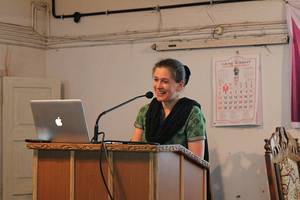
Prof. Dr. Heike Oberlin is Managing Director at the Department of Indology, Asia-Orient Institute, University of Tübingen. She was appointed adjunct professor in 2016 and honored as visiting professor at Sapienza University (Rome) for 2025. Her roles include Deputy Equal Opportunities Officer (DHV, 2024), University Council member (since 2021), and DFG Review Board leadership (2020-2024). Education: PhD in Indology (Würzburg, 2008) on Kūṭiyāṭṭam , habilitation (2013) in Tübingen Research: Focus on South Indian Sanskrit theater, Malayāḷam language/literature, palm-leaf manuscriptology, gender studies, digital humanities Her work bridges traditional Kūṭiyāṭṭam performance with academic research, including international workshops (2013-2016, German-Israeli Foundation-funded). Awards include Ernst Waldschmidt Prize (2008) , Erudite Scholar in Residence (2018) , and Gisela Bonn Prize (2019) for German-Indian relations. She established the Gundert Chair for Malayalam (2015) and co-edited Two Masterpieces of Kūṭiyāṭṭam (2019). Lectures and exhibitions highlight her interdisciplinary approach, linking theater to religious studies, digital archiving, and gender dynamics.
Benjamin Nagengast is Professor of Educational Psychology and Deputy Director of the Hector Institute for Empirical Educational Research at the University of Tübingen. His work focuses on educational psychology, quantitative research methods, and motivation theory, with a particular emphasis on academic self-concept, intervention programs, and causal analysis in educational settings. He previously served as co-director of the LEAD Graduate School & Research Network and head of the LEADing Research Center until June 2022. His research spans topics including: Educational effectiveness and policy evaluation Motivational dynamics and value-belief interactions Multilevel modeling of educational outcomes Personality-achievement correlations Longitudinal studies of developmental trajectories While not explicitly listing scientific awards, his publications highlight methodological innovations and large-scale empirical studies. He mentors students through collaborative research projects, though individual advisees aren't named. His work frequently appears in top journals like Psychological Science and Journal of Educational Psychology , with recent articles examining detracking effects, twin comparison processes, and the interplay between self-concept and achievement. He maintains active collaborations with institutions like the University of Oxford and University of Jena.
Mark Pletcher, MD, MPH is a Professor in the Department of Epidemiology & Biostatistics at the University of California, San Francisco (UCSF) School of Medicine. In 2023, he became Chair of the UCSF Department of Epidemiology and Biostatistics. He is an epidemiologist and general internal medicine physician whose research focuses on clinical decision-making and policy relevant to primary care and prevention, particularly in cardiovascular disease prevention. Dr. Pletcher earned his M.D. from the University of California, San Francisco in 1998 and completed his residency at UCSF School of Medicine. He also completed UCSF's Diversity, Equity, and Inclusion Champion Training in 2019. His research interests span cardiovascular disease prevention with particular focus on early life causes of atherosclerosis, prevention of coronary heart disease, clinical decision-making regarding preventive medications, screening for subclinical cardiovascular disease, interventions to improve blood pressure control, and the use of technology to enhance health outcomes. He has led numerous studies on marijuana use and cardiovascular health, blood pressure management, and digital health interventions. His work often leverages large cohort studies like the Coronary Artery Risk Development in Young Adults (CARDIA) study. Analysis of his recent publications reveals a strong focus on digital health interventions for hypertension management, cardiovascular risk assessment in young adults, liver disease applications of artificial intelligence, and the impact of pandemic policies on mental and physical health outcomes. His research increasingly incorporates machine learning and large language models for clinical decision support, particularly in gastroenterology and cardiology applications. Dr. Pletcher leads the UCSF CTSI's Informatics and Research Innovation Program and has been Principal Investigator on numerous NIH and PCORI-funded projects including the Health eHeart Study and the PCORnet Blood Pressure Control Laboratory. His research funding spans cardiovascular disease prevention, digital health interventions, and health policy evaluation. He mentors students, fellows, and junior faculty members, and teaches clinical research methods. His laboratory work focuses on the Health eHeart Alliance and related digital health initiatives that leverage consumer technologies for cardiovascular research.
Aaron Elkins serves as an Associate Professor and Director in the Management Information Systems Department within the Fowler College of Business at San Diego State University. His research bridges artificial intelligence, information systems, and social impact initiatives with a primary focus on combating human trafficking through technological solutions. His educational background includes: PhD from the University of Arizona (2011) with dissertation research on vocalic markers of deception for automated emotion detection systems BS in Information Systems from San Diego State University (2003) Elkins' research program centers on developing machine learning and knowledge management frameworks to identify human trafficking victims through analysis of online advertisements and communication patterns. His work integrates natural language processing with criminology to detect deception markers and trafficking indicators in digital content, particularly examining emoji usage and linguistic patterns in illicit online ads. This interdisciplinary approach creates practical tools for law enforcement and social service agencies operating in high-stakes environments. His 2018-2020 publications demonstrate consistent focus on AI-driven victim identification, with increasing sophistication in analyzing unstructured text data from trafficking operations. The research trajectory shows progression from emoji-based deception detection to comprehensive knowledge management systems for victim identification, reflecting growing technical depth and real-world applicability. No scientific awards were documented in the provided materials. Details regarding student advising and research funding mechanisms were not specified in the available information. He maintains active affiliation with the James Silberrad Brown Center for AI Research, where his work contributes to the center's mission of developing socially impactful artificial intelligence applications through cross-disciplinary collaboration.
Mauro Camiz serves as a Tenure-Track Researcher (Assistant Professor) in the Department of Modern Literature and Culture within Sapienza University of Rome's Faculty of Humanities. He teaches core Germanic Philology courses including Introduction to Germanic Philology and Germanic Philology Master's Degree/IA , scheduled for the second semester of the 2025-26 academic year across multiple degree programs in Linguistics, Modern Letters, and Cultural Studies. Academic Background: PhD in Historical Linguistics of Eurasia, University of Macerata (2008-2011) Master's Degree in Linguistics, Sapienza University of Rome (2006) Postdoctoral Fellowships in Germanic Philology, Sapienza University of Rome (2012-2015) Research Focus: Camiz specializes in medieval Germanic textual traditions with dual expertise in Anglo-Saxon and Scandinavian domains. His work examines religious poetry development, interdialectal contact phenomena, and translation practices in early medieval contexts. Key investigations include Bede's Historia Ecclesiastica reception, Benedikts saga source criticism, and anthroponymic patterns in literary texts. Recent expansions address Danish-Italian literary exchanges in early modernity, particularly Machiavelli's Belfagor translations. Scholarly Output Trends: Publications from 2008-2021 reveal sustained engagement with Old English and Old Norse primary sources, evolving from manuscript linguistics toward comparative cultural analysis. The trajectory shows increasing methodological sophistication in narrative theory and translation studies, with recent works demonstrating expanded temporal scope into early modern Scandinavian adaptations of Italian literature. Awards & Recognition: No scientific awards or fellowships were documented in the source materials. Academic Service: Camiz manages comprehensive course operations through Google Classroom platforms since 2020-21, maintains structured examination protocols in the Faculty of Humanities building (Ed. CU003), and provides appointment-based office hours. His teaching spans undergraduate and graduate levels across five distinct degree programs.
Federica Perazzini serves as a Researcher in the Department of Modern Literature and Culture at Sapienza University of Rome, teaching advanced English literature courses for the Master's Degree in Modern Philology through seminar formats under the PNRR ARmaME project where she acts as Principal Investigator. Her instruction covers Shakespearean tragedies (Hamlet, Macbeth) and modern/postmodern works (Mrs Dalloway, The Hours) with Italian-language delivery while maintaining English textual analysis. Her research traverses English literary history from the eighteenth century to contemporary media, specializing in Gothic literature's evolution across adaptations like Penny Dreadful, gender/queer theory investigations of female agency and deviance, fashion studies examining clothing as identity performance, and trauma theory applications. She integrates digital humanities methodologies with traditional close reading to analyze cultural representation and historical context, particularly evident in her computational studies of eighteenth-century phraseology and vestimentary symbolism. Perazzini's scholarly output demonstrates consistent thematic development across publications, with recent works exploring the intersection of Gothic tropes and science fiction, vestimentary identity construction in Defoe's narratives, and intersectional trauma in Victorian adaptations. Her research reveals a methodological preference for interdisciplinary frameworks that bridge literary analysis with cultural history and digital tools. As Principal Investigator of the PNRR ARmaME project, she directs research dissemination activities while supervising Master's students through course-based instruction. Though formal PhD advisees aren't documented, her teaching includes comprehensive assessment structures with ongoing assignments and written examinations requiring original textual analysis in English.
Nadia Cannata is a Full Professor of Italian Linguistics and Philology at Sapienza University of Rome, where she is affiliated with the Department of European, American and Intercultural Studies within the Faculty of Humanities. She has held this position since 2008 and maintains regular office hours for students. Her academic career spans multiple prestigious institutions including Oxford University, University of Reading, and Harvard University's Villa I Tatti. Her educational background includes a D.Phil from Oxford University (1991) and a summa cum laude Degree in Literature from the University of Rome "La Sapienza" (1985). Professor Cannata specializes in Renaissance studies with research interests spanning Italian linguistics, philology, book history, vernacular and Neo-Latin literature, and the interrelations between linguistic theory and fine art in the early Renaissance. Her work particularly focuses on orality and written records in Early Modern Europe, with a significant emphasis on medieval epigraphy in the vernacular. She has pioneered the EDV (Italian Medieval Epigraphy in the Vernacular) project, creating a comprehensive database of vernacular inscriptions from 9th-15th century Italy. Her recent work has expanded into language museum studies, where she directs the EUROTALES project - a Museum of the Voices of Europe that explores linguistic heritage across the continent. Professor Cannata's publications show a clear trajectory from traditional philological scholarship toward interdisciplinary approaches that bridge historical linguistics with digital humanities and museum studies. Her recent work increasingly focuses on the relationship between language, cultural identity, and public engagement, with particular attention to how linguistic heritage can be presented to diverse audiences through innovative museum practices. Villa I Tatti Fellowship, Harvard University (1997-98) Leverhulme Trust Fund Scholar (2001-2002) British Academy Post-Doctoral Fellow (1991) Premio Sapienza Ricerca (2011) British Academy Grant (2014) Istituto Lorenzo de' Medici Award (2016) Professor Cannata has secured significant research funding, including €16,000 for the "Letture e riscritture dell'antico" project (2014-15) and €10,000 for the "Museum and Languages" international conference. She was one of the curators for the exhibition "I libri che hanno fatto l'Europa" (The Books That Made Europe) at the Accademia Nazionale dei Lincei in Rome (2016). As director of the EUROTALES project, she leads a collaborative initiative involving multiple international partners to create a museum of European linguistic heritage that combines scholarly research with public engagement. Her work bridges traditional philological scholarship with contemporary digital humanities approaches, making significant contributions to our understanding of linguistic history and cultural identity formation in Europe. Currently, Professor Cannata directs the EUROTALES project, which has established her as a leading expert in language museum studies, culminating in her co-authorship of "Language Museums and the Display of Intangible Cultural Heritage" (Routledge, 2020), the first comprehensive study of language museums worldwide. She serves on the advisory boards of several international peer-reviewed journals including The Italianist, Critica del Testo, and Studj Romanzi, and is a member of the peer review college of MIUR, the Italian Ministry of Education, Universities, and Research.
Mehmet Çiçek is a Professor at Gaziantep University's Faculty of Education in the Department of Turkish Language Education. He holds a doctorate in Linguistics from Université de Reims Champagne-Ardenne (France) and has served in various academic and administrative roles since 1992. Doctorate: Linguistics, Université de Reims Champagne-Ardenne (1995-1999) Master's: Linguistics, Université de Reims Champagne-Ardenne (1993-1995) Licence: Atatürk University, Turkey (1987-1991) His research focuses on Turkish language education, semiotics, discourse analysis, and cross-linguistic studies. Recent work examines textual analysis, cultural representation in language learning, and pedagogical methodologies. His publications span Turkish language structure, semiotic systems, and educational applications. Articles include analyses of adjective placement, plural/possessive morphology, and discourse in literary and visual contexts. Prof. Çiçek has supervised multiple graduate theses on Turkish pedagogy, cultural transfer in language teaching, and discourse analysis. He has held leadership roles including Faculty Dean and Department Chair at Gaziantep University. He contributes to academic governance as a board member and serves on examination juries for professorship and doctoral applications.
ÖNDER ÇANGAL is an Associate Professor at Gaziantep University Faculty of Education Department of Turkish and Social Sciences Education since 2024. He previously served as Associate Professor (2022-2024) and Lecturer (2015-2022) at Gaziantep University Turkish Language Teaching Center. His international experience includes teaching Turkish at Yunus Emre Institutes in Belgrade (2021), Algeria (2019-2020), and Bosnia (2012-2015), as well as Turkic studies at Emir Abdulkadir Islamic Sciences University (2019-2020). PhD in Teaching Turkish as a Foreign Language (Hacettepe University, 2016-2020) MSc in Turkish Language Education (Gazi University, 2011-2013) BSc in Turkish Language Teaching (Gazi University, 2007-2011) His research focuses on Turkish as a Foreign Language (TFL) pedagogy, digital language tools, cultural context in language learning, and technology integration in education. With over 27 articles and 20 book chapters, his work examines social media applications, grammar acquisition challenges, and specialized Turkish curricula for migrants and professionals. Scientific recognition includes the 2024 Ziya Gökalp Başarı Ödülü and 2022 Kurtuluş Bilim Ödülü . He designed online Turkish learning portals under national projects and developed cultural immersion programs for Serbian students. His publications analyze Turkish language teaching methods across 18 countries and address writing skill challenges for Syrian and Bosnian learners.
Prof. Dr. Anita Schilcher is a Professor of Didactics of German Language and Literature at the University of Regensburg, Faculty of Languages, Literature and Cultural Studies, Institute of German Studies. She has held this position since 2007 and also serves as Director of the Regensburg University Center for Teacher Education (RUL) since 2013. Her work focuses on German language and literature didactics, with particular emphasis on reading and writing promotion, children's and young adult literature, and teacher education. Her educational background includes: 1987: Abitur at the Gymnasium Pfarrkirchen 1987-1993: Studies for primary school teaching, Master's degree in German Literature with minors in Psychology and General Pedagogy 1992-1994: Preparatory service for primary school teaching 1997-2000: Doctorate in Didactics of German Language and Literature at the University of Passau 2007: Habilitation on writing didactics Prof. Schilcher's research interests span multiple areas of German didactics and language education. She has made significant contributions to the understanding of narrative competence, literary education, and the development of reading and writing skills in primary education. Her work on writing didactics has led to innovative teaching approaches that bridge theoretical understanding with practical classroom application. She has also conducted extensive research on children's and young adult literature, examining gender representation and the educational potential of popular culture texts. Her current research focuses on evidence-based reading promotion, teacher competencies, and the integration of media in literary education. Her recent publications reveal a strong focus on practical applications of educational research, particularly in developing and evaluating reading and writing promotion programs. She has been instrumental in large-scale projects like FiLBY (integrated reading promotion in Bavaria) and ELiS (evidence-based reading promotion in schools), which combine theoretical research with practical implementation in classrooms across Germany and Europe. Her work consistently bridges the gap between educational theory and classroom practice, with a particular emphasis on developing evidence-based teaching strategies that can be effectively implemented by teachers. Her scientific recognition includes: Karl-Heinz-Pollok Memorial Prize for her habilitation Prof. Schilcher has supervised numerous doctoral students, with completed dissertations covering topics such as ancient mythology in contemporary children's literature, linguistic-cognitive activation through teacher questions, narrative abilities in primary and secondary education, and oral competencies of teacher trainees. She has been involved in significant research grants including FALKO (subject-specific teacher competencies), FiLBY (integrated reading promotion in Bavaria), RESTLESS (Regensburg self-regulation training for reading and writing strategies), and ELiS (evidence-based reading promotion in schools), demonstrating her leadership in large-scale educational research initiatives. She leads the research network for "didactic-empirical writing research" (dieS) and is a member of the project team of ZSK Regensburg. Her work with the Regensburg University Center for Teacher Education (RUL) has positioned her as a key figure in shaping teacher education in Bavaria, particularly through her involvement in the development and implementation of the new primary school curriculum (LehrplanPlus).
Inge Zink is a Professor at the Faculty of Medicine, KU Leuven, affiliated with the Department of Neuroscience and the Experimental Oto-rhino-laryngology Research Group. She is also a member of the KU Leuven Brain Institute (LBI) and the Interdisciplinary Language Institute (LILI). Her research focuses on developmental language disorders, bilingualism, autism, and genetic variants like 16p11.2 and 22q11.2, with a strong emphasis on early diagnosis and intervention protocols. Unit: Experimental Oto-rhino-laryngology Research Group Membership: LBI, LILI, Biomedical Sciences Evaluation Committee Research Interests: Zink's work explores the intersection of language development, autism, and genetic disorders. She develops diagnostic tools such as the PITTO protocol for bilingual children with developmental language disorders and investigates environmental factors influencing language acquisition in autistic children. Her projects use EEG-based neural envelope tracking and deep phenotyping to analyze language and cognitive trajectories. Publications: Recent studies highlight her focus on bilingual assessment accuracy, genetic variants' impact on language, and gesture comprehension as a screening tool. Her research spans clinical applications and interdisciplinary collaborations. Teaching: Zink contributes to courses in clinical speech therapy, developmental linguistics, and social-communicative skills training, integrating her research into educational frameworks.
Michail Vlachos serves as a Lecturer in the Department of Management of Technology and Entrepreneurship (MTE) within the College of Management of Technology (CDM) at EPFL (École Polytechnique Fédérale de Lausanne). His current status is listed as "Invited guest," indicating a non-permanent academic appointment focused on teaching within the MTE-ENS unit. His research and pedagogical expertise centers on practical applications of Data Science and Machine Learning , with specialized focus areas including Recommender Systems , Generative AI , and Natural Language Processing . He instructs a comprehensive hands-on course covering regression, classification, clustering, dimensionality reduction, text analytics, and neural networks through Python-based coding sessions, emphasizing real-world implementation of techniques like chatbots and graph analytics.
Stefan Dimov Stefanov is a Senior Lecturer at the Department of English and American Studies, Faculty of Modern Languages, St. Cyril and St. Methodius University of Veliko Turnovo. His academic profile spans multiple disciplines with particular focus on contemporary cultural phenomena shaped by digital technologies. Dr. Stefanov's research interests include: Remix Culture and Digital Authorship Translation Technology and CAT Tools Comparative Literature and Cultural Studies Media Studies and Digital Humanities Philosophy of Language and Contemporary Discourse His scholarly work demonstrates consistent engagement with how digital environments transform creative processes and cultural production. Dr. Stefanov has published extensively on remix practices, examining how digital technologies facilitate new forms of creative reuse while challenging traditional copyright frameworks. His research also explores intersections between language, power, and contemporary social issues, with publications addressing pandemic responses, linguistic politics, and cultural debates. Dr. Stefanov has participated in significant research projects including 'Comparativistics in the Age of Globalization: Perspectives and Challenges' (2014), which investigated connections between Slavic and Anglophone literatures in the post-totalitarian period, transnational dynamics in Slavic literatures, and comparative studies of travel literature about Eastern Europe and the Balkans. His 2024 monograph 'Authorship in Remix Culture: The Creative Reuse of Found Material' provides comprehensive analysis of contemporary remix practices. Other notable publications address the Bulgarian reception of Jerzy Liebert, specialized translation tools, and philosophical implications of remix culture from environmental and ethical perspectives. Dr. Stefanov's academic profile reflects commitment to interdisciplinary scholarship bridging literary studies, digital humanities, translation studies, and cultural criticism, consistently addressing the evolving relationship between technology, creativity, and cultural expression in the 21st century.
Dr. Muhammad Aziz serves as a Senior Lecturer in Arabic at Yale University, where he integrates innovative pedagogical methodologies to enhance students' linguistic, communicative, and cultural competencies. His academic profile is deeply rooted in Middle Eastern Studies, with 80% of his work dedicated to the field, and he actively participates in national conferences on Arabic language instruction while contributing to community organizations including the National Yemeni Arab American Association (NAYA) and The Yemeni American News. His educational foundation includes: Ph.D. in Near Eastern Studies, University of Michigan (2004) M.A. in Near Eastern Studies, University of Michigan (1998) M.A. in Middle Eastern & North African Studies, University of Michigan (1997) B.A., Sanaa University, Yemen (1986) Aziz's research spans Arabic language pedagogy, Yemeni literature, Islamic theology, and Sufism, with particular emphasis on Yemeni cultural identity and mystical traditions. His scholarly work bridges historical analysis of early Islamic texts with contemporary literary studies, examining how religious and cultural narratives shape modern Arabic expression across Yemeni, Egyptian, and broader Arab contexts. His publication trajectory from 2008-2021 reveals consistent focus on Yemeni Islamic history and Sufism, evolving from encyclopedia entries on medieval scholars to comprehensive studies of Yemeni proverbs and epistolary literature. Key thematic threads include the intersection of spirituality with literary production, historical documentation of Sufi movements in Yemen, and pedagogical approaches to advanced Arabic literacy. His academic distinctions include: Certified ACTFL OPI-Rater/Tester in Arabic (2009-2023) Great Books of Islamic Civilization Prize (1997) Professor Richard P. Mitchell Memorial Prize (1996) Fulbright Fellowship (1995-1997) Frederick W. Hilles Publication Fund (2011) While specific graduate advisees aren't documented, Aziz's grant history demonstrates sustained research support through the Fulbright Fellowship and Yale's publication fund, enabling his scholarly output on Yemeni Islamic heritage. His current translation project on Ahmad bin Alwân's medieval treatises continues this trajectory of bridging historical Islamic scholarship with contemporary academic discourse. Professionally, he engages through Yale's Council on Middle East Studies and maintains community leadership via NAYA and The Yemeni American News, reflecting his dual commitment to academic rigor and diaspora community development.
Ari Huhta is a Professor at the Centre for Applied Language Studies at the University of Jyväskylä. His research focuses on applied linguistics , language assessment , and second language acquisition , with particular emphasis on diagnostic and dynamic assessment frameworks in foreign language education. Active member of the Applied Language Studies and Language Campus follow-up groups Collaborates with institutions like the Finnish National Agency for Education and Research Council of Finland His work integrates language technology and educational evaluation to innovate assessments for L2 writing , reading , and speaking . Recent projects include AI-driven diagnostic tools and automatic speaking evaluation systems. Key collaborations span projects such as Dynamic Diagnostic Language Assessment and ‘Broken Finnish’ , examining societal gatekeeping in language proficiency. His publications address assessment validity , stakeholder involvement , and technological mediation in learning processes.