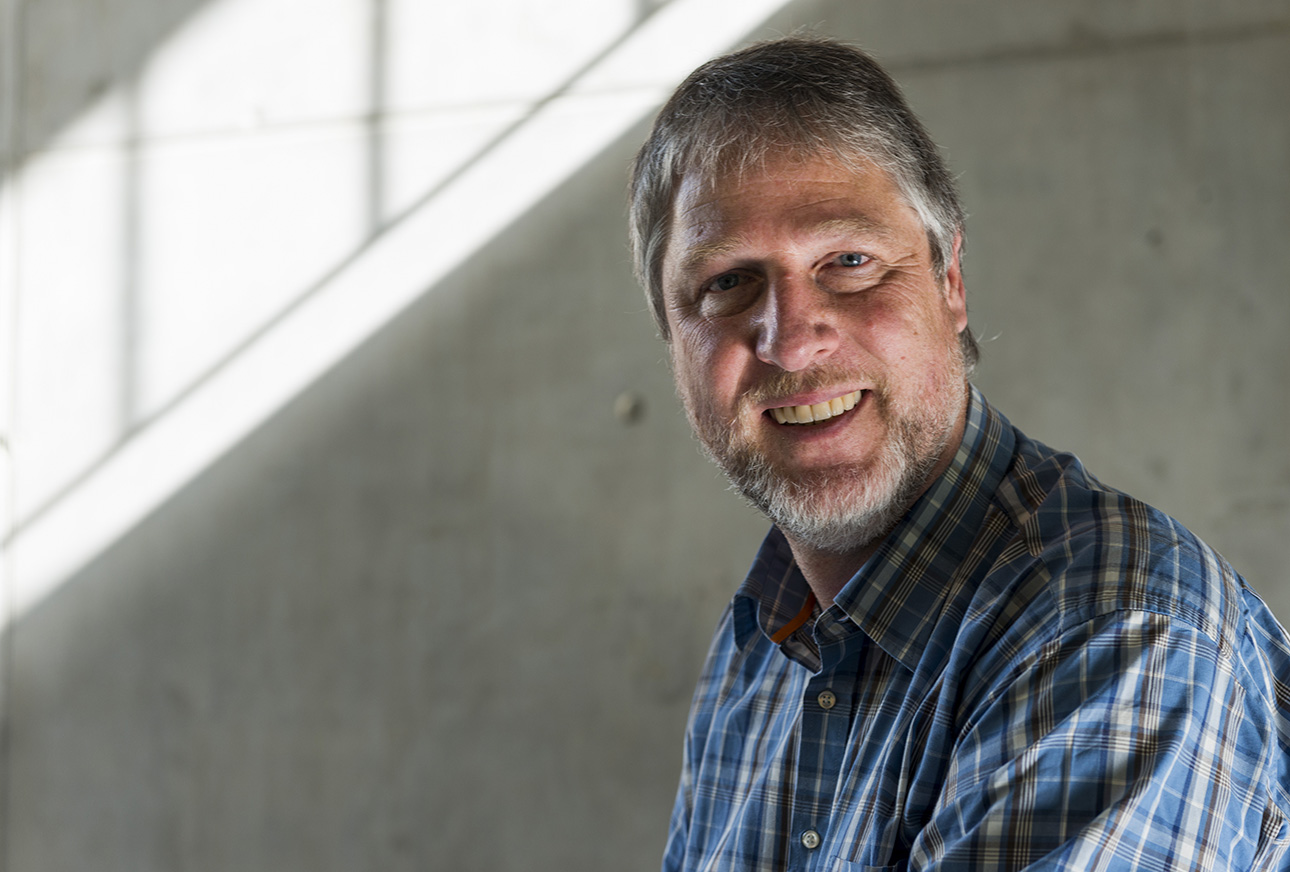
Professor Bernd Möbius is a leading academic in Phonetics and Phonology at the Department of Language Science and Technology, Saarland University. His research bridges phonetic theory with speech technology applications, focusing on text-to-speech systems, prosody modeling, and computational simulations of speech processes. Current research projects: DFG SFB 1102, C1: Information density and phonetic structure predictability DFG SFB 1102, C4: Slavic intercomprehension and surprisal theory (INCOMSLAV) Research Themes: Key areas include text-to-speech synthesis, speech prosody analysis, experimental methods in speech production/perception, information density in phonetics, and cross-linguistic studies of Slavic-Germanic languages. Scientific Contributions: Recent work explores Parkinson-induced dysarthria detection, breath noise acoustics, surprisal-driven speech behaviors, multilingual BERT models for idiomaticity, and perceptual consequences of acoustic adjustments.
Andreas Bulling is a Professor at the Institute for Visualisation and Interactive Systems , University of Stuttgart, Germany. His research focuses on Human-Computer Interaction , Eye Tracking , and Computer Vision , with applications in Machine Learning , Virtual Reality , and Information Visualization . 2025 Publications: HOIGaze (Extended Reality), ChartQC (Data Visualization), HAIFAI (Human-AI Interaction), SummAct (Behavioral Summarization), Chartist (Chart Reading). 2024 Contributions: HumanEYEze (Multimodal AI), HOIMotion (3D Object Detection), MultiMediate'24 (Engagement Estimation), Unified Model of Saliency (Scanpath Prediction). His recent work explores gaze estimation , interactive behavior modeling , and privacy-preserving eye-tracking systems . Key subfields include Extended Reality , Neural Networks , and Behavioral Biometrics . While no explicit scientific awards are mentioned, his research has been widely cited (8,003 total citations) and downloaded (132,740 times). Andreas leads projects in Interactive Systems and collaborates with institutions such as Aalto University , KU Leuven , and National University of Singapore . His lab focuses on eye movement analysis , human motion forecasting , and task-driven input modeling .
Schloss Dagstuhl - Leibniz Center for InformaticsGermany
Julian McAuley is a Professor in the Department of Computer Science and Engineering at the University of California, San Diego's Jacobs School of Engineering. His research spans recommender systems, machine learning, natural language processing, music information retrieval, and multimodal learning. He maintains an active research group with numerous PhD students and postdocs working on cutting-edge AI problems. His research interests focus on developing advanced algorithms for personalized recommendation systems, with particular emphasis on sequential recommendation, multimodal learning, and integrating large language models with traditional recommendation approaches. His work bridges the gap between theoretical machine learning and practical applications across multiple domains including e-commerce, music, and healthcare. McAuley has published extensively in top-tier conferences including NeurIPS, ICML, KDD, SIGIR, and ACL, with his most recent work exploring the intersection of large language models and recommendation systems. His publications reveal a strong trend toward multimodal approaches that combine text, vision, and audio for more comprehensive understanding and recommendation. He has received significant research funding from major technology companies including Google, Amazon, Facebook, Adobe, and Samsung, as well as government agencies like the National Science Foundation and Department of Defense. His work has practical applications across multiple industries, with a focus on improving user experience through better personalization. McAuley advises numerous PhD students who have gone on to successful careers at leading technology companies and academic institutions. His former students include Wang-Cheng Kang and Jianmo Ni at Google DeepMind, Chris Donahue and Zachary Lipton as assistant professors at CMU, and Ruining He at Google Deepmind.
Prof. Dr.-Ing. Rüdiger Daub serves as Professor and Chair of Production Engineering and Energy Storage Systems at the Technical University of Munich (TUM), operating within the Department of Mechanical Engineering. His leadership encompasses research direction, academic supervision, and strategic development of battery production technologies at TUM's Garching campus (Boltzmannstr. 15), with active industry collaborations driving innovation in sustainable manufacturing. Daub's research program pioneers advanced production methodologies for lithium-ion and solid-state batteries, focusing on electrode manufacturing, electrolyte filling, and cell assembly processes. His work investigates critical parameter interdependencies affecting battery safety and performance, developing inline monitoring systems and digital twin technologies for real-time process optimization. Key contributions include moisture control in electrode production, electrochemo-mechanical characterization of solid-state systems, and robotics solutions for deformable object assembly, all integrated with machine learning for quality assurance in industrial settings. Analysis of his 2023-2025 publications reveals a dominant research trajectory toward solving production bottlenecks in next-generation energy storage. The work demonstrates increasing integration of computational modeling with empirical validation, particularly in solid-state battery manufacturing and high-voltage electrolyte systems. A notable trend is the cross-pollination of robotics, computer vision, and uncertainty quantification techniques to address complex assembly challenges and distribution shifts in quality monitoring, reflecting industry's urgent need for adaptable, data-driven production systems. Leading TUM's specialized laboratories for battery cell production, Daub's team maintains comprehensive facilities for electrode calendering, electrolyte filling, and cell assembly with integrated tracking and tracing capabilities. The research infrastructure supports collaborative projects with automotive OEMs and battery manufacturers to develop scalable production processes, emphasizing environmental sustainability through water-based electrode production and footprint optimization. Current initiatives focus on digital factory modeling and prelithiation technologies for next-generation battery systems.
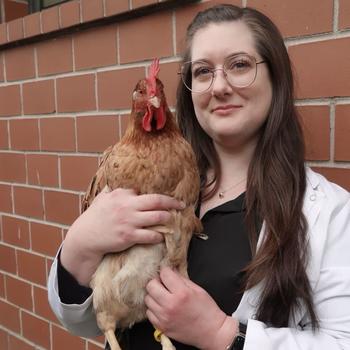
Larissa Schlegel-Pape serves as a Scientific Associate at the Department for Ornamental and Pedigree Poultry within the Farm Animal Clinic of Freie Universität Berlin's Faculty of Veterinary Medicine. Her work focuses on developing innovative methods for assessing chicken welfare through the creation of the "Stressed Chicken Scale," which aims to systematically identify stress indicators in poultry. Her research interests center on animal welfare science, specifically stress assessment in chickens using both behavioral observation and computer vision technology. She investigates how body posture, movement patterns, and other visual indicators can reliably signal discomfort or stress in poultry, with the goal of creating practical assessment tools for veterinarians and poultry farmers. Her work bridges veterinary medicine, ethology, and technological innovation, contributing to refinement research (one of the 3Rs principles) in animal husbandry. Analysis of her publications reveals a strong focus on developing and validating the Stressed Chicken Scale across multiple contexts. Her work spans methodological development, practical implementation studies, and technological integration with computer vision systems. The research demonstrates progression from conceptual framework to validation studies and practical application, with increasing sophistication in assessment techniques and broader implications for animal welfare standards in poultry farming. Schlegel-Pape actively collaborates with the Federal Institute for Risk Assessment (BfR) and participates in interdisciplinary projects involving artificial intelligence applications in agriculture. She presents her findings regularly at major German veterinary conferences including the DVG (Deutsche Veterinärmedizinische Gesellschaft) events, DACh Epidemiology conferences, and specialized poultry medicine gatherings. Her work contributes significantly to advancing animal welfare assessment methodologies and promoting refinement in poultry husbandry practices.
Prof. Dr. Pia Knoeferle is a leading academic at Humboldt-Universität zu Berlin , where she serves as a Professor in the Department of German Language and Linguistics . She is a principal investigator in the Collaborative Research Center (CRC 1412) focused on register phenomena and leads the Reaction Time, Eye-tracking, and EEG Laboratories . Her research spans psycholinguistics , cognitive neuroscience , and computational modeling of language , with a central interest in how real-time language comprehension interacts with social context , formality-register congruence , and morphosyntactic processing . Appointments: Professor at Humboldt-Universität (2024), CRC 1412 member Methodologies: Eye-tracking, EEG, Visual World Paradigm, ERP Her work investigates lifespan language processing (children, adults, older adults) through contextual cue integration , including emotional , spatial , and social context such as gender cues , eye gaze , and facial expressions . Key questions include: How do pragmatic and contextual factors modulate lexical and grammatical processing ? What representations underlie register sensitivity in spoken and written comprehension ? Recent articles (2022-2024) focus on register congruence effects in German sentence processing, age-related differences in formality-register anticipation , and interactions between register and morphosyntactic knowledge . Using eye-tracking and visual world paradigms , her team examines incremental integration of socially-situated context with verb-argument relations and grammatical constraints . Findings suggest subtle late-stage register effects and interference between pragmatic and syntactic processing . Her lab collaborates with researchers like Katja Maquate , Valentina Nicole Pescuma , and Camilo Ronderos , contributing to the Frame text of the Second Phase Proposal for CRC 1412 (2020) and subsequent reviews in Frontiers in Psychology (2023). The work emphasizes complementary methods to model register variability across languages , modalities , and cultural contexts .
Rhenish Friedrich Wilhelm University of BonnGermany
Professor Paul Marx is a faculty member at the University of Bonn, affiliated with the Faculty of Philosophy and the Institute of Political Science and Sociology. His research focuses on critical areas of political sociology and policy analysis, with particular emphasis on labor market dynamics and political participation. His research interests center on labor market policy , attitude research , policy analysis , politics and emotions , political socialization , tax and redistribution policy , and inequalities in political participation and representation . Professor Marx examines how economic conditions, particularly labor market experiences, shape political attitudes, behaviors, and representation. His work often employs mixed-methods approaches, combining quantitative analysis with qualitative insights from focus groups and elite interviews. Analysis of Professor Marx's recent publications reveals a consistent focus on the intersection of economic conditions and political behavior. His research demonstrates how labor market insecurity, income inequality, and welfare state policies influence political participation, voting behavior, and attitudes toward redistribution. A notable trend is his examination of political inequality, particularly how economic hardship in childhood affects later political engagement. His work also addresses contemporary political debates in Germany and Europe, including identity politics, gender-neutral language, and taxation policies. Professor Marx maintains an active research agenda with numerous publications in 2023-2025. His work appears to focus on German politics and comparative European welfare states, with some research extending to development contexts such as Bangladesh. His methodology frequently combines survey data with experimental and qualitative approaches to provide comprehensive insights into political behavior.
Prof. Dr. Teresa Sansour is a full Professor of Pedagogy and Didactics in Cases of Intellectual Development Impairments with Special Consideration of Inclusive Educational Processes at the Institute for Special and Rehabilitation Education, Carl von Ossietzky University of Oldenburg. She joined the university in April 2020 and has held leadership roles including Vice Director for Teaching at the Center for Teacher Education (since October 2021) and Deputy Institute Director (since April 2025). Her academic affiliations reflect a deep commitment to inclusive and special education. Her research focuses on educational interactions in the context of intellectual disabilities, inclusive subject didactics, the participation of people with complex disabilities, and the professionalization of educators and prospective teachers. Key research areas include inclusive literacy, art education, teacher motivation, and social integration. She leads significant funded projects such as Literary Texts in Simple Language (LiES) and Lighthouses for Participation , both aimed at enhancing inclusion for people with disabilities. The recent publications of Prof. Sansour span topics such as school absenteeism in autism, self-concept in intellectual disabilities, inclusive art education, and participation models. Her work demonstrates a strong interdisciplinary and applied focus, combining qualitative methods with pedagogical innovation. She frequently publishes in peer-reviewed journals and edited volumes on special education, inclusive didactics, and disability studies. Member, German Society for Educational Research (DGFE), Section Special Education Member, Network for Complex Disabilities e.V. Chair, Advisory Board of the Georg-Leffers-Stiftung Chair, Association for the Promotion of Pedagogical Rehabilitation and Social Integration of People in Risk Situations Board Member, German Interdisciplinary Society for Research Promotion for People with Intellectual Disabilities (DIFGB) Prof. Sansour actively contributes to academic leadership and teacher training. She serves as program coordinator for the Bachelor’s in Special Education and accreditation officer for the Special Education/Social Studies cluster. Her work includes advising on inclusive curricula, fostering research collaborations, and securing external funding for inclusive initiatives. She has not received explicitly mentioned scientific awards in the provided text. She is involved in multiple collaborative research teams and projects focused on inclusion, literacy, and disability rights.
Max Planck Institute for Security and PrivacyGermany
Yangruibo Ding is an incoming Assistant Professor in the Department of Computer Science at the University of California, Los Angeles (UCLA), and currently serves as a Postdoctoral Scientist at AWS Agentic AI. He has held significant research positions at Google DeepMind, Amazon AWS AI Labs, and IBM Research, establishing himself as a leading researcher in software engineering with a focus on large language models for code. His research focuses on developing large language models (LLMs) and agentic systems for software engineering. He specializes in training LLMs with advanced symbolic reasoning capabilities for debugging, testing, program analysis, and verification. His work aims to build efficient, collaborative agentic systems for complex software development and maintenance tasks, with particular emphasis on code generation, vulnerability detection, and execution-aware pre-training techniques. Dr. Ding's publication record reveals a strong trajectory toward enhancing code intelligence through comprehensive semantics reasoning and self-refinement approaches. His research spans multiple dimensions of software engineering including code completion, vulnerability detection, model evaluation, and cross-file context understanding, with applications across various programming languages and development environments. Dr. Ding has received numerous prestigious awards recognizing his contributions to the field: IBM Ph.D. Fellowship Award (2022-2024) ACM SIGSOFT Distinguished Paper Award (2023) IEEE TSE Best Paper Award Runner-up (2022) Ph.D. Service Award, Columbia CS (2025) NSF Student Travel Award for ESEC/FSE'23 (2023) ACM SIGSOFT CAPS Travel Grant (2023) NSF Travel Award for ICSE'22 (2022) As he establishes his research group at UCLA, Dr. Ding is actively seeking students with strong coding skills and experience in large language models, program analysis, verification, or security. He serves on program committees for major conferences including ICSE (2026), ASE (2024, 2025), and ESEC/FSE Artifacts Track (2023), and regularly reviews for top-tier conferences and journals in AI and software engineering. His research is conducted through collaborations with leading industry teams including AWS Agentic AI, Google DeepMind's Learning4Code team, and IBM Research's AI for Code team, creating a robust network of industry-academia partnerships that drive innovation in software engineering research.
Schloss Dagstuhl - Leibniz Center for InformaticsGermany
Sotirios Liaskos is an Associate Professor in the School of Information Technology at the Faculty of Science, York University. He is a leading researcher in requirements engineering and conceptual modeling, with a focus on goal models, empirical evaluation, and model-driven engineering. Research Interests: Requirements Engineering Goal and Conceptual Modeling Empirical Software Engineering Model-Driven Design and Automation Uncertainty and Decision-Theoretic Reasoning in Models Applications in Blockchain and Reinforcement Learning His recent work emphasizes the empirical validation of modeling constructs, the integration of decision theory into goal models, and the automated generation of secure workflows and AI training environments. He has led and co-authored numerous experimental studies on model comprehensibility and semantic quality. Publication Trends: His publications consistently appear in top venues like ER, RE, and iStar. The last five years show a strong trend toward empirical evaluation of modeling languages, decision-theoretic goal models, and applications of goal modeling in emerging domains such as blockchain and reinforcement learning simulation design. Scientific Contributions: Developed frameworks for empirical evaluation of modeling language ontologies (Peira framework). Advanced decision-theoretic approaches to goal modeling under uncertainty. Pioneered model-driven methods for generating blockchain simulators and reinforcement learning environments. Conducted foundational empirical studies on the comprehensibility of contribution links and visualization alternatives in goal models. Advising and Collaboration: He has advised several researchers including Ibrahim Jaouhar, Wisal Tambosi, Mehrnaz Zhian, and Saba Zarbaf. He maintains a highly collaborative research profile with frequent co-authorship with John Mylopoulos, Shakil M. Khan, and other international researchers. He has served as a co-editor for multiple iStar workshop proceedings, indicating leadership in the goal-oriented requirements engineering community. Labs and Teams: While no specific lab name is mentioned, his work is closely associated with research groups focused on requirements engineering and conceptual modeling, likely within York University’s software engineering research cluster. His collaborations span institutions in Canada, Europe, and beyond.
Torsten Grust is a Professor of Computer Science at the University of Tübingen, leading the Database Systems research group since 2008. Previously, he held professorships at TU München and TU Clausthal. He earned his M.Sc. (Diploma) and Ph.D. in Computer Science from Universität Konstanz in 1994 and 1999, respectively. His research focuses on database languages, query and programming language technology, and scalable processing of non-relational queries. He bridges database and programming language research, emphasizing mutual benefits between the fields. **Education:** Ph.D. in Computer Science, University of Konstanz (1999) M.Sc. (Diploma), Computer Science, University of Konstanz (1994) Visiting Scientist, IBM Silicon Valley Laboratories (2000) **Research Interests:** Design and optimization of database languages Query compilation and execution engines Integration of functional programming with SQL Query provenance and debugging **Awards and Honors:** ACM SIGMOD Reproducibility Award (2021) University of Tübingen Teaching Award (2021/22) Winner of Dyalog 2019 APL Program Solving Competition Member of the VLDB Endowment Board of Trustees (2022–2027) **Advising & Grants:** Guided numerous students, including alumni such as Alexander Ulrich, Benjamin Dietrich, and Christian Duta Recipient of grants supporting research in query compilation, provenance analysis, and database language design **Labs & Teams:** Leads the Database Systems research group at University of Tübingen Collaborates with the National Institute of Informatics (Tokyo) on query and programming languages
Helmholtz Centre for Environmental ResearchGermany
Joakim Nivre is a Professor at Uppsala University's Department of Linguistics and Philology. He is a leading researcher in computational linguistics, with a focus on dependency parsing, Universal Dependencies (UD) framework development, and multilingual NLP applications. His recent work explores LLMs in climate change discourse analysis, pharmacovigilance explainability, and historical text processing. Key research areas: Dependency parsing theory, Universal Dependencies standardization, LLM evaluation Collaborations: SweSAT-1.0 benchmark development, ClimateEval project, PARSEME integration His 2025-2023 publications demonstrate expertise in explainable AI for healthcare, synthetic data generation for idioms, and multilingual benchmark design. Notably, he co-developed SweSAT-1.0 to evaluate Swedish LLMs and contributed to typology-informed UD revisions. Despite extensive work in NLP, no scientific awards are mentioned in available texts.
Prof. Dr. Verena Hüttl-Maack holds the Chair of Marketing and Consumer Behavior at the University of Hohenheim's Faculty of Economics and Social Sciences. Her roles include academic leadership, research, and teaching in consumer behavior, brand management, and advertising effectiveness. She has been affiliated with the university since 2012, following her habilitation in 2013. Her research explores areas like curiosity-driven marketing, sustainability perceptions, and multilingual packaging effects. Education: Studied Business Administration at the University of Augsburg and University of Wales (UK). Doctorate (2010): Thesis on brand extensions. Habilitation (2013): University of Hohenheim. Research Interests: Her work focuses on the psychological and behavioral aspects of consumer decision-making, particularly how curiosity, language use, and brand messaging influence evaluations. Key themes include the role of art in advertising, competitive advertising effects, and sustainable consumption behaviors. Publications: Over 50 peer-reviewed articles in journals like Journal of Consumer Psychology , Psychology & Marketing , and International Journal of Advertising . Recent work addresses sustainability perceptions in food marketing and the impact of augmented reality on consumer experiences. Grants & Collaborations: Led projects on short food supply chains, consumer responses to multilingual packaging, and transformative consumer journeys. Collaborates internationally with institutions in Germany, Spain, Greece, and Hungary. Labs/Teams: Active in the Marketing and Consumer Behavior research group at Hohenheim, focusing on experimental design and applied consumer research.
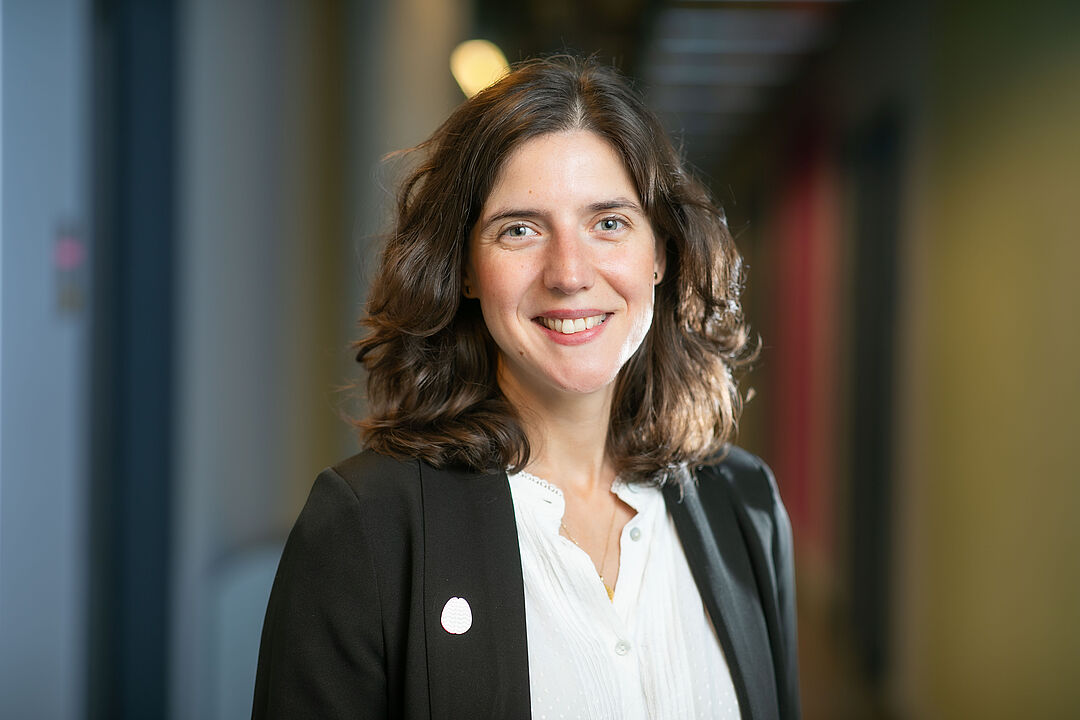
Fatma Deniz is a Full Professor (W3) of Computer Science at Technische Universität Berlin, supported by the Berlin Equal Opportunities Program. She leads the Chair of Language and Communication in Biological and Artificial Systems, and is a member of the Berlin Bernstein Center for Computational Neuroscience. Her roles include membership in TU Berlin's Executive Board and the Berlin University Alliance Steering Committee. She holds a Ph.D. (Dr. rer. nat.) from TU Berlin and a Diploma in Computer Science from Technische Universität München, with research training at Caltech and postdoctoral work at UC Berkeley. Her research focuses on understanding neural mechanisms of language processing, integrating computational neuroscience, cognitive science, and artificial intelligence. Key areas include semantic representation dynamics, cross-modal neural alignment, and language learning in bilingual contexts. She has pioneered studies showing the brain's invariant semantic processing across reading and listening modalities. Her grants include an ERC Starting Grant (2023-2028) for studying language learning shifts and a NSF-BMBF CRCNS grant on bilingual representations. She co-edited The Practice of Reproducible Research: Case Studies in Data Science (UC Press, 2017) and contributed to foundational work on reproducible data science methodologies. She has advised projects in neuroimaging, AI ethics, and computational linguistics, and collaborates with institutions like UCSF and the German Academic Exchange Service. Her lab explores neural correlates of language through fMRI, MEG, and machine learning techniques.
Max Planck Institute for Human Cognitive and Brain SciencesGermany
Dr. Burkhard Maess is a Research Professor and Group Leader at the Max Planck Institute for Human Cognitive and Brain Sciences, leading the Methods and Development Group Brain Networks. His research focuses on auditory and language processing, signal analysis, and dynamic modeling of neuronal networks. He holds a Diploma in Physics (University of Leipzig, 1987) and a PhD in Physics (University of Leipzig, 1990). His career includes postdoctoral positions at the Academy of Sciences of the GDR and the Free University of Berlin before joining the MPI in 1995. Since 2000, he has led research groups on MEG/EEG signal analysis and cortical network dynamics. His work integrates advanced neuroimaging techniques like MEG and EEG to study sensory processing, neural network dynamics, and the effects of aging on auditory attention. Key contributions include developing high-resolution BEM-FMM methods for source localization and analyzing cross-frequency coupling in neuroscience data. His group also explores spinal cord electrophysiology and the neural underpinnings of perceptual decision-making. Dr. Maess’ research spans cognitive neuroscience, biomedical engineering, and computational modeling, with a focus on bridging empirical findings with theoretical frameworks in neuroscience.