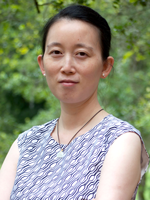
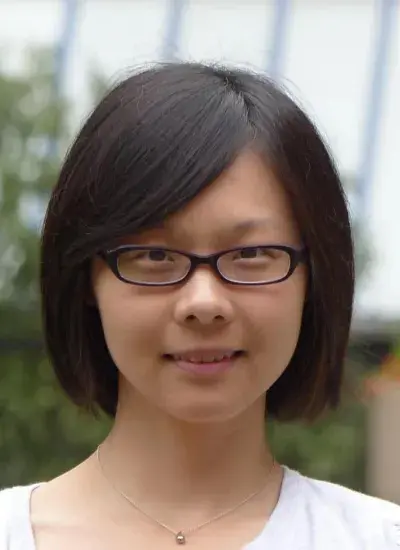
Fiona Draxler is a researcher affiliated with Ludwig Maximilian University of Munich, Germany. Her work focuses on Human-Computer Interaction (HCI), AI in education, and augmented reality applications for learning. She has published extensively on topics including microlearning systems, user experience with generative AI, and contextual learning technologies. PhD in 2023: "Designing intelligent support for learning from and in everyday contexts" Research areas span: Human-AI collaboration in educational settings User experience with generative AI tools Contextual learning systems Augmented reality for grammar acquisition Interruption management in mobile learning Recent publications (2023-2025) examine AI ghostwriting effects, ChatGPT integration in knowledge work, and responsible LLM development practices. Fiona collaborates frequently with Albrecht Schmidt, Lewis L. Chuang, and other HCI researchers.
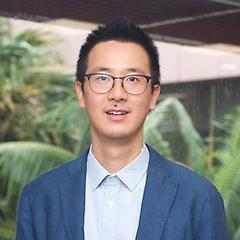
Chien-Sheng Wu is a prominent researcher in natural language processing and artificial intelligence, actively contributing to advancements in large language models (LLMs), dialogue systems, and information retrieval. His work focuses on enhancing factual consistency, developing frameworks for service AI agents, and exploring vision-language model limitations in arithmetic tasks. Key research areas: LLMs, knowledge grounding, dialogue summarization, and human-AI collaboration Recent publications analyze the capacity of LLM agents in CRM tasks, multihop reasoning frameworks, and content moderation tools. His collaborations span institutions like ACL, EMNLP, and NAACL. 2025 papers address workflow extraction, visual arithmetic understanding, and RAG system evaluation 2024 work includes Haystack summarization challenges and executable text-editing interfaces Scientific awards and student mentorship details are not explicitly mentioned in available data. Affiliations remain unspecified, but his contributions to NLP benchmarks and evaluation frameworks are significant.
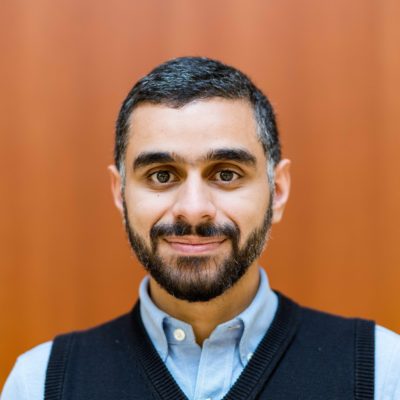
Aniket Kittur is a researcher at Carnegie Mellon University , focusing on Human-Computer Interaction , Crowdsourcing , and Artificial Intelligence . His work explores how Generative AI and Large Language Models can enhance creative ideation, scientific innovation, and information sensemaking. 2025 : BioSpark and Inkspire systems for biological-analogical and AI-augmented design. 2024 : Contributions to semantic reading interfaces and analogical search engines. 2023-2022 : Tools like Selenite and BioSpark for organizing inspiration and decision-making. Earlier Work : CrowdForge (2011), Analogy Mining (2018), and social dynamics in Wikipedia (2013). His research emphasizes cross-domain knowledge transfer , AI-human collaboration , and scalable sensemaking . While no scientific awards or student lists are explicitly mentioned in the provided text, his collaborations span institutions and disciplines, including projects like Synergi and Threddy for scholarly synthesis. Recent articles highlight LLM-augmented transfer and generative analogical scaffolding as key trends.
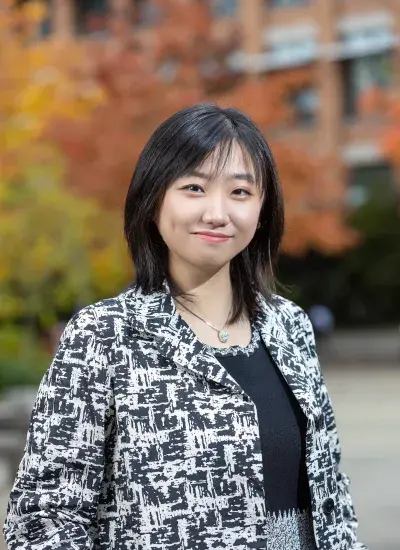
Boran Gao is an Assistant Professor in Biological Sciences at Purdue University, affiliated with the College of Science. His research focuses on machine learning, artificial intelligence, and their applications in healthcare informatics, natural language processing, and federated learning. He explores topics like knowledge editing in large language models (LLMs), fairness in AI, and causal inference. Recent work emphasizes scalable solutions for copyright compliance in LLMs, efficient federated learning frameworks, and bias mitigation strategies. His contributions span both theoretical advancements and practical implementations, including frameworks like Suv and Roselora. Despite no listed awards, his prolific publication record highlights impactful contributions to AI ethics and distributed learning.
Alejandra Magana Deleon is a Professor of Engineering Education and W.C. Furnas Professor in Enterprise Excellence at Purdue University's Purdue Polytechnic Institute. She holds dual appointments in the Department of Computer and Information Technology and the School of Engineering Education. Her roles include Deputy Editor for the Journal of Engineering Education and Co-Editor of the Education Department for IEEE Computer Graphics & Applications. Education: Ph.D. (2009), M.S. in Educational Technology (2007), both from Purdue University; M.S. in Electronic Commerce (2003) and B.S. in Information Systems Engineering (2000) from ITESM, Mexico City. Research Interests: Focuses on computational models for STEM learning, haptic and visuo-haptic simulations, AI in education, and embodied cognition. Her work addresses how technologies like VR, robotics, and AI can enhance conceptual understanding and problem-solving skills. Grants & Projects: Leads multi-million-dollar NSF-funded research (e.g., $12.5M EMBRIO project) and initiatives on AI education, culturally relevant programming, and data-driven manufacturing. Serves as PI/Co-PI on projects integrating computation into engineering curricula. Awards: Includes 2024 ASEE Fellow, Fulbright Specialist, Seeds for Success Award (2023), and multiple teaching and research awards from Purdue. Labs & Teams: Director of the ROCkETEd Lab and member of the Purdue Cyberlearning Consortium. Active in developing tools like PECAS Mediator for online teamwork analysis.
Abulhair Saparov is an Assistant Professor in the Department of Computer Science at Purdue University, joining in Fall 2024. He holds a Ph.D. and M.S. in Machine Learning from Carnegie Mellon University (2022 and 2017 respectively), and a B.S.E. in Computer Science from Princeton University (2013). His research focuses on Artificial Intelligence , Machine Learning , Natural Language Processing , Computational Science , Bioinformatics , and Distributed Systems . Notable projects include Neuro-Symbolic Learning, alignment of Large Language Models, and cognitive bias analysis in AI systems. Recent work examines LLM fallacies in causal inference, robustness via noisy exemplars, and deductive reasoning capacity testing. His publications span mechanisms of transformer-based models and foundational challenges in AI safety.
Elena Leah Glassman is an Assistant Professor of Computer Science at Harvard University's John A. Paulson School of Engineering and Applied Sciences. She leads the Variation Lab, focusing on AI-resilient interfaces that enhance human collaboration with AI systems. Her work bridges Human-Computer Interaction (HCI) and Artificial Intelligence (AI), emphasizing cognitive science principles to improve usability and safety in open-ended tasks like text/code writing and sensemaking. Education: B.S., M.Eng., and Ph.D. in Electrical Engineering and Computer Science from MIT, followed by a postdoctoral fellowship at UC Berkeley. Recognized as a 2023 Sloan Research Fellow and National Academy of Sciences Kavli Fellow. Research interests include AI-assisted creativity tools, ethical AI interfaces, program synthesis visualization, and accessible text systems. Notable projects include CorpusStudio, ChainForge, and DynaVis. Recent awards include CHI 2024 Best Paper and multiple Honorable Mentions at top HCI venues. Teaches CS 178/179 on interactive system design, emphasizing needfinding, creativity, and usability. Advises a lab of PhD students and postdocs working on HCI-AI intersections. Active in conference communities (CHI, UIST) and open-source tool development. Labs/Teams: The Variation Lab focuses on augmenting human intelligence through interface design. Collaborates with industry and academic partners on projects like accessible text tools and AI evaluation frameworks.
Yun Huang is an Associate Professor in the School of Information Sciences at the University of Illinois Urbana-Champaign, co-directing the Social Computing Systems (SALT) Lab. She holds faculty affiliate roles in the Department of Computer Science, Illinois Informatics, and the Siebel Center for Design. Her research focuses on human-computer interaction, social computing, and human-AI collaboration, with an emphasis on accessibility and ethical AI integration. Dr. Huang holds a PhD from the University of California, Irvine, and a bachelor's degree from Tsinghua University. Her work examines context-driven design of crowdsourcing systems, AI ethics, and inclusive technologies. Notable projects include developing accessible video commenting systems for the deaf community (Signmaku) and AI-driven tools for collaborative research (CoQuest). Her recent publications explore topics such as LLM integration in extended reality, emotion-aware conversational agents, and safety design in social VR environments. She has received accolades including the Linowes Faculty Fellowship and multiple teaching excellence awards. Current projects address inclusive AI, STEM education accessibility, and human-AI alignment frameworks. Active research initiatives include 'Advancing STEM Online Learning through Interactive Companionship' and 'Inclusive AI: A ChatGPT Plugin for Vulnerable Groups.' Her work bridges technical innovation with social impact, emphasizing participatory design and user-centered solutions.
David Barber is a Professor and Director of the UCL Centre for Artificial Intelligence and the UKRI Centre for Doctoral Training in Foundational AI. His research focuses on probabilistic modelling, machine learning, and Bayesian reasoning. He is also a Distinguished Scientist at UiPath and has contributed significantly to tools like the BRML toolbox and Julia-based probabilistic inference engines. His work spans theoretical advancements in AI, medical imaging analysis, and ethical AI practices. Education: Not explicitly stated in the provided texts. Research Interests: Probabilistic Modelling, Bayesian Reasoning, AI Ethics, Medical Imaging, and Generative Models. His book, Bayesian Reasoning and Machine Learning , is a foundational text in the field. Publications: Recent works address topics like autonomous UI exploration, diffusion models, algorithm auditing, and mortality prediction in medical contexts. These contributions highlight his interdisciplinary impact across computer science, healthcare, and ethics. Labs/Teams: Leads the UCL Centre for Artificial Intelligence and collaborates on projects involving survival analysis and AI ethics through the UKRI CDT.
Dr. Daisy Zhe Wang is a Professor in the Department of Computer & Information Science & Engineering at the University of Florida, affiliated with the Herbert Wertheim College of Engineering. She directs the Data Science Research (DSR) Lab, focusing on advanced data analysis systems using machine learning and probabilistic methods. Her work spans databases, data science, and informatics, with specializations in probabilistic knowledge graphs, multimodal fusion, and healthcare analytics. Education: PhD in Computer Science from the University of California, Berkeley (2011). Awards include the Arnold and Lisa Goldberg Rising Star Professorship in Computer Science (2019-2021) and the UF Term Professorship (2018). Her lab's current projects include developing systems for tree species classification using remote sensing and improving surgical risk prediction algorithms like MySurgeryRisk. Research emphasizes bridging data science with domain-specific applications, including electronic health records (EHR) analysis, environmental remote sensing, and knowledge graph-driven decision systems. She has pioneered frameworks like RAMQA for multimodal QA and M3 for multi-hop retrieval, advancing both theoretical and applied aspects of data science. Grants and collaborations include large-scale data competitions and partnerships with healthcare institutions. The DSR Lab maintains active research in AI ethics, explainable AI, and scalable data management systems, with ongoing work on neuro-symbolic architectures and multimodal learning.
Dr. Jie (Jack) Yang is a Lecturer in Database Systems & Big Data at the School of Computing and Information Technology, University of Wollongong. He holds a PhD from the same institution. His research focuses on Natural Language Processing (NLP), including Large Language Models (LLMs), Multimodal NLP, Machine Reading Comprehension, and Knowledge Graph applications across domains like Education, Healthcare, and Finance. He is affiliated with the Association for Computational Linguistics (ACL) and IEEE. Research Interests Dr. Yang's work emphasizes theoretical advancements and practical solutions in NLP. His recent projects include developing robust document retrieval systems, adversarial detection techniques, and enhancing AI models' robustness through masking and contrastive learning. He collaborates on applications like automated postural assessment using CNNs and AI-driven educational tools. Grants & Projects He leads projects such as AMKD.AI (Knowledge Graph toolkit), Next-Gen AIOT (interactive kiosks), and AI4U (AI competency initiatives). His funded research spans areas like LLM-based tourism data management, cybersecurity for AI models, and healthcare NLP applications. Teaching & Supervision Dr. Yang coordinates courses like Advanced Programming (CSCI851/CSCI251) and supervises PhD/Master’s students in topics like LLM explainability, skeleton-based action recognition, and adversarial learning. He emphasizes practical industry alignment in education and research. Labs & Teams He contributes to interdisciplinary teams advancing AI in education, healthcare, and industry collaboration through initiatives like the Telstra-UOW AIOT Hub and UOW’s Pretrained Language Models (PLMs) for medical document processing.
Abdullah Almaatouq is the Douglas Drane Career Development Associate Professor in Information Technology and Management at the MIT Sloan School of Management. His research focuses on enhancing cooperation, coordination, and collective intelligence within decision-making systems such as teams, crowds, and markets. He holds a PhD in Computational Science and Engineering from MIT, alongside dual master's degrees in Media Arts and Sciences (MIT Media Lab) and Computational Science and Engineering. Prior to MIT, he earned his undergraduate degree from the University of Southampton, UK. His research interests include computational social science, network science, and the design of effective collective decision systems. He is affiliated with the MIT Center for Computational Engineering, MIT Center for Collective Intelligence, and MIT Connection Science Research Initiative. His work emphasizes advancing social science methodologies through innovative experimental designs and theory-building. Abdullah’s publications explore topics like group synergy, adaptive social networks, and human-AI collaboration. His recent work highlights the conditions under which combining human and AI capabilities yields optimal results, particularly in complex decision-making tasks. He also investigates how task complexity and group dynamics influence collective performance. Notable contributions include studies on the wisdom of crowds, algorithmic mediation in social networks, and the moderating effects of task complexity on group outcomes. His research bridges computational methods with behavioral insights, aiming to design systems that amplify human capabilities in collaborative environments.
Sherry Tongshuang Wu is an Assistant Professor in the Human-Computer Interaction Institute at Carnegie Mellon University , with additional affiliations in the Language Technology Institute . She holds a Ph.D. in Computer Science and Engineering from the University of Washington (2022) and a B.Eng. from Hong Kong University of Science and Technology (2016). Education Ph.D., Computer Science and Engineering, University of Washington (2022) M.S., Computer Science and Engineering, University of Washington (2018) B.Eng., Computer Science, Hong Kong University of Science and Technology (2016) Sherry's research bridges Human-Computer Interaction and Natural Language Processing , focusing on interactive debugging and correction of AI systems . Her work develops tools to map general-purpose AI to specific use cases, emphasizing human-AI collaboration , model testing , and responsible AI . She has authored award-winning papers in ACL , CHI , TOCHI , and TVCG , addressing topics like LLM evaluation , task delegation , and AI education . Recent publications highlight trends in Human-AI Interaction , Model Interpretability , and Ethical AI . Her work spans interactive error analysis , prompt engineering , and dataset curation , with applications in education, software development, and collaborative learning. Key subfields include LLM truthfulness , counterfactual testing , and perspective-aware retrieval systems . Scientific Awards Google Academic Research Award (2024) Amazon Research Awards (2024) AIED 2024 Best Paper & Honorable Mention CSCW 2023 Best Demo Award ACL 2020 Best Paper Award Sherry mentors PhD, Master’s, and undergraduate students in areas like AI for education , LLM applications , and responsible AI development . She has served on program committees for CHI , ACL , and EMNLP , and leads initiatives for community-driven AI evaluation and ethical dataset curation .
Haiyi Zhu is the Daniel P. Siewiorek Associate Professor of Human-Computer Interaction and Director of HCI Undergraduate Programs at Carnegie Mellon University's School of Computer Science, where she leads the Social AI research group. Her work bridges human-computer interaction and responsible AI, with a focus on how AI technologies integrate into social groups, communities, and societies. Dr. Zhu received her B.S. in Computer Science from Tsinghua University and her M.S. and Ph.D. in Human-Computer Interaction from Carnegie Mellon University. Her educational background laid the foundation for her interdisciplinary approach that combines technical expertise with deep understanding of human behavior and social contexts. Her research focuses on human-AI interaction, social computing, and responsible AI, particularly examining how AI technologies can be integrated into various aspects of social processes, interactions, and decision-making while enhancing benefits and reducing potential harms. She has conducted significant projects in child welfare, mental health support, and workplace settings, with a particular emphasis on addressing the needs of vulnerable and marginalized populations. Her work demonstrates how AI can be designed to support rather than replace human expertise, especially in high-stakes domains where ethical considerations are paramount. Her publication portfolio reveals a consistent trajectory toward understanding and improving human-AI partnerships across multiple domains. Early work focused on foundational aspects of algorithmic fairness and explainability, while more recent publications address increasingly complex applications in mental health, gig work, and public sector services. A notable trend is the growing emphasis on community-driven approaches to AI design and evaluation, reflecting a maturation of the field toward more participatory and inclusive practices. NSF CRII award recipient Allen Newell Award for Research Excellence Over ten paper awards at top venues including CHI, CSCW, and Human Factors Multiple Best Paper and Honorable Mention awards at CHI, CHIWORK, and SaTML Named to Pittsburgh's 40 Under 40 (2024) As an advisor, Dr. Zhu mentors numerous PhD students working on diverse aspects of human-AI interaction, with several securing prestigious fellowships including NSF GRFP. Her research is supported by multiple programs at the National Science Foundation, the National Institute of Mental Health, and various industry sponsors. She has also taken on significant service roles in the community, serving as secretary/treasurer of HCIC and as program committee member for major conferences including CHI and CSCW. Her lab, the Social AI group, operates at the intersection of technology design and social impact, emphasizing both technical innovation and ethical considerations.
Ayham Boucher is a researcher and leader in AI innovation at Cornell University, serving as Head of AI Innovations for Cornell Information Technologies (Ithaca) and Information Technologies & Services (Weill Cornell Medicine). He has over eight years of experience advancing AI applications in education, research, and administration. His work includes directing the AI Innovation Lab, which develops custom AI solutions, and co-leading the AI Innovation Accelerator collaboration involving over 50 institutions. Educationally, he holds a Master's in Computer Engineering from Syracuse University. His research focuses on Large Language Models (LLMs), Retrieval-Augmented Generation (RAG) systems, and AI Agents. He teaches an AI applications course at Cornell, bridging theory and practice for students. His contributions span academic and practical domains, emphasizing ethical AI integration and educational technology. Collaborations with diverse institutions highlight his role in shaping AI strategies across higher education.