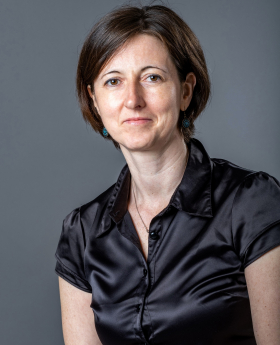
GÖRÖG Péter is an Associate Professor at the Department of Engineering Geology and Geotechnics , part of the Faculty of Civil Engineering at Budapest University of Technology and Economics . His research focuses on geotechnical engineering, rock mechanics, and structural stability analysis, particularly in historic masonry structures and underground cavities. He has taught courses such as Engineering Geology, Rock Mechanics, and Hydrogeology, and has contributed to projects involving numerical modeling and seismic risk assessment. Email: gorog.peter@emk.bme.hu Research Trends : His recent work emphasizes creep modeling in soft rocks, stability analysis of underground structures, and the impact of geological parameters (e.g., GSI, joint dip) on engineering projects. Publications from 2025-2024 highlight advancements in fractional derivative-based models, seismic load effects, and failure mode simulations for masonry bridges. Scientific Awards : Építő250 Scholarship Academic Contributions : Active in both theoretical and applied geotechnics, GÖRÖG Péter has led field investigations in Hungary and Croatia, analyzed historic stone bridges, and developed models for porous limestone stability. His work bridges material science and civil engineering challenges.
Pál Koppa is a Professor at the Department of Atomic Physics , Faculty of Natural Sciences (TTK) , Budapest University of Technology and Economics. His research spans optical data transmission, diffractive optical technology, laser material processing, 3D visualization, and holographic data storage. Research Interests Optical data transmission and switching in free space Diffractive optical technology Laser material processing and measurement technology 3D visualization Optical and holographic data storage Modeling of optical systems Scientific Contributions Koppa's work includes advancements in holographic storage, optical encryption, and nanocomposite materials. His recent publications focus on metallic nanoparticle films, polarized LEDs, and 3D display technologies, demonstrating interdisciplinary expertise in optics and materials science.
András Poppe is a Professor and Head of Department at the Department of Electron Devices , Budapest University of Technology and Economics . He is also a member of the Strategic Innovation Group at SIEMENS Digital Industry Simulation and Test Solutions since 2021. His academic journey began with an MSc in Electrical Engineering (1986) from BME, followed by a Cand.Sci. degree (1996) from the Hungarian Academy of Sciences and a PhD (1996) from BME. His research focuses on thermal transient testing of semiconductor devices, LED/OLED characterization , electro-thermal simulation , and digital twin development for LEDs and luminaires. Recent publications highlight his work on Multi-domain modeling for Industry 4.0 Thermal management in LED systems Compact model validation Phosphor layer effects in white LEDs Standardized LED datasheets Electro-thermal failure analysis in OLEDs Poppe has received the Harvey Rosten Award for Excellence twice (2012, 2017) for contributions to electronics physical design. He leads the Hungarian Scientific Research Fund grant (128315, 2018-2022) on LED aging investigation and participates in EU projects like Delphi4LED and AI-TWILIGHT . He chairs the CIE TC2-84 committee and co-founded the JEDEC JC15 and CIE TC2-91 standardization groups.
Dr. Andras Poppe is a Professor and currently serves as the Head of the Department of Electron Devices at the Faculty of Electrical Engineering and Informatics (VIK) of Budapest University of Technology and Economics. With over 238 publications and 52,196 reads on ResearchGate, he is a prominent researcher in the field of semiconductor devices, particularly focusing on LED technology and thermal analysis. Dr. Poppe's research interests center around the multi-domain modeling of LEDs, encompassing electrical, thermal, and optical characteristics. His work addresses critical challenges in solid-state lighting, including reliability testing , thermal management , and lifetime prediction of LED devices. He has made significant contributions to the development of SPICE-like multi-domain models for LEDs, which are essential for virtual prototyping in the Industry 4.0 era. His research has practical applications in outdoor lighting, automotive lighting, and general illumination systems where environmental stresses impact long-term performance. An analysis of Dr. Poppe's recent publications reveals a strong focus on LED reliability under various environmental conditions, particularly high ambient temperatures and different dimming frequencies. His work bridges theoretical modeling with practical applications, as evidenced by his involvement in European research projects like Delphi4LED and AI-TWILIGHT. The publications demonstrate expertise in thermal transient measurements, multi-domain characterization, and the development of compact models for system-level simulations. Dr. Poppe has been actively involved in numerous research collaborations, particularly within European projects that aim to advance LED technology and its applications. His work has contributed to the development of standardized multi-domain compact models of LEDs, which are crucial for the design of reliable and efficient lighting systems. While specific grant information isn't detailed in the provided text, his extensive publication record suggests substantial research funding support for his work in LED technology and thermal analysis. Dr. Poppe leads research activities within the Department of Electron Devices at Budapest University of Technology and Economics, where his team focuses on advanced characterization and modeling of semiconductor devices, particularly LEDs. The laboratory work appears to involve sophisticated testing equipment for high-speed LED characterization, thermal transient measurements, and reliability testing under various environmental conditions. His research group collaborates with international partners, as evidenced by co-authorship with researchers from various European institutions.
Adél Len is an Assistant Professor at the University of Pécs, Faculty of Engineering and Information Technology, with a focus on neutron scattering techniques and nanostructural research. She has held positions at the Wigner Research Centre for Physics (2001-2018) and the Centre for Energy Research (2018-present). Her work bridges materials science, structural analysis, and cultural heritage preservation. PhD in Nuclear Chemistry (Eötvös Loránd University, 2010) Habilitation (University of Pécs, 2023) Her research involves Small-Angle Neutron Scattering (SANS) for studying nanostructures in materials, including cement hydration, carbon composites, aerogels, and archaeological samples. She has led the Nanostructural Research with Neutrons group since 2015 and contributed to EU FP7 NMI3 ACCESS and IPERION CH projects. Her recent publications highlight advancements in SANS data interpretation, polymer-CNT nanocomposites, and biomedical applications of silica xerogels. She supervises PhD students and teaches courses on Mechanics, Materials Science, and Physics at the University of Pécs.