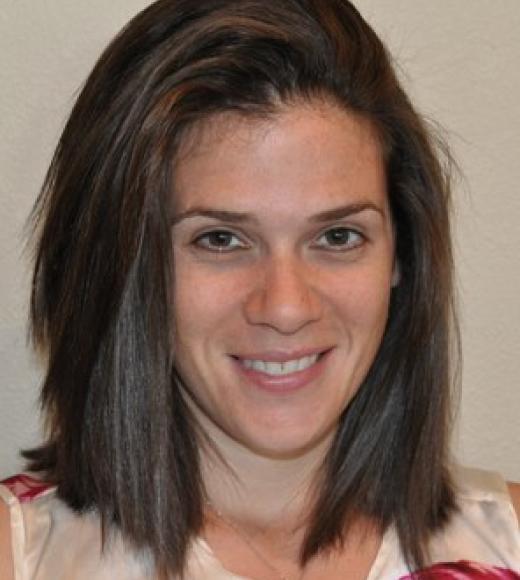
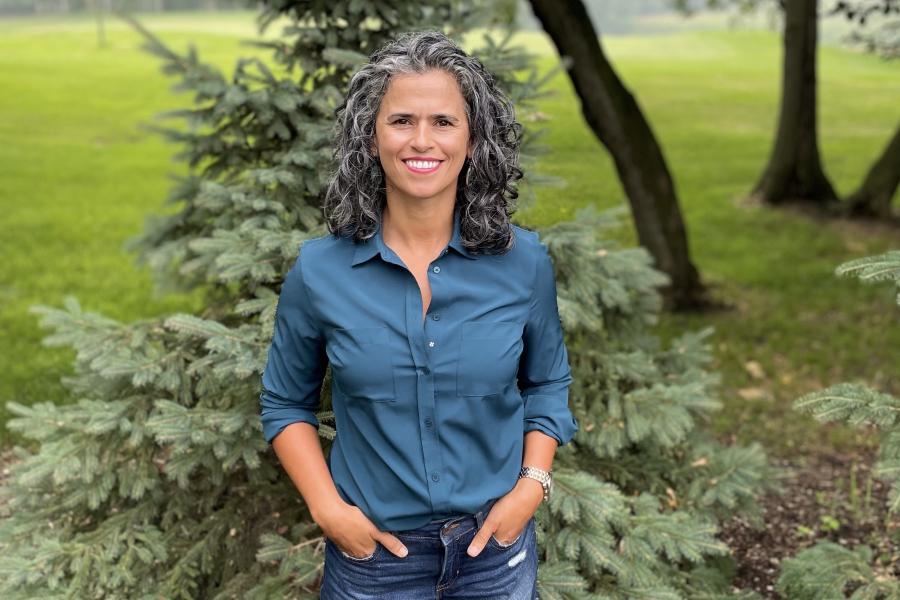
Lillie Padilla is an Assistant Professor of Spanish Linguistics at Sam Houston State University's Department of World Languages and Cultures. Holding a Ph.D. and M.A. in Spanish Linguistics from Arizona State University alongside a Bachelor of Arts from the University of Ghana, her research explores interdisciplinary connections between: Afro-Latinx representation in educational materials Discourse analysis and language ideologies Sociolinguistic studies in Equatorial Guinea Critical race theory applications in language teaching Her work focuses on Spanish subject pronoun expression patterns in multilingual contexts and curriculum development for inclusive pedagogy. Recent publications examine: Representation gaps in Spanish language textbooks Methodological challenges in Equatorial Guinea research Critical discourse analysis of Netflix's Elite series Intersectional representation of Afro-Latinx women Scientific achievements include: Finalist for American Association of Linguistics 2025 award for co-edited volume Representation, Inclusion and Social Justice in World Language Teaching Padilla's research continues to shape conversations about linguistic diversity and marginalized voices in language education through both empirical studies and theoretical frameworks.
Loreta Vilkienė is a Professor at the Department of Lithuanian Studies, Vilnius University, since October 2020, and served as its Head from 2018–2023. She has been affiliated with Vilnius University since 2007, initially as an Associate Professor, and has lectured since 2001. Her academic background includes a PhD in Humanities (2000) and a qualification as a philologist and teacher of Lithuanian (1986), both from Vilnius University. Education: PhD in Humanities, Vilnius University (2000) Philologist and Teacher of Lithuanian, Vilnius University (1986) Research Interests: Applied linguistics (foreign language teaching/assessment, language attrition, partial acquisition) and sociolinguistics (linguistic attitudes, diaspora language dynamics, language-identity links). Her work focuses on multilingualism, heritage language maintenance, and sociolinguistic transitions in post-Soviet contexts. Article Trends: Recent publications analyze language attitudes in Lithuania, lexical proficiency in native speakers, diaspora language policies in Kazakhstan and Russia, and sociolinguistic impacts on identity. Her studies integrate quantitative methods (e.g., vocabulary size estimation) and qualitative discourse analysis. Scientific Awards: Recipient of the 2006 Lietuvos Science Award (applied sciences) for collaborative work on Lithuanian language pedagogy. Grants & Projects: Managed EU-funded projects like ARQUS (2020) and international diaspora language studies (2020–2022). Active in UNESCO-related language preservation initiatives and digital outreach platforms. Outreach: Delivered public lectures on diaspora identity, contributed to podcasts, and authored 15+ peer-reviewed articles. Co-developed teaching tools like the Po truputį Lithuanian language series.
Mark Gales is Professor of Information Engineering at the University of Cambridge and an Official Fellow at Emmanuel College. He is currently on sabbatical leave for the 2024/25 academic year. Prior to his academic career, he worked as a consultant at Roke Manor Research Ltd, developing radar systems, before transitioning to speech and language processing. PhD in 'Model-Based Techniques for Robust Speech Recognition' (University of Cambridge, 1995) BA in Electrical and Information Sciences (University of Cambridge, 1988) His research focuses on speech and language processing , particularly in automated language assessment and low-resource speech technology . He leads the Automated Language Teaching and Assessment (ALTA) Institute , which collaborates with Cambridge University Press & Assessment (CUP&A) to develop commercial tools like Linguaskill and Speak & Improve . These platforms provide automated spoken/written assessment for millions of users globally. Recent publications highlight his work in LLM-driven speech processing , including adversarial attacks on foundation models, end-to-end spoken error correction, and uncertainty estimation frameworks. His team's research spans multilingual capabilities, with deployments in languages ranging from Dholuo to Tok Pisin . Awards : IEEE Fellow, ISCA Fellow Leadership : Fellows' Steward at Emmanuel College Mark has contributed extensively to Hidden Markov Model (HMM) applications in speech recognition, which underpinned early automatic speech systems. His work now bridges LLM-based language assessment with cross-lingual transfer learning and robustness testing for real-world deployments.
Georgia Zellou is an Associate Professor in the Department of Linguistics at the University of California, Davis, where she co-directs the Phonetics Lab and conducts award-winning research at the intersection of phonetics, speech perception, and human-AI interaction. Her work investigates how phonetic detail is cognitively represented through variations in speech production, with significant contributions to understanding speech alignment with voice assistants, face-masked speech intelligibility, and cross-linguistic perception of synthetic voices. Her academic credentials include a Ph.D. in Linguistics from the University of Colorado at Boulder (2012), an M.A. in Linguistics from Stony Brook University (2007), and a B.A. in Linguistics & Anthropology from the University of Florida (2005, Cum Laude, Phi Beta Kappa). Ph.D., Linguistics, University of Colorado at Boulder (2012) M.A., Linguistics, Stony Brook University (2007) B.A., Linguistics & Anthropology, University of Florida (2005) Professor Zellou's research program centers on laboratory phonology approaches to real-world communication challenges, examining how acoustic-phonetic details influence speech perception across contexts. Her studies span speech alignment with voice-AI systems (e.g., Amazon Alexa), sociophonetic variation in bilingual speech, and the cognitive mechanisms underlying perceptual compensation for coarticulation. She employs experimental methods including eye-tracking, acoustic analysis, and perceptual testing to uncover how phonetic variation functions pragmatically in human communication and human-machine interaction. Analysis of her 15 most recent publications (2023-2025) reveals three dominant research trajectories: (1) human-AI voice interaction dynamics, including prosodic alignment and social evaluation of TTS voices; (2) intelligibility optimization in challenging contexts (face masks, clear speech for diverse listeners); and (3) cross-linguistic phonetic variation in vowelless words and consonant clusters. These works consistently bridge theoretical phonology with applied speech technology, demonstrating how fine-grained phonetic detail influences communication effectiveness in both human-human and human-machine contexts. Her scientific recognition includes: Fulbright Scholar (2022) for research in France Chancellor’s Award for Excellence in Undergraduate Mentoring (2019) Fellow of the Linguistic Society of America (2020) Amazon Faculty Research Award (2019) for Alexa-related speech studies Dean’s Fellow designation at UC Davis (2020-2023) Professor Zellou maintains an active mentoring practice recognized with the Chancellor’s Award, supervising undergraduate researchers in the Phonetics Lab while teaching core linguistics courses from introductory to advanced graduate levels. Her research program is supported by competitive grants including NSF funding, Amazon Research Awards, and UC Davis internal grants (Hellman Foundation, ISS Junior Faculty Grant), reflecting the translational value of her work for speech technology development. She has co-directed major initiatives including the 2019 LSA Linguistic Institute. The Phonetics Lab she co-leads serves as a hub for experimental phonetics research, focusing on speech production-perception relationships through projects investigating vocal accommodation to voice assistants, nasal coarticulation dynamics, and cross-linguistic prosody. Current collaborations with industry partners aim to implement human speech adaptation principles into voice assistant design to enhance naturalness and engagement.
Mohammad T. Alhawary is Professor of Arabic Linguistics and Second Language Acquisition at the University of Michigan's Middle East Studies department within the College of Literature, Science, and the Arts. He serves as Director of both the MA Program in Arabic for Professional Purposes (APP) and the MA Program in Teaching Arabic as a Foreign Language (TAFL). His educational background includes a Ph.D. from Georgetown University (1999). Prior to joining the University of Michigan, he contributed to developing Arabic and Middle Eastern Studies programs at various US institutions. Professor Alhawary's research spans both theoretical and applied Arabic linguistics, with particular focus on second language acquisition processes. His work examines how factors like age, input quality, output practice, and first language transfer affect Arabic language learning. He has made significant contributions to understanding Arabic language pedagogy, curriculum design, proficiency testing, and the application of technology in language learning. His research also extends to bilingualism, multilingualism, language impairment, and Arabic medieval grammatical traditions. His publications reflect a strong trajectory in Arabic linguistics research, with recent works focusing on practical language teaching applications, reading comprehension mechanisms, code-switching patterns in digital communication, and multilingual acquisition processes. The 2023 publication 'Teaching Arabic as a Foreign Language' represents his latest contribution to language pedagogy methodology. 2019 AATA Book Award for 'Arabic Second Language Learning and Effects of Input, Transfer, and Typology' As an academic leader, Professor Alhawary serves as Executive Director of the American Association of Teachers of Arabic and edits both the Journal of Arabic Linguistics Tradition and Al-'Arabiyya journal. He continues to develop empirical research on Arabic second language acquisition to inform teaching practices both in America and globally.
Professor Luke Harding is a faculty member at the Department of Linguistics and English Language , Lancaster University , within the School of Social Sciences . His work bridges applied linguistics, language assessment, and critical discourse studies, with a focus on the ethical and societal implications of testing. Research Interests : Language testing and assessment, World Englishes and English as a Lingua Franca (ELF), second language listening and pronunciation assessment, diagnostic approaches to language evaluation, and language assessment literacy. Recent projects integrate digital technology and corpus linguistics into testing frameworks. Publications : Published extensively in Language Testing , Applied Linguistics , and Language Assessment Quarterly . Co-edited the Routledge Handbook of Language Testing (Second Edition) (2022), a key reference work in the field. Teaching : Leads modules in Language Test Construction and Evaluation , Issues in Language Testing , and Statistical Analysis for Language Testing within the university's distance MA program. Leadership : Convened the Language Testing Research Group with colleagues Tineke Brunfaut and John Pill, advancing interdisciplinary approaches to assessment.
Verónica Loureiro-Rodríguez is an Associate Professor in the Department of Linguistics at the University of Manitoba's Faculty of Arts. Her research focuses on sociolinguistics, language identity, and code-switching, with special attention to global hip hop and multilingual communities. She holds a PhD from the University of California, Davis, an MA from the University of Colorado at Boulder, and a BA from the Universidade de Santiago de Compostela. Dr. Loureiro-Rodríguez's work examines language attitudes across diverse contexts, including French-English dynamics in Manitoba, Spanish-Valencian bilingual processing, and code-switching in music. She has also explored language use in robotics and cultural hybridity among Puerto Rican and Mexican communities. Her teaching excellence was recognized with the 2021 Faculty of Arts Teaching Excellence Award. Education: PhD (UC Davis), MA (CU Boulder), BA (USC) Awards: 2021 Teaching Excellence Award (Established Faculty) Research Focus: Language policy, digital sociolinguistics, and cultural identity She currently supervises graduate students in Master's and PhD programs, focusing on sociolinguistic methodologies like the matched-guise technique. Her research often intersects with music studies, robotics, and diaspora linguistics.
Dr Eva Ogiermann is an Associate Professor in English Language and Applied Linguistics at King’s College London, serving as Programme Director for the MA in Language and Cultural Diversity. She holds a PhD from Carl von Ossietzky Universität Oldenburg (2007) and an MA from the University of Münster (2001). Her research focuses on cross-cultural pragmatics, politeness theory, and bilingual communication, with a particular interest in how language reflects cultural norms and identities. Current Position: Reader (Associate Professor) at King’s College London Previous Institutions: University of Oldenburg (Germany), University of Portsmouth, University of Surrey Editorial Roles: Former associate editor of the Journal of Pragmatics (2010–2018) Her work examines cultural specificity of language use, including studies on apology strategies, request negotiation, and family communication dynamics. Recent projects analyze pandemic-era signage’s role in disseminating risk communication and maintaining social cohesion during crises. She also explores epistemic authority in academic writing tutorials and the pragmatic functions of marketing language. Key research contributions include From Speech Acts to Lay Understandings of Politeness (2019) and numerous articles in top journals like Journal of Pragmatics and Pragmatics and Society . Her teaching spans BA and MA programs in applied linguistics and language education. Dr Ogiermann leads the Implementing Covid-19 measures project, studying how non-official signage adapts government health guidelines. She actively contributes to the Centre for Language, Discourse & Communication, fostering interdisciplinary research at the intersection of language, culture, and society.
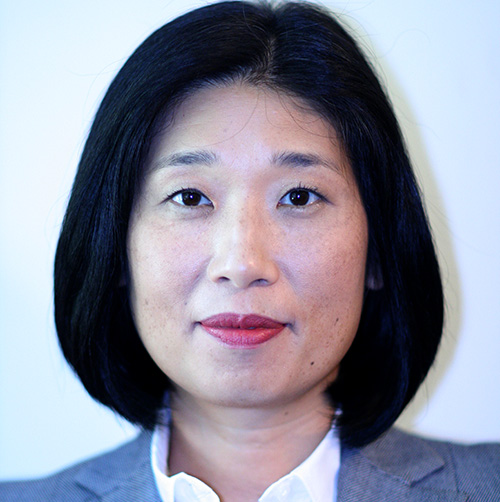
Mizuki Mazzotta is an Assistant Teaching Professor in the Department of Russian and East Asian Languages and Cultures at Emory University, where she also serves as Japanese Language Coordinator. Her academic journey includes a Ph.D. in Applied Linguistics from Georgia State University (2018) and M.A. degrees in Linguistics (McGill University) and Applied Linguistics (University of South Florida). Her research focuses on instructed second language acquisition, particularly the role of affect and sociocultural theory in L2 learning. She has extensive experience teaching Japanese language courses and mentoring students at Emory and previous institutions like Georgia State University. Education: Ph.D., Applied Linguistics, Georgia State University (2018) M.A., Linguistics, McGill University (2005) M.A., Applied Linguistics, University of South Florida (1997) B.A., English Literature, Soka University (1995) Research Interests: Instructed Second Language Acquisition Corrective Feedback in L2 Writing Sociocultural Theory in Language Education Learner Affect and Motivation Technology-Enhanced Language Learning Cultural Awareness in Language Instruction Awards & Grants: Recipient of multiple grants including the KAKENHI Grant (Japan), Mellon Humanities Pathways Grant, and Emory College Pedagogy Mini-Grant. Member of honor societies: Phi Beta Delta and Golden Key International. Service & Leadership: Executive Committee Member, Emory College Language Center Organizer of Japanese Program Guest Speaker Talks and Cultural Events Reviewer for Language Teaching Research and other academic journals Interviewer for the Japan Exchange Teaching Program Teaching & Mentorship: Instructor of Japanese language courses at Emory and Georgia State University Developer of study abroad programs in Japan and internship collaborations Mentor for Japanese interns and temporary faculty
Ji-young Shin serves as an Assistant Professor in the Teaching Stream within Education Studies at the University of Toronto Mississauga's Department of Language Studies. Her position integrates teaching, research, and practical application in language education with emphasis on assessment innovation and technology integration. Her academic credentials include: PhD in English / Second Language Studies & ESL from Purdue University, USA MS in Educational Psychology & Research Methodology from Purdue University, USA MA in Teaching English to Speakers of Other Languages (TESOL) from Hankuk University of Foreign Studies, South Korea BA in English Education (Japanese minor) from Hankuk University of Foreign Studies, South Korea Shin's research program focuses on language assessment, corpus linguistics, and technology-mediated pedagogy. She employs mixed methods with quantitative emphasis, utilizing corpus-informed computational analysis and latent-trait modeling complemented by qualitative discourse analysis. Her work addresses critical gaps in second language acquisition, educational measurement, and digital learning environments, particularly regarding AI applications and test validation across diverse language contexts. Her publication trajectory from 2017-2025 demonstrates consistent innovation in language assessment methodologies and technology integration. Key themes include AI-powered chatbots for L2 Korean instruction, online vocabulary testing for Spanish, and corpus-based writing pedagogy. Her work shows increasing focus on artificial intelligence applications and cross-linguistic validation studies, reflecting evolving priorities in language education research. Shin has secured competitive research funding including: Global Classrooms Grant (2025–2026) for VR-enhanced intercultural competence Black, Indigenous, and/or Racialized Scholar Grant (2025–2026) for cross-border AI language learning IRCC Engage3 Project (2022–2024) as Co-PI on VR/AI educational advancement Advancement Fund Plus (2022) for generative AI in teacher education British Council Award (2019) for technology-mediated assessment development She teaches advanced courses including 'The Future of Ed Tech: Active Learning Classrooms and Artificial Intelligence' (EDS285) and supervises community-based experiential learning (EDS388). Her grant portfolio indicates active supervision of research assistants and collaboration with international teams focused on AI implementation and assessment validation. Current projects explore generative AI for language learning across diverse contexts and virtual reality applications in teacher education. While specific laboratory infrastructure isn't documented, her collaborative publications with researchers across Korea, Spain, and the United States suggest participation in international research networks focused on language assessment technology and corpus applications.
Kathrin Siebold is a Professor at the Institute for German Linguistics of Philipps-Universität Marburg , specializing in German as a Foreign and Second Language (DaF/DaZ) . She leads the German as a Foreign and Second Language Working Group and oversees multiple MA and teacher training programs , including international double degree collaborations with institutions in China, France, and Spain. Contact: +49 6421 28-24892 | Email | Room B213, Marburg Educational Background includes a Dr. phil. (2007) from Universidad de Sevilla for her dissertation on speech acts and verbal politeness, with distinctions like Doctorado Europeo and Premio extraordinario del Doctorado . She earned her Magister Artium in German and Romance Studies from Philipps-Universität Marburg (1998) and Ludwig Maximilians-Universität München (1993–1997). Research Interests center on contrastive and intercultural pragmatics , focusing on speech acts, politeness, discourse markers, and interactional competences in L2. She explores empirical classroom research , video-based observation (VEO), and pedagogical innovations like Virtual Exchange and Tandem Learning . Her projects address multilingualism , language policy , and professional development of DaF/DaZ educators. Scientific Contributions include co-founding the open-access journal ZIAF (Zeitschrift für Interaktionsforschung in DaFZ) and organizing conferences such as the International Conference on German as a Foreign Language and the Marburger FaDaF-Thementage . Her recent 15 publications (2025–2023) analyze classroom interaction, discourse markers, and international educational collaborations. Awards: Premio extraordinario del Doctorado (2007) | Doctorado Europeo (2007) Professional Leadership involves coordinating research projects like DaF im iberoamerikanischen Kontext (DAAD-funded 2025–2027), Stark nach Corona in DaFZ (2023–2024), and Videobasierte Unterrichtsbeobachtung mit VEO (2023–2025). She collaborates with universities in Chile, Argentina, Spain, and Poland through Germanistische Institutspartnerschaften .
Randy Fred Appel is an Associate Professor at Waseda University's Global Education Center, with a PhD in Education (Applied Linguistics) from Concordia University. His academic career includes prior roles as Assistant Professor at Waseda University (2017-2021), Research Assistant at Concordia University (2014), and teaching positions at Concordia, Carleton University, and Algonquin College. Education: PhD (2017) and MA (2011) in Applied Linguistics from Concordia and Carleton Universities, respectively. Appel's research focuses on L2 English academic writing, corpus linguistics, formulaic sequences, and L1-related differences. His work examines lexical bundles, linking adverbials, and metadiscourse features in cross-linguistic contexts, with applications in language assessment and pedagogy. Recent projects include analyzing French for Academic Purposes assessments and developing automated measures for lexical sophistication in writing tasks. His publications span journals like English for Specific Purposes , System , and Journal of English for Academic Purposes , with a 2025 paper on interactional metadiscourse in business writing and 2023 studies on linking adverbials across Asian learner groups. He has received significant funding, including a Japan Society for the Promotion of Science Grant-in-Aid for Early-Career Scientists (2020-2022). Scientific Awards: SSHRC Doctoral Fellowship (2014), Concordia Graduate Fellowship (2012), Ontario Graduate Scholarship (2009) Appel has contributed to curriculum development through syllabi for Academic Writing and Discussion in English courses at Waseda's Global Education Center (2025). He actively participates in academic conferences, including the Language Testing Research Colloquium (2022) and Asia TEFL Conference (2019). His service includes peer reviewing for journals like System and International Journal of Business Governance and Ethics .
Haiyang Ai is an Associate Professor in the Literacy and Second Language Studies program at the University of Cincinnati's School of Education. His research applies corpus linguistics and natural language processing to investigate second language acquisition, writing complexity, and bilingual language processing. His educational background includes a Ph.D. in Applied Linguistics from The Pennsylvania State University (2015), an M.A. in Linguistics & Applied Linguistics from the University of Chinese Academy of Sciences (2006), and a B.A. in English from Shaanxi Normal University (2003). Dr. Ai's research spans corpus linguistics, natural language processing, second language acquisition, and computer-assisted language learning. He specializes in compiling and analyzing native and learner corpora to develop intelligent language learning systems and investigate lexical/syntactic complexity in L2 writing. His methodological approach integrates computational tools with theoretical linguistics to address practical language teaching challenges. His recent publications (2019-2023) demonstrate consistent focus on lexical bundles in professional communication, automating complexity measurement in Chinese, speech perception mechanisms in bilinguals, and grammatical puzzles in English learning. These works bridge corpus-based analysis with psycholinguistic experimentation across diverse subfields including morphosyntax, pragmatic competence, and cognitive processing in L2 acquisition. Dr. Ai has secured multiple University of Cincinnati grants including three CECH Faculty Development Grants ($2500 in 2017-2018 for verb-noun collocation research, $2000 in 2016-2017 for corrective feedback tools) and the NCFDD Faculty Success Program ($3250 in 2017), all supporting his development of computational language learning resources.
Alexis Housen is a Professor of Linguistics & Applied Linguistics at the LW Academic Unit Linguistics and Literary Studies within Vrije Universiteit Brussel . Their research focuses on second language acquisition, multilingualism, and psycholinguistics. Currently active in over 30 projects, including leadership roles in initiatives like the Eye-Catching project (2021-2024) and the International Francqui Professor program (2023-2025). Research Interests : Housen's work examines language acquisition processes, particularly in second language learning contexts. Key themes include lexis-grammar interfaces, salience effects in SLA, and the role of instruction in phonological acquisition. Their empirical studies integrate psycholinguistic methodologies with corpus-based analyses. Recent Contributions : Recent publications address salience's role in morphology acquisition, complexity metrics in L2 writing, and comparative proficiency analysis across oral/written modalities. Their work demonstrates interdisciplinary influence across linguistics, education, and cognitive science. Recognition : Awarded the European Second Language Association Fellowship (2000). Active in international collaborations, presenting at conferences like the European Second Language Association and Birkbeck College symposia. Grants & Leadership : Oversees €1.2M+ in active funding through projects like SRP-Groeifinanciering: Multilingual language control (2022-2027). Serves in leadership roles including Dean and Head of Research Groups.
Kristen Di Gennaro is an Associate Professor in the Department of English at Pace University's Dyson College of Arts and Sciences, New York City. She holds an EdD in Applied Linguistics from Columbia University and has been actively contributing to research and teaching in second language writing, language assessment, and sociolinguistics. Her research interests include: Written corrective feedback and its impact on L2 writing Fairness in writing assessment and placement Language and gender, including microaggressions and catcalling Predatory publishing practices ('spamvitations') Sociopragmatic features in academic writing Generation 1.5 and international student writing Her recent publications, appearing in top-tier journals such as Journal of Second Language Writing , College Composition and Communication , and ELT Journal , reflect a strong focus on equity, pedagogy, and the sociopolitical dimensions of language use. Her work often bridges applied linguistics with composition studies, emphasizing empirical research and curriculum innovation. She has received several honors, including: Finalist, Christopher Brumfit Thesis Award (2012) Pace University Outstanding Contribution Award (2006) New York State TESOL Teacher of the Year (2004) Professionally, she has served as Director of Composition and Interim Director of the Writing-Enhanced Course Program. She is an active reviewer for journals such as College Composition and Communication , Assessing Writing , and Language Teaching Research , as well as for publishers like Oxford University Press. She has also secured internal research grants, including the Provost's Grant for the Thinkfinity Initiative. She teaches a wide range of undergraduate courses in composition, linguistics, and language and society, including ENG 110, ENG 201 (Writing in the Disciplines), ENG 300 (Language and Gender), and independent studies.