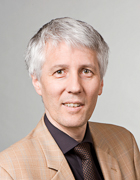
Prof. Alois Christian Knoll is a full professor at the Technical University of Munich (TUM) in the School of Computation, Information and Technology. His academic career includes roles at Bielefeld University and leadership in major EU initiatives like the Human Brain Project and ECHORD++. He specializes in robotics, AI, and autonomous systems, with a focus on medical robotics, sensor-based systems, and neuromorphic engineering. Knoll has supervised over 100 doctoral theses and authored/co-authored over 1,000 publications. Education: Diploma in Electrical Engineering (University of Stuttgart, 1985); PhD in Computer Science (Technical University of Berlin, 1988); Habilitation (TU Berlin, 1993). He has been at TUM since 2001, leading the Robotics, AI, and Real-Time Systems department. Research interests span autonomous systems, neuro-IT integration, and traffic simulation. Key projects include fortiss (Bavarian State Institute for Computer Science) and TUM-CREATE (Singapore collaboration). Awards include IEEE Fellow, University of Tokyo Fellow, and the Carl-Ramsauer-Prize (1990). Current roles include editorships in robotics journals, leadership in EU flagship projects, and teaching across multiple programs. His work bridges computer science, neuroscience, and engineering, with applications in healthcare, automotive systems, and urban mobility.
Yin Tat Lee is an Associate Professor at the Paul G. Allen School of Computer Science & Engineering , University of Washington, and a Senior Principal Researcher in Microsoft AI. His research spans convex optimization , convex geometry , graph algorithms , online algorithms , and differential privacy , with applications in machine learning and theoretical computer science.
Madelon Hulsebos is a Researcher at CWI in Amsterdam, where she leads the Table Representation Learning (TRL) Lab and contributes to the Database Architectures group. She is also a faculty member of the European Laboratory for Learning and Intelligent Systems (ELLIS) Amsterdam unit. Her career bridges academia and industry, including a postdoctoral fellowship at UC Berkeley and prior industry experience in automating data analysis pipelines with ML. Education : PhD in Computer Science (University of Amsterdam, 2023), with research at Sigma Computing and MIT; Postdoctoral Fellow (UC Berkeley, 2024). Her research focuses on establishing tabular data as a key AI modality through Table Representation Learning , generative models for relational data, and robust systems for data analysis. Key interests include: Relational Table Embeddings LLMs for QA/text2SQL and data wrangling Retrieval over Data Lakes and Databases Agentic Systems for Data Science Democratizing insights from structured data Recent work highlights trends in benchmarking table retrieval (TARGET), semantic column detection (AdaTyper, Sherlock), and large-scale tabular data curation (GitTables, SchemaPile). These projects address challenges in metadata utilization, data lake search, and end-to-end systems for structured data. She has secured significant funding, including the NWO AiNed Fellowship Grant ($1M) for her 5-year DataLibra project. Madelon organizes workshops at NeurIPS , SIGMOD , and ACL , and reviews for top venues like VLDB and NeurIPS. Scientific Awards : NWO AiNed Fellowship Grant ($1M) She actively mentors students and collaborates on European AI initiatives, including monthly TRL seminars and workshops. Her lab's tools (GitTables, TARGET) are widely adopted for training foundation models on tabular data.
Teruko Mitamura is a prominent researcher at Carnegie Mellon University with over three decades of contributions to natural language processing, computational linguistics, and artificial intelligence. Her work spans from foundational research in event representation to advanced applications in multimodal systems and question answering. Her research interests focus on event detection and understanding, question answering systems, information retrieval, and multimodal processing. She has made significant contributions to event coreference resolution, timeline construction, and cross-document event analysis, developing methodologies that have become standard in the field. Her work often bridges theoretical advances with practical applications, particularly in complex information environments requiring deep semantic understanding. Natural Language Processing : Specializing in event extraction, coreference resolution, and narrative understanding with over 179 publications Question Answering Systems : Developing advanced techniques for complex question answering, particularly through NTCIR QA Lab and PoliInfo tasks Multimodal Processing : Integrating textual, visual, and temporal information for richer understanding in systems like ProMQA Evaluation Methodologies : Creating robust frameworks for assessing NLP systems through TAC KBP Event Tracks Her recent publication trends show a strong focus on leveraging large language models for event understanding, multimodal question answering, and timeline construction. She has expanded her research into specialized domains including patent analysis and novelty examination, demonstrating the breadth of her research impact across academic and practical applications. Active participant in major NLP conferences including ACL, EMNLP, NAACL, and AAAI with consistent publications Long-standing collaborator with researchers at CMU's Language Technologies Institute including Eduard H. Hovy and Eric Nyberg Contributor to shared tasks that have shaped research directions in event processing and question answering Organizer of multiple NTCIR QA Lab tasks focused on political information question answering Dr. Mitamura has mentored numerous researchers who have gone on to make their own contributions to the field, as evidenced by her extensive co-authorship network and the progression of her former students and collaborators into faculty and research positions. Her work continues to evolve with the field while maintaining her focus on deep semantic understanding of events and narratives.
Dr. Yolanda Gil is a Research Professor in Computer Science and Spatial Sciences at the University of Southern California, where she serves as Principal Scientist and Senior Director for Strategic Initiatives in Artificial Intelligence and Data Science at the Information Sciences Institute (ISI). She is also the Director of AI and Data Science Initiatives in the Viterbi School of Engineering and leads the USC Center for Knowledge-Guided Interdisciplinary Data Science (CKIDS). Dr. Gil received her Licenciatura in Computer Science from the Polytechnic University of Madrid and her M.S. and Ph.D. in Computer Science from Carnegie Mellon University, with a focus on artificial intelligence and cognitive science. Her research focuses on developing AI approaches that use knowledge to accelerate scientific discovery processes. Her key research interests include knowledge capture and representation, semantic workflows, ontology tools, scientific discovery methods, task-based collaboration, provenance tracking, knowledge networks, reproducibility in science, and machine learning for data analysis. She collaborates with scientists across multiple domains to improve how scientific knowledge is created, shared, and used. Dr. Gil's work has significant impact across multiple scientific domains including climate science, neuroscience, and omics research. Her projects demonstrate her commitment to building knowledge-guided systems that transform how scientists conduct research. She has pioneered approaches to capture the provenance of scientific experiments and to automate the analysis of complex scientific data. Fellow of the Association for Computing Machinery (ACM) Fellow of the Association for the Advancement of Science (AAAS) Fellow of the Institute of Electrical and Electronics Engineers (IEEE) Fellow of the Association for the Advancement of Artificial Intelligence (AAAI) 24th President of the Association for the Advancement of Artificial Intelligence Co-chair of the CRA/AAAI 20-Year Artificial Intelligence Research Roadmap for the US Initiator and leader of the W3C Provenance Group that resulted in a widely-used standard for web trust As an educator and leader, Dr. Gil directs the Data Science Program in Computer Science and serves as Co-Director of multiple joint MSc programs including Communication Data Science, Spatial Data Science, Environmental Data Science, Public Policy Data Science, and Healthcare Data Science. She also leads the new dual degree USC-Tsinghua University on Communication Data Science. Her leadership extends to mentoring numerous students and researchers in AI and data science. Through the USC Center for Knowledge-Guided Interdisciplinary Data Science (CKIDS), Dr. Gil organizes DataFest events each semester, fostering collaboration and innovation in data science across disciplines.
Elena Simperl is a Professor of Computer Science and Deputy Head of Department for Enterprise and Engagement at King's College London's Department of Informatics. She co-directs the King's Institute for Artificial Intelligence and serves as Director of Research for the Open Data Institute. As a Hans Fischer Senior Fellow at the Technical University of Munich's Institute for Advanced Study, she leads the Trustworthy Knowledge Graphs focus group and contributes to advancing human-centric AI research across European institutions. Professor Simperl obtained her doctoral degree in Computer Science from the Free University of Berlin and her diploma from the Technical University of Munich. Prior to joining King's, she held academic positions in Germany, Austria, and at the University of Southampton, and was a Turing Fellow. Her career trajectory demonstrates consistent leadership in bridging academic research with practical applications in data ecosystems. Her research sits at the critical intersection of AI and social computing, focusing on human-centric approaches to building sociotechnical systems that integrate data, algorithms, and human capabilities. She investigates how to make knowledge engineering more accessible, how to leverage collective intelligence for data quality improvement, and how to design participatory AI systems that address societal challenges like misinformation. Her work spans knowledge graphs, semantic technologies, crowdsourcing, and open data, with particular emphasis on the social dimensions of data-intensive systems and the governance frameworks needed for trustworthy AI deployment. Analysis of her recent publications reveals a strong evolution toward integrating large language models with traditional knowledge engineering practices while maintaining human oversight. There's a clear trajectory from foundational work on knowledge representation toward increasingly applied research addressing real-world challenges in media ecosystems, citizen science, and data governance, with growing attention to policy implications of AI technologies. Fellow of the British Computer Society Fellow of the Royal Society of Arts Hans Fischer Senior Fellow at TUM-IAS (2023) Ranked among top 100 most influential scholars in knowledge engineering of the last decade Included in Women in AI 2000 ranking Professor Simperl has led 14 major European and national research projects totaling millions in funding, including MediaFutures (a Horizon 2020 program tackling online misinformation), QROWD, ODINE, Data Pitch, and ACTION. She currently co-chairs the Croissant working group in ML Commons developing data standards for AI, and serves as president of the Semantic Web Science Association. Her research has directly influenced the development of data ecosystems supporting startups and citizen science initiatives across Europe, demonstrating exceptional ability to translate theoretical advances into practical impact. As Director of Research at the Open Data Institute, she oversees initiatives connecting data entrepreneurs with artists and civic organizations. Her leadership in the MediaFutures project established a data-driven innovation hub that supported 51 startups/SMEs and 43 artists through three open calls, creating a sustainable model for arts-technology collaborations addressing media challenges. Her work with the ODINE project helped create a European ecosystem for data-driven startups, demonstrating her commitment to building practical applications of open data principles.
Prof. Sebastian Rudolph is a Professor of Computational Logic at the Institute for Artificial Intelligence , Faculty of Computer Science , TU Dresden. Since 2021, he has been an Affiliate Member of the Faculty of Mathematics. His research spans theoretical and applied artificial intelligence, focusing on Knowledge Representation and Reasoning through formalisms like Description Logics, Existential Rules, and Formal Concept Analysis, with applications in Semantic Technologies. 2017 : ERC Consolidator Grant for decidability principles in logic-based knowledge representation 2006-2013 : Postdoctoral researcher, project leader, and Privatdozent at KIT's Institute AIFB 2011 : Habilitation at KIT Earlier : PhD in Algebra and teaching qualification in mathematics, physics, and computer science at TU Dresden His recent publications address decidability of logical reasoning, non-monotonic extensions in formal concept analysis, standpoint logics, and multiagent systems. He supervises the DeciGUT and KIMEDS projects, and is involved in the SECAI and ScaDS.AI centers. Teaching activities include courses on Theoretical Computer Science, Existential Rules, and Formal Concept Analysis.
Chantal Pellegrini is a Lecturer and PhD student at the Chair of Computer Aided Medical Procedures (Prof. Navab) at Technical University of Munich (TUM). Her research focuses on Deep Learning applications in medical imaging, including explainable AI for radiology report generation and Vision-Language Models for clinical decision support. She actively contributes to the DHM, NARVIS Lab, and RobUSt research groups. Teaching responsibilities include courses such as 'Computer Aided Medical Procedures', 'Medical Augmented Reality', and 'Surgical Robotics'. She supervises student projects in medical AI and healthcare innovation, with recent projects involving multimodal report generation and graph pretraining for medical applications. Education: BSc/MSc Computer Science (TUM), current PhD student since 2022 Labs: DHM (German Heart Center), NARVIS Lab, RobUSt Robotics & Ultrasound Research Keywords: Medical Image Understanding, Radiology Reports, LLMs in Healthcare Her publications span surgical OR dataset development, reinforcement learning for clinical decisions, and explainable X-ray diagnosis systems. She mentors MA/BA students in medical AI and project management for healthcare applications.
Joakim Nivre is a Professor at Uppsala University's Department of Linguistics and Philology. He is a leading researcher in computational linguistics, with a focus on dependency parsing, Universal Dependencies (UD) framework development, and multilingual NLP applications. His recent work explores LLMs in climate change discourse analysis, pharmacovigilance explainability, and historical text processing. Key research areas: Dependency parsing theory, Universal Dependencies standardization, LLM evaluation Collaborations: SweSAT-1.0 benchmark development, ClimateEval project, PARSEME integration His 2025-2023 publications demonstrate expertise in explainable AI for healthcare, synthetic data generation for idioms, and multilingual benchmark design. Notably, he co-developed SweSAT-1.0 to evaluate Swedish LLMs and contributed to typology-informed UD revisions. Despite extensive work in NLP, no scientific awards are mentioned in available texts.
Hector Geffner is an Alexander von Humboldt Professor at RWTH Aachen University, leading the Chair of Machine Learning and Reasoning. He specializes in automated planning, machine learning, and reasoning, with a focus on representation learning for acting and planning. His work bridges symbolic and model-based AI, emphasizing general policies and subgoal decomposition. Education & Background : PhD from UCLA (1989), prior roles at IBM Watson Research Center and Universidad Simón Bolívar. Former ICREA researcher and professor at Universitat Pompeu Fabra (2001–2022). Research Interests : Classical and probabilistic planning, reinforcement learning, knowledge representation, and applications in robotics. His ERC-funded RLeap project explores learning generalized policies and symbolic representations for effective decision-making. Teaching : Courses include 'Actions and Planning in AI' and 'Social and Technological Change', emphasizing interdisciplinary AI applications. Awards & Recognition : Alexander von Humboldt Professorship (2023), AAAI/EurAI Fellowships, and editor of influential works on Judea Pearl’s contributions to AI. Grants & Projects : Advanced ERC grant (2020–2025), Humboldt Foundation support, and RWTH funding for research on planning and reasoning. Labs & Teams : Heads the Chair of Machine Learning and Reasoning at RWTH, focusing on interdisciplinary research in AI, robotics, and planning algorithms.
Prof. Dr. Johanna Heitzer is a University Professor for Mathematics Education at RWTH Aachen University since 2011. She leads the Teaching and Research Area of Mathematics Education within the university's mathematics department. Her office is located in Room 352 of the Kreuzherrenstraße 2 building in Aachen. She serves as co-editor of the journal 'mathematik lehren,' co-author of the 'Mathematics - New Ways' textbook series, and holds numerous committee positions including membership in the Faculty Advisory Board and Structural Commission of the Center Council. 1989: High school diploma 1989-1994: Mathematics and Physics Teacher Training at RWTH Aachen 1994-1996: Traineeship at Aachen Teacher Training College 1997: Research assistant at University of Münster 1998-2007: Mathematics and Physics teacher at Korschenbroich Gymnasium 2007-2010: Scientific assistant and doctorate at RWTH Aachen 2011-present: University Professor at RWTH Aachen Professor Heitzer's research focuses on the training and further education of mathematics teachers, development of contemporary teaching materials, applied and interdisciplinary mathematics, and the transition from school to university. Her work emphasizes concept formation, linguistic communication in mathematics, and the historical development of mathematical ideas as teaching resources. She investigates mathematics-specific learning and cognitive processes through multiple research projects including the Aachen school-university project iMPACt. Her recent scholarly output demonstrates a strong trend toward integrating digital technologies in mathematics education, particularly 3D printing and e-learning tools. She has increasingly focused on the social relevance of mathematics, exploring concepts of fairness, sustainability, and citizen empowerment through mathematical modeling. Her work bridges theoretical mathematics education with practical classroom applications, maintaining a strong connection to both historical perspectives and contemporary educational challenges. Special prize from Sparkasse Bad Hersfeld-Rotenburg for best mathematics Abitur (1989) Borchers Plaque for doctoral examinations passed with distinction (2011) DMV honor as Mathemaker of the Month (2013) Brigitte Gilles Prize 2013 for the MINT-L4 Center Professor Heitzer has supervised numerous doctoral students, serving as primary or secondary advisor for at least nine PhD dissertations between 2016-2021. Her research projects include the School-University Project MathePlus Aachen (iMPACt), e-Learning 'Mathematics for Civil Engineers,' and the development of mathematics items for StudiChecks NRW. She has secured funding through the Quality Initiative for Teacher Education (both phases) and participates in the ComeIn project focused on digitalization in teacher training. Her grants consistently emphasize practical applications of mathematics education research with direct impact on classroom practice. As a founding member of the MINT-L4@RWTH center and initiator of the working group Mathematical Education for Sustainable Development, Professor Heitzer has established significant collaborative structures. She participates in the Subject Didactics Forum at the Teacher Training Center of RWTH Aachen and has served in leadership roles including Chair of the Center Council (2014-2016) and Board member of the Teacher Training Center (2014-2017). Her work connects with national and international networks through her membership in the Society for Mathematics Education (GDM), the German Association for Mathematics and Science Education (MNU), and the German Mathematical Society (DMV).
Simon Razniewski is a Professor of Knowledge-based Artificial Intelligence at TU Dresden and ScaDS.AI, focusing on integrating language models and knowledge bases. He previously held roles at Bosch Center for AI (2023–2024), Max Planck Institute for Informatics (2017–2021), and Free University of Bozen-Bolzano (2014–2017). His research spans knowledge extraction, computational logic, and data science applications. He holds a PhD (2014) and Diplom (MSc, 2010) from Free University of Bozen-Bolzano and TU Dresden, respectively. Research interests include large language models (LLMs), knowledge graph construction, and uncertainty quantification in natural language processing. His work bridges AI theory and practice, with publications at top venues like ACL and EMNLP. He teaches courses on LLMs and knowledge-aware AI, and has advised numerous collaborative projects across academia and industry. Prominent contributions include frameworks like GPTKB for LLM knowledge materialization and QUITE for Bayesian reasoning in NLP. His prior roles at Siemens IT and Globalfoundries inform his applied research focus. The International Center for Computational Logic (ICCL) at TU Dresden is his primary research hub, emphasizing interdisciplinary computational logic and AI advancements.
Professor Alexander Koller is a leading academic in Computational Linguistics at Saarland University's Department of Language Science and Technology. He holds a courtesy appointment in Computer Science and contributes to the Saarland Informatics Campus - one of Europe's premier computer science research centers. He leads the Computational Linguistics group and serves as speaker for the DFG-funded Research Training Group 'Neuroexplicit Models of Language, Vision, and Action'. PhD in Computer Science (Saarland University) Former positions: University of Potsdam, Columbia University, University of Edinburgh Sabbatical experiences: Meta AI (Paris), Allen Institute for AI (Seattle) His research focuses on computational modeling of meaning and reasoning in NLP, combining neural and symbolic approaches. Key contributions include semantic parsing systems like the AM parser and Alto, neurosymbolic models, and the GIVE Challenge for NLG evaluation. His recent work explores LLMs' limitations in problem-solving and compositional generalization. Recent publications highlight diverse applications across semantic parsing, dialogue systems, and LLM evaluation. Awards include ACL 2020 Best Theme Paper and multiple Outstanding Paper recognitions at ACL conferences. 2025 - AI Action Summit keynote speaker 2023 - ACL Outstanding Paper Awards 2022 - ELLIS Faculty appointment He maintains the DialogOS system for spoken dialogue development and teaches advanced computational linguistics topics. His group includes multiple postdocs and PhD students working across LLMs, dialogue systems, and semantic modeling.
Gerd Stumme is a Full Professor of Computer Science at University of Kassel , leading the Chair on Knowledge and Data Engineering . He serves as Executive Director of the Research Center for Information Systems Design (ITeG) , director of the International Centre for Higher Education Research (INCHER) , and founding member of the Hessian Institute for Artificial Intelligence (hessian.AI) . His research spans the intersection of Data Science, AI, and Mathematics , focusing on semantic/structural analysis of social networks, concept hierarchies, and mathematical structures (graphs, ordered sets) for knowledge acquisition. He pioneered work on Semantic Web, Web Mining, Social Bookmarking , and Recommender Systems , and has recently revisited mathematical foundations for knowledge representation. Recent publications analyze ordinal motifs in lattices , controversy mapping , and social network structures , with applications to business models, journalism, and AI. His work often integrates graph theory and formal concept analysis . He is a core developer of BibSonomy , a social bookmarking and publication-sharing system, and has contributed to FolkRank and TriAS algorithms for collaborative knowledge management.
Prof. Dr. Wolfgang Nejdl is a Professor at the Institute for Data Science within the Faculty of Electrical Engineering and Computer Science at Leibniz University Hannover. He serves as Executive Director of the L3S Research Centre and Leibniz Forschungszentrum Inclusive Citizenship. Web Science Information Retrieval Artificial Intelligence Deep Learning His recent research focuses on AI applications in medicine , multimodal data fusion , and ethical AI systems . Projects include CAIMed (AI in Causal Medicine) and DAISEC (AI & Cybersecurity). His publications span conferences like AAMAS, WWW, and SIGIR. Notable awards include membership in the National Academy of Science and Engineering (acatech) . Former students hold positions at institutions like Stanford, TU Dresden, and ETH Zürich. Current projects involve climate resilience AI , federated learning for healthcare , and quantum-inspired data science .