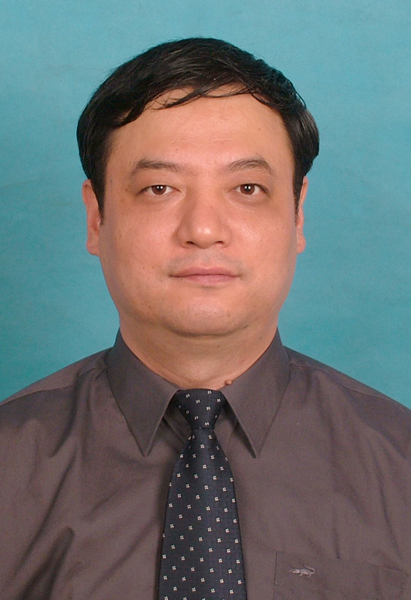
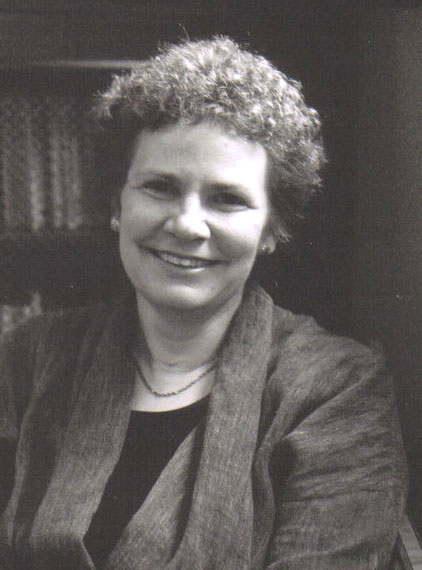
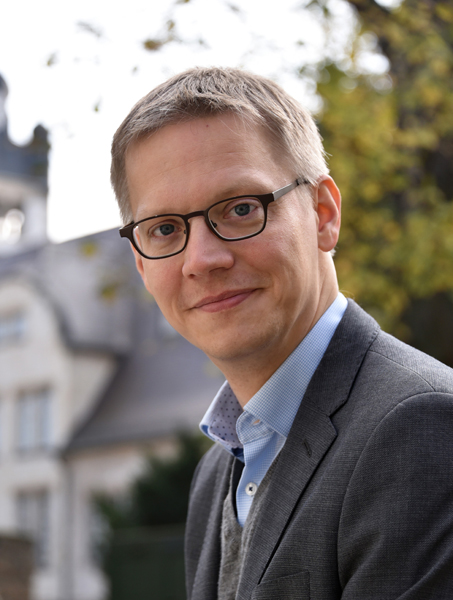
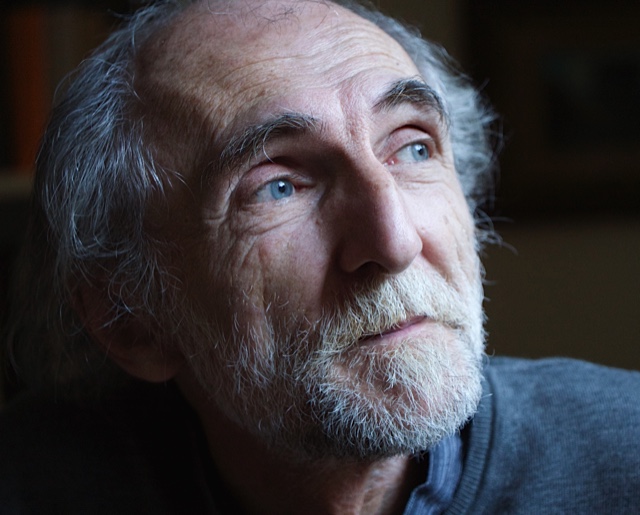
Professor Thomas Lukasiewicz is a Full Professor and Head of the Artificial Intelligence Techniques research group at the Faculty of Informatics, Vienna University of Technology (TU Wien). His research focuses on enabling machines to mimic human-like intelligence through techniques spanning deep learning, symbolic reasoning, and predictive coding. Key areas include explainable AI, hybrid neurosymbolic systems, and applications in healthcare and law. He teaches courses such as Deep Learning for Natural Language Processing, Scientific Research and Writing, and multiple seminars in artificial intelligence and knowledge representation. His research projects include Explainable AI in Healthcare (2023–2027) and foundational work on predictive coding networks. His publications (15+ recent articles) address medical image segmentation, neurosymbolic frameworks, and language model evaluation in mathematics. Notable work includes neurosymbolic hybrid models (CCN⁺), reinforcement learning for medical report generation, and theoretical foundations of predictive coding networks.
Oliver Grau is a Chair Professor for Image Science and a leading figure in Media Art research, affiliated with Hong Kong Baptist University (Academy of Visual Arts, Distinguished Fellow since 2023) and Danube University Krems (Chair Professor for Image Science from 2005–2022). He founded the Archive for Digital Art (ADA) and the international MediaArtHistories Conference Series , with key roles at institutions across Germany, Austria, and Australia. His work bridges art, science, and technology, focusing on immersive images, digital heritage, and emotion research. Key Positions: Director of ADA (since 2000), Founding Director of MediaArtHistories Conference Series (since 2005), PI for high-resolution digitization of the Goettweig Graphic Print Collection (2005–2017). Research Grants: Funded by DFG, Austrian Science Fund, Australian Research Council, VW Foundation (total 8.3 Mio EUR), and Erasmus+ Joint Master program (5.4 Mio EUR). Research Interests: Grau’s scholarship spans the history of media art, telepresence, artificial life, emotion research, and digital humanities. His work emphasizes the evolution of immersive visual experiences from historical art forms to digital media, integrating theoretical and practical approaches. Article Trends: His recent publications focus on digital art’s sociopolitical dimensions, archiving challenges in the digital era, and cross-disciplinary methodologies. Themes include media art conservation, web-based tools for digital humanities, and the intersection of artistic expression with contemporary global issues like climate change and surveillance. Scientific Awards: Distinguished Fellow at Hong Kong Baptist University (2023) Science Award of Lower Austria (2019) Honorary Doctorate from University of Oradea (2014) Invitations to G-20 summit, Olympic Games, and international symposia Labs & Teams: He leads the Archive for Digital Art, managing a global team of 28 staff, and co-founded the Erasmus+ Joint Master in Media Arts Cultures. His projects emphasize collaborative archiving tools (e.g., Web 2.0/3.0 archives) and large-scale digitization initiatives.
Claudia Plant is a Professor in the Faculty of Computer Science , leading the Research Group Data Mining and Machine Learning . Her research focuses on clustering algorithms, data mining, and machine learning applications in areas like biomedical data, wind energy, and causality inference. She has contributed to projects such as Knowledge-infused Deep Learning for Natural Language Processing (2020–2028) and Hybrid Computational Sciences (2021–2021). Plant has authored over 160 publications, with recent work emphasizing deep learning, anomaly detection, and GPU-optimized algorithms. She actively engages in academic activities, including talks on clustering methods and interdisciplinary projects like Governing Algorithms: The Politics of Data and Decision-Making . Her research interests span clustering algorithms , graph neural networks , causality discovery , and ethical digital transformation . Notable projects include causal analysis of wind farm dynamics and AI-enhanced education tools. Plant’s work bridges computational methods with societal challenges, such as empowering marginalized communities through ethical technology adoption.
Prof. Maosong Sun is a Professor at the Department of Computer Science and Technology, Tsinghua University, China. He holds additional leadership roles including Executive Vice Dean of the Institute for Artificial Intelligence and Deputy Director of the National Engineering Laboratory for Cyberlearning and Intelligent Technology. His research focuses on natural language processing (NLP), artificial intelligence, machine learning, and computational education. He leads interdisciplinary projects in computational humanities, knowledge graphs, and MOOC platforms like XuetangX, which has over 58.8 million registered learners. Key contributions include pioneering work in Chinese NLP tools, poetry generation systems like Jiuge, and large-scale research initiatives funded by Chinese and Singaporean programs. Awards include the Tsinghua University Education Award (2019) and the National Outstanding Practitioner Award (2007). Established NLP and Computational Humanities & Social Sciences Lab (2008) Co-director of the Joint Research Center for Extreme Search (2011-present) Over 200 publications with 11,000+ citations (h-index 47)
Emanuel Sallinger is a Full Professor at TU Wien's Databases and Artificial Intelligence Group and Vice Dean of Academic Affairs for Business Informatics and Data Science. He leads the Knowledge Graph Lab, focusing on scalable knowledge-based systems, reasoning in knowledge graphs, and AI integration. His research spans computational logic, database theory, and blockchain applications. Education: PhD in Computer Science (awarded 'sub auspiciis praesidentis rei publicae'), Master's degrees in Computational Intelligence and Informatics Management, and a Bachelor's in Software and Information Engineering. Research Interests: Knowledge graphs (construction, reasoning, scalability), logic-based systems, AI/ML integration with databases, enterprise architecture modeling, and financial knowledge systems. His work emphasizes practical applications like enterprise modeling, sustainable waste management, and regulatory compliance. Grants & Projects: Lead Vienna Science and Technology Fund (WWTF)-funded Knowledge Graph Lab. Involved in projects like 'Knowledge Graph-driven Tour Management' (sustainability), 'SustainGraph' (waste processing), and 'Enterprise Architecture Knowledge Graphs'. Teaching: Offers courses on Knowledge Graphs, Generative AI, Database Systems, and research methodology. Supervises doctoral and master's students in AI, databases, and knowledge representation. Labs/Teams: Knowledge Graph Lab at TU Wien, collaborating with industry on blockchain-based systems, financial AI, and enterprise architecture frameworks.
Gabriella Giannachi is Professor of Performance and New Media and Director of the Centre for Intermedia at the University of Exeter's Faculty of Humanities, Department of English. She leads interdisciplinary collaborations between artists, academics, and scientists to advance research in performance and digital arts. Her educational background includes: BA in Modern Languages and Literatures from Turin University's Faculty of Letters and Philosophy PhD in English from Cambridge University, researching silence in modern European Drama with Trinity Hall scholarship Giannachi's research pioneers performance documentation in mixed reality environments, examining how digital archives function as mobile interpretation hubs for cultural engagement. She investigates mobile user-generated documentation's role in knowledge production, museum visitor dynamics, memory formation, and identity construction within ecological and heritage contexts, with significant focus on copyright and accessibility implications. Her publication trends reveal consistent exploration of presence theory across physical-digital boundaries, with award-winning CHI conference papers (2009-2013) and books like 'Performing Mixed Reality' (2011) establishing frameworks for understanding mixed reality performance, environmental art, and digital heritage preservation. Her scientific recognition includes: Three consecutive CHI Best Paper Awards (2009, 2012, 2013) Theatre Library Association Book Award nomination for 'Performing Presence' (2012) Royal Society of Arts Fellowship nomination (2012) While specific advisees aren't documented, her research partnerships demonstrate extensive collaborative supervision across institutions including Tate, Imperial War Museum, British Library, and Stanford Libraries, securing projects that integrate artistic practice with scientific research. As Centre for Intermedia Director, she cultivates experimental teams investigating how digital archives transform cultural engagement through mobile platforms, particularly in environmental contexts via partnerships with Met Office Hadley Centre and Ludwig Boltzman Institute.
Stefan Woltran is a Full Professor in the Databases and Artificial Intelligence department at TU Wien. He serves as Vice Dean of Academic Affairs for the Informatics Master program and leads the Research Unit for Databases and Artificial Intelligence. His research focuses on logic-based AI, including Propositional Logic, Nonmonotonic Reasoning, Argumentation frameworks, Knowledge Representation, and Logic Programming. He coordinates the Double-Degree Program Logic and Computation. His research projects include analyzing formal properties of logic-based AI approaches, complexity analysis, and developing algorithms via logic and dynamic programming. Notable projects include the HYPAR and REVEAL-AI initiatives exploring abstract argumentation and AI problem-solving. He has contributed to over 150 publications since 2001, focusing on argumentation frameworks, computational complexity, and formal methods. Woltran teaches courses such as Abstract Argumentation, Formal Methods in Computer Science, and Theoretical Computer Science. His work integrates theoretical advancements with practical solver development, such as the ASPARTIX system for argumentation tasks. He actively participates in international conferences and competitions in computational argumentation, emphasizing the application of formal methods to real-world problems.
Professor Maxine Berg is a distinguished historian at the University of Warwick, where she has served as Professor of History since 1998. She is the Founding Director of both the Global History and Culture Centre (2006-2010) and the Warwick Eighteenth Century Centre (1998-2007), and directed the Luxury Project from 1998-2002. Her academic journey began in the Department of Economics at Warwick (1978-1993) before moving to the Department of History. Her educational background includes: BA Hons, Simon Fraser University, Canada (1967-71) MA, University of Sussex (1971-72) DPhil, Oxford (1972-76) Professor Berg specializes in global and world history, economic and social history, and historiography. Her research has significantly shaped our understanding of global trade networks, the development of consumer culture in the eighteenth century, and the connections between luxury goods, economic development, and cultural exchange. She has pioneered interdisciplinary approaches that connect economic history with cultural studies, examining how material culture and consumption patterns have shaped historical developments across national boundaries. Her work on the 'Cultures of Consumption' has been particularly influential in reframing historical narratives around economic development. Her scholarly output demonstrates a clear trajectory from examining British economic history toward increasingly global perspectives, culminating in her leadership of the Global History and Culture Centre. The publications reveal a consistent focus on how material culture, particularly luxury goods, served as conduits for cultural exchange and economic development across national boundaries during the eighteenth century. Her contributions to the field have been recognized through prestigious awards including: ERC Advanced Researcher Fellowship Honorary Fellow of Balliol College, Oxford (2007-present) Fellow of the British Academy (2004-present) Guggenheim Fellowship (2003-2004) Professor Berg has supervised 12 postdoctoral fellows, including one Marie Curie Fellow, and 10 PhD students (3 completed in 2010), and currently supervises 3 postdoctoral fellows, a Museum fellow, and 4 PhD students. She has been instrumental in organizing international scholarly exchange through 15 international conferences and workshops funded by the Leverhulme Research Interchange and the AHRC Global Arts Research Network (2002-2009), and 5 international conferences on Luxury and Consumption (1998-2003). She served on the Standing Committee and Grants Board of the British Academy, where she played a key role in shaping research funding priorities in historical studies. Her leadership extends to directing major research centers, serving on editorial boards, and participating in professorial appointments committees for universities across the UK, US, and France. She was instrumental in framing and setting up the ESRC Cultures of Consumption Programme and has served on funding panels of major research councils including the ESRC and AHRC.
Johannes Grave is Professor of Early Modern Art History at Friedrich Schiller University Jena (since 2019), having previously held professorships at Bielefeld University (2012-2019) and deputy directorship at the Centre allemand d'histoire de l'art in Paris (2009-2012). He earned his PhD from the University of Jena with a dissertation on Goethe's print collection. His research explores art theory, European Romanticism, and historical image studies, with emphasis on: Temporality in visual perception Comparative practices in art analysis German/French/Italian painting traditions The intersection of aesthetics and social imagination His publications demonstrate consistent focus on Romantic landscapes (especially Caspar David Friedrich), Renaissance aesthetics, and redefinitions of the sublime. Recent works critically engage with art historiography, copyright debates, and exhibition politics. Notable scientific recognition includes: Gottfried Wilhelm Leibniz Prize (2020) Hans Janssen Prize for European Art History (2012) Fellowships at DFG research groups in Berlin, Bielefeld, and Greifswald He leads doctoral projects on Romantic art, image comparison, and museology, supervising 18+ PhD candidates. As speaker for the cluster initiative Imaginamics and CRC 1288 'Practices of Comparing', he coordinates interdisciplinary teams exploring social imagination dynamics.
Judith Schoonenboom is a Professor at the University of Vienna and Deputy Head of the Department of Education. She teaches courses in quantitative and interpretive methodologies, research design, and PhD/master's thesis supervision, including seminars like 'Methodology and Research Design' and 'Quantitative Methodologies in Education Science'. Her academic responsibilities reflect a focus on advanced research methodologies in educational contexts. Schoonenboom's research centers on mixed methods and multimethod approaches in education science, emphasizing methodological innovation, data integration, and theoretical development. Key interests include the interplay between qualitative and quantitative research, design patterns in mixed methods, and strategies for enhancing inferential rigor in social science studies. Her work bridges epistemological frameworks with practical research applications. Her scholarly publications demonstrate a consistent focus on advancing mixed methods research, particularly through innovations in design, integration techniques, and theoretical reflection. Recent works explore causal inference in qualitative research, visualization of methodological interactions, and performative approaches, highlighting trends toward interdisciplinary synthesis and practical methodology refinement.
Achille Varzi is a Full Professor of Philosophy at Columbia University since 2006, specializing in analytic metaphysics, logic, and mereology . His academic journey includes an Assistant Professorship at Columbia (1995–1999) and research roles in Artificial Intelligence at Trento’s Institute for Scientific and Technological Research (1989–1995). He earned his PhD from the University of Toronto (1994) under Hans G. Herzberger and holds an honorary professorship at Trento. Research Focus: Leading authority in mereology , exploring part-whole relations through numerous publications, edited volumes, and a forthcoming book with A.J. Cotnoir. His work bridges logic, ontology, and philosophy of language. Public Engagement: Active as a public intellectual with media contributions and a philosophical TV program on Italian national television. Publications Trends: Recent works emphasize classical mereology , ontological neutrality , and vagueness . Earlier contributions include foundational texts on spatial reasoning, identity, and paradoxes in logic. Scientific Awards: Recognized with prestigious fellowships and prizes in Italy and Canada, including the David Savan Dissertation Prize for his groundbreaking PhD thesis. Editorial Leadership: Serves as editor of The Journal of Philosophy since 2001.
Hans Tompits is an Associate Professor in the Department of Knowledge-Based Systems at Technische Universität Wien (Vienna University of Technology). His research focuses on computational logic, declarative logic programming, and formal methods, with a particular emphasis on Answer-Set Programming (ASP). He coordinates the Master's program in Logic and Computation and leads projects in areas such as formal methods for optimization, fault-tolerant autonomous systems, and algorithmic composition. His work bridges theoretical advancements with practical applications, including tools like SeaLion (an ASP IDE with debugging support) and dlvhex (an ASP-based semantic web reasoner). He has contributed to foundational topics like program equivalence, debugging techniques, and integration of ASP with external systems. His recent projects address challenges in autonomous vehicle architectures, music composition algorithms, and safety-critical system design. Tompits has published extensively on topics ranging from nonmonotonic reasoning and modal logics to the development of declarative programming tools. His interdisciplinary approach spans computer science, mathematics, and AI, with applications in both academic and industrial contexts.
Univ.-Prof. Martin Pinzger is a Professor at the Department of Informatics Systems, Alpen-Adria-Universität Klagenfurt. He serves as Head of Department and Member of the Senate, actively contributing to academic governance. Research Focus: Automating Software Engineering Tasks, Mining Software Repositories, Program Analysis, Software Evolution and Visualization Recent Work: Developing tools for API evolution analysis, cybersecurity AI (CAI), robotics benchmarking (RobotPerf), and dependency validation His research combines empirical studies with tool development for software maintenance and security. Current projects address challenges in REST API breaking changes, cloud security certifications, and robotic system performance evaluation. Publications since 2023 demonstrate continued engagement with topics spanning AI-driven code segmentation, microservice API evolution, and cybersecurity tool development. Key trends include cross-disciplinary applications of NLP to software engineering and security-focused tool creation. Contact: martin.pinzger@aau.at
Joachim Schätz is a Lecturer at the Institute for Theatre, Film and Media Studies at the University of Vienna . He previously served as a University Assistant (Post-Doc) from March 2019 to February 2024 and has been a researcher in multiple projects, including the FWF-funded Practices of Educational and Teaching Films in Austria (2019–2023) and the Horizon 2020 Innovation Action Visual History of the Holocaust: Rethinking Curation in the Digital Age as a Research Coordinator (2017–2019). His research interests span the contexts of film usage poetics and politics of comedy theories of detail interfaces between economics and aesthetics documentary practices Austrian and German film history educational film historiography with a focus on media materiality and pedagogical applications. His recent publications and projects emphasize educational films, media history, and intermedial analysis. He co-founded the research network BTWH – The Emergence of Modernity and contributed to the FWF research project exploring Austria's educational film practices. Scientific awards include the DOC team scholarship for the project 'Sponsored Films and the Culture of Modernization' which supported his early research into the interplay of economics and aesthetics in Austrian industrial films. Joachim Schätz has no PhD or Master's students listed in his publications or academic contributions. His work often intersects with collaborative projects, such as the digital resource Lehrfilmpraktiken.at , which he co-coordinated.
Dr. Greca Nathascia Meloni is a filmmaker and ethnographer at the University of Vienna's Institute for Cultural and Social Anthropology , specializing in multispecies relationships and environmental anthropology. Her work bridges academic research with public engagement through ethnographic films and blog platforms like fareapicoltura.net . Current research focuses on non-native plant studies and human-environment interactions Recipient of the Theodor Körner Prize for academic excellence (2021) Research Interests span five core areas: Multispecies Ethnography Visual Ethnography Environmental Anthropology Critical Plant Studies Anthropology of Cultural Heritage Her filmography including The Journey of the Bees (2022) demonstrates expertise in ethnographic filmmaking and environmental storytelling. Recent publications address climate impacts on apiculture, collaborative writing methodologies, and sociocultural dynamics in Mediterranean regions. Scientific Recognition : Theodor Körner Prize (2021) Fiorenzo Serra International Film Festival First Prize (2022) Maintaining strong academic connections through her university role while pursuing independent filmmaking projects, Meloni effectively combines research with creative dissemination.