Dong Wen is a Lecturer and DECRA Research Fellow at the School of Computer Science and Engineering, University of New South Wales, Australia . Previously, he served as a Postdoctoral Research Fellow at the University of Technology Sydney. His research focuses on big graph analytics, distributed algorithms, and graph neural networks , with applications in real-world scenarios through industry collaborations. Research Interests: Dong Wen specializes in data management, graph processing, and real-time analytics. His work intersects computer science with civil engineering through multifunctional cement-based sensors and energy-efficient materials, as evidenced by his recent publications on smart infrastructure and sustainable composites. Scientific Contributions: He has secured the prestigious DECRA fellowship and published extensively on energy-autonomous structural monitoring systems and waste-valorized materials. His research team actively recruits MPhil PhD students with scholarship opportunities available.
Antonia Saravanou is a Ph.D. graduate from the Department of Informatics and Telecommunications at the National and Kapodistrian University of Athens (NKUA), advised by Prof. D. Gunopulos. She holds an M.Sc. in Advanced Information Systems and a B.Sc. in Computer Science from the same department. Since 2011, she has worked as a Research Scientist and Engineer at NKUA and Athens University of Economics and Business (AUEB), and is affiliated with the Knowledge Discovery in Databases Laboratory (KDDLab) and the Management of Data, Information & Knowledge Group (Madgik). Her research spans Data Mining, Machine Learning, and Anomaly Detection, with a focus on Social Network Analysis, Graph Representations, and Healthcare Applications. She has completed research visits at Stanford University's Geometric Computing Group, Spotify Tech Research, and Bloomberg AI. Education: Ph.D., Informatics and Telecommunications, NKUA M.Sc., Advanced Information Systems, NKUA B.Sc., Computer Science, NKUA Her research explores graph-based methods for event detection in social networks, self-supervised node representation learning, and applications in healthcare and news analysis. Projects include music recommendation systems via graph representations, infant mortality prediction models using birth certificate data, and real-time news monitoring frameworks. She has also worked on knowledge graph applications for news ranking and anomaly detection in sparse time series data. Scientific Awards: Outstanding Reviewer for ICLR 2021 Top Reviewer for NeurIPS 2018 As a teaching assistant, she has supported graduate and undergraduate courses at NKUA, including Mining Big Datasets, Data Mining, and Artificial Intelligence. She actively participates in outreach programs like ACM Student Chapter UoA, Rails Girls Athens, and Django Girls.
Dr. Kalliopi Zervanou is an Assistant Professor at the Faculty of Science, Utrecht University, specializing in Natural Language Processing and Text Mining within the Data Intensive Systems research group. Her work bridges Artificial Intelligence, Semantic Web technologies, and healthcare informatics. Research Focus: Information extraction from unstructured texts, interpretable AI methods, and data integration for real-world applications in mental health, logistics, and digital humanities. Education: PhD in Computer Science (University of Manchester, UK), MSc in Machine Translation (UMIST, UK), and BA in French Literature & Linguistics (Aristotle University, Greece). Experience: Former positions at Leiden University, TU/e, Radboud University, Tilburg University, and Technical University of Crete. Visiting researcher at NaCTeM (UK) and USC Viterbi School (USA). Awards: ICAART 2020 Best Industrial Paper award for baggage mishandling prediction research. Her methodological expertise spans rule-based systems, unsupervised learning, and large language models, with a focus on historical texts, OCR error correction, and multilingual challenges. She contributes to healthcare analytics through EHR classification and prognosis modeling.
Vadym Yermolayev serves as a Professor at the Department of Computer Science and Information Technology within the Faculty of Applied Sciences at Ukrainian Catholic University (UCU). He leads UCU's PhD program in Intelligent Systems and holds an Honorary Professorship at Kherson State University. His academic work focuses on semantic technologies, ontology engineering, and knowledge graph construction, with active participation in international research projects and organizations like ACM and ELLIS. Professor of Semantic Technologies Head of PhD Program in Intelligent Systems Honorary Professor at Kherson State University Member of ACM and ELLIS Research Interests span semantic technologies, ontology engineering, and knowledge representation, with applications in education, industrial analytics, and anti-corruption systems. His work integrates machine learning with formal knowledge modeling and develops frameworks for knowledge ecosystem dynamics. Scientific Contributions include leading research groups at Zaporizhia National University and collaborating on European Commission-funded projects. He has published extensively in ICTERI conference proceedings and developed methodologies for terminology saturation analysis and ontology alignment. Honorary Professor at Kherson State University Member of ACM (Association for Computing Machinery) Member of ELLIS (European Laboratory for Learning and Intelligent Systems) Professional Involvement includes external expert roles for European Commission programs (FP6, FP7, H2020) and industrial consulting with Cadence Design Systems GmbH.
Tom Hope is an Assistant Professor (Senior Lecturer) at the Hebrew University of Jerusalem's School of Computer Science and Engineering, and a Research Scientist at The Allen Institute for AI (AI2). His work focuses on developing AI methods that augment and scale scientific knowledge discovery by harnessing vast repositories of scientific knowledge through literature, knowledge bases, and electronic medical records. His educational background includes a PhD with Dafna Shahaf, followed by postdoctoral research at AI2 and the University of Washington working with Daniel Weld and Eric Horvitz. Prior to his PhD, he led an applied AI research team at Intel that published award-winning work. Hope's research spans a full-stack spectrum from constructing new datasets and machine learning models to designing user-facing systems. His primary focus areas include text mining, knowledge graphs, information extraction, multimodal models, LLMs, and human-computer interaction for scientific discovery. He explores how computational approaches can transform the scientific process by helping researchers explore literature, generate hypotheses, and make informed decisions. His work has been featured in top venues including NAACL, EMNLP, ACL, CHI, AAAI, KDD, CACM, and PNAS, with coverage in Nature and Science. His recent publications reveal a strong emphasis on scientific idea generation systems, literature-based hypothesis formation, and tools for navigating scientific literature. His work often bridges AI techniques with real-world scientific challenges, particularly in biomedicine. 2022 Azrieli Early Career Faculty Fellowship (awarded to eight scientists across all fields) KDD 2017 Best Research Paper Award AKBC 2021 Outstanding paper award Selected for 2021 Global Young Scientists Summit Selected for 2019 Heidelberg Laureate Forum ELLIS Society member Member of KDD 2020 Best Paper Selection Committee Hope has advised numerous students from leading institutions including Carnegie Mellon, University of Washington, Georgia Tech, and others. His research is organized around five main thrusts: AI Inspiration systems for idea generation, Biomed Predictions for clinical applications, Knowledge Graph construction, Scientific Information Extraction, and Scientific Search engines for discovery. His work has significant implications for accelerating scientific discovery and improving clinical decision-making through evidence-based AI systems.
Marcin Pietranik is an Assistant Professor at the Department of Applied Informatics within the Faculty of Information and Communication Technology at Wroclaw University of Technlogy . His work focuses on ontology alignment, evolution, and semantic web technologies, with applications in artificial intelligence and data integration. Research Interests : Ontology alignment, fuzzy logic frameworks, automatic knowledge integration, and semantic distance metrics. Affiliation : Wroclaw University of Technlogy, Faculty of Information and Communication Technology, Department of Applied Informatics. Article Trends (15 most recent): Ontology alignment methods using fuzzy logic and semantic attributes Applications of machine learning to fake news detection Business rule validation against domain specifications Deep learning for agricultural tasks (grapevine growth stages) Consensus-building algorithms in multi-agent systems
Diego Reforgiato Recupero serves as Full Professor at the University of Cagliari's Department of Mathematics and Computer Science since February 2022, previously holding an Associate Professor position from December 2015. He maintains dual affiliations as an associated researcher at CNR's Semantic Technology Laboratory (STLAB) and active roles in university governance including the Commission for start-up and spin-off. His research spans Artificial Intelligence, Semantic Web, and Human-Robot Interaction with concrete applications in healthcare robotics and financial AI. Key methodologies include knowledge graph extraction, semantic role labeling, and frame-based language analysis, consistently bridging theoretical NLP with real-world implementations through spin-off ventures. Recent publications reveal a concentrated trajectory in healthcare robotics since 2017, where semantic technologies enable geriatric assessment systems and social robots. This work integrates deep learning with knowledge representation to solve practical challenges in hospital settings, demonstrating strong continuity between his Semantic Web foundations and emerging AI applications. Computer World Horizon Award (2006) Marie Curie International Grant PROVIDEO (2008) Best Researcher Award 2012 Telecom Italia Working Capital Award (2012) 10+ Best Research Paper Awards Data mining/sentiment analysis patent (20100023311) He coordinates major European initiatives including PhilHumans (funding 8 Ph.D. students) and Dr. VCoach Marie Curie Fellowship, while managing approximately 40 FP7/H2020 projects through R2M Solution. His grant leadership spans ICT, energy-saving networks, and robotics with industrial partners like Philips Research. As director of the Human-Robot-Interaction Laboratory and co-director of both the Artificial Intelligence and Big Data Laboratory and Semantic Web Laboratory, he leads interdisciplinary teams developing commercializable technologies. His spin-offs—including VISIOSCIENTIAE for financial AI and B-UP for semantic software—demonstrate consistent translation of academic research into market applications.
Anna Bernasconi is a Tenure-Track Researcher (Assistant Professor) at the Department of Electronics, Information and Bioengineering at Politecnico di Milano, where she leads the Bioinformatics and Data Science Lab within the Genomic Computing group. She has been a visiting researcher at Universitat Politècnica de València (Jan-June 2022). Her research focuses on applying conceptual modeling, data integration, and knowledge engineering in life sciences and other applied sciences domains, with an emphasis on building open-source tools and services. Dr. Bernasconi earned her Master in Computer Engineering in 2015 from Politecnico di Milano and the University of Illinois, Chicago. She completed her PhD from Politecnico di Milano in 2021 with a thesis on genomic data integration. Her academic journey has positioned her at the intersection of computer science and bioinformatics. Her research interests span multiple areas of bioinformatics and data science. She specializes in bioinformatics data and metadata integration methodologies to support complex biological query answering. In recent years, she has focused on viral genomics , particularly sequence modeling, integration, and search systems for mitigating the effects of pandemics like COVID-19. She applies conceptual modeling and knowledge engineering techniques to develop open-source tools for genomic data analysis. Her work bridges computer science with life sciences, addressing challenges in genomic surveillance, data integration, and knowledge management. Dr. Bernasconi's recent publications demonstrate a clear trend toward developing practical tools for genomic surveillance and text analysis. Her work spans from viral genome analysis (Nature Communication 2024) to database systems (SIGMOD 2024) and topic modeling for large text corpora (EDBT 2025), showing her ability to work across multiple technical domains while maintaining a focus on real-world applications in health and environmental science. National Scientific Habilitation in two categories: 09/H1 – Sistemi di Elaborazione delle Informazioni (II Fascia) and 01/B1 – Informatica (II Fascia) Principal Investigator of the SENSIBLE PRIN PNRR 2022 project (funded with ~240K Euros) Principal Investigator of the NGI Search TETYS project (150K Euros funding) Co-founder of LegisRatio S.r.l., a Politecnico di Milano spin-off innovative startup Academic Editor for Plos One and BMC Bioinformatics Dr. Bernasconi actively mentors students and collaborates across disciplines. She is Principal Investigator of significant research projects including SENSIBLE, which aims to develop an early warning system for viral pathogens based on genomic surveillance, and TETYS, which focuses on topic modeling and visualization for large text corpora. Her research has secured funding from the Italian Ministry of University and Research (MUR) and the European Union's Horizon Europe program. She collaborates with experts across disciplines, including virologists like Prof. Ilaria Capua from Johns Hopkins University. She leads the Bioinformatics and Data Science Lab at Politecnico di Milano, which has developed several notable tools including ViruClust (for comparing SARS-CoV-2 genomic sequences), VariantHunter (for monitoring mutation evolution), and RecombinHunt (for identifying recombination events in viral species). Her team also created CORToViz for exploring the CORD-19 dataset and TETYS for topic modeling in various domains including climate change research.
Assoc. Prof. Vassia Atanassova, PhD is an Associate Professor in the Bioinformatics and Mathematical Modelling Department at the Institute of Biophysics and Biomedical Engineering , Bulgarian Academy of Sciences. She holds a PhD in Informatics and Computer Sciences (2013) and has been actively contributing to generalized nets, intuitionistic fuzzy sets, and decision-making under uncertainty since 2002. Education : PhD in Informatics and Computer Sciences (2013), Institute of Information and Communication Technologies – BAS Master in Marketing (2009), University of National and World Economy Bachelor in Informatics (2004), Faculty of Mathematics and Informatics, Sofia University Her research focuses on intuitionistic fuzzy logic applications, generalized net modeling , and Wiki technologies for knowledge transfer . She has developed novel intuitionistic fuzzy operators and conducted extensive work on intercriteria analysis for complex systems. Recent publications emphasize fuzzy decision-making frameworks (2015-2019), with applications in Algorithm optimization Economic modeling Bioinformatics Medical data analysis Scientific Awards : Youngest Researcher Award 'Ivan Evstratiev Geshov' (2011) 2nd Award, VIII Youth Session of Federation of Scientific-Technical Unions (2010) She serves as Guest Editor for MDPI Mathematics and technical editor for international journals. Her teaching includes PhD-level courses on Wikipedia-based knowledge transfer and fuzzy set theory at Bulgarian universities.
Dr. Asef Nazari is a Senior Lecturer in Mathematics at Deakin University's School of Information Technology, Faculty of Science Engineering and Built Environment. With over two decades of experience, his work spans mathematical modeling, optimization, and AI applications in energy systems, supply chains, and cybersecurity. Education : PhD (University of Ballarat), MSc (Amirkabir University of Technology), BSc (University of Tabriz), Graduate Certificate in Higher Education Teaching (Deakin University) Research : Focuses on Electricity network planning with renewables Optimization techniques (non-smooth, integer programming) AI/ML for cryptocurrency markets and causal inference Community battery systems for EV charging Soft happy coloring in network analysis Supply chain and project scheduling optimization Grants : Leads industry collaborations like the REACH Scholarship (2025–2028) and has secured funding from Monash University/ClimateWorks and The Ian Potter Foundation. Teaching : Developed the 'Mathematics for AI' master's unit, emphasizing real-world problem-solving in optimization, operations research, and data analysis. Supervision : Currently guides 8 PhD students in topics like AI-driven authentication security and land-use modeling. Awards : Recognized as a Fellow of the Higher Education Academy (FHEA)
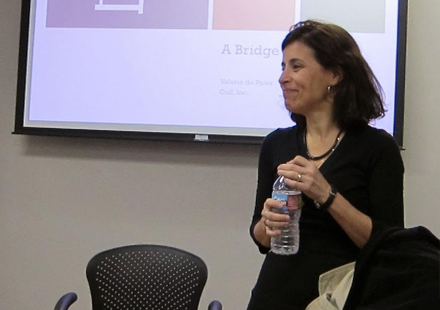
Valeria de Paiva is a mathematician and AI research scientist, currently serving as Founder of the Topos Institute in Berkeley where she explores the deep connections between mathematics, logic, and computation. She earned her PhD under the supervision of Martin Hyland, working on Dialectica categories, which established her foundational work connecting linear logic with Gödel's Dialectica interpretation. Dr. de Paiva's research spans category theory, programming languages, type theories, and logic in computer science, with special emphasis on the semantics of natural language and lexical semantics. She has pioneered work in linear and modal logics and their applications to mathematics, particularly in building tools to extract, structure, and reason about mathematical knowledge. Her research bridges symbolic/structural and distributional meaning representations through knowledge graphs, ontologies, and computational frameworks. Her recent publications reveal a strong trend toward mathematical concept extraction and natural language processing for mathematical texts. She has developed innovative approaches like MathGloss for building mathematical glossaries and Parmesan for educational concept extraction, demonstrating how theoretical foundations in category theory can solve practical problems in knowledge representation and education. Among her notable recognitions is the unofficial title of 'Ambassador of Logic,' awarded after she was invited by the Division of Logic, Methodology, and Philosophy of Science and Technology to record a video on logic. She has served as council member of this division from 2020-2023. Dr. de Paiva is deeply committed to mentoring and supporting women in logic and computer science. She has mentored 12 PhD students and postdocs at the Applied Category Theory MRC 2022. She co-founded and maintains the Women in Logic website, blog, and Facebook group, serves on the steering committee for Women in Logic, and helps organize the Workshop on Women in Logic, which has held nine editions as of the latest information. She also contributes to the ACM-W Scholarship Program supporting women students in computing worldwide. She is actively involved in numerous academic initiatives including serving as co-chair for CICM 2025 and MFPS 2024, and as scientific committee member for CT2025. She co-founded groups including Women in Logic, Lógicas Brasileiras, and the Women in Logic Workshop, and has organized numerous international conferences and workshops focused on logic, category theory, and computational semantics.
James Martin is a Professor of Computer Science at the University of Colorado at Boulder and a Fellow in the Institute of Cognitive Science. He holds a B.S. in Computer Science from Columbia University and a Ph.D. in Computer Science from the University of California at Berkeley. His research focuses on computational semantics, particularly how languages convey meaning to humans and computers, with a specific emphasis on metaphor processing and non-literal language analysis. He co-authored the widely used textbook Speech and Language Processing (3rd edition in progress), and his work extends to applications in healthcare and education through projects like the TalkMoves dataset analyzing classroom discourse. Current research includes cross-document event coreference resolution, AMR parsing tools (e.g., X-AMR), and AI-driven educational systems via the Institute for Student-AI Teaming (iSAT). Education History: Bachelor of Science in Computer Science, Columbia University Doctor of Philosophy (Ph.D.) in Computer Science, University of California, Berkeley Research Interests: Natural Language Processing (NLP) and Computational Linguistics Metaphor Analysis in Language and AI Semantic Parsing and Knowledge Representation AI Applications in Healthcare and Education Dialogue Systems and Classroom Discourse Analysis Recent Work Trends: His 2023-2024 publications emphasize multimodal NLP, cross-document semantic analysis (e.g., event coreference resolution), and AI tools for education (e.g., TalkMoves application for teacher feedback). NSF-funded National AI Institutes collaborations highlight strategic technology development. No scientific awards explicitly listed, though his textbook and research contributions are widely recognized in the field. Currently not actively recruiting PhD students. Labs/Teams: Core contributor to NLP initiatives at University of Colorado, particularly in semantic parsing and educational AI through iSAT. Involved with projects like the TalkMoves dataset and AMR annotation tools (CAMRA, X-AMR).
Minhong Wang is a Professor at the Faculty of Education, University of Hong Kong, with additional affiliation at the University of Edinburgh's Usher Institute. With an extensive publication record spanning over two decades from 2005 to 2025, Wang has established themselves as a leading researcher in educational technology and learning sciences. Their work bridges the gap between computer science and education, developing innovative technology-enhanced learning environments that support complex skill development and knowledge construction. Wang's research interests focus on educational technology, learning analytics, computer-supported collaborative learning, and cognitive mapping approaches. Their work examines how technology can enhance problem-solving processes, support self-regulated learning, and improve educational outcomes across various contexts. Recent research has expanded into multimodal learning analytics, teacher professional development through technology, and the application of advanced computational methods to educational challenges. Wang's approach integrates theoretical frameworks with practical implementations, creating systems that transform how educators and learners interact with digital environments. Analysis of Wang's recent publications (2023-2025) reveals a strategic expansion of research scope while maintaining core educational technology focus. The work demonstrates increasing sophistication in learning analytics methodologies, with growing integration of computer vision techniques and advanced machine learning approaches. This reflects a trend toward more comprehensive multimodal analysis of learning processes, moving beyond traditional text-based interactions to incorporate visual, spatial, and behavioral data in educational contexts. The research maintains strong practical applications while advancing theoretical understanding of how technology mediates learning. Wang has collaborated extensively with researchers across multiple institutions globally, particularly in Hong Kong, mainland China, and international partners. Their work demonstrates consistent funding support through numerous research projects, though specific grant details aren't visible in the publication record. The collaborative nature of the work suggests leadership in research teams focused on developing and evaluating innovative educational technologies.
Behrooz Mansouri is an Assistant Professor of Computer Science at the University of Southern Maine. He holds a Ph.D. (2022) in Computer Science from the Rochester Institute of Technology (Rochester, NY), an M.Sc. (2017) in Software Engineering from the University of Tehran, and a B.Sc. (2013) in Software Engineering from Shahid Beheshti University. His roles include Director of the Michael E. Dubyak Center, Director of the Artificial Intelligence and Information Retrieval (AIIR) Lab, and Graduate Program Director. He previously worked on the Parsijoo Persian search engine project and co-organized the ARQMath lab during his Ph.D. Education: Ph.D., Computer Science, Rochester Institute of Technology, USA (2022) M.Sc., Software Engineering, University of Tehran, Iran (2017) B.Sc., Software Engineering, Shahid Beheshti University, Iran (2013) His research focuses on Information Retrieval (IR) , Natural Language Processing (NLP) , and Mathematical Information Retrieval (MIR) . He leads the AIIR Lab, which develops systems like MathMex (a conversational math search engine) and explores cross-lingual math retrieval, legal question classification, and cloud detection in satellite imagery. Recent projects include NSF-funded work on conversational math search and participation in CLEF SimpleText labs. His lab's work has been recognized, including a Best Lab Paper at SimpleText'24 and an NSF CRII Grant (2024). He advises students on projects like legal case search, math definition extraction, and AI ethics in STEM education. Grants & Awards: NSF CRII Grant: 'Towards Conversational Search Systems for Math' (2024) Best Lab Paper at SimpleText'24 (2024) Outstanding Reviewer at ECIR 2024 Doctoral Consortium Co-chair at SIGIR 2025 The AIIR Lab collaborates on interdisciplinary projects, including MathMex (math definition search), Cloud Detection in Satellite Images , and Tree Classification . Prospective students are encouraged to align with these research themes and apply via specific guidelines outlined on his website.
Mr. Waqar Ali is a Lecturer and Research Assistant at the ZHAW School of Engineering (Zurich University of Applied Sciences), affiliated with the Machine Perception & Cognition Group. His academic journey includes a Bachelor's (2016) and Master's (2019) in Computer Science from Comsats University. He has held teaching roles at Lahore Garrison University (2021) and Abasyn University (2019–2021). His research focuses on Pattern Recognition, Graph Neural Networks, Deep Learning, and Natural Language Processing. Awards include the Shahbaz Sharif Merit Scholarship (2017) and a Bachelor Fellowship from HEC Pakistan (2012). Notable projects include an Evidence-Based Diagnostic Assistance for Echocardiography initiative. His publications span advanced graph learning techniques, sentiment analysis models, and energy optimization systems. He has contributed to peer-reviewed journals and conferences such as the Joint IAPR Statistical Techniques in Pattern Recognition (2024). His work bridges theoretical machine learning with practical applications in healthcare diagnostics, smart grids, and Urdu language processing. Collaborative projects include roles at the University of Alicante (2024).