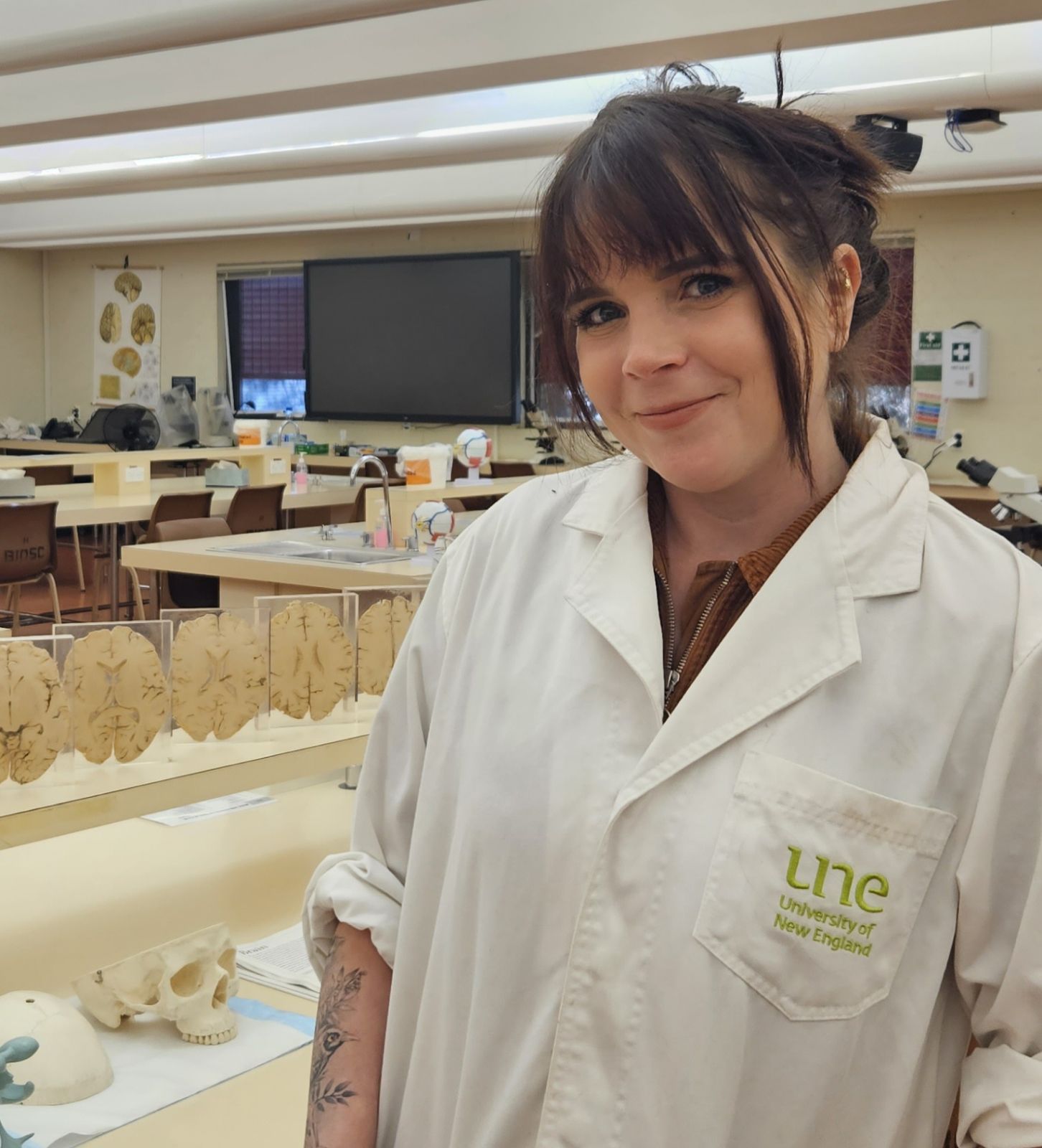
Dr. Lucy Farrow is a Lecturer in Biomedical Science at the University of New England's School of Science and Technology, specializing in neurobiology and avian cognition. Her research investigates how anthropogenic stressors affect neural development and cognition in native bird species. Research explores avian neuroethology through behavioral experiments and cellular analysis. Key interests include acoustic individual recognition in wild passerines, neural impacts of environmental stressors, and context-specific antipredator behaviors. Work integrates quantitative neurobiological methods with field observations to study cognitive adaptations. Publications reveal focus on avian communication systems, particularly alarm call semantics and individual recognition, alongside emerging work on automated mobility systems. Recent studies examine noisy miner cognition and neurobiological techniques like flow cytometry for neuronal quantification. No scientific awards listed.
Amy Moran is a faculty member at the School of Life Sciences within the University of Hawai'i at Mānoa . Her research focuses on the physiological ecology and evolution of marine invertebrates , with particular emphasis on eggs, embryos, and larvae , as well as their responses to climate change factors . She leads the Moran Lab, which conducts interdisciplinary research across diverse environments from the tropics to the poles . Research Themes: Marine invertebrate ecophysiology Larval development and thermal sensitivity Climate change impacts on Antarctic and tropical species Evolutionary life history biology Recent Student Advancements: Graham Lobert (PhD 2025): Temperature effects on Antarctic invertebrate embryos Ethan Nash (MS 2025): Plasticity in tropical echinoids Aaron Toh (PhD 2025): Antarctic larval and thermal ecology Gabi Mukai (PhD 2025): Fisheries insights via oceanographic modeling and sociology Scientific Awards: ADVANCE Fellows Award (2005): Recognizing research on egg size evolution in tropical marine invertebrates The Moran Lab integrates field and laboratory studies to explore how temperature and oxygen availability influence body size (e.g., polar gigantism), developmental energetics, and dispersal mechanisms in marine organisms. Their work spans Antarctic sea spiders , corals , and barnacles , with recent articles analyzing phenotypic plasticity , thermal tolerance , and metabolic scaling . Lab members actively engage in marine education and outreach .
Dr. Kyle Artelle is an Assistant Professor in Environmental Biology at SUNY College of Environmental Science and Forestry, with adjunct appointments at the University of Victoria. His research focuses on conservation approaches supporting both people and biodiversity, particularly through Indigenous-led stewardship models. Research areas include: carnivore ecology, human-wildlife coexistence, and Indigenous governance in conservation. Fieldwork occurs primarily in the Great Bear Rainforest in partnership with Heiltsuk, Wuikinuxv, Kitasoo/Xai'xais, and Nuxalk First Nations. Current projects include grizzly bear stewardship programs and marine ecosystem restoration initiatives. Dr. Artelle advises multiple graduate students and maintains affiliations with the Center for Native Peoples and the Environment. Research Focus: Indigenous-led conservation governance Human-carnivore coexistence Bear ecology and salmon interactions Community-based monitoring Decolonial conservation models
Dr Iva Popovic is an Adjunct Research Fellow in the School of the Environment at The University of Queensland. Her research focuses on evolutionary biology, marine conservation, and genomics, particularly addressing challenges in coral reef ecosystems, invasive species dynamics, and climate adaptation. She leads projects on genetic diversity in marine organisms and the application of genomics to conservation strategies. PhD in Biological Sciences from The University of Queensland (2019) Her work spans coral speciation, hybridization, and the genetic basis of thermal tolerance in marine species. She collaborates on tools like Reef Adapt to inform climate-smart marine management. Over 24 peer-reviewed articles and 4 datasets highlight her contributions to marine genomics and biodiversity research. Key research interests include: coral predator genetics, cryptic species discovery, and genomic tools for invasive species control. She emphasizes practical applications of evolutionary insights for conservation.
Rebecca MacKay is an Assistant Professor in the Department of Biology at Fort Valley State University's College of Arts and Sciences. Her research focuses on parasitology and behavioral ecology, particularly examining how parasites influence the behavior of aquatic invertebrates like crayfish. Her recent work explores parasitic effects on grazing behavior in keystone species, decision-making in prey under conflicting environmental stimuli (landscapes of fear vs. safety), and context-dependent personality changes in crayfish. These studies highlight interdisciplinary intersections between parasitology, behavioral ecology, and aquatic ecosystem dynamics.
Dr. Paul A. Moore is a Professor in the Department of Biological Sciences at Bowling Green State University's College of Arts and Sciences. His research focuses on sensory ecology, particularly chemical ecology and behavior of aquatic organisms, through the Lab for Sensory Ecology which he founded in 1994. The lab investigates how chemical signals mediate ecological decisions in crustaceans, combining techniques from physics, chemistry, psychology, and ethology across laboratory, field, and oceanic environments. Research interests span Chemical plume dynamics in aquatic environments Neuroethology of crustacean orientation Predator-prey interactions Ecotoxicological impacts on behavior Social hierarchy formation Hydrodynamic signal processing Scientific contributions emphasize the interplay between environmental physics and sensory biology, with collaborations in Woods Hole, Stony Brook, Berkeley, Milwaukee, and the Bahamas. Laboratory work integrates Multi-disciplinary methodologies GIS modeling Neurochemical analysis Field observation Experimental ecology Computational simulations Graduate training emphasizes independent project development, scientific thinking, and holistic skill development. Alumni hold faculty positions at institutions like Aurora University, Grand Valley State University, and Virginia Tech, while others pursue careers in conservation, epidemiology, and environmental policy.
Dr. Iain McKechnie is an Associate Professor of Anthropology at the University of Victoria, where he directs the Historical Ecology & Coastal Archaeology (HECA) Lab and the UVic Zooarchaeology Lab . His research integrates coastal archaeology, zooarchaeology, and historical ecology to examine Indigenous fisheries, marine conservation, and human-environment interactions on the Northwest Coast. He collaborates extensively with First Nations communities and institutions like the Hakai Institute and Parks Canada. Education: PhD in Anthropology (University of British Columbia) MA in Archaeology (Simon Fraser University) BA in Anthropology (University of California, Santa Cruz) Dr. McKechnie's research focuses on coastal archaeology , zooarchaeology , and historical ecology , emphasizing the role of archaeological data in supporting Indigenous knowledge and marine conservation. His work investigates long-term sustainability in fisheries, Indigenous resource management, and the impacts of climate change on coastal ecosystems. He employs interdisciplinary methods, including ancient DNA analysis and geospatial modeling, to reconstruct historical ecological dynamics. His publications reveal a consistent emphasis on Indigenous fisheries , marine historical ecology , and collaborative conservation . Recent articles explore topics ranging from ancient genomics of Coast Salish woolly dogs to paleothermometry in fisheries, highlighting trends in climate adaptation, biodiversity governance, and ethical research partnerships with Indigenous communities. Grants and Collaborations: McKechnie's research is supported by the Natural Sciences and Engineering Research Council (NSERC), Social Sciences and Humanities Research Council (SSHRC), Mitacs, Parks Canada, the Hakai Institute, and the Canadian Foundation for Innovation. He works with multiple First Nations on heritage management and environmental policy. He co-directs the HECA Lab, which engages graduate students in climate change and heritage projects, and the UVic Zooarchaeology Lab, housing over 2,980 animal skeletons for osteological research. Additionally, he holds affiliate positions at the Bamfield Marine Sciences Centre and co-organizes international conferences like the International Council of Archaeozoology (ICAZ) 2027.
Fred Watson is a Professor in the Department of Applied Environmental Science at California State University, Monterey Bay , affiliated with the College of Science . His interdisciplinary work integrates teaching, research, and practical application across diverse environmental and ecological domains. Native plant ecology Wildlife ecology Remote sensing Hydrology Conservation planning His scholarly contributions focus on ecosystem dynamics , water quality treatment , and land use strategies , with recent articles (2018–2022) addressing predator-prey interactions, agricultural bioreactor design, and conservation survey methodologies. His research emphasizes simulation modeling , spatial ecology , and sustainable resource management .
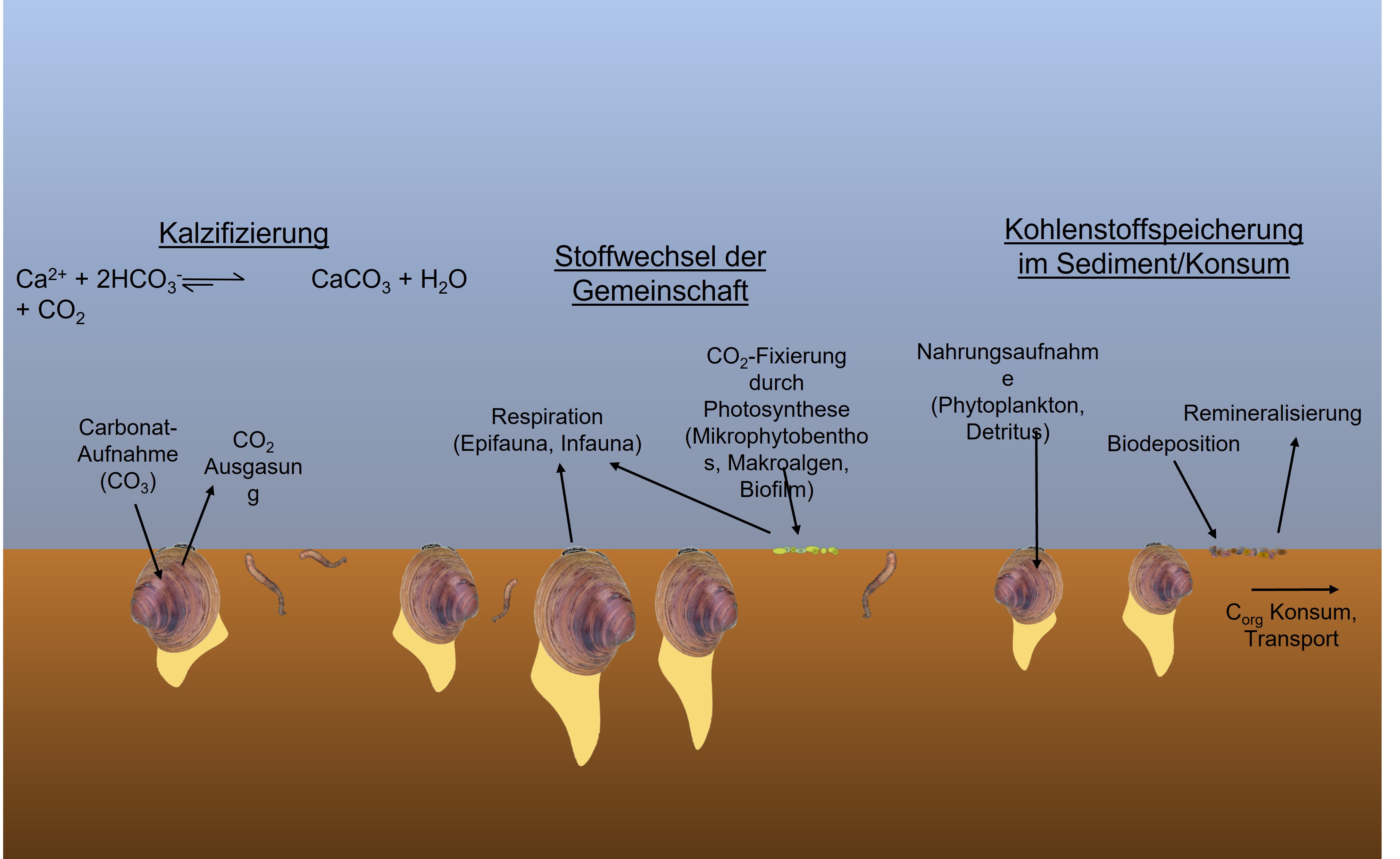
Dr. Fabian Wolf is a researcher at the Leibniz-Institute for Baltic Sea Research (IOW) in Rostock, Germany. His work focuses on experimental stress ecology , analyzing how marine heatwaves , upwelling events , and climate change affect benthic species communities in the Baltic Sea. He specializes in mesocosm systems and long-term abiotic data analysis , particularly in Arctica islandica community dynamics and Blue Carbon processes. His recent research examines the interplay between temperature variability and ecological resilience , with publications on keystone predator stress responses and macroalgal community fluctuations . Funded by the Deutsche Bundesstiftung Umwelt (DBU) , his doctoral scholarship supports studies on extreme climate events and their mitigation potential. Dr. Wolf has presented at international conferences, including the Swedish Oikos Conference (2023) and British Ecological Society's Festival of Ecology (2020). His work integrates physical oceanography with biological impacts , contributing to understanding coastal ecosystem stability under environmental change.
Dr. Andreanna Welch is an Associate Professor in the Department of Biosciences at Durham University, leading the Welch Lab which focuses on molecular ecology, evolution, and phylogenomics. Her research integrates genetic techniques with ecological and environmental data to address biodiversity conservation, evolutionary processes, and responses to environmental change. She employs ancient DNA, metagenomics, and transcriptomics to study species across scales, from genes to ecosystems. Key research interests include understanding mechanisms driving biodiversity, ecological adaptations, and conservation strategies for species facing anthropogenic pressures. She investigates topics such as evolutionary relationships, niche partitioning, and species coexistence. Current projects span seabird phylogenomics, seal population dynamics in Antarctica, and biodiversity in African cocoa agroforestry systems. She actively mentors PhD, postgraduate, and undergraduate students, emphasizing interdisciplinary approaches. Dr. Welch collaborates internationally, with studies on Hawaiian petrels, Caribbean migrants, and urban bird ecology. Her work highlights the impact of climate and human activity on biodiversity, using ancient DNA to trace historical population trends. She advocates for diversity in science and promotes sustainable agriculture through ecosystem service analysis. Lab Website: Welch Lab Studentship Opportunities: Competitive PhD funding available annually.
Daniel Hernández is a Professor of Biology at Carleton College, where he has been affiliated since 2009. He holds roles in interdisciplinary programs such as the UC Santa Cruz Doris Duke Conservation Scholars Program (2016–2025) and chairs the board of Sharing Our Roots (2022–2024). His work bridges ecological research, conservation, and education. He earned a PhD in Biology from the University of Minnesota. Dr. Hernández’s research focuses on prairie ecosystems, restoration ecology, and the impacts of land management practices. Key areas include soil carbon dynamics, biodiversity conservation, plant-herbivore interactions, and the effects of climate change on plant communities. He actively participates in field-based studies, emphasizing practical applications for sustainable agriculture and wildlife management. He teaches advanced courses such as Directed Research in Biology (BIOL 394), Global Change Biology (BIOL 210), and interdisciplinary courses like Food, Forests & Resilience (ENTS 250). His courses often incorporate fieldwork, including a study abroad program in Oaxaca (ENTS 251). His research outputs emphasize ecosystem resilience, invasive species control, and the interplay between human activities and natural systems. Notable studies explore grazing impacts on prairie diversity and the ecological roles of keystone species like beavers and wolves. Dr. Hernández’s lab, the Conservation Science and Stewardship Lab, fosters collaborative projects with environmental organizations and policymakers to inform conservation strategies. He advocates for community engagement in ecological stewardship and STEM accessibility for underrepresented groups through SACNAS and SACNAS.
Kevin Sedivec is a Professor in the School of Natural Resource Sciences at North Dakota State University (NDSU). His career focuses on rangeland management, animal nutrition, and sustainable livestock systems, with extensive engagement in extension programs. Role : Professor and Range Science Program Lead Contact : 201B Morrill Hall, (701)-799-4689 Research Interests include: Range Nutrition Noxious Weed Management Grazing Systems Rangeland Monitoring Horse Forages His recent publications (2023–2025) emphasize maternal nutritional programming , soil microbiome responses to grazing/fire , and economic/technological tools for forage management . Studies explore how vitamin/mineral supplementation in beef heifers affects fetal development, immune responses, and multigenerational metabolic outcomes, alongside rangeland restoration techniques. Education : Ph.D., Animal and Range Sciences, NDSU (1994) M.S., Animal and Range Sciences, NDSU (1989) B.S., Zoology, NDSU (1987)
Dr. Diana Tomback is a Professor and Chair of the Department of Integrative Biology at the University of Colorado Denver. She is renowned for her work in conservation biology and forest ecology, particularly focusing on high-elevation white pines and their ecological interactions. In 2023, she was honored as an AAAS Fellow, recognizing her distinguished contributions to understanding treeline dynamics, seed dispersal networks, and forest restoration strategies under climate change. Her research emphasizes the critical role of species like whitebark pine (Pinus albicaulis) as keystone and foundation species, leveraging advanced techniques such as remote sensing and machine learning to improve ecological monitoring. She has led interdisciplinary efforts to develop restoration plans for imperiled pine ecosystems, integrating climate science, policy, and community engagement. Dr. Tomback’s work bridges ecology, conservation, and technology, with a focus on mitigating threats from invasive pathogens, altered fire regimes, and climate variability. Awards: AAAS Fellow (2023) Key Themes: Whitebark pine conservation, treeline ecology, seed dispersal by Clark’s nutcrackers, climate adaptation, and ecological restoration. Her publications span over three decades, addressing topics like post-fire regeneration, species distribution modeling, and the socio-ecological impacts of invasive pathogens. She actively collaborates with federal agencies and NGOs to translate research into actionable conservation strategies.
Dr. Anthony Lowney is a Lecturer in Zoology at Hartpury University and Research Associate at the FitzPatrick Institute of African Ornithology. His research examines positive species interactions in extreme environments, particularly sociable weaver colonies as biodiversity hotspots. Key Findings: Documented 100+ species utilizing weaver colonies in the Kalahari Quantified microclimate moderation within colonies (ΔT = 4-8°C) Identified facilitation cascades supporting endangered species He contributes to the Kalahari Ecosystem Engineer Project (KEEP), investigating climate change impacts across trophic levels. Fieldwork spans South Africa, Chad, and the Philippines, including rediscovery studies of critically endangered birds.
Dr. Christopher Gordon is a Research Fellow at the Hawkesbury Institute for the Environment (HIE), Western Sydney University, with extensive expertise in landscape ecology and conservation biology. His research spans Australian and South African ecosystems including arid zones, savannas, and forests, focusing on biotic-abiotic interactions and disturbance impacts. His research interests center on wildfire ecology/risk management and trophic ecology . He investigates historical wildfire regimes' effects on carbon sequestration and biodiversity, and apex predator extirpation impacts on ecosystem resilience. His work employs landscape-scale field surveys, remote sensing, and spatial analysis across multiple biomes. Gordon's publication trends reveal strong focus on disturbance ecology (fire regimes, predator loss) and conservation applications (rewilding, fire management). His recent work connects trophic cascades to landscape-scale changes using innovative methods like drone LiDAR. Excellence in Research Impact Award (2023) with HIE Bushfire Research Group He secures significant funding including multiple 2023-2024 NSW government grants for Black Summer fire recovery monitoring, rainforest wildfire reconstruction, and flying fox conservation. His current HIE project uses remote sensing to study drought-wildfire interactions in eastern Australian rainforests. Gordon maintains active international collaborations, evidenced by his Aarhus University postdoc (2018-2020) on African elephant rewilding. His research directly informs environmental management policy through NSW government partnerships.