Stefan Hagelمشاهده پروفایل
دانشیار
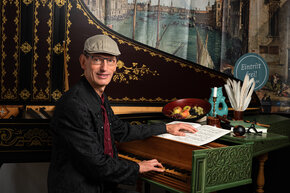
Stefan Hagel serves as Privatdozent and Deputy Head of the Department of Ancient Sciences at the Austrian Academy of Sciences (ÖAW), where he leads the Research Group Ancient Music. His academic appointment is formally affiliated with the University of Vienna, reflecting his dual institutional presence in Austria's scholarly ecosystem. Institution: Austrian Academy of Sciences / University of Vienna Position: Privatdozent, Deputy Department Head, Group Leader Research Focus: Ancient Music Archaeology and Digital Humanities Hagel's research bridges classical philology, archaeology, and computational methods to reconstruct ancient musical practices. His work centers on Greek and Roman music theory, instrument reconstruction (particularly lyres and auloi), and the application of digital tools to analyze ancient musical systems. His methodology combines physical reconstructions with textual analysis and software development, creating interdisciplinary pathways for understanding antiquity's sonic dimensions. Hagel frequently demonstrates his findings through international lecture-concerts, making ancient music tangible for academic and public audiences alike. His recent publications reveal a trajectory toward increasingly sophisticated technological integration, examining water organs, solmisation systems, and cross-cultural musical exchanges across the Mediterranean and Near East. Hagel's scholarship demonstrates how computational approaches can resolve longstanding questions about instrument mechanics, tuning systems, and performance practices that traditional philological methods alone cannot address. Major Projects: 'Ancient Music Beyond Hellenisation', 'DiAGRAM' (Digitising Aspects of Graphical Representation in Ancient Music) Software Development: Classical Text Editor (critical editions platform), MultiKey (keyboard utility) As an active participant in the European Music Archaeology Project, Hagel collaborates internationally to reconstruct ancient soundscapes. His work with physical instrument reconstructions provides empirical data for theoretical models, while his digital humanities initiatives create infrastructure for future research. Though not explicitly mentioned in the materials, his leadership position suggests involvement in mentoring junior researchers and securing research funding for his specialized field.