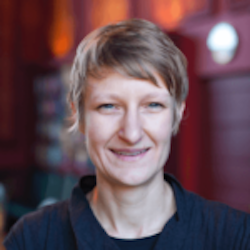
Professor Ekaterina Pavlovskaia is a distinguished academic and Head of the School of Engineering at the University of Aberdeen, UK. She holds a Personal Chair in Mechanical Engineering and has been a key figure in advancing research in nonlinear and non-smooth dynamical systems. Her academic career at Aberdeen spans over two decades, progressing from Research Fellow to Professor and Head of School. Her educational background includes a Ph.D. in Applied Physics and Mathematics from the Institute for Problems of Mechanical Engineering (IPME), Russian Academy of Sciences (1998), and an MEng in Mechanical Engineering with first-class honors from St. Petersburg State Polytechnical University (1996). Ekaterina’s research focuses on nonlinear dynamics , vibro-impact systems , fracture mechanics , and offshore drilling technologies . She has led pioneering work in modeling complex mechanical systems involving impacts, wave propagation, and dynamic contact problems. Her research integrates theoretical, numerical, and experimental approaches, often targeting industrial applications in energy and mechanical systems. The analysis of her recent publications reveals a consistent focus on nonlinear phenomena in mechanical oscillators, particularly near grazing and bifurcation thresholds. Her work bridges fundamental dynamics with practical engineering challenges, such as percussive drilling and vibration control using smart materials like shape memory alloys. Chartered Engineer (CEng) Fellow of the Institution of Mechanical Engineers (FIMechE) Subject Editor, Journal of Sound and Vibration Regular reviewer for multiple high-impact journals in mechanics and dynamics She has secured significant research funding as Principal or Co-Investigator from organizations including the Royal Academy of Engineering, EPSRC, ITI Energy, and the Royal Society. Her projects often involve international collaboration, particularly with institutions in Russia and Thailand, focusing on sustainable offshore decommissioning and energy extraction technologies. She has supervised multiple research students and contributed to knowledge transfer via KTP projects. She is a member of the editorial board for Mathematical Problems in Engineering (2007–2011) and continues to shape the discourse in mechanical dynamics through her editorial and peer-review roles. She is actively involved in research teams focusing on energy systems and structural dynamics, particularly within the Centre for Applied Dynamics Research (CADR) at the University of Aberdeen. Her leadership extends to guiding strategic research directions in engineering through her role as Head of School.