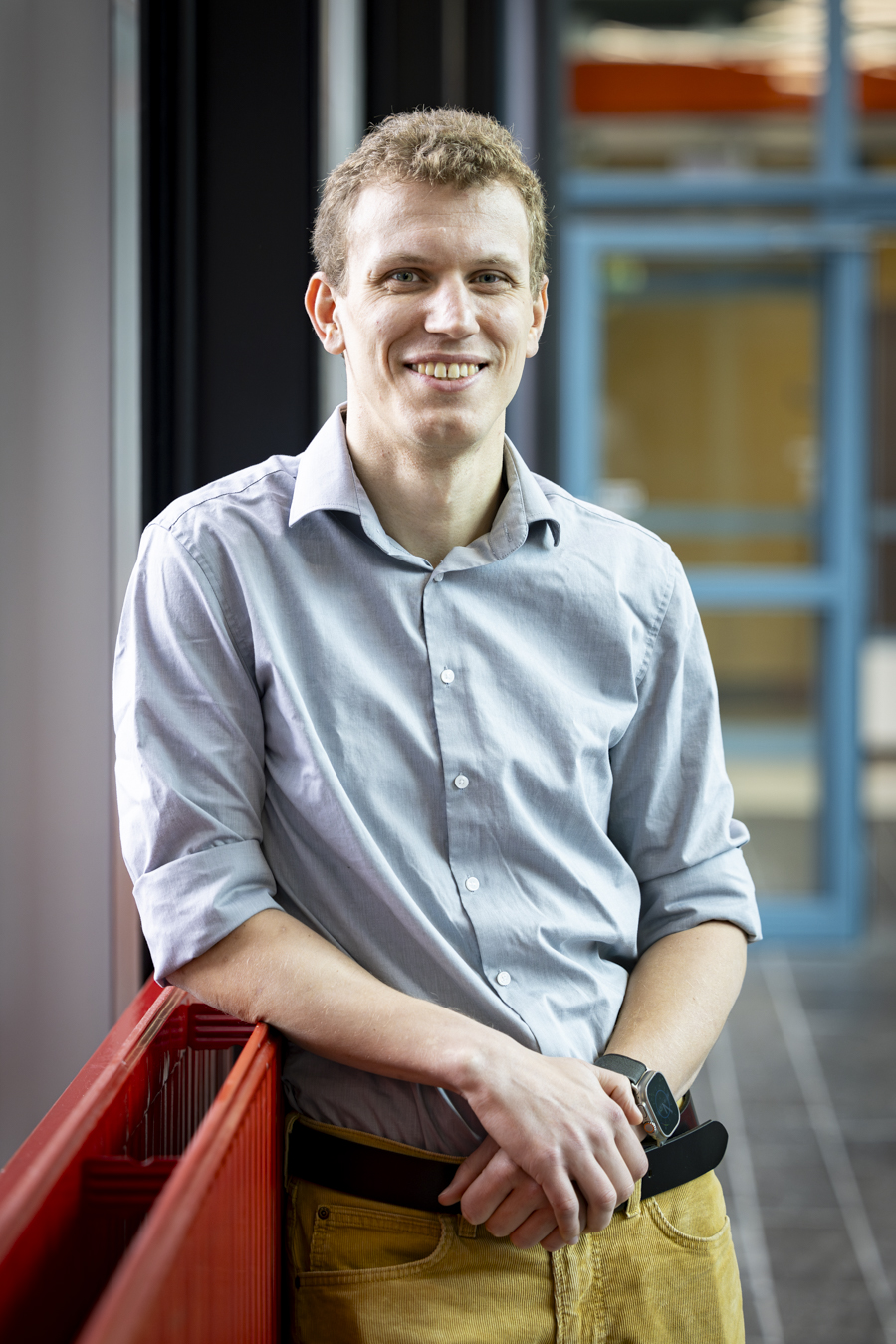
Rima Alaifari is currently an Assistant Professor for Applied Mathematics at ETH Zürich , where she works on applied analysis, inverse problems, and scientific machine learning. Her research emphasizes stability analysis and regularization of inverse problems, applied harmonic analysis, phase retrieval, and operator learning. She is an associated member of the ETH AI Center and will transition to a full professorship at RWTH Aachen University in 2025 as Chair of Analysis and its Applications. Education : PhD in Mathematics (2010–2014, Vrije Universiteit Brussel); MSc in Applied and Industrial Mathematics (2005–2010, Johannes Kepler University) Research Focus : Stability estimates for inverse problems, phase retrieval in wavelet/Gabor transforms, operator learning with neural networks, and deep learning robustness. Article Trends : Her recent work bridges harmonic analysis with machine learning, focusing on phase retrieval stability, adversarial perturbations in imaging, and mathematically grounded neural operator frameworks like ReNO and CNO. Advising : She has supervised PhD students like Tandri Gauksson and Matthias Wellershoff. Former postdoctoral researchers include Francesca Bartolucci (now at TU Delft) and Jesse Railo (Finnish Inverse Prize winner).
Boris Buffoni is a Senior Lecturer at École Polytechnique Fédérale de Lausanne (EPFL) in the School of Basic Sciences, Institute of Mathematics, specifically within the Chair of Partial Differential Equations. He maintains his office at MA C2 605 (MA Building), Station 8, 1015 Lausanne, Switzerland, and can be contacted at boris.buffoni@epfl.ch or +41 21 693 49 87. His academic role spans both teaching responsibilities across multiple mathematics programs and active research in theoretical and applied mathematics. Dr. Buffoni's research program centers on the calculus of variations applied to Lagrangian and Hamiltonian systems, with significant contributions to optimal transportation in Lagrangian dynamics and hydrodynamics. His work explores semi-global minimization methods for quasi-linear elliptic variational problems and the variational approach to capillary-gravity water waves and their energetic stability. Additional research foci include local bifurcation and center-manifold theory for elliptic PDEs, the configurations of infinite elastic cylinders under compression or traction, and the analytic theory of global bifurcation with applications to gravity waves and their secondary bifurcations. The trajectory of his recent publications reveals a deepening focus on three-dimensional water wave phenomena, particularly steady rotational flows, gravity-capillary solitary waves, and advanced mathematical techniques for analyzing these complex systems. His 2025 publications demonstrate continued innovation in applying Kato's approach to locally coercive problems and developing the theoretical foundations of global bifurcation. The consistent application of variational methods and bifurcation theory across his work represents a unifying theme in addressing challenging problems in fluid dynamics and nonlinear partial differential equations. Dr. Buffoni has received research support including an EPSRC grant (GR/L41059) for work on 'Multibump localised solutions for spatially homogeneous partial differential equations,' reflecting the significance of his contributions to the field. His teaching portfolio at EPFL includes foundational courses such as Analysis II, Functional Analysis I, and Partial Differential Equations of Evolution, where he imparts knowledge of differential and integral calculus of real functions of several variables, linear functional analysis, and fundamental techniques for solving evolution equations.
Martin J. Gander is Full Professor of Mathematics at the University of Geneva (Faculty of Sciences, Department of Mathematics) and heads the Digital Analysis research group. His career has included positions at ETH Zürich, Stanford, École Polytechnique and McGill University before he moved to Geneva in 2004. Education ETH Zürich Stanford University École Polytechnique, Paris Research Interests Prof. Gander’s work lies at the intersection of numerical analysis and scientific computing , with particular emphasis on: Iterative solvers and preconditioning for large linear systems Domain-decomposition and parallel-in-time methods Absorbing boundary conditions and perfectly matched layers Waveform relaxation and multigrid techniques Geometric integration and mathematical biology Industrial Collaboration He has consulted for companies and institutions such as Venyo , Meteo Suisse , Meteorological Service of Canada , Alcan , Pratt & Whitney and Volvo . Advising & Team Prof. Gander has supervised more than twenty-five doctoral students and post-doctoral fellows, currently including Teilo Wahl , Ausra Pogozelskyte , Si-Wei Liao , Yafei Sun and Liudi Lu .
Leon Bungert is a Professor of Mathematics of Machine Learning at the University of Würzburg, working in applied analysis and numerics with a particular focus on data science and machine learning. His research investigates PDEs and variational models on graphs, adversarial robustness of machine learning, variational regularization, and nonlinear optimization. Dr. Bungert serves as a guest editor for the European Journal of Applied Mathematics, an associate editor for Advances in Continuous and Discrete Models: Theory and Applications, and is a member of the program committee at SSVM 2025. He is also an ELLIS member and actively organizes conferences and workshops, including "MIA'25" at IHP in Paris (January 13-15, 2025), "Synergies of Machine Learning and Numerics" in Osaka (March 11-13, 2025), and "Mathematical Analysis of Adversarial Machine Learning" in Oaxaca (August 17-22, 2025). Research Interests Dr. Bungert's primary research areas include: PDEs on graphs Adversarial robustness in machine learning Inverse problems Optimization Variational problems in L-infinity Nonlinear eigenvalue problems Image reconstruction with structural priors His work bridges theoretical mathematics with practical applications in machine learning, particularly focusing on the mathematical foundations of deep learning and developing robust algorithms that can withstand adversarial attacks. He has made significant contributions to understanding the connections between partial differential equations and machine learning algorithms. Research Trends Analysis of Dr. Bungert's recent publications reveals a strong focus on the intersection of machine learning and mathematical analysis. A key theme is the application of variational methods and partial differential equations to machine learning problems, particularly in understanding and improving the robustness of neural networks against adversarial examples. His work on Lipschitz learning on graphs has established important theoretical foundations for graph-based semi-supervised learning. Additionally, his research on the infinity Laplacian and p-Laplacian equations provides deep insights into the mathematical structure of machine learning algorithms. The development of Bregman learning frameworks for sparse neural networks represents a significant contribution to efficient deep learning model training. Professional Activities Dr. Bungert is actively involved in the academic community through editorial roles and conference organization. His current professional activities include: Guest editor for the European Journal of Applied Mathematics Associate editor for Advances in Continuous and Discrete Models: Theory and Applications Member of the program committee at SSVM 2025 ELLIS member Co-organizer of multiple international conferences and workshops Technical Contributions Dr. Bungert has developed several open-source software packages that implement his theoretical contributions, including: Code for convergence rates of Lipschitz learning on graphs A Bregman training framework for sparse neural networks CLIP: Cheap Lipschitz Training of Neural Networks Nonlinear Power Method for Proximal Operators and Neural Networks Robust Image Reconstruction with Misaligned Structural Information These implementations are primarily in Python and MATLAB, demonstrating his commitment to making theoretical advances accessible for practical applications.
Olaf Schenk is a Professor at the Institute of Computing within the Faculty of Informatics at Università della Svizzera italiana (USI), Switzerland. He serves as Director of the Institute of Computing and Co-Director of the Master in Computational Science. He is also an adjunct member of the Computer Systems Institute at USI. PhD in Information Technology and Electrical Engineering, ETH Zurich (2001) Venia Legendi in Mathematics and Computer Science, University of Basel (2009) Applied Mathematics, Karlsruhe Institute of Technology (KIT), Germany His research focuses on high-performance computing , computational science and engineering , and applied algorithms for extreme-scale simulations. He bridges computer science with scientific computing needs, particularly in parallel algorithms , sparse solvers , graph analytics , and manycore architectures . His work emphasizes scalable software tools and programming models for emerging HPC systems. The 15 most recent publications reflect a consistent focus on sparse matrix computations , parallel and task-based algorithms , graph partitioning , and performance optimization for heterogeneous and manycore systems. Keywords span high-performance computing, numerical linear algebra, and large-scale data analysis, showing strong integration of theoretical algorithm design with practical implementation. Olaf Schenk has received several prestigious honors: Elected Fellow, Society for Industrial and Applied Mathematics (SIAM) Senior Member, IEEE and ACM SIAM Supercomputing Prize 2023 IBM Faculty Award Two Leadership Computing Awards from the U.S. Department of Energy He has held leadership roles as Chair, Vice Chair, and Program Director of the SIAM Activity Group on Supercomputing. He serves as Associate Editor for ACM Transactions on Mathematical Software and on the editorial board of SIAM Journal on Scientific Computing . He has participated in over 60 international program committees, including top-tier conferences such as SC, IPDPS, and IEEE CSE. He advises PhD and Master’s students in computational science and leads research projects funded by national and international agencies. He is also the Founder & Director of Panua Technologies Sagl, focusing on high-end software for simulation and optimization. His research group at USI works on next-generation computing tools for extreme-scale scientific simulations, with ongoing work in adaptive algorithms, resilience, and hybrid CPU-GPU computing. He leads collaborative projects with institutions in Europe and the U.S., aiming to develop scalable, robust, and efficient software for future exascale systems.
Bart Vandereycken is an Associate Professor in the Mathematics Department at the University of Geneva, specializing in numerical analysis and scientific computing. His research focuses on large-scale and high-dimensional problems solved using low-rank matrix and tensor techniques, with applications in numerical linear algebra, optimization, and nonlinear eigenvalue problems. He previously held positions as an instructor at Princeton University and postdoctoral researcher at EPF Lausanne and ETH Zurich, and earned his PhD from KU Leuven in 2010. His research interests include Riemannian optimization algorithms, multilevel preconditioning, and machine learning applications. He serves as an associate editor for SIAM Journal on Matrix Analysis and Applications and Linear Algebra and its Applications . Bart organizes the Numerical Analysis seminar with colleagues, and advises students interested in numerical analysis or numerical linear algebra. Recent work emphasizes convexity structures in matrix decompositions, robust preconditioning techniques, and scalable low-rank algorithms for high-dimensional PDEs. His 2024–2025 publications explore advancements in Riemannian optimization schemes, subspace iteration methods, and distributed computing applications of matrix decompositions. Key themes include improving convergence guarantees and developing geodesic-based optimization frameworks for challenging numerical problems.
Lénaïc Chizat is a Tenure Track Assistant Professor at the Swiss Federal Institute of Technology in Lausanne (EPFL) within the School of Basic Sciences and Institute of Mathematics. He chairs the Dynamics of Learning Algorithms (DOLA) laboratory and teaches advanced courses in machine learning and computational optimal transport, focusing on mathematical analysis of neural networks and measure transportation theory. His research centers on optimal transport theory and its applications to deep learning, with emphasis on Wasserstein geometry, entropic regularization, and gradient flow dynamics. He investigates implicit regularization in neural networks, convergence properties of learning algorithms, and the infinite-width limits of deep architectures. His work bridges theoretical mathematics with practical machine learning challenges, particularly in computational aspects of modern supervised learning. Analysis of his 15 most recent publications (2023-2025) reveals a strong thematic focus on entropic optimal transport, where he has made fundamental contributions to Sinkhorn algorithm convergence in continuous settings and Wasserstein barycenter computation. His research consistently explores the mathematical foundations of deep learning, especially training dynamics, min-max optimization, and the role of initialization in neural network scaling. Chizat currently advises PhD student Wang Guillaume Yitian and leads the DOLA laboratory, which develops theoretical frameworks for understanding learning algorithm dynamics through the lens of optimal transport and measure-valued optimization.
Jacques Rappaz is a Professor Emeritus at the École Polytechnique Fédérale de Lausanne (EPFL) , affiliated with the School of Basic Sciences (SB) . His primary role is within the Department of Mathematics (MATH) , and he also serves as a Scientific Consultant in the GR-PI Group . Rappaz’s research focuses on numerical analysis, computational fluid dynamics, and mathematical modeling of complex physical systems such as glacier dynamics, magnetohydrodynamics (MHD), and industrial processes like aluminum electrolysis. He has advised numerous PhD students and contributed to advancements in finite element methods, phase-field modeling, and turbulence simulation. Education & Academic Background: While detailed educational history is not explicitly stated, his long-standing position at EPFL and extensive publication record in applied mathematics and engineering suggest a strong academic trajectory in computational sciences. He holds an honorary professorship, reflecting his contributions to mathematics and engineering disciplines. Research Interests: Numerical analysis of PDEs and nonlinear systems Modeling multiphase flows and phase transitions Glaciology dynamics and climate impact studies Magnetohydrodynamic phenomena in industrial contexts Finite element methods for engineering applications Advising & Collaborations: Rappaz has supervised multiple PhD students specializing in computational mechanics and applied mathematics. His work integrates interdisciplinary approaches, collaborating with engineering teams on projects like aluminum production optimization and glacier motion simulation. Labs & Teams: Active within the GR-PI Group (likely related to plasma or industrial processes) and the PH-SB unit, focusing on applied physics and mathematical modeling.
Prof. Thomas Wihler is a Professor at the Mathematical Institute (MAI) of the University of Bern, within the Faculty of Science. His research focuses on numerical analysis, partial differential equations, and computational methods, particularly involving finite element methods and discontinuous Galerkin techniques. He holds a leadership role in the Institute Management and is contactable at thomas.wihler@unibe.ch. His academic background includes advanced studies in mathematics, though specific details of his education are not explicitly provided in the text. His research interests emphasize adaptive algorithms, numerical solutions to elliptic and parabolic PDEs, and the development of efficient discretization strategies for complex physical models. Recent work highlights contributions to energy-based adaptivity, error estimation, and the analysis of nonlinear systems such as the Gross-Pitaevskii equation. Publications from 2021–2025 reflect a focus on advancing numerical methods for PDEs, including studies on optimal finite element approximations, exponential convergence of discontinuous Galerkin schemes, and adaptive strategies for nonlinear problems. His work often bridges theoretical analysis with practical computational techniques, addressing challenges in both stability and efficiency. No specific scientific awards or grants are mentioned in the provided texts. His academic contributions are primarily through research publications and leadership in the Mathematical Institute.
Jon Cockayne is an Associate Professor at the University of Southampton specializing in Bayesian Numerical Methods , Probabilistic Numerical Methods , and Uncertainty Quantification . His research focuses on integrating probabilistic approaches into numerical algorithms, particularly for solving linear systems , differential equations , and MCMC output analysis . He has contributed to BayesCG (Bayesian Conjugate Gradient) and Computation-Aware Gaussian Processes . Notable collaborations include work on Statistical Finite Element Methods , Probabilistic Iterative Methods , and Calibrated Numerical Algorithms for industrial applications like Hydrocyclone Equipment state estimation.
Dr. Alexander Heinlein is an Assistant Professor in the Numerical Analysis group at the Delft Institute of Applied Mathematics (DIAM), Faculty of Electrical Engineering, Mathematics & Computer Science (EEMCS), Delft University of Technology (TU Delft). His work bridges scientific computing and machine learning through scientific machine learning (SciML) , focusing on domain decomposition methods and multiscale approaches for solving complex partial differential equations on modern hardware like GPUs. Research interests include: Developing high-performance computing algorithms for nonlinear PDEs with applications in fluid-structure interaction and photonic crystals Advancing physics-aware machine learning techniques for groundwater heat transport and post-burn contraction prediction Creating parallel preconditioners like FROSch for challenging problems in computational mechanics Building hybrid numerical-ML frameworks with domain decomposition for multi-physics applications His recent publications highlight a 128-235x speedup in biomedical simulations through deep operator networks , and keynote presentations on geometric challenges in machine learning-based surrogate models at international conferences like CASML 2024. Scientific awards include: 2025 NWO Open Technology Programme grant for the RAPID-Wind project on offshore wind turbine foundations Students and collaborations involve: Yuhuang Meng (PhD candidate, 2024) Jing Zhao (co-supervisor) Prof. Jun Zou (Chinese University of Hong Kong collaboration, 2024) He leads software development for COMSOL and Trilinos extensions while maintaining open-source reproducibility standards.