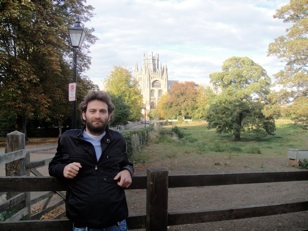
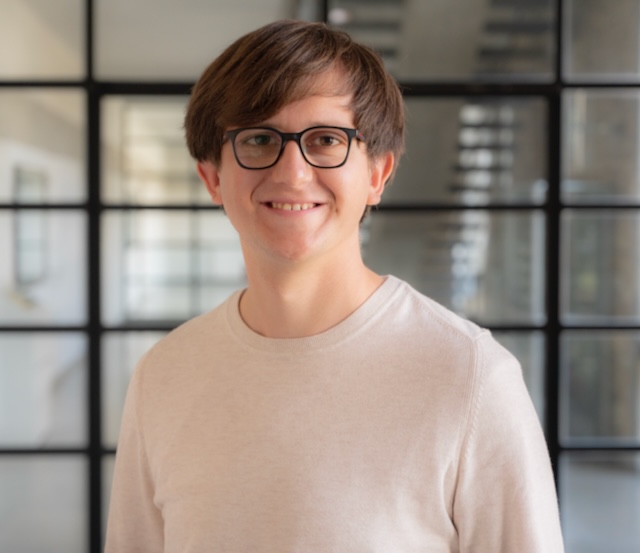
Antoine Mellet is a Full Professor in the Department of Mathematics at the University of Maryland, College Park. His research focuses on partial differential equations, mathematical biology, fluid dynamics, and homogenization theory. He has extensively studied Hele-Shaw flows, diffusion-aggregation phenomena, chemotaxis models, and fractional diffusion limits. NSF Grant DMS-2307342 (2023-2026) NSF Grant DMS-2009236 (2020-2023) NSF Grant DMS-1501067 (2015-2019) NSF Grant DMS-1201426 (2012-2015) NSF Grant DMS-0901340 (2009-2012) NSF Grant DMS-0456647 (2005-2008) His recent publications explore age-structured tumor growth models, volume-preserving mean curvature flows, and connections between diffusion-aggregation equations and geometric evolution problems. Collaborators include prominent researchers like D. Levy, I. Kim, and C. Imbert.
Professor Guozhen Lu is a distinguished faculty member at the University of Connecticut, recently elected to the Connecticut Academy of Science and Engineering (CASE) in 2025. His research bridges advanced mathematical analysis with geometric and functional frameworks, establishing him as a leading figure in modern analysis. Lu's research centers on Partial Differential Equations, Harmonic Analysis, and Geometric Analysis, with particular emphasis on functional inequalities including Sobolev, Trudinger-Moser, and Hardy-Rellich inequalities. His work explores sharp constants, stability phenomena, and extremal problems across diverse geometric settings such as Heisenberg groups, hyperbolic spaces, and CR manifolds. He investigates how geometric structures influence analytical properties, often revealing deep connections between analysis and geometry. Analysis of his 2024-2025 publications shows intense focus on stability of fundamental inequalities (Sobolev, Poincaré, Uncertainty Principle), with innovative approaches to multi-parameter operators and geometric constraints. His work consistently targets optimal constants and dimension-dependent phenomena, pushing boundaries in non-Euclidean analysis. His notable scientific recognition includes: Connecticut Academy of Science and Engineering (CASE) Membership (2025) While specific details about student advising and grant funding are not documented in available sources, Lu's editorial contributions (including special issues honoring Robert Fefferman and David Jerison) demonstrate significant service to the mathematical community. No information is available regarding dedicated laboratories or research teams.
Alicia Cantón Pire is a Professor at the Department of Mathematics and Computer Science Applied to Civil and Naval Engineering , affiliated with the Higher Technical School of Naval Engineers (ETSIN) at the Polytechnic University of Madrid (UPM) . Her research spans multiple domains within Mathematics, Applied Mathematics, and Computer Science, focusing on geometric modeling, complex analysis, and graph theory. Research Interests : Asymptotic values of meromorphic functions, Gromov hyperbolicity in planar graphs, geometric characteristics of Bézier surfaces, and isoperimetric inequalities. Teaching : Engaged in academic instruction, with access to the Moodle platform for current courses. Professional Affiliations : Member of mathematical societies including the Royal Spanish Mathematical Society (RSME) , Spanish Society of Applied Mathematics (SeMA) , and the American Mathematical Society (AMS) . Her work integrates theoretical mathematics with practical applications in engineering and computer science, reflecting in her collaborative publications and extensive contributions to geometric and analytic problems. Email : alicia.canton@upm.es
Dr. Nikolas Kantas is a Reader in Statistics at Imperial College London's Department of Mathematics. He completed his undergraduate studies and PhD at the University of Cambridge's Signal Processing Group. His research focuses on developing numerical methods for complex problems in inference, optimisation, filtering, and control. Research Interests: Kantas specializes in computational statistics and stochastic processes, with expertise in particle filtering, Sequential Monte Carlo, and Markov Chain Monte Carlo methods. His work bridges theoretical foundations with applications in data assimilation, optimization under uncertainty, and high-dimensional statistical modeling. Publication Trends: Recent work (2022-2025) demonstrates strong focus on optimization algorithms, stochastic differential equations, and Monte Carlo methods. Key themes include multi-objective optimization, privacy-preserving algorithms, Langevin dynamics, and distributed computing. Methodological innovations frequently address high-dimensional and real-time computational challenges. Student Advising & Grants: Currently supervises 4 PhD students and has graduated 9 doctoral candidates. Research funding includes JP Morgan AI Faculty Research Awards and support from the National Physical Laboratory (NPL). Academic Leadership: Co-organizes the annual Greek Stochastics workshop on Statistics and Applied Probability. Coordinates PhD programs through the Mathematics Research program, MFC CDT, and Statistics and Machine Learning CDT.
Dominik Stöger is an Assistant Professor (tenure-track) in the Department of Mathematics at KU Eichstätt-Ingolstadt since 2021, affiliated with the Mathematical Institute for Data Science and Machine Learning (MIDS). His research bridges mathematical theory and data science applications. His educational background includes: B.Sc. in Mathematics, Technical University of Munich (2013) M.Sc. in Mathematics, Technical University of Munich (2015) Ph.D. in Mathematics, Technical University of Munich (2019) Stöger's research centers on mathematical foundations of data science, with emphasis on non-convex optimization in machine learning, theoretical analysis of overparameterized models, and low-rank matrix recovery. He combines optimization theory and high-dimensional probability to develop rigorous guarantees for modern algorithms, addressing critical challenges in deep learning theory. His recent publications (2020-2025) demonstrate consistent output in top venues including COLT, NeurIPS, and ICLR, with particular focus on implicit regularization phenomena and non-convex recovery guarantees. The 2025 pipeline shows active work extending theoretical boundaries in matrix sensing and neural network analysis. Stöger has received significant recognition: NeurIPS 2021 Spotlight Paper (top 3% of submissions) COLT 2025 paper presentation As a tenure-track faculty member, he maintains active collaborations across institutions (USC, TUM) and likely advises graduate students. His research program shows strong momentum with multiple concurrent projects advancing theoretical machine learning. He contributes to the research ecosystem through affiliation with MIDS, fostering interdisciplinary work in mathematical data science at KU Eichstätt-Ingolstadt.
Yohei Sakurai serves as an Associate Professor in the Department of Mathematics at Saitama University, Japan, with his academic base at the university's campus in Saitama City (255 Shimo-Okubo, Sakura-ku, Saitama 338-8570). His research program centers on differential geometry, with concentrated expertise in Riemannian geometry and geometric analysis. Key investigation areas include Comparison geometry, Spectral geometry, Isoperimetric problems, Metric measure geometry, Optimal transport theory, Geometric flows, Harmonic maps, and Minimal surfaces. These interconnected fields address fundamental questions about geometric structures, curvature constraints, and transformation dynamics in mathematical spaces.
Sinho Chewi is an Assistant Professor of Statistics and Data Science at Yale University, where he conducts research at the intersection of mathematics, statistics, and machine learning. His work focuses on theoretical aspects of computational statistics, particularly leveraging optimal transport theory for solving complex problems in sampling and inference. Chewi earned his B.S. in Engineering Mathematics and Statistics from the University of California, Berkeley in 2018, followed by a PhD in Mathematics and Statistics from the Massachusetts Institute of Technology in 2023 under the supervision of Philippe Rigollet. Prior to joining Yale, he was a postdoctoral researcher at the Institute for Advanced Study during the 2023-2024 academic year. His research interests span optimal transport theory , log-concave sampling , variational inference , and theoretical foundations of machine learning . Chewi is currently authoring a comprehensive book on the complexity of log-concave sampling, building on his extensive publication record. His work bridges theoretical mathematics with practical applications in statistical computing and artificial intelligence. Analysis of Chewi's publication record reveals a strong focus on developing rigorous mathematical frameworks for sampling algorithms, with particular emphasis on complexity analysis, convergence guarantees, and connections between functional inequalities and optimization. His recent work extends into diffusion models, neural network theory, and parallel sampling algorithms, demonstrating both depth in core statistical theory and breadth across machine learning applications. ICLR 2023 (Notable Top 5%) ALT 2023 (Best Student Paper) NeurIPS 2021 (Spotlight) ICLR 2025 DeLTA Workshop (Best Short Paper Award) Chewi has received significant research support through his postdoctoral position at the Institute for Advanced Study and collaborations with leading researchers at institutions including MIT, NYU, and Microsoft Research. His teaching portfolio includes advanced courses in optimization techniques and sampling methods, reflecting his expertise in theoretical foundations of machine learning algorithms.